
What Makes a Costa Mesa Car Accident Case Worth More?
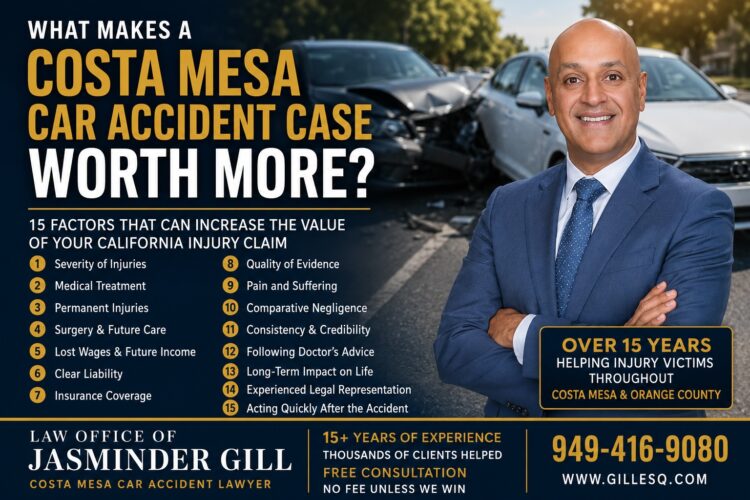
15 Factors That Can Increase the Value of Your Costa Mesa Injury Claim | Law Office of Jasminder Gill
Every car accident is different. Two collisions may happen on the same street, involve similar vehicles, and even result in similar property damage, yet one case may settle for a few thousand dollars while another results in a recovery worth hundreds of thousands—or even millions—of dollars.
One of the first questions many injured victims ask after a crash is:
“How much is my car accident case worth?”
While this is a reasonable question, there is no calculator that can accurately determine the value of a personal injury claim. Insurance companies evaluate dozens of factors before making a settlement offer, and experienced personal injury attorneys analyze many of those same factors when determining the potential value of a case.
The truth is that the value of your claim depends on far more than the cost of repairing your vehicle or paying your emergency room bill. The severity of your injuries, the quality of the evidence, the available insurance coverage, your future medical needs, and even how quickly you sought treatment can all influence the outcome of your case.
At the Law Office of Jasminder Gill, we have spent more than 15 years helping injury victims throughout Costa Mesa and Orange County recover compensation after serious car accidents. Over the years, we have helped thousands of clients navigate the insurance claims process, negotiate with insurance companies, and pursue the financial recovery they need to rebuild their lives.
If you were injured because another driver’s negligence caused a collision, understanding what increases—or decreases—the value of a personal injury claim can help you make informed decisions from the very beginning.
Why Every Car Accident Case Has a Different Value
Insurance companies do not simply look at one number when evaluating a claim. Instead, they review the entire picture.
Adjusters ask questions such as:
- How serious are the injuries?
- Is liability clear?
- Will future medical treatment be necessary?
- Are the injuries permanent?
- Did the victim lose income?
- Is there enough insurance coverage?
- How convincing is the available evidence?
- Would a jury likely sympathize with the injured victim?
The answers to these questions often determine whether the insurance company makes a fair settlement offer or disputes portions of the claim.
For this reason, no two personal injury cases are exactly alike.
A person who suffers a herniated disc requiring surgery after being rear-ended on Harbor Boulevard may have a very different claim than someone who experiences temporary soreness after a low-speed collision near South Coast Plaza.
Understanding these differences helps explain why settlement values vary significantly from one case to another.
Factor #1: The Severity of Your Injuries
The single most important factor affecting the value of nearly every car accident claim is the severity of the injuries.
Generally speaking, more serious injuries require:
- More medical treatment
- Longer recovery periods
- More time away from work
- Greater physical pain
- Increased emotional distress
- Higher future medical expenses
- Permanent limitations
Insurance companies understand that injuries affecting someone’s life for months—or even permanently—typically involve greater damages than injuries that resolve within a few weeks.
Some of the injuries that frequently result in higher-value claims include:
- Traumatic brain injuries (TBI)
- Herniated or ruptured spinal discs
- Spinal cord injuries
- Multiple fractures
- Pelvic injuries
- Internal organ damage
- Burn injuries
- Permanent nerve damage
- Amputations
- Injuries requiring surgery
However, it is important to remember that serious injuries are not always obvious immediately after an accident.
Many people leave the scene believing they only have minor soreness because adrenaline temporarily masks pain. Days later, they begin experiencing severe headaches, numbness, neck pain, back pain, dizziness, or difficulty walking.
Diagnostic imaging such as MRIs and CT scans often reveal injuries that were not immediately apparent.
Never assume your injuries are minor simply because you are able to walk away from the collision.
Factor #2: The Type of Medical Treatment You Receive
Insurance companies carefully review every aspect of your medical treatment.
They look at:
- Where you sought treatment
- How quickly treatment began
- The specialists involved
- Diagnostic testing performed
- Physical therapy
- Pain management
- Surgery recommendations
- Future medical care
For example, a claim involving:
- Emergency transportation by ambulance
- Hospital admission
- MRI imaging
- Orthopedic specialists
- Neurologists
- Pain management physicians
- Physical therapy
- Surgery
will generally be evaluated differently than a claim involving one urgent care visit followed by no additional treatment.
This does not mean you should seek unnecessary treatment.
Instead, you should follow your physician’s recommendations and receive appropriate medical care for your injuries.
The goal is recovery—not increasing a settlement.
Insurance companies often attempt to argue that extensive treatment was unnecessary.
Your medical records and treating physicians frequently become important evidence when responding to those arguments.
Factor #3: Whether Your Injuries Are Permanent
Some injuries heal completely within a few weeks or months.
Others permanently affect how someone works, exercises, sleeps, drives, or enjoys everyday life.
Permanent injuries often include:
- Chronic neck pain
- Chronic back pain
- Permanent nerve damage
- Reduced range of motion
- Loss of strength
- Permanent scarring
- Cognitive impairment after traumatic brain injuries
- Permanent disability
- Loss of sensation
Permanent injuries may require:
- Future surgeries
- Long-term physical therapy
- Ongoing pain management
- Medication
- Assistive medical devices
- Home modifications
Because these damages continue long after the accident, they often increase the potential value of a personal injury claim.
Future medical expenses and long-term limitations deserve careful evaluation before accepting any settlement offer.
Factor #4: Whether Surgery Is Necessary
One of the clearest indicators of a serious injury is the need for surgery.
While every case is unique, surgery often reflects the severity of the trauma suffered during the collision.
Examples include:
- Cervical spine surgery
- Lumbar spine surgery
- Shoulder reconstruction
- ACL reconstruction
- Rotator cuff repair
- Hip surgery
- Wrist surgery
- Ankle surgery
- Facial reconstruction
Surgical procedures often involve:
- Hospitalization
- Anesthesia
- Rehabilitation
- Physical therapy
- Time away from work
- Future follow-up care
Insurance companies recognize that surgery usually results in higher medical expenses and more significant pain and suffering.
However, even if surgery is recommended, it is important to discuss all treatment options with your physician before making medical decisions.
Your health—not the value of your claim—should always come first.
Factor #5: Lost Wages and Reduced Future Earning Capacity
For many accident victims, medical bills represent only part of the financial impact.
A serious injury may prevent someone from working for days, weeks, months, or even permanently.
California law may allow injured victims to seek compensation for income lost because of another person’s negligence.
Lost income may include:
- Regular wages
- Salary
- Overtime
- Bonuses
- Commissions
- Self-employment income
- Sick leave used during recovery
- Vacation time used because of the accident
Some injuries also permanently affect a person’s ability to earn a living.
For example, a construction worker who suffers a spinal injury may no longer be able to perform physically demanding work.
A commercial driver who develops permanent shoulder limitations may no longer meet the physical requirements of the job.
An office worker who suffers a traumatic brain injury may experience lasting cognitive difficulties that affect concentration, memory, and productivity.
These long-term financial losses are often referred to as loss of future earning capacity, and they can represent a substantial portion of a serious personal injury claim.
Economic experts are sometimes used to calculate these future losses based on age, occupation, education, expected career growth, and life expectancy.
Factor #6: Clear Liability Makes a Stronger Case
One of the first questions an insurance company asks is:
Who caused the accident?
When liability is obvious, insurance companies generally have fewer opportunities to dispute responsibility.
Examples of collisions where liability may be relatively straightforward include:
- Rear-end collisions
- Drivers running red lights
- Failure to yield at intersections
- Drunk driving crashes
- Distracted driving accidents
- Drivers traveling the wrong direction
- Unsafe lane changes supported by witnesses or video
However, not every accident is this simple.
Some collisions involve conflicting statements, multiple vehicles, poor weather conditions, or disputed facts. In these situations, building a strong liability case becomes critical.
Evidence that may establish fault includes:
- Police collision reports
- Independent witness statements
- Dash camera footage
- Traffic camera recordings
- Security camera video
- Vehicle damage patterns
- Black box or event data recorder information
- Cell phone records when distracted driving is suspected
The stronger your evidence, the stronger your negotiating position.
Factor #7: Available Insurance Coverage
Even if your injuries are severe, the amount of compensation available may depend on the insurance coverage that exists.
Potential sources of recovery may include:
- The at-fault driver’s liability insurance
- Your uninsured motorist coverage
- Your underinsured motorist coverage
- Employer insurance policies
- Commercial vehicle insurance
- Rideshare insurance through Uber or Lyft
- Umbrella insurance policies
- Business insurance policies
One of the first steps an experienced attorney takes is identifying every available insurance policy that may provide coverage.
Commercial truck accidents, delivery vehicle crashes, and accidents involving company vehicles often involve significantly higher insurance limits than ordinary passenger vehicle collisions.
Identifying every potential source of recovery can make a substantial difference in serious injury cases.
Factor #8: The Quality of the Evidence
Evidence is the foundation of every successful injury claim.
Insurance companies make decisions based upon documentation—not assumptions.
Some of the strongest evidence includes:
- Photographs from the accident scene
- Vehicle damage
- Skid marks
- Road conditions
- Traffic signals
- Surveillance footage
- Dashcam recordings
- Witness statements
- Medical records
- Diagnostic imaging
- Expert opinions
The earlier evidence is preserved, the more valuable it often becomes.
Unfortunately, valuable evidence disappears quickly.
Businesses overwrite surveillance footage.
Vehicles are repaired or sold.
Witnesses relocate.
Memories fade.
Because of this, preserving evidence immediately after a collision is one of the most important steps in building a strong claim.
Factor #9: Pain and Suffering
Medical bills are only one part of a personal injury case.
Many accident victims experience physical and emotional consequences that continue long after their fractures heal or their vehicle is repaired.
California law may allow compensation for non-economic damages, including:
- Physical pain
- Emotional distress
- Anxiety
- Depression
- Loss of sleep
- Fear of driving
- Loss of enjoyment of life
- Loss of hobbies
- Permanent physical limitations
- Reduced quality of life
Unlike medical bills or lost wages, pain and suffering cannot be measured with a receipt.
Instead, insurance companies evaluate the severity of the injuries, the length of recovery, permanent impairments, and the overall effect the accident has had on someone’s daily life.
Keeping a journal documenting pain levels, limitations, and recovery can sometimes help illustrate these damages.
Factor #10: Comparative Negligence
California follows a legal rule known as pure comparative negligence.
This means an injured person may still recover compensation even if they were partially responsible for the accident.
For example:
- If a jury determines your damages are $500,000 but also finds you were 20% responsible, your recovery may be reduced by that percentage.
Because of this rule, insurance companies often attempt to shift some of the blame onto the injured person.
They may argue that you:
- Were speeding.
- Failed to maintain a proper lookout.
- Followed too closely.
- Could have avoided the collision.
- Changed lanes improperly.
- Failed to react quickly enough.
Strong evidence and a thorough investigation are often essential to limiting these arguments.
Factor #11: Consistency Throughout Your Case
Insurance companies compare everything.
They compare:
- Police reports
- Medical records
- Witness statements
- Recorded statements
- Social media posts
- Deposition testimony
- Photographs
- Surveillance footage
If information appears inconsistent, adjusters may attempt to challenge your credibility.
Honesty and consistency remain among the strongest assets any injury victim has throughout the claims process.
Factor #12: Following Your Doctor’s Recommendations
Insurance companies pay close attention to medical treatment.
They often question claims when someone:
- Delays treatment.
- Misses appointments.
- Stops physical therapy.
- Ignores physician recommendations.
- Fails to attend follow-up visits.
Life happens, and missing an occasional appointment does not necessarily ruin a claim.
However, consistently following medical advice creates stronger documentation and demonstrates that you are taking your recovery seriously.
Factor #13: The Long-Term Impact on Your Life
Insurance companies also consider how an injury affects everyday living.
Questions may include:
- Can you return to work?
- Can you care for your children?
- Can you continue exercising?
- Can you perform household chores?
- Can you participate in hobbies?
- Has your relationship with your spouse changed?
- Do you continue to experience daily pain?
These long-term effects often become especially important in cases involving permanent disabilities or chronic pain.
Factor #14: Having an Attorney Who Prepares Every Case Thoroughly
Insurance companies evaluate not only the injured person’s claim but also the law firm representing them.
A thoroughly prepared case often includes:
- Complete medical records
- Expert opinions
- Witness interviews
- Accident scene photographs
- Vehicle inspections
- Future medical evaluations
- Lost wage calculations
- Economic damage analyses
Preparing every case as though it could proceed to trial often strengthens settlement negotiations.
When insurance companies recognize that a case has been carefully developed, they may take negotiations more seriously.
Factor #15: Acting Quickly Can Protect Your Rights
One of the biggest mistakes accident victims make is waiting too long to seek legal advice.
Evidence disappears faster than many people realize.
Surveillance footage may be deleted within days.
Vehicles are repaired.
Witnesses become difficult to locate.
Physical evidence disappears.
The earlier an investigation begins, the greater the opportunity to preserve valuable evidence supporting your claim.
Even if you are unsure whether you need legal representation, speaking with an attorney early can help you understand your options and avoid mistakes that could affect your recovery.
Insurance Companies Evaluate the Entire Picture
Many people assume their claim is worth only the total of their medical bills.
That is rarely how serious injury cases are evaluated.
Insurance adjusters look at the complete picture, including:
- The severity of your injuries
- The type of treatment you received
- Whether your injuries are permanent
- Whether surgery was required
- Lost income
- Future medical care
- Liability
- Insurance coverage
- The quality of the available evidence
No single factor determines the value of a case.
Instead, each piece contributes to the overall strength of your claim.
Unfortunately, insurance companies often focus on factors they believe reduce the value of a case while minimizing evidence that supports the injured victim.
This is one reason why experienced legal representation can make a meaningful difference during settlement negotiations.
Common Mistakes That Can Reduce the Value of Your Case
While many factors increase the value of a claim, certain mistakes can reduce it.
Some of the most common include:
- Waiting days or weeks before seeking medical treatment.
- Giving a recorded statement without understanding its purpose.
- Posting about the accident on social media.
- Accepting the first settlement offer.
- Missing medical appointments.
- Ignoring physician recommendations.
- Throwing away damaged evidence.
- Failing to photograph the accident scene.
- Waiting too long to contact an attorney.
Avoiding these mistakes may strengthen your claim and improve your ability to recover fair compensation.
Why Choose the Law Office of Jasminder Gill?
After a serious car accident, choosing the right attorney is one of the most important decisions you can make.
For more than 15 years, the Law Office of Jasminder Gill has proudly represented injured clients throughout Costa Mesa and Orange County. Our firm has helped thousands of clients recover compensation after car accidents, truck accidents, motorcycle accidents, bicycle accidents, pedestrian accidents, and other serious injury cases.
We understand that every case is personal.
That’s why we provide direct communication with our clients while aggressively pursuing the compensation they deserve.
When you hire our firm, you receive:
- Free consultations
- No fee unless we win
- 15+ years of experience
- Personalized legal representation
- Thorough accident investigations
- Direct attorney access
- Aggressive negotiations with insurance companies
- Trial-ready preparation when necessary
Our goal is simple: to help our clients recover physically, financially, and emotionally after a serious accident.
Get Help From a Costa Mesa Motor Vehicle Accident Lawyer
If you or a loved one has been injured in a motor vehicle accident, you don’t have to deal with insurance companies alone.
If you’re searching for a motor vehicle accident lawyer near you, The Law Office of Jasminder Gill represents accident victims in Costa Mesa, Newport Beach, Santa Ana, Irvine, and throughout Orange County. We are committed to helping clients recover maximum compensation for medical expenses, lost income, and pain and suffering.
Insurance companies often try to minimize claims or shift blame after an accident. Our firm works to protect your rights, gather evidence, and build a strong case to ensure you receive the full compensation you deserve.
Learn more from our Car Accident Lawyer in Costa Mesa.