
Costa Mesa 405 Freeway Car Accident Lawyer | Law Office of Jasminder Gill
Representing People Injured in I-405 Collisions Throughout Costa Mesa and Orange County
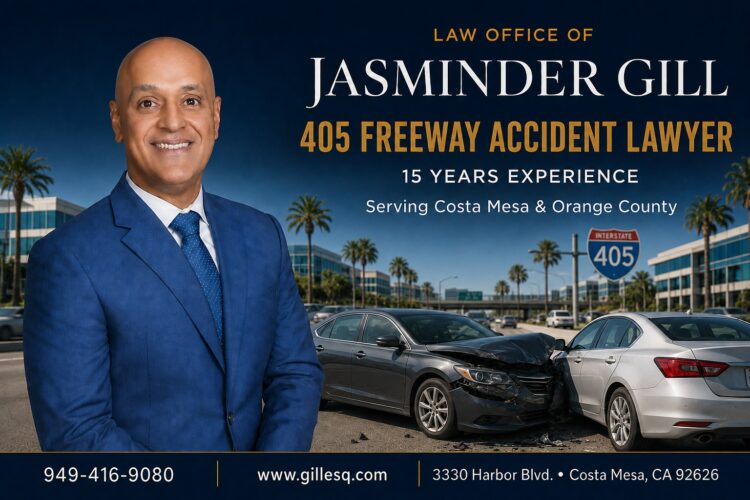 A collision on Interstate 405 can happen without warning. One moment you may be traveling through Costa Mesa in ordinary freeway traffic. The next, you may be dealing with a disabled vehicle, painful injuries, emergency medical care, missed work, and calls from multiple insurance companies.
I-405 is one of Orange County’s most heavily traveled transportation corridors. Drivers approaching Costa Mesa encounter changing traffic speeds, busy entrance and exit ramps, express lanes, commuter congestion, commercial vehicles, and connections with State Route 55 and State Route 73.
When a driver texts, speeds, follows too closely, makes an unsafe lane change, or fails to react to stopped traffic, one impact can trigger a multi-vehicle collision.
15+ YEARS EXPERIENCE | THOUSANDS OF CLIENTS HELPED | MILLIONS RECOVERED | CALIFORNIA ATTORNEY SINCE 2009 | PUNJABI SPEAKING | SPANISH CONSULTATIONS | 24/7 FREE CONSULTATIONS
Call 949-416-9080 for a free consultation
At the Law Office of Jasminder Gill, we represent people injured in 405 Freeway accidents in Costa Mesa and throughout Orange County. Attorney Jasminder Gill has more than 15 years of personal injury experience, has helped thousands of clients, and has recovered millions of dollars for injured people and their families.
Every case is different. Past results do not guarantee or predict a similar outcome.
Our firm investigates freeway accidents, preserves available evidence, identifies responsible drivers and businesses, examines insurance coverage, documents injuries, and pursues compensation supported by the evidence.
There are no upfront attorney’s fees. You pay no attorney’s fee unless compensation is recovered for you. The terms of representation are governed by a written fee agreement.
Why Hire a Costa Mesa 405 Freeway Accident Lawyer?
Freeway accident claims can become complicated quickly. Vehicles may be moved before investigators arrive, drivers may provide conflicting accounts, witnesses may leave, and traffic-camera or dashboard-camera footage may be overwritten.
When several vehicles are involved, each driver’s insurance company may attempt to shift responsibility to someone else. A commercial truck, rideshare vehicle, delivery driver, government vehicle, or uninsured motorist can create additional insurance and liability issues.
An insurance adjuster may contact you before you understand your diagnosis, prognosis, or the future cost of your injuries. The adjuster may request a recorded statement, broad medical authorization, or early settlement.
When you hire the Law Office of Jasminder Gill, our firm can:
- Investigate how the 405 Freeway collision occurred
- Obtain available police and collision reports
- Identify all involved vehicles and drivers
- Locate and interview witnesses
- Seek dashboard-camera and surveillance footage
- Preserve vehicle and electronic evidence
- Examine roadway marks, debris, and damage patterns
- Determine whether multiple drivers share responsibility
- Investigate distracted, impaired, or fatigued driving
- Identify commercial and rideshare involvement
- Analyze uninsured and underinsured motorist coverage
- Gather medical records and bills
- Document lost income and diminished earning capacity
- Evaluate future medical needs
- Communicate directly with insurance companies
- Prepare a documented settlement demand
- File a lawsuit when a fair resolution cannot be reached
- Prepare the case for trial when necessary
Our objective is to develop the evidence while the client focuses on medical treatment and recovery.
For broader information about collision claims, visit our Costa Mesa car accident lawyer page.
Why I-405 Accidents Can Be So Serious
Freeway collisions can produce significant force because vehicles may be traveling at highway speeds immediately before impact. Even when congestion reduces traffic speed, closely spaced vehicles can create chain-reaction crashes involving several impacts.
Conditions that can increase the severity of an I-405 accident include:
- High travel speeds
- Sudden traffic slowdowns
- Limited following distance
- Multiple lanes of traffic
- Vehicles merging simultaneously
- Commercial truck traffic
- Concrete barriers
- Disabled vehicles
- Nighttime visibility
- Rain and wet pavement
- Road debris
- Several successive impacts
- Limited shoulder space
- Emergency braking
- Vehicles crossing several lanes
A vehicle may be struck from the rear and pushed into another lane, concrete barrier, commercial truck, or additional vehicle. The first impact may not be the only cause of the injuries.
A complete investigation should examine the entire collision sequence.
The I-405 Corridor Through Costa Mesa
Interstate 405 runs through Costa Mesa and connects drivers with other major Orange County roadways. The Costa Mesa portion is affected by traffic entering and leaving the freeway, connections with SR-55 and SR-73, and travel toward employment centers, retail areas, John Wayne Airport, Irvine, Fountain Valley, and surrounding communities.
Accidents may occur near:
- The I-405 and SR-55 connection
- The I-405 and SR-73 connection
- Harbor Boulevard
- Fairview Road
- Bristol Street
- South Coast Drive
- MacArthur Boulevard
- Freeway entrance ramps
- Exit-only lanes
- Auxiliary and merging lanes
- Express-lane access areas
- Interchange transition zones
The location of the collision can affect the available evidence. Nearby businesses, transportation facilities, dashboard cameras, traffic systems, and other vehicles may have recorded the crash or events leading to it.
I-405 Express Lanes and Accident Claims
The 405 Express Lanes operate along a portion of the I-405 corridor beginning near Costa Mesa and continuing toward the Los Angeles County line.
Accidents involving express lanes may occur when drivers:
- Cross lane markings unsafely
- Enter or exit at an improper location
- Misjudge the speed of express-lane traffic
- Make abrupt lane changes
- Brake suddenly near access points
- Become confused about lane separation
- Strike barriers
- Follow too closely
- Drive too fast for traffic conditions
The presence of an express lane does not automatically determine liability. Investigators must examine lane markings, signs, vehicle movements, traffic conditions, video, and witness statements.
Toll-account information may help establish that a vehicle used the express lanes, but it may not show precisely how the collision occurred.
Common Types of 405 Freeway Accidents
I-405 collisions can involve two vehicles or develop into complicated crashes involving multiple motorists, businesses, and insurance carriers.
Rear-End Collisions
Rear-end crashes frequently occur when traffic slows abruptly and an approaching driver fails to stop in time.
Contributing factors may include:
- Following too closely
- Texting
- Speeding
- Driver fatigue
- Inattention
- Wet pavement
- Defective brakes
- Unsafe merging
- Looking at navigation directions
The rear driver is not automatically responsible in every case. Another vehicle may have made an unsafe lane change, created a sudden hazard, or initiated a chain reaction.
Learn more about rear-end accident claims.
Multi-Vehicle and Chain-Reaction Accidents
A single collision on a congested freeway can trigger several additional impacts. A vehicle may be struck from behind, pushed forward, turned sideways, or forced into an adjacent lane.
Multi-vehicle cases may require an analysis of:
- The order of impacts
- Vehicle positions
- Damage patterns
- Skid and tire marks
- Driver statements
- Witness accounts
- Dashboard-camera footage
- Electronic vehicle data
- Traffic conditions
- Whether one driver had already stopped safely
- Whether later impacts caused additional injuries
More than one driver may share responsibility. Each insurer may attempt to blame another participant, making independent investigation important.
Unsafe Lane-Change Accidents
A driver who changes lanes without adequate clearance can sideswipe another vehicle or cause surrounding motorists to brake and swerve.
Unsafe lane changes may involve:
- Failing to signal
- Failing to check mirrors
- Failing to check blind spots
- Crossing several lanes at once
- Cutting into limited space
- Entering an exit-only lane unexpectedly
- Moving around slow traffic aggressively
- Crossing express-lane markings improperly
A driver does not need to make physical contact to cause a collision. A “phantom vehicle” may create an emergency and leave before being identified.
Sideswipe Collisions
Sideswipe accidents may initially appear minor, but at freeway speeds they can cause a driver to lose control, strike a barrier, spin into traffic, or collide with several vehicles.
Evidence may include paint transfer, damage height, scrape direction, lane markings, video, and witness statements.
Head-On and Wrong-Way Accidents
Wrong-way collisions on freeways are uncommon but frequently severe. They may involve intoxication, confusion, medical emergencies, poor visibility, or unsafe entry onto a ramp.
A wrong-way accident may require investigation of:
- The driver’s condition
- Alcohol or drug use
- Signage and ramp configuration
- Vehicle location history
- Surveillance footage
- Emergency calls
- Witness reports
- Whether the driver traveled through several interchanges before the impact
Rollover Accidents
A vehicle may roll over after striking another car, barrier, shoulder, or roadway feature. SUVs, trucks, and vehicles subjected to a “tripping” force may be particularly vulnerable.
Potential causes include:
- Excessive speed
- Abrupt steering
- Unsafe lane changes
- Tire failure
- Collision with another vehicle
- Road debris
- Cargo movement
- Defective components
A rollover may involve both driver negligence and a potential vehicle or product defect.
Motorcycle Accidents
Motorcyclists face substantial risks on I-405 because they have limited physical protection and may be difficult for inattentive drivers to detect.
Motorcycle crashes may result from:
- Unsafe lane changes
- Failure to check blind spots
- Following too closely
- Distracted driving
- Opening space that closes suddenly
- Road debris
- Commercial vehicle turbulence
- Abrupt traffic slowdowns
- Impaired driving
A motorcyclist may suffer serious injuries without direct contact if another driver’s conduct forces the rider to take evasive action.
Commercial Truck Accidents
Semi-trucks, tractor-trailers, delivery vehicles, box trucks, and other commercial vehicles regularly use the 405 Freeway.
A truck accident may involve:
- The commercial driver
- The motor carrier
- The truck or trailer owner
- A maintenance contractor
- A loading company
- A manufacturer
- Several commercial insurance policies
- Federal and state safety requirements
- Electronic logging and vehicle data
Truck and commercial vehicle evidence may be controlled by the carrier and should be preserved promptly.
Learn more from our Costa Mesa truck accident lawyer page.
Hit-and-Run Accidents
A driver may flee after striking another vehicle or causing a crash. The fleeing vehicle may still be identified through:
- Witness descriptions
- Partial license-plate information
- Dashboard-camera footage
- Business surveillance
- Traffic-camera evidence
- Vehicle debris
- Paint transfer
- Social media
- Repair records
- Law-enforcement investigation
If the driver cannot be identified or lacks insurance, uninsured motorist coverage may apply, subject to the policy and claim requirements.
Rideshare Accidents
An accident involving an Uber or Lyft driver may involve different insurance questions depending on whether the driver was offline, waiting for a request, traveling to pick up a passenger, or transporting a passenger.
Application data, trip records, location information, and communications may help establish the driver’s status at the time of the crash.
Delivery Vehicle Accidents
Delivery drivers may spend long shifts navigating traffic, watching applications, locating exits, and attempting to meet demanding schedules.
Potentially responsible parties may include:
- The driver
- A delivery company
- A contractor
- A vehicle owner
- Another business exercising control over the work
- A maintenance provider
Liability depends on the employment relationship, level of control, insurance coverage, and facts of the accident.
Accidents Caused by Road Debris
Cargo, vehicle parts, construction materials, and other objects can create serious hazards on I-405.
A debris claim may involve:
- A driver who failed to secure cargo
- A trucking or delivery company
- A vehicle owner
- A maintenance provider
- A construction contractor
- Another party that placed or dropped the object
Identifying the source quickly is important because the responsible vehicle may leave the area.
Common Causes of I-405 Freeway Accidents
Most freeway collisions involve one or more unsafe driving decisions.
Distracted Driving
A driver may look away from traffic to:
- Read or send a text
- Use social media
- Enter navigation directions
- Adjust music
- Eat or drink
- Reach for an item
- Speak with passengers
- Attend to a child or pet
- Watch an accident in another lane
At freeway speeds, even a brief distraction can prevent the driver from recognizing stopped traffic.
Potential evidence includes phone records, application data, video, witness statements, vehicle systems, and admissions.
Speeding and Driving Too Fast for Conditions
A driver may be traveling below the posted limit and still be moving too fast for congestion, rain, darkness, limited visibility, or stopped traffic.
Speed can affect:
- Stopping distance
- Reaction time
- Collision force
- Vehicle control
- The likelihood of a rollover
- The number of vehicles involved
Electronic vehicle information, physical evidence, video, and reconstruction analysis may help estimate speed.
Following Too Closely
Tailgating leaves little room to respond to sudden traffic changes. The danger increases when a driver is distracted, speeding, fatigued, or operating a heavy vehicle.
The proper following distance depends on traffic, weather, speed, visibility, and vehicle type.
Aggressive Driving
Aggressive conduct may include:
- Repeated lane changes
- Tailgating
- Cutting off other vehicles
- Excessive speed
- Blocking another driver
- Driving on the shoulder
- Refusing to allow merging
- Brake-checking
- Road-rage behavior
Video and independent witnesses can be particularly important in an aggressive-driving case.
Impaired Driving
Alcohol, illegal drugs, prescription medication, and certain over-the-counter medications can impair judgment, reaction time, coordination, and awareness.
Evidence may include testing records, police observations, receipts, video, witness statements, and admissions.
Driver Fatigue
A tired driver may drift from a lane, brake late, miss an exit, or fail to recognize stopped traffic.
Fatigue may result from:
- Inadequate sleep
- Long work shifts
- Overnight travel
- Untreated sleep disorders
- Medication
- Illness
- Extended commuting
- Commercial driving schedules
Unsafe Merging
Drivers entering I-405 must evaluate traffic speed and available space. Drivers already on the freeway must also operate reasonably around merging traffic.
Accidents may occur when a driver:
- Enters too slowly
- Forces into unavailable space
- Fails to yield when required
- Speeds up to block a merge
- Changes lanes without checking
- Stops unexpectedly on the entrance ramp
- Crosses the gore area
- Attempts to reach an exit at the last moment
Wet Roads and Reduced Visibility
Rain can reduce tire traction, increase stopping distance, and make lane markings or vehicles harder to see.
Weather does not automatically excuse unsafe driving. Motorists must adjust speed and following distance to existing conditions.
Vehicle Defects and Poor Maintenance
A crash may result from or become worse because of:
- Tire failure
- Brake failure
- Steering defects
- Defective lights
- Suspension failure
- Airbag problems
- Seat-belt defects
- Faulty collision-avoidance systems
The vehicle and failed components may need to be preserved for inspection.
Who May Be Liable for a 405 Freeway Accident?
Liability after an I-405 collision depends on how the accident happened and who contributed to it. One driver may be primarily responsible, or several motorists and businesses may share fault.
Potentially responsible parties include:
- A negligent passenger-vehicle driver
- A commercial truck driver
- A trucking or delivery company
- A rideshare driver
- A vehicle owner
- An employer
- A maintenance or repair company
- A vehicle or component manufacturer
- A company that loaded or secured cargo
- A construction contractor
- A public entity responsible for a dangerous roadway condition
- Another party whose conduct contributed to the crash
Determining responsibility requires more than reviewing which vehicle struck another. Investigators may need to analyze the order of impacts, lane changes, traffic speed, visibility, electronic data, and the actions of every driver involved.
Negligent Drivers
Most freeway claims begin with a driver who failed to operate safely.
Negligent conduct may include:
- Texting while driving
- Speeding
- Following too closely
- Making an unsafe lane change
- Driving while impaired
- Driving while fatigued
- Failing to yield
- Entering or exiting the freeway unsafely
- Crossing lane markings improperly
- Driving on the shoulder
- Failing to secure cargo
- Failing to maintain the vehicle
- Ignoring changing traffic conditions
A traffic citation may support a claim, but it does not necessarily decide civil liability. A driver can potentially be responsible even without receiving a citation.
Likewise, the absence of a citation does not prove that the driver acted safely.
Employer Liability
A business may be responsible when its employee causes a collision while acting within the course and scope of employment.
This issue may arise when the driver was:
- Making deliveries
- Traveling between work locations
- Transporting equipment
- Running a business errand
- Driving a company vehicle
- Carrying passengers or clients
- Performing another assigned task
A company may also be independently responsible for negligent hiring, training, supervision, maintenance, scheduling, or retention.
The driver’s personal insurance may not be the only source of compensation. Commercial liability, employer, or excess policies may also apply.
Vehicle Owner Liability
The driver may not own the vehicle. A car, truck, van, or commercial vehicle may belong to an employer, family member, rental company, leasing company, or another business.
Ownership matters because the owner may have:
- Provided permission to use the vehicle
- Failed to maintain the vehicle
- Entrusted it to an unsafe driver
- Maintained separate insurance
- Contracted with another party to operate it
Registration records, rental agreements, leases, insurance policies, and business contracts may help establish ownership and control.
Negligent Entrustment
A vehicle owner may face liability when the owner knowingly or negligently allows an unsafe person to drive.
Relevant circumstances may include knowledge that the driver:
- Did not have a valid license
- Had a history of serious collisions
- Was intoxicated
- Was medically unable to drive safely
- Had a record of reckless driving
- Was inexperienced with the vehicle
- Was otherwise unfit to operate it
The fact that an owner gave permission is not automatically enough to prove negligent entrustment. The evidence must address what the owner knew or should have known.
Commercial Trucking Company Liability
A commercial truck accident on I-405 may involve several corporate entities.
Potential defendants include:
- The truck driver
- The motor carrier
- The tractor owner
- The trailer owner
- A maintenance contractor
- A shipper
- A loading company
- A freight broker in certain circumstances
- A vehicle or component manufacturer
Truck accident investigations may require evidence such as:
- Electronic logging-device records
- Engine and event data
- Driver qualification files
- Hours-of-Service information
- Inspection and maintenance records
- Dispatch communications
- Driver-facing and forward-facing camera footage
- GPS and telematics data
- Cargo documents
- Commercial insurance policies
Commercial carriers may begin investigating immediately. Evidence-preservation notices should be sent before data is overwritten or vehicles are repaired.
Delivery Company Accident Claims
Delivery vehicles regularly travel I-405 while transporting packages, food, equipment, and commercial goods.
A delivery accident may involve a national company, local business, independent contractor, logistics provider, or third-party fleet.
The investigation may examine:
- Who hired the driver
- Who owned the vehicle
- Who controlled the route
- Whether the driver was using a delivery application
- Whether delivery quotas encouraged unsafe driving
- Whether the company monitored speed or distraction
- The driver’s training
- Vehicle maintenance
- The applicable insurance policies
A company’s description of a driver as an independent contractor does not by itself determine all issues of responsibility. The actual relationship and level of control may need to be evaluated.
Uber and Lyft Accidents on the 405 Freeway
Rideshare accident coverage can depend on the driver’s status when the collision happened.
Potential periods include:
- The driver was offline
- The application was on and the driver was waiting for a request
- The driver had accepted a trip and was traveling to the passenger
- The passenger was inside the vehicle
Available coverage and responsible parties may differ among these periods.
Evidence may include:
- Application records
- Trip information
- Driver status
- Pickup and drop-off records
- GPS information
- Driver and passenger communications
- Personal insurance
- Rideshare insurance
Passengers generally do not cause the collision simply by occupying the rideshare vehicle. They may have claims against the rideshare driver, another driver, or both.
Motorcycle Accident Liability
A driver may fail to recognize a motorcycle before changing lanes, merging, or braking unexpectedly. Insurers may unfairly assume that the motorcyclist was speeding or riding unsafely.
Evidence should be examined before accepting that conclusion.
Relevant evidence may include:
- Helmet-camera footage
- Dashboard-camera video
- Motorcycle damage
- Vehicle contact points
- Skid and scrape marks
- Witness statements
- Electronic information
- Lane positions
- Traffic speed
- Visibility
A motorcyclist may have a valid claim even without direct vehicle contact when another driver’s negligence forces the rider to crash.
Accidents Involving Government Vehicles
Some I-405 accidents involve public buses, highway vehicles, emergency vehicles, or employees of a government entity.
Government claims are subject to special procedures and shortened deadlines. In California, an administrative claim commonly must be presented within six months for a personal injury claim against a public entity, subject to exceptions and additional requirements.
Waiting for the ordinary personal injury deadline can cause a government-related claim to be lost.
The responsible entity must be identified promptly so the correct claim can be presented in the required manner.
Dangerous Roadway and Construction Claims
Not every freeway collision results solely from driver negligence. A roadway, construction zone, or maintenance condition may contribute to the accident.
Potential hazards include:
- Missing or confusing signs
- Poorly marked lane shifts
- Inadequate temporary barriers
- Debris left in traffic lanes
- Defective guardrails
- Dangerous pavement conditions
- Malfunctioning traffic controls
- Inadequate construction warnings
- Poorly designed detours
- Obstructed visibility
- Unsafe work-zone access
- Improperly positioned equipment
A public entity is not automatically responsible whenever an accident occurs near a roadway condition. These claims involve specialized legal standards, notice issues, immunities, and procedural requirements.
Construction contractors, subcontractors, maintenance companies, and equipment operators may also share responsibility depending on who created or controlled the hazard.
Defective Vehicle and Product Liability Claims
A vehicle defect may cause a collision or make the resulting injuries more severe.
Potential product issues include:
- Tire separation or blowout
- Brake failure
- Steering failure
- Defective airbags
- Seat-belt failure
- Roof weakness
- Door-latch failure
- Fuel-system defects
- Defective electronic safety systems
- Faulty replacement parts
A manufacturer, distributor, seller, maintenance provider, or repair company may potentially bear responsibility depending on the cause.
The vehicle and failed component should be preserved. Repairing, selling, dismantling, or destroying the vehicle may eliminate evidence needed to evaluate a product claim.
Determining Fault in a Multi-Vehicle I-405 Accident
Chain-reaction collisions can be difficult to reconstruct because several impacts may occur within seconds.
Investigators may need to determine:
- Which collision happened first
- Whether traffic was stopped or moving
- Which vehicles were already at rest
- Whether a driver changed lanes
- Whether a second impact caused additional damage
- Whether one vehicle pushed another forward
- Whether a commercial vehicle was involved
- Whether any driver left the scene
- Whether several drivers contributed
A police report may provide useful information, but it may not resolve every issue. Officers may arrive after the vehicles have been moved and may rely on conflicting driver statements.
Physical and electronic evidence may provide a clearer picture of the sequence.
Evidence That Can Strengthen a 405 Freeway Accident Claim
Evidence after a freeway collision may disappear quickly. Vehicles are moved, debris is cleared, roadway marks fade, and video may be overwritten.
Important evidence may include:
- Police and CHP collision reports
- Photographs and videos
- Witness statements
- Dashboard-camera footage
- Traffic-camera footage
- Business surveillance video
- Vehicle damage
- Roadway marks
- Debris distribution
- Final vehicle positions
- Tow and storage records
- Electronic vehicle data
- Cell phone records when distraction is suspected
- GPS information
- Rideshare or delivery application data
- Commercial vehicle records
- Toll and express-lane records
- Medical records
- Medical bills
- Employment and wage documentation
- Expert analysis
A strong claim connects liability evidence with medical and financial documentation showing the full effect of the accident.
Police and CHP Collision Reports
A collision report may identify:
- The drivers
- Vehicle owners
- Insurance companies
- Passengers
- Witnesses
- Road and weather conditions
- Vehicle positions
- Reported statements
- Visible damage
- Citations
- The officer’s observations
- A preliminary assessment of contributing factors
Reports sometimes contain mistakes or incomplete information. Names may be misspelled, insurance details may be incorrect, witness accounts may be omitted, and the officer may not have seen the collision.
The report should be reviewed alongside other evidence.
Dashboard-Camera Footage
Dashboard cameras can provide valuable evidence of:
- Traffic speed
- Lane positions
- Sudden braking
- Unsafe lane changes
- Vehicle signals
- Following distance
- Aggressive driving
- A phantom vehicle
- The sequence of impacts
- Statements made after the collision
Save the original file promptly. Do not edit, crop, add captions, or rely solely on a version uploaded to social media.
Video from uninvolved motorists may also be available. Witnesses should be contacted before the recording is deleted.
Traffic Cameras and Business Surveillance
Some freeway, ramp, intersection, transportation, and nearby business cameras may capture a collision or vehicle movements before the crash.
Potential sources include:
- Transportation cameras
- Ramp cameras
- Nearby businesses
- Parking facilities
- Gas stations
- Hotels
- Shopping centers
- Commercial fleets
- Public transportation vehicles
- Residential cameras near ramps or surface streets
Not every camera records or preserves footage. Some systems provide only live traffic images, while recorded footage may be retained briefly.
Requests should be made quickly and directed to the organization controlling the system.
Electronic Vehicle Data
Modern vehicles may contain event data recorders or other electronic systems that preserve information associated with a collision.
Depending on the vehicle, available data may include:
- Vehicle speed
- Brake application
- Throttle position
- Engine speed
- Seat-belt status
- Airbag deployment
- Change in velocity
- Timing of recorded events
Not every vehicle records the same information. Data should be collected and interpreted by qualified professionals familiar with the specific vehicle and system.
The vehicle should not be repaired, sold, or destroyed before electronic and physical evidence needs are evaluated.
Cell Phone Evidence
When distracted driving is suspected, legally obtainable phone information may help establish whether a driver was calling, texting, using an application, or otherwise interacting with the device near the time of the crash.
Phone records do not always show every form of device use. Some activity may occur through downloaded applications or stored device information.
The scope of any request should be reasonably connected to the accident and comply with applicable legal procedures.
Express-Lane and Toll Records
Toll and express-lane information may help establish that a vehicle traveled through a particular location or used the 405 Express Lanes.
These records may include:
- Transaction times
- Toll account information
- Vehicle identification
- Entry or detection locations
- Photographs associated with a transaction
Toll records generally do not prove exactly how a collision occurred, but they may support a timeline or identify a vehicle.
Witness Statements
Independent witnesses can be especially valuable when drivers dispute the lane change, traffic speed, or order of impacts.
A witness may have observed:
- Texting
- Tailgating
- Aggressive driving
- Unsafe merging
- Excessive speed
- A vehicle crossing several lanes
- The first impact
- A driver leaving the scene
- Statements made immediately afterward
Witnesses may leave before officers arrive. Obtain their contact information when safely possible.
Vehicle Damage and Accident Reconstruction
Damage patterns can help establish:
- The angle of impact
- The direction of force
- Vehicle overlap
- Contact height
- Whether the vehicles were moving
- The order of certain impacts
- Whether one vehicle was pushed into another
Accident-reconstruction professionals may also evaluate:
- Skid and tire marks
- Debris
- Roadway measurements
- Sight distance
- Traffic flow
- Vehicle specifications
- Electronic data
- Video
- Final positions
Expert reconstruction is not necessary in every case, but it may be important when liability is disputed or several vehicles are involved.
Preserving the Vehicles
An insurance company may declare a vehicle a total loss and move it to a salvage facility. The vehicle could then be sold, dismantled, exported, or destroyed.
Before releasing a seriously damaged vehicle, consider whether it should be:
- Photographed
- Measured
- Scanned
- Inspected
- Downloaded for electronic data
- Preserved for a product claim
- Examined for paint transfer
- Evaluated for seat-belt or airbag performance
Written preservation requests may be needed when another party controls a vehicle.
Insurance Coverage After a 405 Freeway Accident
Several insurance policies may apply to the same freeway collision.
Potential coverage includes:
- The at-fault driver’s liability policy
- The vehicle owner’s insurance
- Employer or commercial coverage
- Trucking-company insurance
- Rideshare coverage
- Delivery-company coverage
- Excess or umbrella policies
- Uninsured motorist coverage
- Underinsured motorist coverage
- Medical payments coverage
- Collision coverage
Identifying all applicable policies is particularly important after a catastrophic injury or multi-vehicle collision.
Uninsured and Underinsured Motorist Coverage
Uninsured motorist coverage may apply when:
- The at-fault driver has no insurance
- The responsible driver cannot be identified after a hit-and-run
- Another covered uninsured event occurs
Underinsured motorist coverage may apply when the responsible driver’s liability limits are insufficient to cover the damages.
UM and UIM claims are made through an applicable insurance policy, but the insurer may still dispute liability, injuries, treatment, and claim value.
Policy language, notice requirements, evidence, and deadlines should be reviewed carefully.
What if the At-Fault Driver Fled the Scene?
After a hit-and-run accident:
- Call 911
- Obtain medical assistance
- Write down the vehicle description
- Record any portion of the license plate
- Identify the direction of travel
- Ask witnesses for contact information
- Preserve dashboard-camera footage
- Photograph debris and paint transfer
- Look for nearby cameras
- Notify the appropriate insurer
Do not pursue a fleeing driver at high speed. Protect your safety and provide the information to law enforcement.
Comparative Negligence in California
California follows a comparative-negligence system. An injured person may still recover compensation when partially responsible, but the recovery may be reduced according to the percentage of fault assigned.
For example, an insurer may claim that the injured driver:
- Followed too closely
- Was speeding
- Made an unsafe lane change
- Failed to avoid the collision
- Was distracted
- Failed to use a seat belt
- Stopped unnecessarily
- Contributed to a chain reaction
The insurance company’s assignment of fault is not final. Physical evidence, witness statements, video, electronic data, and traffic conditions should be examined before accepting responsibility.
Common Insurance Company Tactics
Insurance adjusters may attempt to reduce the claim by:
- Requesting an immediate recorded statement
- Pressuring the victim to accept a quick settlement
- Blaming the injured driver
- Arguing that vehicle damage was minor
- Questioning delayed symptoms
- Blaming a preexisting condition
- Challenging the need for medical treatment
- Reviewing social media
- Disputing lost income
- Underestimating future medical needs
- Suggesting treatment lasted too long
- Claiming another impact caused the injuries
An early settlement may not account for surgery, rehabilitation, chronic pain, permanent limitations, or diminished earning capacity.
Once a claim is resolved through a final settlement and release, it generally cannot be reopened simply because the medical condition later becomes worse.
Preexisting Conditions After a Freeway Accident
A preexisting medical condition does not automatically eliminate an injury claim. A collision may aggravate or worsen an earlier condition.
The medical evidence may need to distinguish:
- Symptoms before the accident
- Symptoms after the accident
- Changes in treatment
- New diagnoses
- Increased limitations
- New imaging findings
- Additional surgery or therapy
- The effect on daily life
Be honest about previous injuries and treatment. Concealing medical history can damage credibility, while accurate records may help demonstrate how the collision changed the condition.
Delayed Symptoms and Gaps in Medical Treatment
Insurance companies may argue that delayed treatment or a gap in care proves the injuries were not serious.
Symptoms can develop or worsen after the accident because of:
- Adrenaline
- Shock
- Inflammation
- Delayed awareness of pain
- The gradual appearance of concussion symptoms
However, unnecessary delays can make it more difficult to connect the condition to the crash. Seek appropriate medical evaluation and follow reasonable treatment recommendations.
Practical obstacles such as lack of transportation, appointment availability, insurance problems, or family responsibilities should be documented when they interrupt treatment.
How the Law Office of Jasminder Gill Builds an I-405 Accident Claim
Our firm may take the following steps:
- Interview the client and available witnesses
- Obtain police, CHP, fire, and emergency records
- Identify every involved driver, owner, employer, and insurer
- Seek dashboard-camera and surveillance footage
- Preserve vehicles and electronic data
- Examine damage patterns and the order of impacts
- Obtain rideshare, delivery, or commercial records when relevant
- Investigate distracted, impaired, or fatigued driving
- Evaluate comparative-negligence allegations
- Identify all available insurance coverage
- Gather medical records and bills
- Document lost income and employment effects
- Evaluate future medical needs
- Consult qualified experts when necessary
- Prepare a detailed settlement demand
- Negotiate with the responsible insurers
- File a lawsuit when a fair resolution cannot be reached
- Prepare the case for trial
Attorney Jasminder Gill has more than 15 years of personal injury experience. The Law Office of Jasminder Gill has helped thousands of clients and recovered millions of dollars for injured people and their families.
Common Injuries After an I-405 Freeway Accident
Freeway collisions can cause serious injuries because vehicles may be traveling at high speeds immediately before impact. Even in congested traffic, a person may experience several separate impacts during a chain-reaction crash.
Common injuries include:
- Traumatic brain injuries
- Concussions
- Skull and facial fractures
- Neck injuries
- Whiplash
- Herniated and ruptured discs
- Back injuries
- Spinal cord injuries
- Paralysis
- Shoulder injuries
- Rotator-cuff tears
- Knee and leg injuries
- Broken bones
- Crush injuries
- Amputations
- Internal bleeding
- Organ damage
- Chest and abdominal injuries
- Nerve damage
- Burns
- Cuts and lacerations
- Permanent scarring
- Chronic pain
- Psychological trauma
- Fatal injuries
Some injuries may require surgery, physical therapy, neurological treatment, pain management, psychological care, and long-term assistance.
Traumatic Brain Injuries and Concussions
A brain injury can occur when the head strikes a window, steering wheel, dashboard, headrest, or another part of the vehicle. The sudden acceleration and deceleration of a freeway collision may also cause the brain to move inside the skull without a direct head impact.
Possible symptoms include:
- Headaches
- Dizziness
- Nausea
- Confusion
- Memory problems
- Difficulty concentrating
- Brain fog
- Vision changes
- Sensitivity to light or sound
- Balance problems
- Fatigue
- Sleep disturbances
- Mood changes
- Speech difficulties
- Loss of consciousness
- Seizures
A person does not have to lose consciousness to sustain a concussion. Some symptoms may appear gradually after the collision.
Normal initial imaging does not automatically rule out every brain injury. Diagnosis and treatment should be determined by qualified medical professionals based on the complete clinical picture.
Learn more about representation for traumatic brain injury victims.
Neck and Back Injuries
Rear-end and multi-impact freeway collisions commonly place substantial force on the neck and spine.
Injuries may include:
- Muscle and ligament strains
- Whiplash
- Disc herniation
- Disc protrusion
- Nerve compression
- Vertebral fractures
- Facet-joint injuries
- Spinal instability
- Radiating pain
- Numbness and tingling
- Reduced range of motion
- Chronic pain
Treatment may involve medication, physical therapy, injections, pain management, or surgery. The appropriate care depends on the diagnosis and individual patient.
Spinal Cord Injuries
A spinal cord injury can result in partial or complete loss of movement or sensation below the injury.
Potential consequences include:
- Weakness
- Loss of sensation
- Difficulty walking
- Paraplegia
- Quadriplegia
- Loss of bladder or bowel control
- Respiratory complications
- Chronic pain
- Dependence on mobility equipment
- Need for personal assistance
A serious spinal injury may require home modifications, accessible transportation, rehabilitation, medical equipment, and lifelong care.
Internal Injuries
A seat belt, airbag, steering wheel, door, dashboard, or intruding vehicle structure may cause internal injuries.
Potentially affected organs and structures include:
- Lungs
- Heart
- Liver
- Kidneys
- Spleen
- Intestines
- Blood vessels
Internal bleeding may not always be immediately visible. Emergency symptoms can include severe abdominal or chest pain, weakness, confusion, breathing difficulty, dizziness, and loss of consciousness.
Call 911 or seek immediate emergency care for serious or worsening symptoms.
Broken Bones and Orthopedic Injuries
A freeway collision may fracture the:
- Arms
- Wrists
- Hands
- Ribs
- Pelvis
- Hips
- Legs
- Knees
- Ankles
- Feet
- Facial bones
Some fractures require internal fixation with plates, screws, rods, or other hardware. Joint injuries may lead to reduced mobility, arthritis, and future surgery.
Psychological and Emotional Injuries
Surviving a serious I-405 collision may cause lasting emotional distress.
Victims may experience:
- Anxiety
- Depression
- Nightmares
- Panic attacks
- Fear of driving
- Post-traumatic stress
- Survivor’s guilt
- Sleep disruption
- Social withdrawal
- Loss of enjoyment of life
Emotional injuries are genuine consequences of serious accidents. Treatment from qualified mental-health professionals can support recovery and help document the effect of the collision.
Delayed Symptoms After a 405 Freeway Collision
Adrenaline and shock may temporarily mask pain. Symptoms can become more noticeable in the hours or days following an accident.
Delayed symptoms may include:
- Headaches
- Neck pain
- Back pain
- Dizziness
- Numbness
- Tingling
- Shoulder pain
- Abdominal discomfort
- Memory problems
- Sleep changes
- Anxiety
- Difficulty concentrating
Seek medical attention when symptoms develop or worsen. Do not ignore potentially serious signs simply because you initially felt able to leave the scene.
Compensation Available After a 405 Freeway Accident
A person injured because of another party’s negligence may be entitled to seek compensation for economic and noneconomic losses.
Available compensation depends on the evidence, insurance coverage, responsible parties, severity of the injuries, and effect of the accident on the victim’s life.
Potential damages include:
Medical Expenses
A claim may include reasonable and necessary medical expenses such as:
- Ambulance transportation
- Emergency-room care
- Hospitalization
- Diagnostic testing
- Surgery
- Physician appointments
- Medication
- Medical equipment
- Physical therapy
- Occupational therapy
- Neurological treatment
- Psychological care
- Rehabilitation
- Future medical treatment
- Long-term nursing or attendant care
Future treatment should be evaluated before resolving a serious claim.
Lost Wages
Compensation may be available for income lost while the victim was unable to work.
Evidence may include:
- Pay statements
- Tax returns
- Employer verification
- Attendance records
- Disability records
- Business records
- Proof of lost overtime, bonuses, or commissions
Self-employed individuals may use invoices, contracts, profit-and-loss statements, and other documentation.
Diminished Earning Capacity
A permanent injury may prevent the victim from returning to the same work, performing the same duties, working the same number of hours, or advancing in a career.
The analysis may consider:
- Age
- Education
- Training
- Employment history
- Previous earnings
- Career trajectory
- Medical restrictions
- Ability to perform alternative employment
- Expected work-life duration
- Employment benefits
Vocational and economic professionals may be needed when future losses are substantial.
Pain and Suffering
Pain-and-suffering damages may address physical pain, discomfort, inconvenience, and the disruption caused by the injuries.
Relevant considerations include:
- Injury severity
- Duration of symptoms
- Number of procedures
- Length of hospitalization
- Rehabilitation
- Medication
- Permanent limitations
- Effect on daily activities
- Expected future suffering
There is no universal formula that determines pain and suffering.
Emotional Distress
Compensation may be available for anxiety, depression, post-traumatic stress, fear, sleep disruption, grief, and other psychological effects.
Permanent Disability
A permanent injury may affect mobility, independence, employment, household responsibilities, relationships, and personal care.
Scarring and Disfigurement
Visible scars, burns, amputations, and facial injuries may cause physical discomfort and emotional distress.
Loss of Enjoyment of Life
An injury may prevent a person from participating in hobbies, exercise, travel, recreation, family activities, and other meaningful parts of life.
Property Damage and Related Expenses
Recoverable property losses may include:
- Vehicle repair or replacement
- Towing
- Storage
- Rental transportation
- Damaged personal property
- Other documented accident-related expenses
Fatal 405 Freeway Accidents and Wrongful Death Claims
Some I-405 collisions tragically result in fatal injuries. When negligence causes a death, qualifying family members may have the right to pursue a wrongful death claim.
Depending on California law and the family’s circumstances, damages may include:
- Funeral and burial expenses
- Loss of financial support
- Loss of household services
- Loss of companionship
- Loss of affection
- Loss of protection
- Loss of guidance
- Other recoverable losses
A related survival claim may seek certain damages belonging to the deceased person’s estate. Wrongful death and survival claims serve different legal purposes.
Fatal accident cases require prompt evidence preservation. Vehicles, electronic information, video, witness testimony, and commercial records may be lost or changed.
Learn more about our representation in wrongful death cases.
What to Do Immediately After a 405 Freeway Accident
Freeway accident scenes are dangerous. Your first priority should be protecting yourself and others from additional impacts.
Call 911
Report the collision, provide your location as accurately as possible, and request medical assistance when anyone may be injured.
Information that may help identify your location includes:
- Direction of travel
- Nearest exit
- Interchange
- Visible sign
- Express or regular lanes
- Lane number
- Nearby landmark
- Mile marker when available
Move to a Safe Location When Appropriate
California Highway Patrol guidance recognizes that vehicles may be moved out of traffic to a safer location under appropriate circumstances while drivers still fulfill their legal obligations.
If the vehicle can be moved safely, moving to a shoulder or nearby safe location may reduce the risk of a secondary collision. Do not move a vehicle when doing so would be unsafe or contrary to instructions from emergency personnel.
Turn on hazard lights and remain alert to moving traffic.
Seek Medical Attention
Accept emergency evaluation for serious symptoms. If you do not leave by ambulance, obtain appropriate medical care when symptoms develop or worsen.
Exchange Information
Obtain:
- Driver names
- Contact information
- Driver’s license information
- License-plate numbers
- Vehicle-owner information
- Insurance details
- Employer or company information
- Truck or rideshare information when relevant
Photograph the Scene
If it can be done without entering traffic, photograph:
- Vehicle damage
- Vehicle positions
- License plates
- Roadway debris
- Skid or tire marks
- Lane markings
- Traffic signs
- Weather
- Injuries
- Commercial vehicle markings
- Nearby cameras
Safety is more important than gathering photographs.
Identify Witnesses
Ask witnesses for their names, telephone numbers, and email addresses. Do not assume the responding officer obtained every witness.
Preserve Video
Save original dashboard-camera, motorcycle-camera, or phone footage. Ask passengers and witnesses to preserve their recordings.
Avoid Admissions or Speculation
Do not guess about speed, distance, or fault. Provide accurate facts to law enforcement without making conclusions about matters you did not observe.
Notify the Insurance Company Carefully
Prompt notice may be required, but you do not have to speculate or accept the adjuster’s conclusions. Consider legal advice before giving a detailed recorded statement.
What Not to Do After an I-405 Accident
Avoid common mistakes that can make a claim more difficult:
- Do not leave without exchanging information or notifying authorities
- Do not stand in active traffic lanes
- Do not admit fault
- Do not speculate about the cause
- Do not post accident details on social media
- Do not sign documents you do not understand
- Do not provide an unrestricted medical authorization
- Do not accept an early settlement without understanding your prognosis
- Do not discard bills, receipts, or damaged property
- Do not ignore medical recommendations
- Do not release a seriously damaged vehicle without considering evidence preservation
- Do not wait to request video or electronic records
How Long Do You Have to File a California Freeway Accident Claim?
California generally provides two years from the date of injury to file many personal injury lawsuits. That general rule does not apply to every claim.
A significantly shorter period may apply when a public entity or government employee is involved. A California government claim commonly must be presented within six months for a personal injury matter, subject to exceptions and additional requirements.
Other circumstances may affect the deadline, including:
- The injured person is a minor
- A defendant leaves California
- A dangerous public roadway condition contributed
- A defective product is involved
- The case involves wrongful death
- A related survival claim exists
- The injured person lacked legal capacity
- Contractual insurance deadlines apply
The statute of limitations is not the same as the practical evidence deadline. Camera footage, electronic data, and witness information may disappear long before the lawsuit deadline.
Obtain advice about the specific deadline promptly.
How Long Does a 405 Freeway Accident Case Take?
The timeline depends on:
- Injury severity
- Duration of medical treatment
- Whether future care can be estimated
- Number of vehicles
- Liability disputes
- Availability of video and electronic evidence
- Commercial or rideshare involvement
- Insurance coverage
- Whether expert analysis is needed
- Whether litigation becomes necessary
A serious claim should not be resolved before the long-term medical and financial consequences are reasonably understood.
FAQ’s About Costa Mesa 405 Freeway Accidents
What should I do after an accident on the 405 Freeway?
Call 911, move to safety when appropriate, obtain medical attention, exchange information, photograph the scene when safe, identify witnesses, and preserve video. Consider speaking with an attorney before providing a detailed recorded statement.
Who investigates accidents on the 405 Freeway?
The California Highway Patrol commonly responds to and investigates freeway collisions. Other agencies may become involved depending on the location, injuries, vehicles, and circumstances.
How can I obtain the CHP collision report?
An involved or interested party may request a copy of the collision report from the appropriate CHP office. Processing procedures, required identification, and fees may apply.
Can I move my vehicle after a freeway accident?
When it can be done safely, a vehicle may generally be moved out of the travel lanes to a safer location while the driver fulfills applicable legal duties. Follow law-enforcement instructions and do not move when it would create additional danger.
Who is responsible in a rear-end freeway accident?
The rear driver is often accused of following too closely or failing to stop, but responsibility depends on the complete circumstances. An unsafe lane change, chain reaction, disabled vehicle, or another hazard may have contributed.
What if several vehicles were involved?
Several drivers may share responsibility. Investigators may examine the order of impacts, damage patterns, video, witness statements, roadway evidence, and electronic vehicle information.
What if another driver caused the crash without hitting my vehicle?
A driver can cause a collision without making direct contact. Uninsured motorist coverage may apply to some phantom-vehicle incidents, but policy and reporting requirements must be evaluated carefully.
What if the driver who caused the accident fled?
Report the collision immediately and preserve all identifying information, video, witness accounts, debris, and paint transfer. You may have an uninsured motorist claim if the driver cannot be identified.
Learn more about hit-and-run accident claims.
What if the other driver did not have insurance?
An uninsured motorist claim may be available through an applicable policy. Other responsible parties or insurance policies may also exist.
What if the other driver’s insurance is insufficient?
Underinsured motorist coverage may provide additional compensation when the responsible driver’s liability limits are inadequate, subject to the applicable policy and legal requirements.
Can I recover if I was partially at fault?
Yes. California’s comparative-negligence system may allow recovery even when an injured person shares responsibility. The recovery may be reduced according to the assigned percentage of fault.
Do I need a lawyer if the police report says the other driver was responsible?
A favorable report can help, but insurers may still dispute liability, injuries, treatment, or damages. A report may also omit witnesses, video, or other important evidence.
What if the police report blames me?
The report is not necessarily the final determination of civil liability. An attorney can evaluate physical evidence, video, witnesses, vehicle data, and other information.
What if my symptoms appeared the next day?
Delayed symptoms are common. Seek appropriate medical evaluation, explain when the symptoms began, and follow reasonable medical advice.
Can I recover compensation for a concussion with normal imaging?
Potentially. Some concussions may not appear on routine imaging. The claim depends on medical evidence, symptoms, diagnosis, treatment, and connection to the accident.
What if I had a previous neck or back injury?
A prior condition does not automatically prevent recovery. Compensation may be available when the collision aggravates or worsens a preexisting condition.
What if a commercial truck caused the collision?
Truck claims may involve the driver, motor carrier, truck owner, trailer owner, maintenance provider, loading company, and several insurance policies. Commercial evidence should be preserved promptly.
What if an Uber, Lyft, or delivery driver caused the accident?
Additional commercial or platform-related insurance may apply. The driver’s application status, trip activity, employment relationship, and vehicle ownership should be investigated.
What if road debris caused the crash?
The person or business that dropped or failed to secure the debris may be responsible. A construction contractor, vehicle owner, maintenance provider, or public entity may also require investigation.
What if a dangerous freeway condition contributed?
A claim may exist against a public entity or contractor, but special standards and shortened deadlines apply. An administrative government claim commonly must be presented within six months, subject to exceptions.
How much is a 405 Freeway accident case worth?
There is no standard value. The amount depends on liability, injury severity, medical treatment, future care, lost income, permanent limitations, available insurance, and supporting evidence.
Will my case go to trial?
Many claims resolve without trial, but settlement is not guaranteed. Litigation may be necessary when responsibility, injuries, or compensation remain disputed.
How much does it cost to hire the Law Office of Jasminder Gill?
There are no upfront attorney’s fees. You pay no attorney’s fee unless compensation is recovered for you. The terms of representation are contained in a written fee agreement.
Speak With a Costa Mesa 405 Freeway Accident Lawyer Today
If you or a loved one was injured in an I-405 collision, you do not have to deal with the responsible parties and insurance companies alone.
Freeway accident evidence can disappear quickly. Vehicles may be repaired, video may be overwritten, witnesses may become difficult to locate, and electronic information may be lost.
The Law Office of Jasminder Gill represents people injured in 405 Freeway accidents in Costa Mesa and throughout Orange County. Attorney Jasminder Gill has more than 15 years of personal injury experience, has helped thousands of clients, and has recovered millions of dollars for injured people and their families.
Every case is different. Past results do not guarantee or predict a similar outcome.
Our firm can:
- Investigate the entire collision sequence
- Identify every potentially responsible party
- Preserve video, vehicles, and electronic evidence
- Evaluate commercial and rideshare involvement
- Examine all available insurance coverage
- Document current and future damages
- Handle communications with insurance companies
- Prepare the case for litigation and trial when necessary
We pursue compensation supported by the evidence for medical expenses, lost income, diminished earning capacity, pain and suffering, permanent disability, emotional trauma, and future care.