
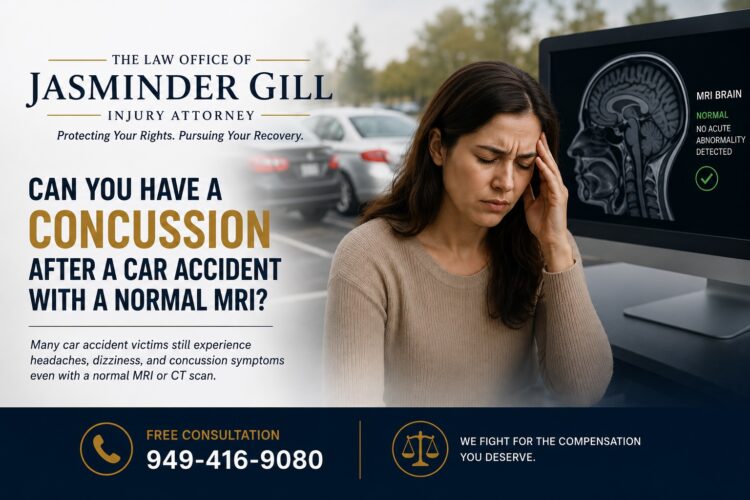
Can You Have a Concussion After a Car Accident With a Normal MRI?
Law Office of Jasminder Gill
Why Many Car Accident Victims Still Experience Headaches, Dizziness, and Concussion Symptoms After a Normal MRI or CT Scan
Many people involved in car accidents throughout Costa Mesa and Orange County leave the emergency room believing they are okay because doctors told them their CT scan or MRI looked “normal.” Unfortunately, that does not always mean a person escaped injury. In fact, many accident victims continue experiencing serious symptoms days, weeks, or even months after a collision despite normal imaging results.
Headaches, dizziness, blurred vision, nausea, memory problems, neck pain, sensitivity to light, fatigue, brain fog, and concentration issues are extremely common after rear-end accidents and other vehicle collisions. These symptoms can significantly affect daily life, work performance, driving ability, and overall health.
Busy roads throughout Costa Mesa such as Harbor Boulevard, Newport Boulevard, Bristol Street, Fairview Road, and the 405 and 55 Freeways continue seeing heavy traffic and serious crashes every year. Many of these accidents involve rear-end collisions, distracted driving, rideshare accidents, and intersection crashes that can cause concussions and traumatic brain injuries even when there is little visible damage to the vehicle.
Many Orange County drivers mistakenly believe a concussion only occurs when someone loses consciousness or suffers a severe head injury. However, mild traumatic brain injuries can happen during crashes that initially appear “minor.” Even low-speed collisions can cause violent movement to the head and neck that affects the brain.
Call 949-416-9080 for a free consultation
Why Normal Imaging Does Not Always Mean You Are Uninjured
One of the most confusing things for accident victims is hearing:
- “Your CT scan is normal.”
- “Your MRI looks okay.”
- “There is no bleeding.”
- “Everything appears fine.”
Yet the person may still feel terrible.
This happens because standard imaging is designed primarily to identify major structural injuries such as:
- brain bleeding
- skull fractures
- swelling
- spinal fractures
- major trauma
Many concussions and mild traumatic brain injuries are considered functional injuries rather than obvious structural injuries. The brain may still be affected even though imaging does not show a major abnormality.
In many cases, accident victims continue suffering from:
- severe headaches
- dizziness
- vertigo
- nausea
- confusion
- blurred vision
- sleep problems
- anxiety
- memory loss
- concentration problems
These symptoms are very real and commonly reported after car accidents throughout Orange County.
How Concussions Happen During Car Accidents
Many people assume they must hit their head directly to suffer a concussion. That is not always true.
A concussion can occur simply from the rapid movement of the brain inside the skull during a sudden collision. Rear-end accidents are especially known for causing this type of injury because the body is violently thrown backward and forward in a short period of time.
The force from a collision may cause:
- the brain to move rapidly inside the skull
- stretching of brain tissue
- inflammation
- disruption in neurological function
- neck injuries contributing to neurological symptoms
This is why rear-end accidents frequently lead to:
- headaches
- neck pain
- dizziness
- nausea
- concentration issues
- sensitivity to light
- balance problems
Even crashes at relatively low speeds may result in symptoms lasting weeks or months.
Rear-End Accidents Are Extremely Common in Costa Mesa
Costa Mesa drivers deal with heavy traffic every day near:
- South Coast Plaza
- Harbor Boulevard
- the 405 Freeway
- the 55 Freeway
- Newport Boulevard
- Fairview Road
- Bristol Street
- Baker Street
- Sunflower Avenue
Sudden stops, distracted drivers, speeding, and congestion contribute to frequent rear-end accidents throughout Orange County.
Many victims initially believe they are only “a little sore” after these crashes. However, symptoms may worsen significantly in the days following the collision.
Rear-end crashes commonly lead to:
- whiplash injuries
- neck strain
- herniated discs
- concussions
- traumatic brain injuries
- shoulder injuries
- back injuries
- nerve irritation
These injuries may not fully appear until adrenaline wears off.
Why Symptoms May Appear Days Later
One of the most misunderstood aspects of concussions and soft tissue injuries is delayed symptom onset.
After an accident, adrenaline and shock may temporarily mask pain and neurological symptoms. Many people leave the scene believing they are okay because:
- they can still walk
- they did not lose consciousness
- they do not see visible injuries
- emergency imaging looked normal
Then several days later they begin experiencing:
- headaches
- dizziness
- nausea
- neck stiffness
- brain fog
- fatigue
- vision problems
- memory difficulties
- worsening pain
This delayed reaction is extremely common after car accidents.
Unfortunately, insurance companies often try to use treatment delays against injury victims by arguing:
“If you were truly injured, you would have sought treatment immediately.”
That argument ignores the reality of how concussions and soft tissue injuries frequently develop.
Common Concussion Symptoms After a Car Accident
Every concussion is different. Some people recover quickly while others experience symptoms for extended periods of time.
Common symptoms after a Costa Mesa car accident include:
- persistent headaches
- migraines
- dizziness
- vertigo
- nausea
- blurred vision
- ringing in the ears
- neck pain
- shoulder pain
- confusion
- trouble concentrating
- memory issues
- sensitivity to light
- sensitivity to sound
- sleep problems
- irritability
- emotional changes
- fatigue
- balance issues
Some people also report feeling:
- disconnected
- mentally slow
- anxious
- emotionally overwhelmed
These symptoms can affect work, parenting, driving, and daily responsibilities.
Why Neck Injuries and Concussions Often Overlap
Whiplash and neck injuries frequently occur alongside concussions.
The sudden movement during a crash can strain muscles, ligaments, and nerves in the cervical spine. Neck injuries can contribute to:
- headaches
- dizziness
- shoulder pain
- numbness
- tingling
- blurred vision
- balance problems
This overlap often makes diagnosis more complicated.
Some accident victims continue experiencing symptoms because both the brain and neck were affected during the collision.
Dizziness and Vertigo After Car Accidents
Dizziness is one of the most common symptoms reported after rear-end accidents.
Victims may describe:
- feeling off balance
- room spinning sensations
- floating sensations
- nausea
- difficulty walking
- lightheadedness
Vertigo may occur because of:
- concussion-related issues
- neck injuries
- vestibular dysfunction
- inner ear disturbances
These symptoms may become worse when:
- standing up quickly
- moving the head
- driving
- using screens
- walking in busy environments
Many people underestimate how disabling dizziness can become after a collision.
Why Headaches After an Accident Should Not Be Ignored
Headaches are extremely common after car accidents, particularly rear-end collisions.
Some headaches appear immediately while others worsen over time.
Headaches after an accident may be related to:
- concussion
- whiplash
- muscle strain
- nerve irritation
- inflammation
- stress
- visual disturbances
Persistent or worsening headaches should always be taken seriously after a collision.
Can You Have a Concussion Without Losing Consciousness?
Yes.
Many concussion victims never lose consciousness.
In fact, some people:
- never hit their head
- walk away from the accident
- speak normally after the crash
- initially feel okay
Then symptoms gradually worsen over time.
Loss of consciousness is not required for a concussion diagnosis.
Why Insurance Companies Often Minimize Concussion Claims
Concussions and soft tissue injuries are often referred to as “invisible injuries” because they may not appear clearly on imaging.
Insurance companies frequently challenge these claims by arguing:
- imaging was normal
- there was little vehicle damage
- treatment was delayed
- symptoms are subjective
- there is no “proof” of injury
This can become frustrating for accident victims who are genuinely suffering.
Insurance companies may also attempt to minimize:
- migraines
- dizziness
- emotional symptoms
- fatigue
- concentration problems
- chronic pain
This is one reason documentation and consistent medical treatment are so important after an accident.
Why Medical Documentation Matters
After a Costa Mesa car accident, documenting symptoms is critical.
Important records may include:
- emergency room visits
- urgent care records
- neurological evaluations
- MRIs
- chiropractic records
- physical therapy notes
- pain management treatment
- symptom journals
- work restrictions
- prescriptions
- referrals to specialists
Consistent documentation helps establish:
- when symptoms began
- how symptoms progressed
- how the accident affected daily life
- the seriousness of the injuries
Common Treatments After a Concussion
Treatment varies depending on symptoms and severity.
Doctors may recommend:
- rest
- reduced screen time
- physical therapy
- vestibular therapy
- chiropractic treatment
- neurological evaluations
- pain management
- medication
- concussion specialists
Some patients recover quickly while others require extended treatment.
Why Delayed Treatment Can Hurt Injury Claims
Insurance companies often look for “gaps” in treatment.
They may argue:
- the injury was not serious
- symptoms were unrelated
- treatment was unnecessary
Unfortunately, many people delay care because they:
- think symptoms will improve
- are worried about medical bills
- are busy with work
- underestimate their injuries
Seeking appropriate medical care early is important for both health and documentation purposes.
Dangerous Roads and Intersections in Costa Mesa
Orange County continues seeing significant traffic accidents throughout:
- Harbor Boulevard
- Newport Boulevard
- Bristol Street
- Fairview Road
- Baker Street
- Sunflower Avenue
- the 405 Freeway
- the 55 Freeway
Congested shopping areas near South Coast Plaza also experience frequent collisions involving:
- distracted driving
- sudden braking
- rideshare traffic
- speeding
- intersection crashes
Rear-end accidents are especially common in stop-and-go traffic conditions.
Rideshare Accidents and Concussion Injuries
Uber and Lyft accidents continue increasing throughout Orange County.
Rideshare passengers may suffer:
- whiplash
- concussions
- neck injuries
- back injuries
- dizziness
- headaches
These claims can become more complicated because multiple insurance policies may be involved.
Children Can Also Suffer Concussions After Accidents
Children involved in collisions may not always communicate symptoms clearly.
Parents should monitor for:
- headaches
- vomiting
- confusion
- sleep changes
- emotional changes
- balance issues
- difficulty concentrating
Even “minor” crashes can affect children differently than adults.
Long-Term Post-Concussion Symptoms
Some accident victims recover within weeks while others continue experiencing symptoms for months.
Long-term symptoms may include:
- chronic headaches
- migraines
- dizziness
- concentration issues
- memory problems
- emotional changes
- sleep difficulties
- neck pain
Persistent symptoms can interfere with:
- work
- school
- parenting
- driving
- exercise
- social activities
What Should You Do After a Car Accident if Symptoms Continue?
If symptoms worsen after a crash:
- follow up with medical providers
- document all symptoms
- avoid ignoring dizziness or headaches
- attend recommended appointments
- keep records of treatment
- avoid minimizing symptoms
Early treatment and documentation may become extremely important later.
Get Help from a Costa Mesa Car Accident Lawyer
If you or a loved one has been injured in a car accident, you don’t have to deal with insurance companies alone.
Car accidents frequently occur along major roads in Costa Mesa such as Harbor Blvd, Newport Blvd, and the 55 freeway. These high-traffic areas often lead to serious rear-end and intersection collisions.
If you’re searching for a car accident lawyer near you, The Law Office of Jasminder Gill represents injury victims in Costa Mesa, Newport Beach, Santa Ana, Irvine, and throughout Orange County. We are committed to helping clients recover maximum compensation for medical expenses, lost income, vehicle damage, and pain and suffering.
Insurance companies often try to minimize claims or pressure victims into accepting low settlements. Our firm works to protect your rights, gather evidence, and build a strong case to ensure you receive the full compensation you deserve.
Learn more from our Car Accident Lawyer in Costa Mesa.