
Costa Mesa Motor Vehicle Accident Lawyer | Law Office of Jasminder Gill
Representing Victims of Car, Truck, Motorcycle, Bicycle, E-Bike, Rideshare, and Pedestrian Accidents
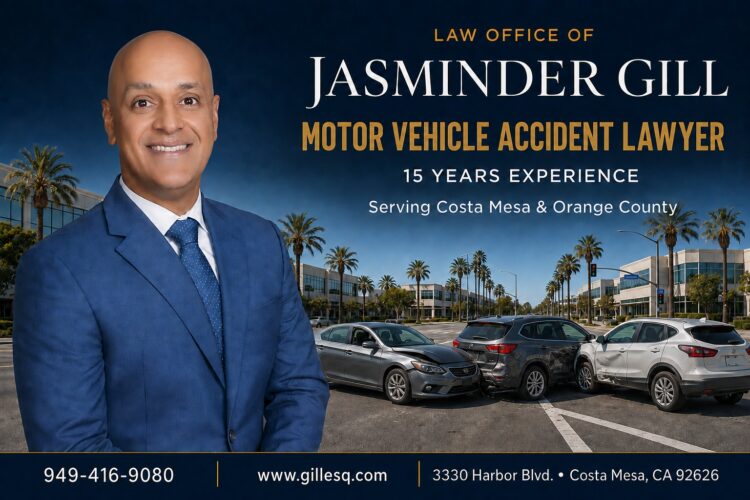 Motor vehicle accidents involve much more than collisions between two passenger cars. A serious crash may involve a commercial truck, motorcycle, delivery van, Uber or Lyft driver, bicycle, e-bike, pedestrian, government vehicle, or several vehicles in a chain reaction.
Each type of accident presents different questions involving liability, insurance coverage, evidence, safety regulations, and compensation.
At the Law Office of Jasminder Gill, we represent people injured in motor vehicle accidents in Costa Mesa and throughout Orange County. Attorney Jasminder Gill has more than 15 years of personal injury experience handling claims involving negligent drivers, commercial vehicles, uninsured motorists, catastrophic injuries, and fatal collisions.
15+ YEARS EXPERIENCE | THOUSANDS OF CLIENTS HELPED | MILLIONS RECOVERED | CALIFORNIA ATTORNEY SINCE 2009 | PUNJABI SPEAKING | SPANISH CONSULTATIONS | 24/7 FREE CONSULTATIONS
Call 949-416-9080 for a free consultation
Our firm investigates how the accident happened, identifies every potentially responsible party, preserves available evidence, examines applicable insurance coverage, and documents the full effect of the injuries.
We handle motor vehicle accidents involving:
- Passenger cars
- Commercial trucks
- Motorcycles
- Bicycles
- E-bikes
- Pedestrians
- Uber and Lyft vehicles
- Delivery vans and trucks
- Company vehicles
- Uninsured drivers
- Underinsured drivers
- Hit-and-run motorists
- Government vehicles
- Defective vehicles and components
- Fatal collisions
If you or a loved one was injured because a driver, business, or another party failed to use reasonable care, contact our office to discuss your legal options.
Why Hire a Costa Mesa Motor Vehicle Accident Lawyer?
Insurance companies may begin investigating a collision before the injured person leaves the hospital. Adjusters, investigators, defense attorneys, and corporate representatives may immediately begin gathering information designed to protect the insurer or responsible business.
An insurance company may:
- Request a recorded statement
- Ask you to sign a medical authorization
- Question whether its insured caused the accident
- Claim that you were partially responsible
- Minimize the severity of your injuries
- Attribute symptoms to a preexisting condition
- Dispute the need for treatment
- Challenge future medical expenses
- Underestimate lost income
- Offer an early settlement
- Delay the claim
- Dispute which policy applies
A quick settlement may not account for surgery, long-term rehabilitation, chronic pain, permanent disability, or diminished earning capacity. Once a settlement and release are finalized, the victim generally cannot return for additional compensation simply because the injuries become worse.
A motor vehicle accident lawyer can protect the victim’s interests while investigating the complete claim.
The Law Office of Jasminder Gill can:
- Investigate the accident scene
- Obtain available police and collision reports
- Identify witnesses
- Seek surveillance and dashboard-camera footage
- Preserve vehicle and electronic evidence
- Examine commercial driving records
- Evaluate rideshare application data
- Identify responsible individuals and companies
- Review available insurance coverage
- Gather medical records
- Document lost income
- Evaluate future care needs
- Handle insurance communications
- Negotiate a settlement
- File a lawsuit when necessary
- Prepare the case for trial
Our goal is to pursue compensation supported by the evidence while allowing clients to focus on their treatment and recovery.
What Is a Motor Vehicle Accident Claim?
A motor vehicle accident claim arises when someone is injured or killed because another person or company failed to act with reasonable care in connection with the operation, ownership, maintenance, design, or control of a vehicle or roadway.
A claim may involve:
- Negligent driving
- Commercial vehicle liability
- Employer responsibility
- Dangerous roadway conditions
- Defective vehicle components
- Negligent vehicle maintenance
- Uninsured motorist coverage
- Underinsured motorist coverage
- Wrongful death
- Several responsible parties
A motor vehicle claim is broader than an ordinary car accident claim because it can include nearly any incident involving a motorized vehicle and another road user.
For information focused specifically on passenger vehicle crashes, visit our Costa Mesa Car Accident Lawyer page.
Motor Vehicle Accidents Remain a Serious California Safety Problem
Motor vehicle collisions continue to cause thousands of deaths and many more injuries across California. According to the California Office of Traffic Safety, 4,061 people were killed in traffic collisions during 2023.
The same state data reports that during 2023:
- 1,355 people died in alcohol-impaired crashes
- 1,106 pedestrians were killed
- 583 motorcyclists were killed
- 145 bicyclists were killed
Traffic fatalities decreased compared with the prior year, but these numbers still demonstrate the devastating effect of unsafe driving throughout California.
Motorcycles, bicycles, e-bikes, and pedestrians are especially vulnerable because they do not have the seat belts, airbags, and vehicle structure protecting occupants of passenger vehicles.
Why Motor Vehicle Accident Cases Can Be Complicated
A collision involving two personal vehicles may involve one primary liability policy. A truck, delivery, rideshare, government, or multi-vehicle accident can involve several defendants and layers of insurance.
Complicated issues may include:
- Disputed right-of-way
- Comparative negligence
- Several impacts
- Commercial vehicle ownership
- Employer responsibility
- Driver classification
- Federal or state safety regulations
- Rideshare application status
- Government claim procedures
- Defective product allegations
- Insufficient insurance
- Multiple injured victims
- Medical causation disputes
- Future care calculations
Identifying the driver is only the beginning. The investigation should determine who owned the vehicle, who controlled the driver’s work, who maintained the vehicle, which policies apply, and whether another party contributed to the accident.
Types of Motor Vehicle Accident Cases We Handle
The Law Office of Jasminder Gill represents people injured across the full range of motor vehicle accidents. Each category has different risks and legal considerations.
Car Accidents
Passenger vehicle collisions may include:
- Rear-end accidents
- T-bone crashes
- Head-on collisions
- Sideswipe accidents
- Rollover crashes
- Intersection accidents
- Freeway collisions
- Multi-vehicle pileups
- Parking lot accidents
- Hit-and-run crashes
Potential evidence includes police reports, photographs, witnesses, surveillance footage, dashboard cameras, vehicle event-data recorders, and medical documentation.
Learn more from our Costa Mesa Car Accident Lawyer.
Commercial Truck Accidents
Commercial truck accidents frequently cause catastrophic injuries because tractor-trailers, box trucks, dump trucks, and other heavy vehicles are much larger than passenger cars.
Truck accident claims may involve:
- The truck driver
- Motor carrier
- Truck owner
- Leasing company
- Maintenance provider
- Cargo-loading company
- Freight broker
- Vehicle or parts manufacturer
- Other contractors
Potential causes include:
- Driver fatigue
- Distracted driving
- Speeding
- Following too closely
- Hours-of-service violations
- Inadequate training
- Brake failure
- Tire failure
- Improper loading
- Unsecured cargo
- Unsafe company policies
Commercial trucking evidence can be lost or overwritten. Electronic logging information, event-data records, inspection documents, driver files, maintenance history, and dispatch communications should be preserved promptly.
Learn more from our Costa Mesa Truck Accident Lawyer.
Delivery Truck and Delivery Van Accidents
Costa Mesa roads are regularly used by package vans, food-delivery drivers, couriers, box trucks, grocery delivery services, and other commercial vehicles.
Delivery drivers may be:
- Looking for addresses
- Checking an application
- Following a route
- Communicating with dispatch
- Parking in an unsafe location
- Backing frequently
- Working under strict time limits
- Driving while fatigued
A delivery company may label the driver an independent contractor, but the contract does not necessarily resolve legal responsibility. The investigation may examine who controlled the work, route, schedule, vehicle, and performance standards.
Potential defendants may include the driver, employer, delivery company, contractor, vehicle owner, or maintenance company.
Learn more about delivery truck accidents in Costa Mesa.
Motorcycle Accidents
Motorcyclists have the same right to use the road as other drivers. Unfortunately, motorists often fail to recognize motorcycles when turning, changing lanes, or entering intersections.
Common motorcycle accidents include:
- Unsafe left-turn collisions
- Lane-change accidents
- Rear-end impacts
- Intersection crashes
- Dooring accidents
- Roadway hazard accidents
- Hit-and-run collisions
Motorcycle accident injuries may include:
- Traumatic brain injuries
- Spinal cord injuries
- Road rash
- Broken bones
- Internal bleeding
- Nerve damage
- Amputations
- Fatal injuries
Insurance companies sometimes rely on unfair assumptions about motorcyclists. Liability should be determined from evidence, not stereotypes.
Learn more from our Costa Mesa Motorcycle Accident Lawyer.
Bicycle Accidents
Bicyclists are vulnerable when drivers fail to check bike lanes, yield at intersections, or leave sufficient passing space.
Bicycle accidents may occur when a driver:
- Makes an unsafe right turn
- Turns left across a cyclist’s path
- Enters a bike lane
- Opens a door into traffic
- Backs without checking
- Fails to yield
- Uses a phone
- Drives while impaired
A driver’s liability policy may provide compensation. Depending on the circumstances, uninsured or underinsured motorist coverage may also apply.
Learn more from our Costa Mesa Bicycle Accident Lawyer.
E-Bike Accidents
E-bike use has increased throughout Costa Mesa and Orange County. E-bikes can travel faster than traditional bicycles, but riders remain vulnerable to passenger vehicles, trucks, unsafe road conditions, and defective equipment.
E-bike accident claims may involve:
- Negligent drivers
- Commercial vehicles
- Dangerous intersections
- Bike lane collisions
- Defective batteries
- Brake defects
- Improper repairs
- Rental companies
- Property owners
- Government entities
The classification of the e-bike, rider’s conduct, equipment condition, roadway, and motorist’s actions may all become relevant.
Learn more from our Costa Mesa E-Bike Accident Lawyer.
Pedestrian Accidents
Pedestrians have virtually no physical protection during a collision. Even a vehicle traveling at a relatively low speed can cause life-changing injuries.
Pedestrian collisions commonly occur in:
- Marked crosswalks
- Unmarked crosswalks
- Intersections
- Parking lots
- Driveways
- School zones
- Shopping districts
- Residential neighborhoods
- Areas with limited nighttime visibility
Potentially responsible parties may include a negligent driver, employer, delivery company, rideshare insurer, property owner, contractor, or government entity.
A pedestrian who was outside a marked crosswalk may still have a valid claim. California comparative negligence principles may permit recovery even if the pedestrian shares some responsibility.
Learn more from our Costa Mesa Pedestrian Accident Lawyer.
Uber and Lyft Accidents
Rideshare accidents involve insurance questions that depend partly on the driver’s application status.
The driver may have been:
- Offline
- Logged in and waiting for a request
- Traveling to pick up a passenger
- Transporting a passenger
The applicable insurance coverage can change between these periods. Rideshare application records, GPS data, trip information, and communications should be preserved.
Rideshare claims may be brought by:
- Passengers
- Other drivers
- Pedestrians
- Bicyclists
- Motorcyclists
- Occupants of other vehicles
Learn more from our Costa Mesa Uber and Lyft Accident Lawyer.
Rear-End Collisions
Rear-end accidents commonly occur in freeway congestion, at traffic lights, and during sudden traffic slowdowns.
The following driver is frequently responsible for failing to maintain a reasonable distance. However, liability may become disputed when:
- Another vehicle changes lanes abruptly
- The lead vehicle reverses
- Several vehicles are involved
- A third vehicle pushes one car forward
- Brake lights fail
- A mechanical problem contributes
Rear-end collisions may cause whiplash, herniated discs, concussions, shoulder injuries, and chronic neck or back pain.
Learn more from our Costa Mesa Rear-End Accident Lawyer.
T-Bone and Side-Impact Accidents
A side-impact collision occurs when the front or side of one vehicle strikes the side of another. Occupants may have limited structural protection between their bodies and the point of impact.
T-bone accidents frequently occur because a driver:
- Runs a red light
- Ignores a stop sign
- Fails to yield
- Makes an unsafe left turn
- Enters traffic from a driveway
- Speeds through an intersection
These crashes can cause brain injuries, spinal damage, fractures, internal organ injuries, and fatalities.
Learn more from our Costa Mesa T-Bone Accident Lawyer.
Head-On Collisions
Head-on crashes are among the most dangerous motor vehicle accidents because the combined force can be extreme.
Common causes include:
- Crossing the center line
- Driving the wrong way
- Unsafe passing
- Distracted driving
- Impaired driving
- Fatigue
- Losing control
- Mechanical failure
Head-on collisions may result in catastrophic brain injuries, spinal cord damage, multiple fractures, internal bleeding, and death.
Hit-and-Run Accidents
A driver may leave the scene because the person is uninsured, unlicensed, impaired, driving a stolen vehicle, or attempting to avoid responsibility.
Evidence that may identify the driver includes:
- Surveillance footage
- Dashboard cameras
- Doorbell-camera recordings
- Witness descriptions
- Partial license plate information
- Vehicle debris
- Paint transfer
- Police investigation
If the driver cannot be found, uninsured motorist coverage may apply through an eligible automobile policy.
Learn more from our Costa Mesa Hit-and-Run Accident Lawyer.
Multi-Vehicle Accidents
A freeway pileup or chain-reaction crash may involve several drivers and insurers. One driver may cause the initial collision while another contributes to a secondary impact.
The investigation may consider:
- Which vehicle caused the first impact
- The order of later impacts
- Vehicle positions
- Dashboard-camera footage
- Event-data information
- Witness statements
- Skid marks
- Police diagrams
- Collision damage
Each driver’s conduct should be evaluated separately. More than one person may share legal responsibility.
Uninsured and Underinsured Motorist Accidents
A responsible driver may have no insurance or insufficient coverage for the injuries caused.
Uninsured motorist coverage may apply when:
- The responsible driver has no insurance
- A hit-and-run driver cannot be identified
- Other policy requirements are satisfied
Underinsured motorist coverage may provide additional compensation when the responsible driver has insurance but the available limits are insufficient.
These are first-party claims made through an applicable insurance policy, but the insurer may still dispute fault, injuries, treatment, and value.
Learn more from our Costa Mesa Uninsured Motorist Lawyer.
Wrongful Death Motor Vehicle Accidents
Fatal motor vehicle accidents may involve passenger cars, commercial trucks, motorcycles, pedestrians, bicyclists, e-bikes, and rideshare vehicles.
Qualifying family members may be able to pursue compensation for:
- Funeral and burial expenses
- Loss of financial support
- Loss of household services
- Loss of care and guidance
- Loss of companionship
- Other damages permitted by California law
A survival action may address certain losses incurred before death. Wrongful death and survival claims have separate legal requirements.
Fatal crashes require immediate investigation to preserve vehicles, electronic data, toxicology results, video, witnesses, and commercial records.
Learn more from our Costa Mesa Wrongful Death Lawyer.
Common Causes of Motor Vehicle Accidents in Costa Mesa
Most motor vehicle accidents are preventable. They often happen because a driver fails to watch the road, control speed, obey traffic signals, yield the right-of-way, or maintain a safe distance.
The cause of an accident may affect which parties are responsible, what evidence should be preserved, and which insurance policies apply.
Distracted Driving
Distracted driving can cause car, truck, motorcycle, bicycle, e-bike, and pedestrian accidents.
Common distractions include:
- Text messaging
- Phone calls
- Social media
- Navigation applications
- Rideshare or delivery applications
- Eating or drinking
- Adjusting music
- Talking with passengers
- Reaching for objects
- Looking at a roadside event
A driver traveling at normal roadway speed can cover a substantial distance while looking away for only a few seconds.
Evidence of distracted driving may include:
- Cellphone records
- Application data
- Witness statements
- Driver admissions
- Dashboard-camera footage
- Surveillance video
- Police reports
- Employer records
- Vehicle information
Under California Vehicle Code section 23123.5, a driver generally may not hold and operate a handheld wireless phone or electronic communications device while driving, subject to the law’s terms and exceptions.
A driver may still be negligent for other forms of distraction even when no handheld device is involved.
Speeding and Driving Too Fast for Conditions
Speeding reduces the time available to recognize a hazard and increases the severity of a collision.
A driver may be operating unsafely even below the posted limit when traffic, rain, darkness, visibility, or construction requires a slower speed.
Speed-related motor vehicle accidents frequently involve:
- Rear-end impacts
- Pedestrian collisions
- Motorcycle accidents
- Rollover crashes
- Loss-of-control accidents
- Freeway pileups
- Fatal collisions
Potential evidence of speed includes:
- Skid marks
- Event-data recorders
- Dashboard cameras
- Surveillance footage
- Witness statements
- Vehicle damage
- Final resting positions
- Accident reconstruction
Following Too Closely
Drivers must leave sufficient space to respond when traffic slows or stops. Tailgating is particularly dangerous in freeway congestion, during rain, around motorcycles, and behind vehicles stopping for pedestrians.
Under California Vehicle Code section 21703, a driver may not follow another vehicle more closely than is reasonable and prudent after considering vehicle speed, traffic, and roadway conditions.
A following distance that appears adequate in light traffic may become unsafe during:
- Stop-and-go congestion
- Construction
- Rain
- Nighttime driving
- Heavy freeway traffic
- Sudden lane closures
- Emergency vehicle activity
Failure to Yield
Failure-to-yield accidents commonly occur at intersections, driveways, parking lots, freeway entrances, and while making left turns.
A driver may fail to yield to:
- Oncoming vehicles
- Motorcycles
- Bicycles
- E-bike riders
- Pedestrians
- Vehicles already in a lane
- Traffic with the right-of-way
These accidents frequently result in T-bone collisions, side impacts, pedestrian accidents, and motorcycle crashes.
Running Red Lights and Stop Signs
A driver who ignores a traffic signal or stop sign can enter an intersection directly into the path of another road user.
Red-light accidents may result from:
- Distraction
- Speeding
- Impairment
- Fatigue
- Aggressive driving
- Attempting to beat a yellow light
- Following another vehicle without checking the signal
Evidence may include traffic cameras, nearby business cameras, signal timing, witnesses, event-data recorders, and physical damage.
Unsafe Left Turns
Left-turn collisions occur when a driver crosses approaching traffic without sufficient time or distance.
Drivers may:
- Misjudge an approaching vehicle’s speed
- Fail to see a motorcycle or bicycle
- Rush through a changing signal
- Turn with an obstructed view
- Follow another turning vehicle without checking
- Focus on pedestrians while overlooking traffic
The turning driver may be responsible, but every accident requires an evaluation of the signals, vehicle speeds, and conduct of all parties.
Unsafe Lane Changes and Merging
A driver should signal, check mirrors, observe surrounding traffic, and check blind spots before changing lanes.
Unsafe lane changes may cause:
- Sideswipe collisions
- Motorcycle accidents
- Freeway crashes
- Truck accidents
- Rollovers
- Chain-reaction collisions
- Vehicles being forced off the road
These crashes often involve conflicting accounts. Video, witnesses, vehicle damage, roadway markings, and electronic data may help determine which vehicle left its lane.
Drunk and Drug-Impaired Driving
Alcohol and drugs can impair judgment, coordination, vision, and reaction time. Certain prescription medications may also affect driving ability.
Impaired drivers may:
- Speed
- Drift between lanes
- Run traffic signals
- Follow too closely
- Drive the wrong way
- Fail to recognize pedestrians
- Fall asleep
- Lose control of the vehicle
Police reports, toxicology results, body-camera footage, witness observations, and criminal case records may become relevant.
A criminal prosecution is separate from a civil injury claim. The victim may still need to pursue compensation through insurance or a lawsuit.
Fatigued Driving
A dangerously fatigued driver may react slowly, drift between lanes, miss a signal, or fall asleep behind the wheel.
Fatigue can result from:
- Inadequate sleep
- Long work shifts
- Extended travel
- Untreated sleep disorders
- Medication
- Overnight work
- Commercial driving schedules
- Delivery pressure
Employment records, driving logs, GPS information, dispatch communications, and delivery data may help establish how long a commercial driver had been working.
Aggressive Driving and Road Rage
Aggressive driving behaviors include:
- Tailgating
- Excessive speeding
- Unsafe passing
- Weaving through traffic
- Brake-checking
- Blocking other motorists
- Ignoring signals
- Making abrupt lane changes
Intentional road-rage conduct can create insurance and liability issues different from an ordinary negligence claim. Available video, witnesses, police records, and driver communications should be preserved.
Inexperienced Drivers
Teenagers and newly licensed drivers may have difficulty judging speed, recognizing hazards, or responding to complex traffic situations.
An investigation may examine:
- Vehicle ownership
- Driver permission
- License restrictions
- Insurance coverage
- Phone use
- Passenger distraction
- Whether the driver was working
A driver’s inexperience does not eliminate responsibility for unsafe conduct.
Unsafe Backing
Backing accidents commonly occur in parking lots, driveways, loading zones, apartment communities, school pickup areas, and construction sites.
Drivers should check behind the vehicle before and during the maneuver. Backup cameras and warning systems assist drivers but do not replace the duty to remain attentive.
Children, pedestrians, bicyclists, e-bike riders, and occupants of smaller vehicles may be difficult to see behind SUVs, pickups, vans, and commercial trucks.
Poor Vehicle Maintenance
Failure to maintain a vehicle can cause or contribute to an accident.
Potential maintenance issues include:
- Worn brakes
- Unsafe tires
- Defective lights
- Steering problems
- Broken mirrors
- Improperly maintained trailers
- Faulty windshield wipers
- Overdue commercial inspections
Potentially responsible parties may include the driver, owner, employer, rental company, repair shop, or maintenance provider.
Defective Vehicles and Components
A defective component may cause the accident or increase the severity of injuries.
Possible defects include:
- Tire blowouts
- Brake failures
- Steering defects
- Accelerator problems
- Airbag failures
- Seat belt defects
- Roof-crush defects
- Fuel system problems
- Faulty driver-assistance technology
- Defective e-bike batteries or brakes
The vehicle or component should be preserved before it is repaired, returned, sold, or destroyed. Product liability cases often require expert inspection and analysis.
Dangerous Roads, Signals, and Construction Zones
Roadway conditions may contribute to an accident when they create an unreasonable risk.
Possible hazards include:
- Malfunctioning traffic signals
- Obstructed stop signs
- Defective pavement
- Missing lane markings
- Inadequate warnings
- Dangerous construction detours
- Poor drainage
- Inadequate sightlines
- Unsafe pedestrian routing
- Defective street lighting
A public entity is not responsible for every collision on a public road. Government claims require proof of specific legal elements and may be subject to immunities and shortened deadlines.
Contractors, traffic-control companies, property owners, and other entities may also share responsibility.
Dangerous Roads and High-Traffic Areas in Costa Mesa
Costa Mesa contains major commercial corridors, residential streets, shopping destinations, schools, entertainment venues, and freeway access points.
Roads and areas with substantial vehicle activity include:
- Harbor Boulevard
- Newport Boulevard
- Bristol Street
- Fairview Road
- Baker Street
- 17th Street
- Victoria Street
- Wilson Street
- Adams Avenue
- Placentia Avenue
- Sunflower Avenue
- Anton Boulevard
- MacArthur Boulevard
- South Coast Plaza-area streets
- Orange Coast College-area roadways
- OC Fair & Event Center-area traffic
- State Route 55
- Interstate 405
Identifying a heavily traveled roadway does not mean every portion is inherently dangerous or that a government agency caused a particular collision. Each accident must be investigated according to its specific location, traffic controls, visibility, roadway conditions, and driver conduct.
Learn more about dangerous intersections in Costa Mesa.
Motor Vehicle Accidents on the 55 Freeway
State Route 55 carries passenger vehicles, motorcycles, commercial trucks, and commuter traffic through Costa Mesa and other Orange County communities.
Common accident factors include:
- Sudden traffic slowdowns
- High speeds
- Unsafe lane changes
- Distracted driving
- Tailgating
- Merging vehicles
- Road construction
- Drivers unfamiliar with the roadway
A 55 Freeway accident may involve several vehicles and secondary impacts. Dashboard-camera footage, witnesses, vehicle data, police reports, and photographs can help determine the sequence.
Learn more from our Costa Mesa 55 Freeway Accident Lawyer.
Motor Vehicle Accidents on the 405 Freeway
The 405 Freeway carries substantial commuter and commercial traffic through and around Costa Mesa. Stop-and-go congestion can develop quickly near entrances, exits, interchanges, and construction areas.
A 405 Freeway collision may involve:
- Passenger vehicles
- Tractor-trailers
- Delivery vans
- Motorcycles
- Rideshare vehicles
- Several injured occupants
- High-speed secondary impacts
Freeway evidence can disappear quickly after vehicles are moved and traffic resumes. Important evidence should be identified and preserved as soon as possible.
Serious Injuries Caused by Motor Vehicle Accidents
Motor vehicle accidents can injure nearly every part of the body. A victim may suffer several separate impacts inside and outside the vehicle.
Injury severity may depend on:
- Vehicle speed
- Vehicle size and weight
- Direction of impact
- Seat position
- Number of collisions
- Seat belt use
- Airbag deployment
- Vehicle intrusion
- Whether the victim was ejected
- Whether the victim was walking or riding
- Age and prior medical condition
Common injuries include:
- Traumatic brain injuries
- Concussions
- Spinal cord injuries
- Herniated discs
- Broken bones
- Internal bleeding
- Organ damage
- Shoulder and knee injuries
- Nerve damage
- Burns
- Road rash
- Lacerations
- Amputations
- Psychological trauma
- Fatal injuries
Traumatic Brain Injuries and Concussions
A brain injury may occur when the head strikes an object or when rapid acceleration and deceleration cause the brain to move within the skull.
Possible symptoms include:
- Headaches
- Dizziness
- Memory loss
- Brain fog
- Difficulty concentrating
- Nausea
- Light sensitivity
- Sound sensitivity
- Vision changes
- Sleep problems
- Mood changes
- Balance difficulties
- Confusion
A person does not need to lose consciousness to suffer a concussion. A normal CT scan or MRI does not necessarily exclude every brain injury.
Moderate and severe traumatic brain injuries can permanently affect employment, judgment, personality, mobility, relationships, and independence.
Learn more from our Costa Mesa Traumatic Brain Injury Lawyer.
Spinal Cord Injuries
High-speed crashes, truck collisions, rollovers, motorcycle accidents, bicycle accidents, and pedestrian impacts may damage the spinal cord.
Spinal cord injuries can cause:
- Partial paralysis
- Complete paralysis
- Loss of sensation
- Chronic nerve pain
- Muscle weakness
- Loss of coordination
- Breathing problems
- Loss of bowel or bladder control
Victims may require emergency surgery, rehabilitation, wheelchairs, accessible transportation, home modifications, personal attendants, and lifelong care.
A catastrophic injury claim should evaluate future needs rather than only the medical bills incurred immediately after the crash.
Neck and Back Injuries
Motor vehicle accidents commonly injure the cervical, thoracic, and lumbar spine.
Possible conditions include:
- Whiplash
- Muscle strains
- Ligament sprains
- Herniated discs
- Bulging discs
- Annular tears
- Facet joint injuries
- Vertebral fractures
- Nerve compression
- Sciatica
Symptoms may include:
- Neck pain
- Back pain
- Muscle spasms
- Reduced range of motion
- Pain radiating into the arms or legs
- Numbness
- Tingling
- Weakness
- Difficulty sitting or standing
Treatment may include medication, physical therapy, injections, pain-management procedures, or surgery.
Broken Bones and Orthopedic Injuries
Vehicle occupants, motorcyclists, bicyclists, e-bike riders, and pedestrians can suffer fractures to the:
- Arms
- Wrists
- Hands
- Legs
- Knees
- Ankles
- Ribs
- Pelvis
- Hips
- Face
Complex fractures may require surgery and internal hardware such as plates, rods, and screws.
Long-term effects may include chronic pain, weakness, reduced mobility, nerve damage, altered gait, and post-traumatic arthritis.
Internal Injuries
Internal injuries may not be visible at the scene and can become life-threatening without treatment.
Possible internal injuries include:
- Internal bleeding
- Lung damage
- Liver injuries
- Kidney injuries
- Spleen injuries
- Bowel damage
- Abdominal trauma
- Cardiac injuries
Warning signs may include abdominal pain, chest pain, dizziness, fainting, weakness, breathing difficulty, or unexplained bruising.
Prompt medical evaluation is important after a substantial impact.
Burns and Scarring
Motor vehicle accident victims may suffer burns from:
- Vehicle fires
- Fuel ignition
- Hot metal
- Chemicals
- Steam
- Airbag deployment
- E-bike battery fires
- Electrical components
Treatment may involve wound care, debridement, skin grafting, plastic surgery, scar revision, and psychological counseling.
Permanent scarring and disfigurement can affect employment, relationships, self-confidence, and quality of life.
Learn more from our Costa Mesa Burn Injury Lawyer.
Amputations and Crush Injuries
Truck, motorcycle, pedestrian, bicycle, and rollover accidents may crush a limb or cause injuries requiring surgical amputation.
Long-term needs may include:
- Repeated surgeries
- Prosthetic devices
- Prosthetic replacement
- Physical therapy
- Occupational therapy
- Home modifications
- Vehicle modifications
- Vocational retraining
- Psychological treatment
- Personal assistance
The future cost of prosthetics and care should be evaluated over the victim’s anticipated lifetime.
Road Rash and Lacerations
Motorcyclists, bicyclists, e-bike riders, and pedestrians may slide across pavement after impact.
Severe road rash can damage several layers of skin and may require:
- Wound cleaning
- Debridement
- Infection treatment
- Skin grafting
- Scar revision
- Plastic surgery
Photographs taken throughout recovery can document the progression of wounds and permanent scarring.
Psychological Trauma
A motor vehicle accident can cause emotional injuries in addition to physical harm.
Victims may experience:
- Anxiety
- Depression
- Post-traumatic stress
- Fear of driving
- Fear of crossing streets
- Nightmares
- Panic attacks
- Sleep disturbances
- Irritability
- Social withdrawal
- Loss of independence
Mental-health treatment may be an important part of recovery and can document the accident’s emotional effect.
Delayed Symptoms After a Motor Vehicle Accident
Some injuries appear immediately, while others develop after adrenaline and shock begin to subside.
Delayed symptoms may include:
- Headaches
- Neck pain
- Back pain
- Dizziness
- Nausea
- Tingling
- Numbness
- Memory problems
- Difficulty concentrating
- Shoulder pain
- Sleep disturbances
- Emotional changes
A delayed symptom does not automatically mean it is unrelated to the accident. However, insurance companies may use treatment delays to dispute causation.
Obtain appropriate medical evaluation and accurately report when symptoms began.
Preexisting Conditions
A prior injury or medical condition does not automatically eliminate a motor vehicle accident claim. A collision may aggravate an existing condition or cause new symptoms.
Relevant questions include:
- What symptoms existed before the accident?
- What treatment was required before the crash?
- What changed after the accident?
- Did the collision create new limitations?
- Did it accelerate the need for surgery?
- Could the victim work normally beforehand?
Medical records from before and after the accident may help establish the change.
Victims should be truthful about prior conditions. Concealing medical history can damage credibility.
Evidence That Can Strengthen a Motor Vehicle Accident Claim
Evidence is necessary to establish fault, identify responsible parties, connect injuries to the accident, and calculate damages.
Important evidence may include:
- Police reports
- Photographs
- Video recordings
- Witness statements
- 911 calls
- Body-camera footage
- Cellphone records
- Event-data information
- Electronic driving logs
- Rideshare records
- Delivery data
- GPS information
- Vehicle inspections
- Maintenance records
- Medical documentation
- Employment records
- Expert analysis
Not every type of evidence exists in every case. The investigation should be tailored to the accident.
Police Reports
A police or California Highway Patrol report may contain:
- Driver information
- Vehicle details
- Insurance information
- Witness names
- Statements
- Road conditions
- Collision diagrams
- Citations
- Initial findings
The report is important, but it does not automatically determine civil liability. Additional evidence may support a different conclusion.
Photographs and Video
Photograph:
- Every involved vehicle
- Damage from several angles
- License plates
- Vehicle positions
- Skid marks
- Debris
- Lane markings
- Traffic signs
- Signals
- Road conditions
- Visible injuries
Conditions may change quickly after vehicles are moved, debris is cleared, and repairs begin.
Witness Statements
Independent witnesses can help establish:
- Who had the right-of-way
- Vehicle speed
- Unsafe lane changes
- Signal conditions
- Driver distraction
- The order of impacts
- Statements made after the crash
- Signs of impairment
Obtain names, telephone numbers, and email addresses. Do not assume the responding officer documented every witness.
Surveillance and Dashboard-Camera Footage
Video may be available from:
- Nearby businesses
- Shopping centers
- Gas stations
- Apartment communities
- Homes
- Buses
- Commercial fleets
- Rideshare vehicles
- Delivery vehicles
Many recording systems overwrite footage after a limited period. Preservation requests should be sent promptly.
Vehicle Event-Data Recorders
Some vehicles contain electronic systems that may record limited pre-collision information, including:
- Vehicle speed
- Brake application
- Accelerator position
- Seat belt status
- Airbag deployment
- Change in velocity
Specialized equipment or legal process may be required to retrieve this information.
Commercial Vehicle Evidence
Truck and delivery vehicle cases may involve evidence unavailable in ordinary passenger vehicle claims.
Examples include:
- Electronic logging records
- Driver qualification files
- Inspection reports
- Maintenance records
- Dispatch communications
- Cargo information
- GPS records
- Delivery schedules
- Company safety policies
This evidence should be preserved before it is routinely destroyed or overwritten.
Medical Evidence
Medical records connect the accident to the injuries and document treatment.
Relevant records may include:
- Ambulance reports
- Emergency department records
- Diagnostic imaging
- Specialist evaluations
- Physical therapy notes
- Surgical reports
- Prescription history
- Work restrictions
- Disability assessments
- Future treatment recommendations
Victims should accurately report symptoms and attend medically recommended appointments.
What to Do After a Motor Vehicle Accident in Costa Mesa
The steps taken after an accident can affect safety, medical recovery, and the legal claim.
Stop and Move to Safety
Stop after the collision. When safe and appropriate, move away from active traffic and turn on hazard lights. Follow law enforcement instructions.
Do not remain in a dangerous location simply to photograph the vehicles.
Call 911
Request emergency assistance when anyone is injured. Law enforcement may document the vehicles, insurance information, witnesses, roadway conditions, and initial statements.
Seek Medical Attention
Obtain appropriate care, particularly when experiencing pain, dizziness, numbness, confusion, weakness, breathing difficulty, or other concerning symptoms.
Exchange Information
Obtain:
- Driver names
- Addresses
- Telephone numbers
- Driver’s license information
- Vehicle registration
- License plates
- Insurance information
- Employer information when relevant
Document the Scene
Take photographs and video when it is safe. Include vehicles, damage, road conditions, signs, signals, lane markings, debris, and injuries.
Locate Witnesses
Ask witnesses for their contact information. Independent testimony may become essential when fault is disputed.
Avoid Admitting Fault
Do not speculate or apologize for causing the accident. Provide truthful information to law enforcement and medical personnel, but do not guess about facts you did not observe.
Notify the Insurance Company
Automobile policies generally require prompt notice. Report the accident accurately, but understand your rights before giving a detailed recorded statement.
Preserve Evidence
Keep photographs, videos, medical bills, repair estimates, receipts, employment records, and insurance correspondence.
Do not repair, return, or discard important evidence before documenting it.
California DMV Accident Reporting
According to the California Department of Motor Vehicles, a driver or representative generally must submit an SR-1 report within 10 days when someone is injured or killed or property damage exceeds $1,000.
An SR-1 is required separately from reports made to:
- Police
- California Highway Patrol
- An insurance company
Law enforcement does not file the driver’s SR-1. The report does not replace an insurance claim or lawsuit.
Insurance Company Tactics After an Accident
Insurance adjusters may attempt to:
- Obtain a recorded statement
- Secure a broad medical authorization
- Contact the victim immediately
- Offer a quick settlement
- Blame the victim
- Minimize vehicle damage
- Dispute medical treatment
- Attribute injuries to prior conditions
- Challenge future care
- Monitor social media
- Delay the claim
- Dispute policy coverage
A friendly adjuster still represents the insurance company’s financial interests.
Recorded Statements
The other party’s insurer may ask you to describe the accident and injuries on a recorded call.
Problems can arise when:
- You are in pain or medicated
- Symptoms are still developing
- You do not remember every detail
- Questions invite speculation
- The adjuster attempts to assign fault
- An answer is taken out of context
Understand your rights before providing a statement to an opposing insurer.
Your own insurance policy may impose cooperation requirements. Legal guidance can help you respond appropriately.
Medical Authorizations
An insurer may request authorization to obtain medical records. Some forms permit access to years of unrelated history.
Relevant medical records may need to be provided, but the insurer may not require unrestricted access to every medical condition. Review the scope before signing.
Social Media
Insurance companies and defense attorneys may review public posts, photographs, videos, comments, and location information.
Avoid posting about:
- The accident
- Injuries
- Treatment
- Daily activities
- Settlement discussions
- Legal strategy
Ask friends and relatives not to tag you. Do not delete existing information that may constitute evidence.
Early Settlement Offers
An early settlement may not account for:
- Future medical treatment
- Surgery
- Lost earning capacity
- Permanent impairment
- Chronic pain
- Psychological trauma
- Medical liens
A settlement generally requires a release ending the claim. Once signed, the victim usually cannot seek additional compensation because the condition later becomes worse.
The diagnosis, prognosis, and applicable insurance coverage should be reasonably understood before the claim is resolved.
Who Can Be Held Liable for a Motor Vehicle Accident?
Liability for a motor vehicle accident is not always limited to the person operating the vehicle. Depending on how the crash occurred, several individuals, businesses, insurers, manufacturers, or government entities may share responsibility.
Potentially responsible parties include:
- A negligent driver
- The registered vehicle owner
- A driver’s employer
- A trucking or delivery company
- A rideshare driver or applicable insurer
- A commercial vehicle operator
- A vehicle maintenance provider
- A repair shop
- A vehicle or component manufacturer
- A cargo-loading company
- A property owner
- A roadway contractor
- A government entity
- Several drivers in a multi-vehicle crash
Identifying every potentially liable party is especially important when the victim’s injuries exceed the available limits of one insurance policy.
Negligent Drivers
A driver may be liable for an accident caused by:
- Distracted driving
- Speeding
- Following too closely
- Running a red light
- Failing to yield
- Making an unsafe turn
- Changing lanes without checking
- Driving under the influence
- Driving while dangerously fatigued
- Backing without looking
- Failing to maintain control
A traffic citation can be important evidence, but it does not automatically determine civil liability. Likewise, a driver may be legally responsible even if the responding officer did not issue a ticket.
Vehicle Owner Liability
The person who caused the accident may not own the vehicle. Depending on the facts and applicable law, the registered owner may face responsibility for allowing another person to operate it.
An investigation should determine:
- Who owned the vehicle
- Whether the driver had permission
- Whether the driver was licensed
- Whether the owner knew the driver was unsafe
- Whether the vehicle was rented or leased
- Whether a business owned the vehicle
- Which insurance policies applied
California law may limit an owner’s liability based solely on permissive use, but additional theories may apply when supported by the evidence.
Employer Liability
An employer may share responsibility when an employee causes an accident while performing work duties.
Examples include:
- A delivery driver completing a route
- A salesperson traveling between appointments
- A commercial driver transporting cargo
- A construction employee moving materials
- A maintenance worker using a company vehicle
- A courier making deliveries
- An employee running a business errand
Employer involvement may provide access to commercial insurance coverage. The employer may also be independently responsible for negligent hiring, training, supervision, retention, or vehicle maintenance.
Important evidence may include:
- Employment records
- Driving history
- Training documents
- GPS information
- Delivery schedules
- Dispatch communications
- Company policies
- Vehicle maintenance records
Trucking Company Liability
A trucking company may be responsible for the negligence of its driver or its own unsafe practices.
Potential trucking company failures include:
- Hiring an unqualified driver
- Failing to provide training
- Encouraging hours-of-service violations
- Ignoring prior safety problems
- Failing to inspect or maintain equipment
- Pressuring drivers to violate safety rules
- Allowing overloaded or improperly secured cargo
- Failing to monitor driver performance
Trucking companies and insurers may send investigators to a serious crash immediately. The victim should have an independent investigation focused on preserving evidence and protecting the victim’s rights.
Delivery Company Liability
Delivery accidents may involve complex business relationships. A driver may be classified as an employee, independent contractor, subcontractor, or application-based worker.
The investigation may examine:
- Who assigned the deliveries
- Who controlled the schedule
- Who established performance standards
- Who selected the route
- Who owned the vehicle
- Who maintained the vehicle
- Who could discipline or terminate the driver
- Which insurance policies covered the trip
A company’s contractual label does not necessarily decide whether it can be held responsible.
Uber and Lyft Insurance Responsibility
The insurance coverage available after a rideshare accident may depend on whether the driver was offline, waiting for a request, traveling to a pickup, or transporting a passenger.
Evidence may include:
- Application status
- Trip records
- GPS information
- Pickup and drop-off records
- Communications
- Personal automobile insurance
- Rideshare insurance information
The rideshare company may dispute which coverage period applied. Electronic data should be requested before it is lost.
Vehicle Manufacturer and Product Liability
A defective vehicle, motorcycle, bicycle, e-bike, tire, or component may cause an accident or increase the severity of an injury.
Potential defects include:
- Brake failure
- Tire separation
- Steering failure
- Accelerator defects
- Airbag failure
- Seat belt failure
- Roof-crush defects
- Fuel system defects
- Defective batteries
- Faulty collision-avoidance technology
Potentially responsible parties may include the manufacturer, component supplier, distributor, rental company, retailer, repair shop, or maintenance provider.
Preserving the vehicle or component in its post-accident condition is critical. It should not be repaired, returned, destroyed, or altered before an appropriate inspection.
Government Entity Liability
A city, county, state agency, or other public entity may potentially share responsibility when a qualifying dangerous public condition contributes to an accident.
Possible conditions include:
- Malfunctioning traffic signals
- Obstructed signs
- Dangerous road design
- Defective pavement
- Inadequate warnings
- Unsafe construction zones
- Missing lane markings
- Poor drainage
- Dangerous sightlines
Government entities are not responsible for every accident that occurs on public property. Special legal elements must be proven, and governmental immunities may apply.
Claims involving public entities generally require a formal administrative claim within a short period—often six months for personal injury.
Multiple Drivers and Shared Responsibility
A multi-vehicle collision may involve negligence by several drivers.
Examples include:
- One driver making an unsafe lane change while another speeds
- Several vehicles following too closely
- A driver causing the first impact and another causing a secondary collision
- A turning driver and an approaching distracted motorist
- Several commercial vehicles contributing to a freeway pileup
Each person or business may be assigned a percentage of responsibility. Multiple insurance companies may attempt to shift fault onto one another or the injured victim.
What Must Be Proven in a Motor Vehicle Accident Claim?
A negligence claim generally requires evidence that:
- The defendant owed a legal duty.
- The defendant failed to exercise reasonable care.
- The conduct was a substantial factor in causing the accident or injuries.
- The victim suffered legally compensable harm.
The precise requirements depend on the type of case. A claim against a negligent driver differs from a product liability action, dangerous-road claim, or commercial trucking case.
Evidence must establish both liability and damages. Proving who caused the collision does not automatically establish the value of the resulting injuries.
California Comparative Negligence
California follows comparative negligence principles. An injured person may still recover compensation when partially responsible, but the award may be reduced according to the person’s percentage of fault.
For example, if damages were established at $300,000 and the victim was found 25% responsible, the recovery could be reduced by 25%.
Insurance companies may claim the victim:
- Was speeding
- Failed to yield
- Changed lanes unsafely
- Was distracted
- Entered traffic unexpectedly
- Crossed outside a crosswalk
- Was riding unsafely
- Could have avoided the collision
- Contributed to a chain reaction
The insurer’s assignment of fault is not final. Video, witnesses, vehicle data, road evidence, and expert analysis may support a different conclusion.
Compensation Available After a Motor Vehicle Accident
A motor vehicle accident claim should account for the complete effect of the injuries, including past losses and reasonably anticipated future needs.
Compensation may include:
- Ambulance transportation
- Emergency room treatment
- Hospital expenses
- Surgery
- Diagnostic testing
- Medical specialists
- Physical therapy
- Prescription medication
- Future medical care
- Lost wages
- Reduced earning capacity
- Pain and suffering
- Emotional distress
- Permanent impairment
- Scarring and disfigurement
- Loss of enjoyment of life
- Property damage
- Rehabilitation
- Home or vehicle modifications
- In-home assistance
- Other accident-related losses
Every case is different. Compensation depends on the injuries, liability evidence, insurance coverage, financial losses, and long-term consequences.
Medical Expenses
Medical damages may include the reasonable value of necessary care related to the accident.
Examples include:
- Paramedic and ambulance services
- Emergency treatment
- Hospitalization
- Diagnostic imaging
- Orthopedic care
- Neurological evaluations
- Physical and occupational therapy
- Pain-management procedures
- Injections
- Surgery
- Psychological counseling
- Prescription medication
- Prosthetics
- Medical equipment
- In-home care
Keep copies of bills, insurance statements, receipts, and mileage records. The amount initially billed by a provider and the amount legally recoverable may differ.
Future Medical Treatment
Severe injuries may require treatment after the claim is resolved.
Future care may include:
- Additional surgery
- Physical rehabilitation
- Pain-management procedures
- Psychological treatment
- Prescription medication
- Prosthetic replacement
- Wheelchairs and mobility equipment
- Home healthcare
- Medical monitoring
- Long-term personal assistance
Physicians, rehabilitation experts, and life-care planners may help estimate future needs. Economists may calculate the long-term cost of care.
Settling before the medical outlook is understood may leave the victim responsible for substantial future expenses.
Lost Wages
Compensation may be available when an accident prevents the victim from working or requires time away for medical appointments.
Lost-income evidence may include:
- Pay stubs
- Wage statements
- Employer verification
- Tax returns
- Time sheets
- Medical work restrictions
- Missed overtime
- Lost bonuses
- Lost commissions
- Used sick or vacation time
Self-employed individuals may use contracts, invoices, business records, calendars, tax documents, and evidence of canceled work.
Reduced Earning Capacity
Catastrophic injuries can prevent victims from returning to their former occupation or earning the same income.
Loss of earning capacity may arise when a victim:
- Cannot return to physical employment
- Must work reduced hours
- Accepts a lower-paying position
- Loses overtime opportunities
- Requires vocational retraining
- Loses advancement opportunities
- Must retire early
- Becomes permanently unable to work
Vocational and economic experts may evaluate the victim’s education, experience, occupation, physical restrictions, and anticipated future earnings.
Pain and Suffering
A personal injury claim may include compensation for the physical and emotional consequences of an accident.
Pain-and-suffering damages may address:
- Physical pain
- Anxiety
- Depression
- Sleep disturbances
- Fear of driving
- Fear of walking near traffic
- Reduced mobility
- Loss of independence
- Inability to participate in activities
- Damage to relationships
- Permanent limitations
- Loss of enjoyment of life
There is no universal formula for calculating these damages. Medical evidence, prognosis, daily limitations, treatment history, and credible testimony can all affect value.
Scarring, Disfigurement, and Amputation
Motorcycle, bicycle, e-bike, pedestrian, truck, rollover, and vehicle-fire accidents may cause permanent visible injuries.
Compensation may address:
- Reconstructive surgery
- Scar revision
- Prosthetic devices
- Future prosthetic replacement
- Physical limitations
- Emotional distress
- Lost earning capacity
- Loss of enjoyment of life
Photographs taken throughout the recovery process can help document the progression and permanence of these injuries.
Property Damage
Property-related compensation may include:
- Vehicle repair costs
- Fair market value of a total-loss vehicle
- Motorcycle, bicycle, or e-bike replacement
- Towing
- Storage
- Rental vehicle expenses
- Damaged personal belongings
- Replacement of child safety seats
- Diminished value when supported
Photograph all damaged property and preserve estimates, invoices, rental agreements, towing bills, and receipts.
What Insurance Coverage May Apply?
A motor vehicle accident may involve several possible insurance policies.
Potential coverage includes:
- Driver liability insurance
- Vehicle owner insurance
- Commercial automobile insurance
- Employer coverage
- Trucking company insurance
- Delivery company insurance
- Rideshare coverage
- Umbrella or excess coverage
- Uninsured motorist coverage
- Underinsured motorist coverage
- Medical payments coverage
- Collision coverage
The insurance card exchanged at the scene may not identify every available policy.
Uninsured Motorist Coverage
Uninsured motorist coverage may apply when:
- The responsible driver has no insurance
- A hit-and-run driver cannot be identified
- Another qualifying uninsured event occurs
Coverage may be available through:
- The victim’s automobile policy
- The policy covering the occupied vehicle
- A resident relative’s policy
- Another policy defining the victim as an insured
Uninsured motorist claims can still involve disputes over liability, medical causation, treatment, and damages.
Underinsured Motorist Coverage
A responsible driver may carry insurance but not enough to compensate the victim for catastrophic injuries.
Underinsured motorist coverage may provide additional compensation after the responsible party’s applicable insurance limits are exhausted.
Before settling the underlying claim, applicable policies and consent requirements should be reviewed. Resolving the claim improperly can create problems with underinsured motorist benefits.
Insurance Coverage for Motorcyclists, Bicyclists, and Pedestrians
Uninsured and underinsured motorist coverage may apply even when the injured person was not inside a car.
Depending on the policy and facts, coverage may protect:
- Motorcyclists
- Bicyclists
- E-bike riders
- Pedestrians
- Passengers
- Household members
The complete policy should be reviewed rather than assuming coverage does not exist.
Medical Payments Coverage
Medical payments coverage, commonly called MedPay, may pay qualifying medical expenses regardless of fault, subject to the policy’s terms and limits.
MedPay may help with:
- Ambulance bills
- Emergency treatment
- Deductibles
- Copayments
- Other qualifying medical costs
The insurer may have reimbursement rights against a later recovery.
Health Insurance and Medical Liens
An accident victim may obtain treatment through private health insurance, Medicare, Medi-Cal, MedPay, or a medical lien.
Healthcare insurers, government programs, and medical providers may seek reimbursement from a settlement. Potential liens should be identified before funds are distributed.
A medical lien can allow a victim to receive treatment without immediate payment, but the patient remains responsible for the charges. Understand the terms and costs before signing.
How Much Is a Motor Vehicle Accident Case Worth?
There is no standard settlement amount.
Value depends on:
- Strength of liability evidence
- Comparative negligence
- Type of accident
- Severity of injuries
- Medical diagnosis
- Length of treatment
- Future medical needs
- Lost income
- Reduced earning capacity
- Permanent disability
- Scarring or disfigurement
- Pain and suffering
- Available insurance
- Number of injured victims
- Credibility and consistency
- Whether litigation is necessary
No responsible attorney can guarantee a case’s value before investigating the facts, injuries, and insurance coverage.
What Can Strengthen a Motor Vehicle Accident Claim?
Helpful evidence may include:
- Clear liability
- Independent witnesses
- Photographs taken promptly
- Video of the accident
- Vehicle electronic data
- Consistent medical documentation
- Objective diagnostic findings
- Physician-supported future care
- Documented income loss
- Permanent impairment
- Commercial insurance
- Evidence of distraction or impairment
The purpose of collecting evidence is to document legitimate losses—not artificially increase a claim.
What Can Reduce a Settlement?
Issues that may reduce value include:
- Disputed liability
- Comparative negligence
- Inconsistent statements
- Unexplained treatment gaps
- Failure to follow medical advice
- Prior similar injuries
- Limited supporting evidence
- Insufficient insurance
- Social-media content inconsistent with the claim
- Accepting a settlement before the prognosis is known
Many issues have legitimate explanations. A complete claim presentation should provide the necessary context.
California Motor Vehicle Accident Filing Deadlines
Under California Code of Civil Procedure section 335.1, many personal injury lawsuits generally must be filed within two years.
Different deadlines may apply when:
- A government entity is involved
- The injured person is a minor
- The responsible party leaves California
- A defendant dies
- The accident causes a death
- A hit-and-run driver remains unidentified
- Insurance coverage requires prompt notice
Claims involving public entities often require an administrative claim within six months.
Do not assume every case has two years. Evidence may disappear long before the legal filing deadline.
How Long Does a Motor Vehicle Accident Case Take?
The timeline depends on:
- Severity of injuries
- Duration of medical treatment
- Future care needs
- Liability disputes
- Number of responsible parties
- Available insurance
- Expert involvement
- Settlement negotiations
- Whether a lawsuit is filed
- Court schedules
A passenger vehicle claim may resolve more quickly than a catastrophic trucking, product liability, government, or wrongful death case.
A fast settlement is not always a fair settlement. The long-term medical outlook should be reasonably understood before the case is resolved.
Will the Case Go to Trial?
Many motor vehicle accident claims settle without trial. Litigation may be necessary when an insurer:
- Denies liability
- Places excessive blame on the victim
- Disputes the medical evidence
- Refuses to consider future losses
- Conceals or disputes coverage
- Offers substantially less than the evidence supports
Filing a lawsuit allows the parties to obtain records, take depositions, retain experts, and prepare for court. Settlement discussions may continue during litigation.
How a Costa Mesa Motor Vehicle Accident Lawyer Can Help
The Law Office of Jasminder Gill can:
- Investigate the accident
- Preserve vehicle and electronic evidence
- Identify witnesses
- Request video
- Obtain police and medical records
- Identify responsible companies
- Examine commercial records
- Evaluate insurance coverage
- Work with appropriate experts
- Document future medical needs
- Calculate lost earning capacity
- Respond to comparative fault allegations
- Negotiate with insurers
- File a lawsuit
- Prepare for trial
Our office handles the legal and insurance process so clients can focus on their treatment and families.
Why Choose the Law Office of Jasminder Gill?
Attorney Jasminder Gill has more than 15 years of experience representing people injured in motor vehicle accidents.
Clients choose our firm because we provide:
- More than 15 years of personal injury experience
- Direct attorney communication
- Individual attention
- Thorough case investigation
- Careful damage documentation
- Aggressive insurance negotiations
- Litigation preparation
- Free consultations
- No attorney’s fee unless compensation is recovered
Learn more about Attorney Jasminder Gill.
Costa Mesa Motor Vehicle Accident FAQs
What is considered a motor vehicle accident?
A motor vehicle accident may involve passenger cars, trucks, motorcycles, rideshare vehicles, delivery vehicles, bicycles, e-bikes, pedestrians, or other road users.
How is a motor vehicle accident claim different from a car accident claim?
A motor vehicle accident claim is a broader category. It may involve commercial trucks, motorcycles, pedestrians, bicycles, e-bikes, rideshare vehicles, or multiple types of transportation.
What should I do immediately after an accident?
Move to safety when possible, call 911 if anyone is injured, exchange information, document the scene, identify witnesses, and obtain appropriate medical attention.
Do I need to file an SR-1?
An SR-1 generally must be submitted to the California DMV within 10 days when anyone is injured or killed or property damage exceeds $1,000.
Should I call the police after a minor collision?
A police response can help document drivers, vehicles, witnesses, insurance information, and initial statements. Reporting requirements depend on the circumstances.
How do I know if I have an injury claim?
You may have a claim if another person or company’s negligence caused the accident and you suffered injuries or other legally compensable losses.
Can I recover compensation if I was partially at fault?
Yes. California comparative negligence law may permit recovery, reduced according to the percentage of responsibility assigned to you.
What if the police report says I caused the crash?
A police report is important evidence but does not necessarily determine civil liability. Other evidence may support a different conclusion.
What if no one received a ticket?
A citation is not required to pursue a civil claim. The evidence may still establish negligence.
Can passengers file injury claims?
Yes. A passenger may pursue claims against one or several responsible drivers and applicable insurance policies.
What if a family member was driving?
A claim is generally handled through insurance. The applicable policy and circumstances should be reviewed.
What if the other driver has no insurance?
Uninsured motorist coverage may apply through your policy, the occupied vehicle’s policy, or another qualifying policy.
What if the driver has too little insurance?
Underinsured motorist coverage may provide additional compensation after the responsible driver’s applicable limits are exhausted.
Can uninsured motorist coverage protect a pedestrian or bicyclist?
Potentially. Coverage may apply even when the injured person was walking or riding rather than occupying a vehicle. The policy must be reviewed.
What if an Uber or Lyft driver caused the accident?
Insurance coverage may depend on the driver’s application status. Electronic trip and application records should be preserved.
What if a delivery driver caused the crash?
The driver, employer, delivery company, vehicle owner, or another commercial entity may be responsible.
What if a semi-truck caused the collision?
A truck claim may involve the driver, carrier, owner, maintenance provider, cargo company, or manufacturer. Commercial evidence should be preserved promptly.
What if a defective vehicle caused my accident?
A product liability claim may be available against a manufacturer, parts supplier, repair shop, or another responsible business. Preserve the vehicle for inspection.
What if a dangerous road contributed?
A claim against a public entity or contractor may be possible. Government claim procedures and short deadlines may apply.
What if my pain began the next day?
Delayed symptoms are common after motor vehicle accidents. Obtain appropriate medical evaluation and accurately report how the symptoms developed.
Can I have a concussion with a normal CT scan?
Yes. A normal CT scan does not necessarily exclude a concussion. A qualified healthcare professional should evaluate ongoing symptoms.
What if I had a preexisting injury?
You may seek compensation when the accident aggravates or worsens a prior condition. Medical evidence should document the change.
Should I give the insurance company a statement?
Understand your rights before providing a recorded statement to an opposing insurer. Your own policy may have cooperation requirements.
Should I sign a medical authorization?
Review it carefully. A broad authorization may permit the insurer to obtain unrelated medical history.
Should I accept the first settlement offer?
Do not accept an offer without understanding your injuries, future treatment, income losses, medical liens, insurance coverage, and the release’s legal effect.
Can I recover medical expenses?
A claim may include reasonable accident-related medical expenses, including emergency treatment, therapy, surgery, medication, and future care.
Can I recover lost wages?
Yes, when the injuries or medical treatment cause missed work. Employment and medical records can document the loss.
Can I recover future income losses?
A claim may include reduced earning capacity when permanent injuries affect the ability to work and earn income.
Can I recover for emotional trauma?
Yes. Depending on the facts, compensation may address anxiety, post-traumatic stress, depression, fear, and loss of enjoyment of life.
How much is my motor vehicle accident case worth?
Value depends on liability, injuries, treatment, future care, income loss, permanent limitations, and available insurance.
How long do I have to file a lawsuit?
Many California personal injury lawsuits generally have a two-year deadline. Government claims and some insurance matters require much earlier action.
How long will my case take?
The timeline depends on medical treatment, liability disputes, available insurance, responsible parties, negotiations, and litigation.
Will my case go to trial?
Most claims settle, but trial may be necessary when the insurance company denies responsibility or refuses to offer reasonable compensation.
How much does it cost to hire the Law Office of Jasminder Gill?
We handle motor vehicle accident cases on a contingency fee basis. There are no upfront attorney’s fees, and no attorney’s fee is owed unless compensation is recovered.
Get Help From a Costa Mesa Motor Vehicle Accident Lawyer
A motor vehicle accident can leave you dealing with painful injuries, medical bills, lost income, vehicle damage, and pressure from multiple insurance companies. You do not have to handle the process alone.
If you are searching for a Costa Mesa motor vehicle accident lawyer or motor vehicle injury attorney near you, the Law Office of Jasminder Gill represents accident victims in Costa Mesa and throughout Orange County.
Attorney Jasminder Gill has more than 15 years of personal injury experience. Our firm handles cases involving:
- Passenger cars
- Commercial trucks
- Motorcycles
- Bicycles
- E-bikes
- Pedestrians
- Uber and Lyft vehicles
- Delivery drivers
- Hit-and-run motorists
- Uninsured drivers
- Catastrophic injuries
- Wrongful death
Insurance companies may attempt to minimize the injuries, shift responsibility, or dispute coverage. Our firm works to preserve evidence, identify responsible parties, document damages, and pursue compensation supported by the facts.