
Close Menu
The Law Office of Jasminder Gill
Hablamos Español
Schedule A Free Consultation
Phone 949.416.9080
Home / Jackknife Truck Accidents

Costa Mesa Jackknife Truck Accident Lawyer | Law Office of Jasminder Gill

Representing Victims of Semi-Truck and Tractor-Trailer Jackknife Accidents Throughout Costa Mesa & Orange County
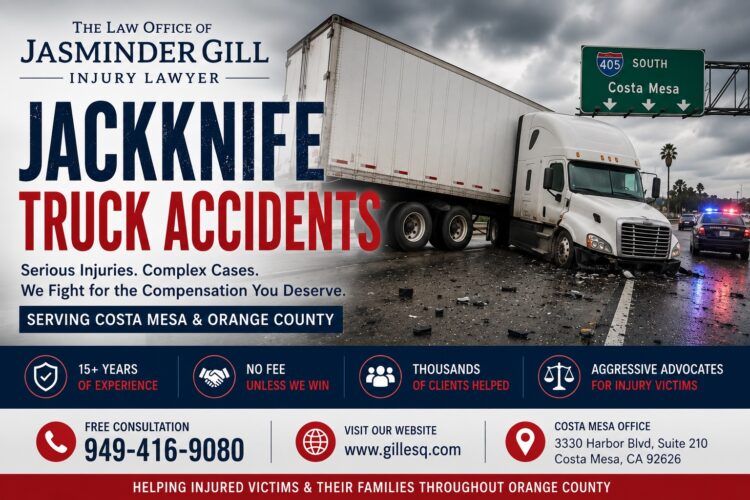
Commercial semi-truck involved in a jackknife accident on a Costa Mesa freeway. Law Office of Jasminder Gill represents truck accident victims throughout Costa Mesa and Orange County.A jackknife truck accident can block several lanes of traffic within seconds and cause a devastating chain-reaction collision. These crashes happen when a commercial truck’s trailer swings outward toward the tractor, creating an angle that resembles a folding pocketknife.

As the trailer moves sideways, it may strike several vehicles, push motorists into barriers, cross opposing lanes, or leave approaching drivers with no safe path to avoid the crash. Jackknife collisions frequently cause catastrophic injuries, permanent disabilities, and fatalities.

At the Law Office of Jasminder Gill, we represent people injured in jackknife truck accidents throughout Costa Mesa and Orange County. Attorney Jasminder Gill has more than 15 years of personal injury experience, has helped thousands of clients, and has recovered millions of dollars in compensation for injury victims.

Our firm investigates the driver’s actions, braking, speed, hours of service, electronic records, vehicle condition, trailer movement, cargo loading, and trucking-company safety practices. We work to preserve evidence, identify every potentially responsible party, and pursue compensation supported by the facts of the case.

Call 949-416-9080 for a free consultation

If you are searching for an Orange County jackknife truck accident lawyer, our Costa Mesa office represents victims of serious semi-truck and tractor-trailer collisions throughout the county.

There are no upfront attorney’s fees. You pay no attorney’s fee unless we recover compensation for you.

Why Hire a Costa Mesa Jackknife Truck Accident Lawyer?

Jackknife accident claims frequently involve more complicated evidence than ordinary passenger-vehicle collisions. Determining why a trailer swung out of control may require examining the tractor, trailer, brakes, tires, cargo, electronic data, driver records, road conditions, and actions of other motorists.

The motor carrier and commercial insurer may begin investigating immediately. While injured motorists receive emergency care, the trucking company may already be inspecting the truck, downloading electronic information, interviewing its driver, and preparing defenses.

Hiring a jackknife truck accident lawyer early can help preserve information before the truck is repaired, returned to service, or moved beyond the reach of an effective investigation.

When you hire the Law Office of Jasminder Gill, our firm can:

  • Investigate how the jackknife collision occurred
  • Identify the truck driver, motor carrier, vehicle owner, and trailer owner
  • Determine who loaded and secured the cargo
  • Obtain police reports and available collision records
  • Locate witnesses
  • Seek traffic, surveillance, and dash-camera footage
  • Preserve the tractor and trailer for inspection
  • Request electronic logging-device records
  • Seek available truck black-box data
  • Review GPS, telematics, and dispatch records
  • Examine driver hours and potential fatigue
  • Obtain inspection, repair, and maintenance records
  • Investigate brake, tire, steering, and coupling-system problems
  • Review cargo weight and securement documents
  • Identify commercial insurance policies
  • Gather medical evidence
  • Document lost income and future earning limitations
  • Communicate with trucking companies and insurers
  • Prepare the case for litigation when necessary

Our goal is to determine not only what happened during the collision, but what safety failures allowed the truck to lose control.

What Is a Jackknife Truck Accident?

A tractor-trailer consists of two major sections:

  • The tractor, containing the engine and driver’s cab
  • The trailer, which carries the cargo

The two sections are connected by a coupling system that permits the trailer to pivot as the truck turns. During normal operation, the trailer follows the tractor in a controlled path.

A jackknife begins when the trailer no longer follows the tractor properly and starts rotating toward the cab. The tractor and trailer form a sharp angle while the trailer moves sideways across the roadway.

The driver may lose the ability to steer or stop the complete vehicle combination. The swinging trailer can sweep across multiple lanes before the truck comes to rest.

How Does a Tractor-Trailer Begin to Jackknife?

Jackknifing frequently involves a loss of traction between the tires and road.

If the tractor’s drive wheels lock or lose traction while the trailer continues moving forward, the trailer’s momentum may push the tractor sideways. The combination can begin folding at the coupling point.

A jackknife can develop rapidly when:

  • The driver brakes too aggressively
  • The tractor and trailer brake unevenly
  • Tires lose traction
  • The truck enters a curve too quickly
  • Cargo shifts
  • The driver makes an abrupt steering movement
  • A mechanical component fails
  • The driver attempts an unsafe evasive maneuver

The precise mechanism depends on the type of truck, load, speed, braking system, road surface, and driver response.

Tractor Jackknifes and Trailer Jackknifes

Not every jackknife develops in exactly the same manner.

Tractor Jackknife

A tractor jackknife can occur when the tractor’s drive wheels lose traction. The rear of the tractor may move sideways while the trailer continues pushing forward.

Potential causes include:

  • Excessive braking
  • Slippery pavement
  • Unbalanced braking
  • Excessive speed
  • Driver overcorrection

Trailer Jackknife

A trailer jackknife may occur when trailer wheels lock or lose traction. The trailer can swing outward while the tractor continues moving forward.

Potential causes include:

  • Trailer brake problems
  • Improper brake adjustment
  • Empty or lightly loaded trailer conditions
  • Wet pavement
  • Sudden braking
  • Cargo movement

Qualified accident-reconstruction and commercial vehicle experts may be needed to determine how the jackknife developed.

Why Jackknife Truck Accidents Are So Dangerous

A typical collision may affect one or two lanes. A jackknifed tractor-trailer can block an entire freeway.

These crashes are particularly dangerous because:

  • A trailer can sweep across several lanes
  • Nearby drivers may have no time to react
  • The truck can strike multiple vehicles
  • Passenger cars may become trapped beneath the trailer
  • The trailer may push vehicles into barriers
  • Cargo may fall or spill
  • The truck may roll over
  • Secondary collisions may continue after the initial impact
  • Fuel or hazardous material may ignite or leak

A trailer can also create an unexpected obstacle for vehicles approaching at freeway speed, leading to severe chain-reaction crashes.

Vehicles Involved in Jackknife Accidents

Jackknife accidents most commonly involve articulated commercial vehicles with a tractor and trailer, including:

  • Semi-trucks
  • Tractor-trailers
  • 18-wheelers
  • Big rigs
  • Flatbed trucks
  • Tanker trucks
  • Refrigerated trailers
  • Container trucks
  • Automobile transporters
  • Construction equipment carriers
  • Double-trailer combinations

The vehicle and cargo type can affect the investigation, applicable safety requirements, and parties that may be responsible.

Common Causes of Jackknife Truck Accidents

A jackknife collision rarely occurs without an underlying cause. In some cases, several failures combine to make the accident unavoidable once the truck begins losing control.

Excessive Speed

Speed affects stopping distance, traction, vehicle stability, and the driver’s ability to respond safely.

A truck driver may be traveling too fast even when operating below the posted limit. Commercial drivers must adjust their speed for:

  • Traffic congestion
  • Rain
  • Fog
  • Road construction
  • Curves
  • Freeway transitions
  • Downhill grades
  • Heavy or shifting cargo
  • Limited visibility
  • Road-surface conditions

Excessive speed can increase the risk of trailer swing, rollover, and loss of control.

Sudden or Improper Braking

Improper braking is a frequent factor in jackknife accidents.

A jackknife may occur when:

  • The driver slams on the brakes
  • The wheels lock
  • The tractor and trailer decelerate unevenly
  • The driver brakes while turning
  • The driver reacts too late to stopped traffic
  • The driver applies incorrect braking techniques
  • The road is wet or slippery

Commercial drivers require appropriate training to understand how a tractor-trailer responds during emergency braking.

Following Too Closely

A tractor-trailer needs more stopping distance than a passenger vehicle. A driver who follows too closely may have no safe option when traffic stops suddenly.

The driver may respond with panic braking or an abrupt evasive maneuver, causing the truck to lose traction and jackknife.

Following-distance issues are particularly dangerous in Orange County’s stop-and-go freeway traffic.

Driver Fatigue

Fatigue can impair reaction time, attention, judgment, lane control, and decision-making.

A fatigued driver may:

  • Fail to recognize slowing traffic
  • Brake too late
  • Drift from a lane
  • Misjudge a curve
  • Overcorrect the steering
  • Fall asleep
  • Make an unsafe evasive maneuver

Federal hours-of-service rules generally limit the driving and on-duty time of covered commercial drivers. Electronic logs, supporting records, and dispatch communications may help determine whether fatigue contributed to the collision.

For detailed information about federal safety requirements, visit our FMCSA Violations in Costa Mesa Truck Accidents page.

Distracted Driving

A distracted driver may fail to recognize traffic conditions until a collision is imminent.

Commercial driver distractions may include:

  • Cellphone use
  • Text messages
  • Dispatch communications
  • Navigation systems
  • Electronic logging devices
  • Food or drinks
  • Paperwork
  • Activity outside the truck

A delayed reaction can lead to hard braking, abrupt steering, and loss of trailer control.

Wet or Slippery Pavement

Rain can mix with oil and debris on Southern California roads, creating slippery surfaces. Trucks may lose traction when drivers fail to reduce speed and increase following distance.

Jackknifing risk can increase when wet pavement combines with:

  • Excessive speed
  • Sudden braking
  • Worn tires
  • Improper brake adjustment
  • Lightly loaded trailers
  • Driver inexperience

Unsafe Evasive Maneuvers

A driver may make an abrupt lane change or steering movement to avoid traffic, debris, or another vehicle. The trailer may respond differently from the tractor, causing it to swing outward.

The investigation should determine whether the evasive action was reasonable and whether another driver created the emergency.

Driver Inexperience or Inadequate Training

Operating a tractor-trailer requires specialized knowledge and skill. A driver must understand braking, load dynamics, turning, traction, following distance, and recovery techniques.

A carrier may share responsibility when it:

  • Hires an unqualified driver
  • Provides inadequate training
  • Fails to evaluate driving skills
  • Assigns unfamiliar equipment
  • Permits a driver to operate specialized cargo without preparation
  • Ignores a history of unsafe driving

Brake-System Problems

Commercial tractors and trailers use complex braking systems. Improper adjustment, defective components, poor maintenance, or uneven brake performance can cause the tractor and trailer to decelerate differently.

Brake-related issues may include:

  • Worn components
  • Air leaks
  • Out-of-adjustment brakes
  • Defective chambers
  • Damaged hoses
  • Contaminated linings
  • Warning-system failures
  • Deferred repairs
  • Inadequate inspections

A previous inspection does not necessarily prove that the brakes were functioning correctly when the collision occurred.

Tire Failures

Truck tires operate under substantial weight, heat, and road stress.

Tire failures may result from:

  • Insufficient tread
  • Underinflation
  • Overinflation
  • Excessive loading
  • Road damage
  • Poor maintenance
  • Improper repairs
  • Manufacturing defects

A failed steering or drive tire may cause a sudden loss of control and an attempted correction that leads to jackknifing.

Improper Cargo Loading

Cargo affects the weight, balance, braking, and stability of a tractor-trailer.

A load may contribute to jackknifing when it is:

  • Overweight
  • Unevenly distributed
  • Improperly positioned
  • Insufficiently secured
  • Allowed to shift
  • Incompatible with the trailer
  • Not inspected during transport

The driver, carrier, shipper, warehouse, or cargo-loading company may share responsibility.

Mechanical and Coupling Failures

Mechanical defects beyond brakes and tires may contribute to loss of control.

Potential problems include:

  • Steering failure
  • Suspension defects
  • Wheel-bearing failure
  • Trailer connection problems
  • Fifth-wheel defects
  • Kingpin failures
  • Electrical problems
  • Defective safety equipment

The tractor and trailer should be preserved for inspection before repairs alter the evidence.

Where Jackknife Truck Accidents Occur in Costa Mesa and Orange County

Jackknife collisions can occur wherever commercial trucks encounter congestion, curves, merging traffic, sudden slowdowns, or slippery road conditions.

Relevant Orange County routes include:

  • Interstate 405
  • Interstate 5
  • State Route 55
  • State Route 57
  • State Route 91
  • State Route 22
  • State Route 73
  • Freeway interchanges
  • Entrance and exit ramps
  • Construction zones
  • Commercial and industrial routes

In and around Costa Mesa, commercial vehicles also travel Harbor Boulevard, Newport Boulevard, Bristol Street, Fairview Road, South Coast Drive, Baker Street, and routes serving local businesses and construction projects.

Jackknife Accidents on Interstate 405

Interstate 405 carries significant commuter and commercial traffic. Sudden congestion, closely spaced ramps, construction activity, and changing travel speeds can increase the danger of following too closely or braking too late.

Jackknife Accidents on State Route 55

State Route 55 connects Costa Mesa with central Orange County and includes locations where merging vehicles and sudden traffic slowdowns can create dangerous conditions for large trucks.

Jackknife Accidents at Freeway Interchanges

A truck entering a curved connector too quickly may lose stability or traction. Freeway transitions can become particularly hazardous when combined with heavy cargo, wet pavement, or driver inexperience.

Liability, Electronic Evidence, and Accident Reconstruction

A jackknife accident does not necessarily mean that the commercial truck driver is the only responsible party. The driver may work for a motor carrier that established the route and schedule, while separate companies own the tractor, lease the trailer, load the cargo, or perform vehicle maintenance.

Determining liability requires examining the entire trucking operation and identifying every safety failure that contributed to the loss of control.

At the Law Office of Jasminder Gill, we investigate the driver, trucking company, vehicle, trailer, cargo, electronic records, and business relationships involved in Costa Mesa and Orange County jackknife truck accidents.

Who Can Be Held Responsible for a Jackknife Truck Accident?

One or several parties may be liable depending on the cause of the collision.

The Commercial Truck Driver

A truck driver may be responsible when unsafe driving causes or contributes to jackknifing.

Examples include:

  • Speeding
  • Driving too fast for conditions
  • Following too closely
  • Braking improperly
  • Making an unsafe lane change
  • Overcorrecting the steering
  • Driving while fatigued
  • Using a cellphone
  • Failing to inspect the truck
  • Failing to examine the cargo
  • Driving while impaired
  • Ignoring a known mechanical problem
  • Violating applicable hours-of-service requirements

A traffic citation may support a claim, but the absence of a citation does not necessarily mean the driver acted safely. Electronic data, video, physical evidence, and witness testimony may establish negligence independently.

The Motor Carrier or Trucking Company

A motor carrier may be responsible for the conduct of a driver acting within the scope of employment. The company may also be directly liable for unsafe corporate practices.

Trucking-company negligence may include:

  • Hiring an unqualified driver
  • Failing to investigate the driver’s safety history
  • Providing inadequate training
  • Failing to supervise drivers
  • Retaining a driver with repeated violations
  • Assigning an unsafe delivery schedule
  • Encouraging excessive driving hours
  • Ignoring signs of driver fatigue
  • Failing to monitor ELD records
  • Permitting distracted driving
  • Failing to inspect commercial vehicles
  • Deferring necessary repairs
  • Allowing defective brakes or tires
  • Permitting an overloaded trailer
  • Failing to enforce cargo securement procedures
  • Ignoring previous safety complaints

Company policies should be compared with how the carrier operated in practice. A written safety policy may have limited value if dispatchers and supervisors routinely ignored it.

The Tractor Owner

The motor carrier may lease the tractor from another company or owner-operator. The vehicle owner may share responsibility when it provides unsafe equipment or fails to complete inspections and repairs for which it was responsible.

Relevant evidence may include:

  • Ownership records
  • Lease agreements
  • Maintenance contracts
  • Inspection responsibilities
  • Repair records
  • Communications concerning defects

The Trailer Owner

A different company may own or lease the trailer. Trailer-specific problems can contribute directly to jackknifing.

Potential issues include:

  • Defective trailer brakes
  • Improper brake adjustment
  • Worn tires
  • Suspension problems
  • Coupling defects
  • Missing safety equipment
  • Inadequate inspections
  • Structural problems
  • Defective cargo restraints

The investigation should determine who possessed, maintained, inspected, and controlled the trailer.

The Cargo Loader or Shipper

Improper cargo loading can affect the truck’s balance, braking, and stability.

A shipper, warehouse, freight company, or loading contractor may share responsibility when it:

  • Overloads the trailer
  • Distributes weight unevenly
  • Fails to secure the cargo
  • Uses damaged restraints
  • Provides inaccurate weight information
  • Fails to inspect the load
  • Conceals a dangerous cargo condition
  • Loads material incompatible with the trailer

Cargo documents and witness testimony may establish who performed and controlled the loading process.

A Maintenance or Repair Company

Motor carriers frequently use outside businesses to inspect and repair tractors and trailers.

A maintenance provider may be liable when negligent work contributes to:

  • Brake failure
  • Tire failure
  • Steering problems
  • Suspension failure
  • Wheel separation
  • Trailer connection failure
  • Loss of vehicle control

Relevant evidence may include repair invoices, work orders, mechanic notes, parts records, inspection documents, and communications with the carrier.

A Truck or Component Manufacturer

A defective product may contribute to a jackknife accident even when the driver responds reasonably.

Potentially defective components may include:

  • Brakes
  • Tires
  • Steering systems
  • Suspension components
  • Fifth-wheel assemblies
  • Kingpins
  • Trailer coupling systems
  • Electronic stability controls
  • Antilock braking systems
  • Cargo securement equipment

The damaged part should be preserved and examined before repair or disposal.

A Freight Broker or Logistics Company

A freight broker may arrange transportation without owning the truck or directly employing the driver. Its potential responsibility depends on the facts, contractual relationships, degree of control, and applicable law.

The investigation may examine whether a broker or logistics company:

  • Selected an unsafe motor carrier
  • Ignored available carrier safety information
  • Controlled operational details
  • Established an unreasonable delivery schedule
  • Pressured the carrier or driver to continue unsafely

Another Negligent Driver

A passenger vehicle may enter the truck’s lane, stop unexpectedly, or create an emergency that causes the commercial driver to brake or steer suddenly.

The existence of another driver’s negligence does not necessarily eliminate trucking-company responsibility. Several parties may share fault.

California’s comparative-fault rules generally allow responsibility to be allocated among all parties whose conduct contributed to the collision.

A Government Entity

A dangerous public roadway condition may contribute to a jackknife accident.

Potential issues include:

  • Defective pavement
  • Poor drainage
  • Malfunctioning traffic signals
  • Missing warning signs
  • Unsafe construction zones
  • Dangerous roadway design
  • Inadequate barriers
  • Debris left in the road

Claims involving public entities have special procedures and potentially short deadlines. A California personal injury claim against a government entity generally must be presented within six months of accrual.

What If the Truck Driver Is an Independent Contractor?

A trucking company may argue that it is not responsible because the driver was classified as an independent contractor.

That description does not automatically resolve liability.

The investigation may consider:

  • Who controlled the work
  • Who selected the route
  • Who established the schedule
  • Who dispatched the driver
  • Who owned the tractor
  • Who supplied the trailer
  • Who provided equipment
  • How the driver was paid
  • Who could terminate the relationship
  • Whether the work was part of the company’s regular business
  • What the contract provides
  • How the parties operated in practice

Even when the driver is an independent contractor, another company may be responsible for its own negligent hiring, scheduling, maintenance, loading, or operational decisions.

Evidence That Can Prove Why a Truck Jackknifed

Commercial trucks may generate extensive evidence before and during a collision. Some of this information is controlled by the trucking company and may not appear in the police report.

Truck Black-Box Data

The phrase “black box” is commonly used to describe electronic vehicle systems that may record operational information.

Depending on the tractor and installed systems, available data may include:

  • Vehicle speed
  • Engine speed
  • Accelerator position
  • Brake application
  • Sudden deceleration
  • Cruise-control status
  • Antilock braking activity
  • Vehicle fault codes
  • Other recorded events

This information may help determine whether the driver was speeding, whether the brakes were applied, and how the tractor responded before the trailer began swinging.

Not every truck records the same information. Qualified technicians may be needed to identify, preserve, and download available data.

Electronic Logging-Device Records

Many regulated drivers use electronic logging devices to record driving time and duty status.

ELD information may include:

  • Driving time
  • On-duty time
  • Off-duty time
  • Vehicle movement
  • Engine hours
  • Miles traveled
  • Driver identification
  • Motor-carrier identification
  • Original entries
  • Permitted edits
  • Annotations
  • Unassigned driving time

These records may help establish whether the driver was fatigued, exceeded applicable limits, or maintained inaccurate duty records.

Supporting Documents for Driver Logs

ELD records may be compared with:

  • GPS data
  • Dispatch records
  • Toll records
  • Fuel receipts
  • Scale tickets
  • Bills of lading
  • Delivery documents
  • Hotel receipts
  • Payroll records
  • Fleet communications
  • Cellphone information

A driver log may appear compliant until compared with records showing where and when the truck was actually operating.

GPS and Telematics Information

Commercial fleet systems may record:

  • Vehicle location
  • Route
  • Speed
  • Stops
  • Travel duration
  • Sudden braking
  • Rapid acceleration
  • Engine activity
  • Other driving events

Telematics data may help reconstruct the truck’s movement before a jackknife collision and determine whether the driver was traveling too quickly for an interchange, curve, or congested roadway.

Dash-Camera and Driver-Facing Video

Commercial trucks may contain:

  • Forward-facing cameras
  • Rear-facing cameras
  • Side cameras
  • Trailer cameras
  • Driver-facing cameras

Video may show:

  • Traffic conditions
  • Road surface
  • Vehicle spacing
  • Signal status
  • Driver distraction
  • Fatigue
  • Lane position
  • Sudden braking
  • Steering movements
  • The beginning of trailer swing

Camera footage may be overwritten automatically and should be requested promptly.

Dispatch Communications

Communications between the driver and motor carrier may reveal:

  • Delivery expectations
  • Schedule pressure
  • Traffic delays
  • Driver fatigue
  • Mechanical complaints
  • Requests for repairs
  • Cargo problems
  • Instructions to continue driving
  • Route changes
  • Warnings from the driver

These records may help establish whether the company knew about an unsafe condition before the collision.

Braking Records and Physical Brake Evidence

Because improper or uneven braking frequently contributes to jackknife accidents, the tractor and trailer brake systems should be examined carefully.

Evidence may include:

  • Driver inspection reports
  • Periodic inspection records
  • Brake adjustment records
  • Repair invoices
  • Mechanic notes
  • Electronic fault codes
  • Previous roadside violations
  • Out-of-service orders
  • Physical brake components
  • Photographs
  • Black-box information

The tractor and trailer may have separate braking issues. An investigation that examines only the tractor could overlook a trailer defect that caused the loss of control.

Tire Evidence

Tire evidence may help determine whether a blowout, tread separation, loss of traction, or inadequate maintenance contributed to the crash.

The investigation may consider:

  • Tread depth
  • Inflation
  • Tire age
  • Wear patterns
  • Previous repairs
  • Load rating
  • Inspection records
  • Replacement history
  • Road hazards
  • Manufacturing information
  • Retread condition

The failed tire and available fragments should be preserved whenever possible.

Cargo Documents and Load Evidence

Important cargo records may include:

  • Bills of lading
  • Weight tickets
  • Loading diagrams
  • Shipping documents
  • Cargo descriptions
  • Restraint information
  • Inspection records
  • Photographs
  • Delivery records
  • Identification of the loader

Cargo evidence may establish whether the trailer was overweight, unbalanced, or inadequately secured.

Driver Qualification and Training Records

A driver qualification investigation may examine:

  • Commercial licensing
  • Driving history
  • Employment history
  • Medical qualification
  • Prior accidents
  • Traffic violations
  • Safety reviews
  • Training
  • Road-test information
  • Disciplinary records
  • Drug and alcohol compliance

Jackknife-specific training may become relevant when the collision involved improper braking, excessive curve speed, trailer movement, or an inadequate response to lost traction.

Police Reports and Witness Statements

Police reports may identify:

  • Drivers
  • Vehicle owners
  • Witnesses
  • Insurance information
  • Traffic citations
  • Road conditions
  • Statements made at the scene

Independent witnesses may describe:

  • The truck’s speed
  • Trailer movement
  • Brake lights
  • Skid marks
  • Falling cargo
  • Driver behavior
  • Weather
  • The sequence of impacts

The police report is an important starting point, but it may not contain every relevant fact.

Accident Reconstruction in a Jackknife Case

Jackknife accidents often require reconstruction because the final vehicle positions may not reveal how the loss of control began.

A qualified reconstruction professional may evaluate:

  • Electronic vehicle data
  • Vehicle speed
  • Brake application
  • Tire marks
  • Roadway friction
  • Vehicle weight
  • Cargo distribution
  • Trailer angle
  • Impact locations
  • Vehicle damage
  • Final resting positions
  • Road grade
  • Weather
  • Driver reaction
  • Video evidence

The analysis may help determine:

  • When the trailer began to rotate
  • Whether the truck was traveling too fast
  • Whether the driver braked improperly
  • Whether a mechanical failure occurred
  • Whether cargo shifted
  • Whether another driver created an emergency
  • Whether the collision could have been avoided

Why the Tractor and Trailer Must Be Preserved

The trucking company may repair and return the equipment to service after the crash. Repairs can alter or eliminate evidence involving:

  • Brakes
  • Tires
  • Steering
  • Suspension
  • Coupling devices
  • Electronic systems
  • Cargo equipment
  • Physical damage
  • Safety components

A preservation letter can identify the tractor, trailer, electronic data, and related records that should be retained.

Insurance-Company Defenses in Jackknife Accident Claims

Commercial insurers may attempt to reduce or deny liability by arguing that:

  • Weather caused the accident
  • Another driver created an emergency
  • The driver responded reasonably
  • No federal rule was violated
  • The truck passed inspection
  • The cargo was loaded by another business
  • The driver was an independent contractor
  • The victim was following too closely
  • The injuries were preexisting
  • Medical treatment was excessive
  • Future care is unnecessary

A jackknife does not automatically prove negligence. The claim must be supported by evidence showing what caused the truck to lose control and how each defendant’s conduct contributed.

What If Weather Contributed to the Jackknife?

Rain, wind, fog, or slippery pavement may be contributing conditions, but drivers must adjust their operation to account for foreseeable hazards.

The investigation may examine whether the driver:

  • Reduced speed
  • Increased following distance
  • Avoided abrupt braking
  • Accounted for the cargo
  • Followed company safety procedures
  • Continued operating when conditions became unsafe

Weather may explain why traction was limited without eliminating driver or company responsibility.

What If Another Driver Cut Off the Truck?

Another driver may share responsibility when an unsafe lane change or sudden stop creates an emergency.

However, the investigation should still determine whether the truck driver:

  • Was following too closely
  • Was speeding
  • Was distracted
  • Was fatigued
  • Had properly functioning brakes
  • Used an appropriate evasive response
  • Could have prevented the loss of control

Several parties may share fault for the same collision.

How the Law Office of Jasminder Gill Investigates a Jackknife Accident

Depending on the circumstances, our investigation may include:

  1. Obtaining the police report and scene evidence
  2. Identifying the driver, motor carrier, tractor owner, and trailer owner
  3. Sending evidence-preservation notices
  4. Locating witnesses and available video
  5. Requesting black-box, ELD, GPS, and camera information
  6. Reviewing driver hours and fatigue evidence
  7. Obtaining driver qualification and training records
  8. Examining tractor and trailer maintenance
  9. Investigating brake and tire conditions
  10. Reviewing cargo weight and securement documents
  11. Determining whether federal safety violations contributed
  12. Consulting qualified experts when necessary
  13. Identifying every potentially responsible party
  14. Reviewing commercial insurance coverage
  15. Documenting injuries, medical treatment, and financial losses
  16. Preparing the case for negotiation or litigation

A complete investigation should explain why the tractor-trailer lost control, who created the dangerous conditions, and how the collision affected the injured person.

Injuries, Compensation, Filing Deadlines, and FAQs

Jackknife truck accidents frequently cause catastrophic injuries because a swinging trailer can strike several vehicles, cross multiple lanes, or create an unavoidable obstruction for approaching motorists.

Victims may require emergency treatment, surgery, rehabilitation, and long-term care. Some are permanently unable to return to their former employment or live independently. In fatal crashes, surviving family members may face emotional and financial losses that continue for years.

At the Law Office of Jasminder Gill, we document the complete physical, emotional, and financial effects of a jackknife collision while pursuing compensation supported by the available evidence.

Common Injuries After a Jackknife Truck Accident

The nature and severity of the injuries depend on the collision speed, impact direction, vehicle position, trailer movement, and whether the passenger vehicle became trapped beneath or between larger vehicles.

Traumatic Brain Injuries

A traumatic brain injury may occur when the head strikes part of the vehicle or when rapid acceleration and deceleration cause the brain to move within the skull.

Potential symptoms include:

  • Headaches
  • Dizziness
  • Confusion
  • Memory problems
  • Difficulty concentrating
  • Sensitivity to light or sound
  • Mood changes
  • Sleep disruption
  • Fatigue
  • Impaired judgment
  • Balance problems

Some brain injuries do not appear clearly on initial imaging. Continuing or worsening symptoms should be reported to an appropriate medical professional.

Spinal Cord Injuries

The force of a commercial truck collision may damage the spinal cord or surrounding vertebrae, discs, and nerves.

Spinal injuries may cause:

  • Chronic neck or back pain
  • Numbness
  • Tingling
  • Weakness
  • Reduced mobility
  • Loss of sensation
  • Partial paralysis
  • Complete paralysis
  • Loss of bowel or bladder function
  • Need for lifelong assistance

Victims may require surgery, rehabilitation, mobility equipment, home modifications, and continuing medical care.

Herniated Discs and Back Injuries

A jackknife collision can place extreme force on the neck and spine.

Back and neck injuries may include:

  • Herniated discs
  • Bulging discs
  • Vertebral fractures
  • Nerve compression
  • Muscle injuries
  • Ligament damage
  • Radiculopathy
  • Chronic pain
  • Limited movement

These conditions may interfere with work, sleep, driving, childcare, exercise, and routine daily activities.

Broken Bones and Orthopedic Injuries

Jackknife accidents may cause fractures involving:

  • Arms
  • Hands
  • Legs
  • Feet
  • Ribs
  • Shoulders
  • Hips
  • Pelvis
  • Spine

Some fractures require surgical hardware, repeated procedures, extensive therapy, and future corrective surgery.

Internal Injuries

Blunt-force trauma can cause internal bleeding and organ damage that may not be immediately visible.

Internal injuries may affect the:

  • Brain
  • Heart
  • Lungs
  • Liver
  • Kidneys
  • Spleen
  • Intestines
  • Blood vessels

Potential warning signs include severe abdominal or chest pain, weakness, fainting, confusion, swelling, and difficulty breathing. Seek emergency medical assistance for potentially serious symptoms.

Crush Injuries

A smaller vehicle may become trapped between the trailer, another vehicle, a barrier, or the roadway.

Crush injuries can cause:

  • Severe tissue damage
  • Nerve damage
  • Vascular injuries
  • Compartment syndrome
  • Infection
  • Organ failure
  • Amputation
  • Permanent disability

Treatment may involve several surgeries, rehabilitation, prosthetic devices, and long-term care.

Burn Injuries

A truck crash involving fuel, electricity, chemicals, or hazardous cargo may produce fires, explosions, and serious burns.

Burn victims may require:

  • Emergency surgery
  • Skin grafts
  • Infection treatment
  • Reconstructive procedures
  • Scar management
  • Physical therapy
  • Psychological treatment
  • Long-term pain management

Amputations

Severe crush injuries, vascular damage, infection, or irreparable trauma may require the surgical removal of a limb. Other victims may suffer traumatic amputations during the crash.

An amputation can create lifelong expenses involving prosthetics, replacement devices, therapy, home modifications, and vocational rehabilitation.

Scarring and Disfigurement

Broken glass, burns, surgery, and other trauma may cause permanent scars or disfigurement.

The claim may consider:

  • Scar location
  • Size and visibility
  • Reconstructive treatment
  • Physical discomfort
  • Reduced movement
  • Emotional distress
  • Effects on employment and social life

Psychological and Emotional Injuries

A serious jackknife accident can cause emotional injuries in addition to physical trauma.

Victims may experience:

  • Post-traumatic stress
  • Anxiety
  • Depression
  • Nightmares
  • Panic symptoms
  • Fear of driving
  • Sleep disruption
  • Irritability
  • Social withdrawal
  • Loss of enjoyment of life

Mental-health care related to the accident may be included in the claim when supported by appropriate evidence.

Delayed Symptoms After a Jackknife Accident

Adrenaline, shock, and the confusion surrounding a multi-vehicle crash can temporarily mask symptoms.

Delayed symptoms may include:

  • Headaches
  • Neck pain
  • Back pain
  • Dizziness
  • Memory problems
  • Numbness
  • Tingling
  • Weakness
  • Abdominal pain
  • Sleep problems
  • Emotional distress

Obtain medical care when symptoms appear or worsen. Waiting too long may endanger your health and allow the insurer to question whether the injuries resulted from the accident.

Compensation After a Jackknife Truck Accident

The compensation available depends on liability, injuries, medical evidence, financial losses, insurance coverage, and the long-term effect of the collision.

Potential damages include the following.

Emergency and Past Medical Expenses

Recoverable medical expenses may include:

  • Ambulance transportation
  • Emergency-room care
  • Hospitalization
  • Diagnostic testing
  • Surgery
  • Physician services
  • Prescription medication
  • Physical therapy
  • Occupational therapy
  • Pain-management treatment
  • Psychological care
  • Medical equipment

Preserve bills, insurance statements, receipts, and treatment records.

Future Medical Care

A serious injury may require treatment for years or throughout the victim’s life.

Future medical damages may include:

  • Additional surgery
  • Rehabilitation
  • Specialist care
  • Medication
  • Injections
  • Medical equipment
  • Prosthetic devices
  • Home modifications
  • In-home assistance
  • Long-term nursing care
  • Psychological treatment

Medical specialists, life-care planners, economists, and other qualified experts may be necessary to evaluate future care.

Lost Wages

Compensation may be available for income lost because the victim could not work.

Evidence may include:

  • Pay statements
  • Tax documents
  • Employer verification
  • Work schedules
  • Medical restrictions
  • Disability records
  • Evidence of lost commissions, overtime, or bonuses

Self-employed victims may use contracts, invoices, business records, and tax documents to demonstrate lost income.

Reduced Future Earning Capacity

A permanent injury may reduce the ability to earn income in the future.

Loss of earning capacity may arise when the victim:

  • Cannot return to the same occupation
  • Must accept a lower-paying position
  • Cannot work full time
  • Loses advancement opportunities
  • Requires frequent medical care
  • Must retire earlier than anticipated
  • Becomes permanently unable to work

Vocational and economic experts may be needed in serious cases.

Pain and Suffering

Noneconomic damages may address the human consequences of the injury, including:

  • Physical pain
  • Emotional distress
  • Chronic discomfort
  • Disability
  • Scarring
  • Anxiety
  • Post-traumatic stress
  • Sleep disruption
  • Loss of independence
  • Reduced enjoyment of life

California does not use a single universal formula for pain and suffering. The evidence should demonstrate how the collision affected the individual victim.

Property Damage

The claim may also include:

  • Vehicle repairs
  • Total vehicle loss
  • Towing
  • Storage
  • Rental transportation
  • Loss of use
  • Damaged personal property

The property-damage claim may be handled separately from the injury claim. Review every release carefully before signing it.

Household Services and Assistance

A serious injury may prevent someone from performing ordinary household activities.

Recoverable expenses may include assistance with:

  • Cleaning
  • Cooking
  • Childcare
  • Transportation
  • Personal care
  • Yard maintenance
  • Household repairs

Keep records showing what assistance became necessary after the crash.

How Much Is a Jackknife Truck Accident Case Worth?

There is no dependable average settlement that determines the value of an individual jackknife accident claim.

Important factors may include:

  • The severity of the injuries
  • Whether the injuries are permanent
  • Past medical expenses
  • Future medical needs
  • Lost wages
  • Reduced earning capacity
  • Pain and suffering
  • Emotional trauma
  • Disability or disfigurement
  • The strength of the liability evidence
  • Whether multiple companies are responsible
  • Whether the victim shares fault
  • Available insurance coverage
  • Whether punitive damages are supported
  • The risks of litigation and trial

Commercial trucking companies may carry substantial insurance policies, but the amount of coverage does not determine the value automatically. Liability, causation, and damages must still be established.

Be cautious of anyone who promises a specific recovery before investigating the crash and reviewing the medical evidence.

Punitive Damages in a Jackknife Accident Case

Punitive damages are intended to punish and deter particularly wrongful conduct. They are different from damages compensating the victim for medical expenses, lost income, and pain and suffering.

Punitive damages are not available in every truck accident case. Their availability depends on California law and the supporting evidence.

Potential issues may include:

  • Commercial driving while intoxicated
  • Deliberately falsifying safety records
  • Knowingly operating a dangerously defective truck
  • Repeatedly permitting an unsafe driver to operate
  • Intentionally destroying critical evidence
  • Company conduct showing conscious disregard for public safety

A regulatory violation or ordinary negligence alone does not automatically support punitive damages.

Fatal Jackknife Truck Accidents and Wrongful Death

A trailer sweeping across several lanes can cause fatal head-on, side-impact, underride, and multi-vehicle collisions.

When negligence contributes to a fatal jackknife crash, qualifying family members may have the right to pursue a wrongful death claim.

Depending on the circumstances and California law, damages may include:

  • Funeral and burial expenses
  • Lost financial support
  • Loss of household services
  • Loss of companionship
  • Loss of protection
  • Loss of guidance
  • Loss of affection and moral support
  • Other legally recoverable losses

A related survival action may address certain claims belonging to the deceased person’s estate. Wrongful death and survival actions involve different damages and procedural requirements.

The Law Office of Jasminder Gill represents families throughout Costa Mesa and Orange County following fatal commercial truck accidents with care, discretion, and determined advocacy.

What to Do After a Jackknife Truck Accident

Jackknife collisions frequently involve several vehicles and chaotic accident scenes. Prioritize safety and medical care.

Call 911

Report the accident and request emergency medical assistance. A law-enforcement investigation may document the vehicles, drivers, witnesses, traffic conditions, and visible evidence.

Seek Medical Treatment

Accept emergency care when necessary. Obtain an appropriate medical evaluation if you experience pain, dizziness, numbness, weakness, confusion, limited movement, or other concerning symptoms.

Photograph the Scene

If you can do so safely, document:

  • The tractor and trailer
  • Vehicle positions
  • Impact locations
  • Truck-company names
  • USDOT numbers
  • License plates
  • Tractor and trailer numbers
  • Cargo
  • Skid marks
  • Tire marks
  • Road debris
  • Traffic signs
  • Lane markings
  • Road conditions
  • Weather
  • Visible injuries

Do not enter moving traffic or endanger yourself to collect evidence.

Obtain Truck and Company Information

Collect available information concerning:

  • The driver
  • Motor carrier
  • Tractor owner
  • Trailer owner
  • Commercial insurance
  • Vehicle registration
  • Shipment or cargo

Photographing identifying information can reduce transcription mistakes.

Identify Witnesses

Ask witnesses for names, telephone numbers, and email addresses. Do not assume every witness will appear in the police report.

Preserve Physical Evidence

Do not dispose of damaged personal property that may demonstrate the force of impact. Photograph the passenger vehicle before it is repaired, sold, or destroyed.

Avoid Speculating About Fault

Provide necessary facts to responding officers, but avoid guessing about speed, distance, or events you did not observe.

Be Careful With Insurance Adjusters

A commercial insurer may contact you shortly after the collision.

Consider obtaining legal advice before:

  • Giving a recorded statement
  • Signing a broad medical authorization
  • Accepting an early offer
  • Signing a release
  • Providing access to unrelated medical history

Avoid Posting About the Crash

Insurance companies and defense attorneys may review publicly available social-media content.

Avoid posting information about:

  • The accident
  • Medical treatment
  • Physical activities
  • Travel
  • Work
  • Insurance negotiations
  • Communications with your attorney

Contact a Jackknife Truck Accident Lawyer

Electronic data, video, physical vehicle evidence, and trucking records may disappear quickly. Prompt legal involvement can help preserve this evidence.

How Long Do You Have to File a Jackknife Truck Accident Lawsuit?

California generally provides two years to file an action for personal injury or wrongful death caused by another party’s wrongful act or neglect.

Important exceptions may shorten or alter the deadline.

If a government entity is potentially responsible, a personal injury claim generally must be presented to the appropriate public entity within six months of accrual.

Different rules may also affect claims involving:

  • Minors
  • Delayed discovery
  • Government vehicles
  • Dangerous public property
  • Defective truck components
  • Wrongful death
  • A deceased person’s estate
  • Out-of-state defendants

Do not wait until the general filing deadline is approaching. Electronic truck data, camera footage, and physical evidence may disappear much sooner.

How Long Does a Jackknife Accident Case Take?

Some claims resolve in several months. Cases involving catastrophic injuries, disputed liability, multiple defendants, or litigation may take a year or longer.

The timeline may depend on:

  • The duration of medical treatment
  • Whether future surgery is anticipated
  • Whether the defendants dispute liability
  • The number of responsible companies
  • How quickly trucking records are obtained
  • Whether experts are necessary
  • Available insurance coverage
  • Whether a lawsuit must be filed
  • Whether the case proceeds to trial

A quick settlement is not always a fair settlement. Resolving the claim before the medical prognosis is understood may leave future expenses unaddressed.

FAQ’s About Costa Mesa Jackknife Truck Accidents

What is a jackknife truck accident?

A jackknife accident occurs when a commercial truck’s trailer swings toward the tractor, creating an angle that resembles a folding pocketknife. The trailer may sweep across multiple lanes and strike several vehicles.

What causes a tractor-trailer to jackknife?

Common causes include sudden braking, excessive speed, loss of traction, driver fatigue, distraction, brake defects, tire failure, improper cargo loading, poor weather, and unsafe evasive maneuvers.

Does a jackknife accident automatically mean the truck driver was negligent?

No. The collision must be investigated to determine why the truck lost control. Driver negligence, mechanical failure, unsafe cargo, another motorist, or several combined factors may have contributed.

Who can be held responsible?

Potentially responsible parties include the truck driver, motor carrier, tractor owner, trailer owner, cargo-loading company, maintenance provider, freight broker, component manufacturer, government entity, or another driver.

Can the trucking company be responsible for the accident?

Yes. The carrier may be responsible for the driver’s conduct or its own negligent hiring, training, supervision, scheduling, inspection, maintenance, or safety practices.

What if the truck driver was an independent contractor?

The company’s label does not always determine the legal relationship. Control, dispatch, scheduling, equipment, payment, contractual terms, and actual working practices may be relevant.

What evidence is important in a jackknife case?

Important evidence may include black-box data, ELD records, GPS information, camera footage, driver files, brake and tire records, cargo documents, witness statements, police reports, and physical vehicle evidence.

What can black-box data reveal?

Depending on the truck, electronic data may reveal speed, braking, acceleration, engine activity, sudden deceleration, and other events before the collision.

Can driver fatigue cause jackknifing?

Yes. A fatigued driver may react late to traffic and respond with panic braking or abrupt steering. ELD records and supporting documents may help establish excessive driving or inadequate rest.

Can defective brakes cause a jackknife accident?

Yes. Improperly adjusted, poorly maintained, or defective tractor or trailer brakes may cause uneven deceleration and loss of control.

Who is responsible for improperly loaded cargo?

Responsibility may involve the driver, carrier, shipper, warehouse, cargo-loading contractor, trailer owner, or another company involved in the shipment.

What if wet pavement contributed to the crash?

Weather and road conditions may contribute, but commercial drivers must adjust speed, following distance, and braking for foreseeable conditions. Rain does not automatically eliminate driver or carrier responsibility.

What if another driver cut off the truck?

Another motorist may share fault. The investigation should still examine the truck’s speed, following distance, driver attention, brakes, and response to the emergency.

Can I recover compensation if I was partially responsible?

California’s comparative-fault system generally permits recovery when an injured person shares responsibility. Compensation may be reduced by the percentage of fault assigned.

What injuries are common in jackknife accidents?

Common injuries include traumatic brain injuries, spinal damage, fractures, internal injuries, crush injuries, burns, amputations, permanent disabilities, and psychological trauma.

Can I recover future medical expenses?

Future medical expenses may be recoverable when appropriate evidence shows that accident-related care will probably be necessary.

Can I recover lost future earnings?

Reduced earning capacity may be included when permanent injuries affect the ability to work, advance, or remain in the same occupation.

Are jackknife settlements larger than ordinary car accident settlements?

Jackknife crashes may cause greater damages and involve commercial insurance, but no result is guaranteed. Value depends on liability, injuries, evidence, losses, and available coverage.

Should I accept the insurer’s first offer?

An early offer may not account for surgery, rehabilitation, chronic pain, future medical expenses, or reduced earning capacity. A signed final release generally ends the claim permanently.

Do you represent jackknife truck accident victims throughout Orange County?

Yes. The Law Office of Jasminder Gill is located in Costa Mesa and represents people injured in jackknife truck accidents throughout Orange County.

How much does it cost to hire the Law Office of Jasminder Gill?

Jackknife truck accident cases are handled on a contingency-fee basis. There are no upfront attorney’s fees, and you pay no attorney’s fee unless compensation is recovered. The written agreement controls the terms of representation.

Why Choose the Law Office of Jasminder Gill?

Attorney Jasminder Gill has more than 15 years of personal injury experience, has helped thousands of clients, and has recovered millions of dollars in compensation for injury victims.

Our firm offers:

  • Direct communication with Attorney Jasminder Gill
  • Detailed investigation of commercial truck accidents
  • Preservation of electronic and physical evidence
  • Identification of responsible drivers and companies
  • Review of commercial insurance coverage
  • Documentation of medical and financial losses
  • Representation during negotiations and litigation
  • Punjabi-speaking legal services
  • Spanish consultations
  • Free consultations
  • No upfront attorney’s fees
  • No attorney’s fee unless compensation is recovered

Speak With a Costa Mesa Jackknife Truck Accident Lawyer

If you or a loved one was injured in a jackknife accident involving a semi-truck, tractor-trailer, 18-wheeler, flatbed, tanker, or another commercial vehicle, you do not have to face the trucking company and commercial insurer alone.

The Law Office of Jasminder Gill investigates driver conduct, truck and trailer maintenance, electronic data, cargo loading, federal safety violations, and every party that may have contributed to the collision.

Our Costa Mesa office represents jackknife truck accident victims throughout Orange County. Contact us to discuss your legal rights and available options during a free consultation.

Call 949-416-9080 for a free consultation!