
Costa Mesa Rear End Accident Lawyer | Law Office of Jasminder Gill
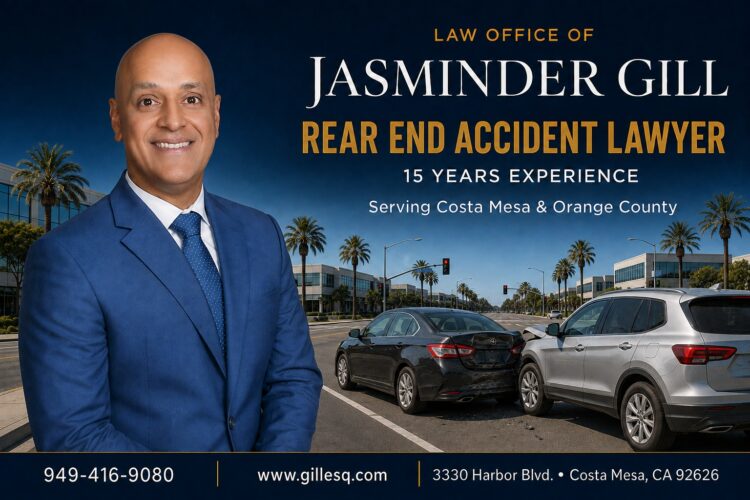 Rear-end collisions are among the most common traffic accidents in Costa Mesa and throughout Orange County. Although insurance companies often refer to these crashes as minor “fender benders,” a rear-end impact can cause painful and lasting injuries—even when vehicle damage appears limited.
Back and Spinal Injuries After a Rear-End Collision
Rear-end collisions can place substantial force on the spine. The impact may cause the torso to move forward while the seat, head restraint, and seat belt affect other parts of the body. This movement can injure the vertebrae, discs, muscles, ligaments, joints, and nerves throughout the cervical, thoracic, and lumbar spine.
Common back and spinal injuries include:
- Herniated discs
- Bulging discs
- Disc protrusions
- Annular tears
- Muscle strains
- Ligament sprains
- Facet joint injuries
- Vertebral fractures
- Spinal stenosis aggravated by trauma
- Nerve-root compression
- Sciatica
- Spinal cord injuries
Symptoms may include:
- Neck or back pain
- Muscle spasms
- Limited range of motion
- Pain radiating into the arms or legs
- Numbness
- Tingling
- Weakness
- Difficulty sitting or standing
- Problems walking
- Loss of coordination
- Bowel or bladder changes
Treatment depends on the diagnosis and may include medication, physical therapy, chiropractic care, injections, pain-management procedures, or surgery. Qualified medical professionals should determine the appropriate treatment.
Lumbar Disc Injuries
The lumbar spine supports much of the body’s weight. A rear-end impact can cause or aggravate damage to the discs in the lower back.
A herniated or bulging lumbar disc may place pressure on nearby nerves and cause:
- Lower-back pain
- Leg pain
- Sciatica
- Numbness
- Tingling
- Muscle weakness
- Difficulty bending
- Difficulty lifting
- Pain while sitting
- Reduced ability to work
Insurance companies may characterize lumbar disc findings as age-related degeneration. However, a person can have preexisting changes without experiencing disabling symptoms before the collision. Medical records, prior history, diagnostic imaging, and physician opinions may help establish whether the accident caused new symptoms or aggravated an existing condition.
Thoracic Spine Injuries
The thoracic spine is located in the upper and middle back. Although it is generally less mobile than the cervical and lumbar regions, a rear-end collision can still cause painful injuries.
Thoracic injuries may produce:
- Mid-back pain
- Muscle spasms
- Rib-area discomfort
- Pain with twisting
- Difficulty breathing deeply
- Reduced upper-body movement
- Pain while sitting or driving
Victims may also suffer injuries to the muscles and connective tissues surrounding the shoulder blades and upper back. These symptoms can interfere with computer work, lifting, driving, household tasks, and sleep.
Spinal Cord Injuries
High-speed rear-end collisions involving trucks, rollovers, secondary impacts, or vehicle intrusion may damage the spinal cord.
A spinal cord injury can cause:
- Partial paralysis
- Complete paralysis
- Loss of sensation
- Muscle weakness
- Difficulty breathing
- Loss of bowel or bladder control
- Chronic nerve pain
- Loss of independence
Victims may require emergency surgery, extensive rehabilitation, wheelchairs, home modifications, accessible transportation, personal attendants, and lifelong medical care.
A catastrophic spinal injury claim should account for decades of future needs—not only the expenses incurred immediately after the crash.
Shoulder Injuries
Seat belts help protect occupants, but the restraint system can place force across the shoulder during a rear-end collision. Drivers may also injure a shoulder while gripping the steering wheel or bracing for impact.
Common shoulder injuries include:
- Rotator cuff tears
- Labral tears
- Tendon injuries
- Shoulder impingement
- Dislocations
- Strains and sprains
- Fractures
- Adhesive capsulitis
- Nerve damage
Shoulder injuries can make it difficult to lift, reach, dress, sleep, drive, or perform physical job duties. Treatment may include therapy, injections, arthroscopic surgery, or other procedures.
Knee and Leg Injuries
A driver or passenger may strike a knee against the dashboard, steering column, seat, or center console. The legs may also twist or brace against the floor during impact.
Possible injuries include:
- Meniscus tears
- Ligament injuries
- Patellar injuries
- Knee contusions
- Fractures
- Hip injuries
- Ankle injuries
- Muscle strains
- Nerve damage
Knee and lower-extremity injuries can interfere with walking, climbing stairs, standing, driving, and working. Even when surgery is not immediately required, the victim may develop chronic pain, weakness, instability, or post-traumatic arthritis.
Chest and Rib Injuries
The seat belt, steering wheel, dashboard, or airbag may cause injuries to the chest during a rear-end collision.
Possible injuries include:
- Rib fractures
- Chest-wall bruising
- Sternum injuries
- Muscle strains
- Lung injuries
- Cardiac injuries
- Difficulty breathing
Chest pain after an accident should not be ignored. A qualified medical professional should evaluate symptoms that could indicate a serious condition.
Seat-belt bruising does not necessarily mean the restraint system malfunctioned. The marks may instead show the significant force involved in the collision.
Facial and Dental Injuries
A rear-end impact may push a vehicle into another object or cause an occupant’s head to strike the steering wheel, dashboard, window, headrest, or another surface.
Facial injuries may include:
- Broken teeth
- Jaw injuries
- Nasal fractures
- Facial lacerations
- Eye injuries
- Cheekbone fractures
- Temporomandibular joint injuries
- Permanent scarring
Treatment may require dental restoration, oral surgery, reconstructive procedures, vision care, or scar revision.
Airbag Injuries
Airbags can reduce the risk of fatal and catastrophic injuries, but deployment can also cause burns, abrasions, bruising, fractures, or hearing problems. Airbag injuries are more likely when a rear-end collision pushes the vehicle into another car or fixed object and causes a frontal or side impact.
Potential injuries include:
- Facial abrasions
- Chemical or friction burns
- Wrist and hand injuries
- Chest bruising
- Eye injuries
- Hearing damage
- Respiratory irritation
Whether the airbag operated properly may require inspection of the vehicle and electronic records.
Nerve Damage
A collision can stretch, compress, or otherwise damage nerves in the neck, back, shoulders, arms, or legs.
Symptoms may include:
- Burning pain
- Numbness
- Tingling
- Shooting pain
- Weakness
- Reduced grip strength
- Loss of sensation
- Muscle wasting
- Poor coordination
Nerve injuries may require neurological testing, electromyography, nerve-conduction studies, injections, medication, therapy, or surgery.
These conditions can be difficult to see and may not appear on ordinary X-rays. Insurance companies may attempt to minimize them despite significant pain and functional impairment.
Headaches, Dizziness, and Vertigo
Headaches commonly occur after rear-end accidents and may result from:
- Whiplash
- Concussion
- Cervical spine injury
- Muscle tension
- Nerve irritation
- Medication
- Stress or sleep disruption
- Temporomandibular joint trauma
Victims may also experience dizziness, vertigo, nausea, balance problems, or visual disturbances. These symptoms can interfere with driving, working, reading, using a computer, and performing ordinary daily activities.
Persistent headaches or neurological symptoms should be discussed with a qualified medical provider.
Psychological Injuries After a Rear-End Accident
A rear-end collision can cause emotional trauma even when physical injuries eventually improve. Victims may become anxious whenever another vehicle follows closely or traffic slows abruptly.
Psychological effects may include:
- Anxiety
- Depression
- Post-traumatic stress
- Panic attacks
- Sleep disturbances
- Nightmares
- Fear of driving
- Fear of freeway travel
- Irritability
- Difficulty concentrating
- Loss of enjoyment of life
A victim may avoid driving, miss work, withdraw from activities, or depend on others for transportation. Mental-health treatment can be an important part of recovery and may also document the emotional effect of the accident.
Delayed Symptoms After a Rear-End Accident
Some injuries are obvious immediately. Others develop gradually after adrenaline, shock, and stress begin to subside.
Delayed symptoms may include:
- Neck stiffness
- Back pain
- Headaches
- Dizziness
- Nausea
- Tingling
- Numbness
- Shoulder pain
- Memory problems
- Difficulty concentrating
- Sleep disturbances
- Emotional changes
The fact that pain began later does not automatically mean it is unrelated to the collision. However, insurance companies frequently use delayed treatment as a reason to dispute causation.
Seeking timely medical evaluation creates a record of the symptoms and allows a medical professional to determine whether additional testing or treatment is appropriate.
What If You Felt Fine at the Accident Scene?
Many people do not immediately recognize that they are injured. They may be focused on moving their vehicle, exchanging insurance information, contacting family members, or arranging transportation.
Adrenaline can temporarily mask pain. Symptoms may become more noticeable after the victim returns home, attempts to sleep, or resumes normal activities.
A statement such as “I’m okay” at the scene may only mean that the person did not need immediate emergency transportation. It does not necessarily establish that no injury occurred.
Victims should avoid making definitive statements about their medical condition before they have been properly evaluated.
Rear-End Collisions With Minimal Vehicle Damage
Insurance companies often argue that limited visible vehicle damage proves the occupants could not have suffered significant injuries. This argument may overlook important factors.
Vehicle appearance does not necessarily reveal:
- The amount of force transferred to an occupant
- Damage hidden beneath the bumper
- The difference in vehicle size and weight
- Whether the occupant was turned at impact
- Whether the person had a prior vulnerability
- The number of impacts
- Seat and head-restraint position
- Whether the vehicle moved after impact
- The occupant’s actual diagnosis and symptoms
Modern bumpers and vehicle structures may flex, rebound, or conceal internal damage. One vehicle may show little exterior damage while the other is substantially damaged.
The injury claim should be evaluated through medical evidence, collision facts, and the victim’s functional limitations—not solely from a photograph of the bumper.
Preexisting Neck and Back Conditions
Many adults have degenerative changes in the spine without significant pain or limitations. A rear-end collision may turn a previously manageable or asymptomatic condition into a painful problem requiring treatment.
An injured person may recover compensation when a collision:
- Aggravates an existing injury
- Causes new symptoms
- Increases the frequency of pain
- Accelerates the need for surgery
- Creates new work restrictions
- Reduces mobility
- Requires treatment that was not previously necessary
Medical records from before and after the accident may help establish the change in symptoms and functioning.
Victims should disclose their medical history truthfully. An insurance company may obtain prior records and use any inconsistency to challenge credibility.
Why a Normal X-Ray Does Not Always End an Injury Claim
X-rays are commonly used to identify fractures, dislocations, and certain bone abnormalities. They generally do not show every soft-tissue, disc, nerve, ligament, or brain injury.
Depending on the symptoms, medical providers may use:
- CT scans
- MRI studies
- Neurological examinations
- Orthopedic evaluations
- Range-of-motion testing
- Electromyography
- Nerve-conduction studies
- Cognitive testing
- Other diagnostic methods
A normal test result does not prove that every possible injury has been excluded. Diagnosis and treatment decisions should be made by qualified healthcare professionals.
Evidence That Can Strengthen a Rear-End Accident Claim
Evidence is important even when the other driver appears clearly responsible. Insurers may dispute the sequence of events, severity of impact, medical causation, or amount of damages.
Useful evidence may include:
- Police reports
- Photographs of every vehicle
- Accident scene photographs
- Dashboard-camera footage
- Surveillance video
- Witness statements
- 911 recordings
- Body-camera footage
- Skid marks
- Vehicle debris
- Event-data recorder information
- Cellphone records
- Rideshare records
- Commercial driving records
- Vehicle inspection reports
- Repair estimates
- Medical records
- Employment documentation
- Expert testimony
Not every type of evidence exists in every case. The investigation should focus on the materials relevant to the collision.
Vehicle Event-Data Recorders
Some vehicles contain electronic systems that record limited information surrounding a collision. Depending on the vehicle, available information may include:
- Vehicle speed
- Brake application
- Accelerator position
- Seat belt status
- Airbag deployment
- Changes in velocity
Accessing this information may require specialized equipment and legal authorization. Data should be preserved promptly when it may be important to a disputed or catastrophic accident.
Dashboard Cameras and Surveillance Video
Video can help establish:
- Traffic conditions
- Vehicle movement
- Lane changes
- The number of impacts
- Whether traffic was stopped
- The force of the collision
- Driver behavior
- Signal conditions
Potential video sources include:
- Involved vehicles
- Witness vehicles
- Nearby businesses
- Residences
- Apartment complexes
- Shopping centers
- Gas stations
- Buses
- Commercial fleets
Many systems automatically overwrite recordings. Preservation requests should be sent quickly.
Witness Statements
Independent witnesses may provide critical information about how a rear-end collision occurred. A witness may have observed:
- The following driver looking at a phone
- A speeding vehicle
- An unsafe lane change
- The order of impacts
- Traffic conditions
- Statements made after the crash
- Signs of impairment
- Whether the victim reported pain
Obtain names, telephone numbers, and email addresses whenever possible. A witness who appears cooperative at the scene may become difficult to locate later.
Photographs of Vehicle Damage
Take photographs from several angles and distances. Document:
- Rear damage to the front vehicle
- Front damage to the following vehicle
- Damage to other involved vehicles
- License plates
- Broken glass
- Debris
- Vehicle interiors
- Airbag deployment
- Seat damage
- The surrounding roadway
Photographs should be taken before repairs whenever possible. Repair estimates, invoices, and vehicle inspections can provide additional evidence.
Medical Evidence
Medical documentation is essential to establish the nature and extent of accident-related injuries.
Relevant records may include:
- Ambulance reports
- Emergency room records
- Urgent care evaluations
- Diagnostic imaging
- Specialist reports
- Physical therapy notes
- Prescription records
- Surgical reports
- Work restrictions
- Future treatment recommendations
- Disability evaluations
Victims should accurately describe their symptoms, identify changes, and attend recommended appointments. Exaggerating or minimizing symptoms can interfere with both treatment and the legal claim.
Documenting the Effect on Daily Life
Medical records do not always show how injuries affect daily activities. A victim may be medically stable but unable to sleep, drive comfortably, lift a child, exercise, or complete household tasks.
A written record may document:
- Pain levels
- Sleep disruption
- Missed family activities
- Assistance required
- Driving limitations
- Work difficulties
- Medication side effects
- Missed appointments or events
- Activities the victim can no longer perform
The record should be truthful and consistent. It should not be written to exaggerate the claim.
What to Do After a Rear-End Accident in Costa Mesa
The steps taken after a collision can affect health, safety, and the ability to prove a claim.
Stop and Move to a Safe Location
Stop after the collision. When it is safe and appropriate, move away from active traffic. Turn on hazard lights and follow law enforcement directions.
Do not remain in a dangerous traffic lane merely to photograph the vehicles.
Call 911 When Someone Is Injured
Request emergency medical assistance when anyone is injured or experiencing concerning symptoms. Law enforcement can document the drivers, vehicles, insurance information, roadway conditions, witnesses, and initial statements.
Exchange Information
Obtain the other driver’s:
- Name
- Address
- Telephone number
- Driver’s license information
- Vehicle registration
- License plate number
- Insurance information
- Employer information when relevant
Photograph the documents when safe, but protect sensitive information from unnecessary public disclosure.
Take Photographs and Video
Document:
- Every vehicle
- Damage
- Vehicle locations
- Traffic signals
- Lane markings
- Debris
- Skid marks
- Road conditions
- Weather
- Visible injuries
If the vehicles must be moved, take photographs first only when it is safe to do so.
Obtain Witness Information
Ask independent witnesses for contact information. Do not assume the police obtained every witness’s name.
Seek Medical Attention
Obtain appropriate care, especially when experiencing pain, dizziness, numbness, weakness, confusion, or other concerning symptoms.
Notify Your Insurance Company
Automobile policies generally require prompt notice of a collision. Provide accurate basic information, but consider obtaining legal advice before giving a detailed recorded statement.
Preserve Evidence
Keep:
- Photographs
- Videos
- Medical bills
- Repair estimates
- Receipts
- Prescriptions
- Employment records
- Insurance correspondence
- Damaged personal property
Do not repair or dispose of potentially important evidence before documenting it.
California DMV Accident Reporting Requirements
According to the California Department of Motor Vehicles, a driver or representative must generally file an SR-1 report within 10 days when someone is injured or killed, or when property damage exceeds $1,000.
The SR-1 requirement applies regardless of who caused the collision and is separate from reports made to:
- Police
- California Highway Patrol
- An insurance company
Law enforcement does not file the driver’s SR-1 report. Failure to submit a required report can affect driving privileges.
An SR-1 is an administrative DMV report. Filing it does not replace an insurance claim or personal injury lawsuit.
Should You Give a Recorded Statement?
The other driver’s insurance company may request a recorded statement soon after the collision. The adjuster may ask questions about speed, pain, prior injuries, medical treatment, and activities.
Problems can arise when:
- The victim is in pain or medicated
- Symptoms are still developing
- The victim is asked to estimate unknown facts
- Questions are designed to establish partial fault
- The adjuster seeks admissions about prior conditions
- An answer is later taken out of context
You are generally not required to provide a recorded statement to the opposing driver’s insurer simply because the adjuster asks for one.
Your own policy may impose cooperation requirements, but you should understand your rights before giving any formal statement.
Be Careful With Medical Authorizations
An insurance company may ask the victim to sign an authorization allowing access to medical records. Some authorizations are drafted broadly and may permit the insurer to obtain years of unrelated history.
The insurer may search for prior:
- Neck pain
- Back pain
- Headaches
- Dizziness
- Shoulder problems
- Chiropractic treatment
- Degenerative changes
- Workplace injuries
Relevant medical history may need to be disclosed, but the insurer does not necessarily require unrestricted access to every medical record. Review any authorization carefully before signing.
Avoid Posting About the Accident on Social Media
Insurance companies and defense attorneys may review public posts, photographs, videos, comments, and check-ins.
They may use a post to argue that the victim:
- Is more active than reported
- Is not experiencing significant pain
- Returned to normal activities
- Gave a different description of the accident
- Caused the collision
- Is exaggerating emotional distress
Do not post about the collision, injuries, treatment, settlement negotiations, or legal claim. Ask friends and relatives not to tag you in photographs or comments.
Do not delete existing content that may constitute evidence. Changing privacy settings does not guarantee that material will remain confidential.
Insurance Company Tactics After a Rear-End Accident
Insurers may use several strategies to reduce the value of a claim.
Common tactics include:
- Contacting the victim immediately
- Requesting a recorded statement
- Offering a quick settlement
- Emphasizing limited vehicle damage
- Blaming preexisting conditions
- Disputing delayed symptoms
- Questioning treatment gaps
- Claiming therapy lasted too long
- Rejecting future medical recommendations
- Underestimating lost income
- Monitoring social media
- Suggesting a lawyer is unnecessary
- Delaying the claim
- Shifting blame among several drivers
The adjuster’s job is to protect the insurance company’s financial interests. A friendly tone does not mean the insurer has independently calculated the full value of the victim’s losses.
Quick Settlement Offers
An early settlement may be offered before the victim knows whether additional imaging, injections, surgery, or prolonged therapy will be necessary.
A settlement generally requires the victim to sign a release ending the claim. Once signed, the victim usually cannot seek additional compensation merely because symptoms worsen later.
Before accepting an offer, consider whether the amount accounts for:
- Existing medical bills
- Future treatment
- Lost wages
- Reduced earning capacity
- Chronic pain
- Permanent limitations
- Emotional distress
- Outstanding medical liens
The medical condition and applicable insurance coverage should be reasonably understood before the claim is resolved.
Gaps in Medical Treatment
An insurer may use a gap in treatment to argue that the injuries healed or were not serious. Gaps may occur because the victim:
- Lacked health insurance
- Could not afford treatment
- Had transportation difficulties
- Could not obtain an appointment
- Was caring for family
- Believed symptoms would improve
- Was following medical instructions
- Had work obligations
Victims should obtain appropriate care and explain legitimate barriers to treatment. Treatment should be based on medical need rather than an attempt to increase a claim.
How the Law Office of Jasminder Gill Can Help
Rear-end accident victims may be handling medical treatment, vehicle repairs, missed work, and repeated insurance calls simultaneously.
Our firm can:
- Investigate the collision
- Preserve available video and vehicle evidence
- Interview witnesses
- Obtain police and medical records
- Identify responsible parties
- Evaluate multiple insurance policies
- Document injuries and treatment
- Calculate lost wages
- Review future medical recommendations
- Respond to comparative negligence allegations
- Communicate with insurance adjusters
- Prepare a settlement demand
- File a lawsuit when appropriate
- Prepare the case for trial
Attorney Jasminder Gill has more than 15 years of experience representing injured people. Our office provides individualized attention based on the client’s medical condition, financial losses, and long-term needs.
Compensation Available After a Rear-End Accident
A rear-end collision can create losses that continue long after the vehicle is repaired. Victims may face emergency medical bills, months of rehabilitation, missed income, chronic pain, permanent physical limitations, and uncertainty about future treatment.
A personal injury claim should evaluate the complete effect of the accident rather than only the expenses incurred during the first few weeks.
Depending on the circumstances, compensation may be available for:
- Ambulance and emergency treatment
- Hospital expenses
- Diagnostic testing
- Doctor and specialist appointments
- Physical therapy
- Chiropractic treatment
- Pain-management procedures
- Prescription medication
- Surgery
- Future medical treatment
- Lost wages
- Reduced earning capacity
- Pain and suffering
- Emotional distress
- Permanent impairment
- Scarring and disfigurement
- Loss of enjoyment of life
- Property damage
- Rental vehicle expenses
- Other accident-related losses
The value of a rear-end accident case depends on the evidence, injuries, medical treatment, liability, available insurance, and long-term consequences. No attorney can guarantee a particular recovery.
Medical Expenses
An injured person may seek compensation for reasonable and necessary medical expenses caused by the collision.
Medical damages may include:
- Paramedic services
- Ambulance transportation
- Emergency room care
- Hospitalization
- X-rays, MRIs, and CT scans
- Orthopedic treatment
- Neurological evaluations
- Physical therapy
- Chiropractic care
- Pain-management treatment
- Injections
- Surgery
- Prescription medication
- Medical equipment
- Mental-health treatment
Keep copies of bills, receipts, insurance statements, mileage records, and other documents showing accident-related medical expenses.
The amount initially billed by a provider and the amount legally recoverable may differ depending on payments, insurance adjustments, liens, and applicable California law.
Future Medical Care
Some rear-end accident injuries require care after the claim is resolved. Future treatment should be evaluated before accepting a settlement.
Future medical expenses may include:
- Additional diagnostic testing
- Continued physical therapy
- Pain-management procedures
- Epidural or other injections
- Surgery
- Follow-up appointments
- Prescription medication
- Mental-health treatment
- Medical equipment
- Rehabilitation
- Home healthcare
Medical specialists may provide opinions about whether future care is reasonably necessary. In catastrophic cases, a life-care planner may estimate the type and cost of long-term treatment.
An insurance company may dispute future care as speculative. Detailed medical recommendations can help establish why treatment is expected and how much it may cost.
Lost Wages
If accident-related injuries prevent a victim from working, compensation may be available for lost income.
Evidence may include:
- Pay stubs
- Wage statements
- Employer verification
- Tax returns
- Time sheets
- Medical work restrictions
- Disability records
- Missed overtime
- Lost bonuses or commissions
- Used sick leave or vacation time
Self-employed victims may use invoices, contracts, business records, calendars, tax documents, and evidence of canceled work.
The victim should also document time missed for medical appointments, therapy, and procedures.
Loss of Future Earning Capacity
A rear-end accident may permanently affect a person’s ability to perform the same work or earn the same income.
A loss of earning capacity claim may arise when the victim:
- Cannot return to a physical occupation
- Must work fewer hours
- Loses opportunities for overtime
- Requires a less demanding position
- Cannot travel for work
- Needs vocational retraining
- Loses opportunities for advancement
- Must retire early
- Becomes permanently unable to work
This damage is not limited to wages already missed. It addresses the reduced ability to earn income in the future.
Vocational and economic experts may evaluate the victim’s age, education, occupation, work history, physical restrictions, expected career path, and future income losses.
Pain and Suffering
A third-party rear-end accident claim may include compensation for physical pain and the emotional consequences of the injuries.
Pain-and-suffering damages may address:
- Neck and back pain
- Headaches
- Dizziness
- Sleep disruption
- Anxiety
- Depression
- Fear of driving
- Loss of independence
- Reduced mobility
- Inability to exercise
- Missed family activities
- Changes in personal relationships
- Loss of enjoyment of life
- Permanent physical limitations
There is no universal formula for valuing these losses. Medical documentation, treatment duration, prognosis, testimony, photographs, and the effect on daily life can all influence the evaluation.
Property Damage After a Rear-End Accident
The injury claim and vehicle damage claim are related but generally evaluated separately.
Property-related losses may include:
- Vehicle repairs
- Total loss value
- Towing
- Storage
- Rental vehicle expenses
- Damaged personal property
- Child car seat replacement
- Diminished value when supported
- Other transportation expenses
Take photographs before repairs and keep estimates, invoices, rental agreements, towing bills, and receipts.
If a vehicle is declared a total loss, the insurance company generally evaluates its pre-accident market value rather than the amount still owed on a loan. Gap insurance may become important when the loan balance exceeds the vehicle’s value.
Who Can Be Held Liable for a Rear-End Accident?
The following driver is often responsible, but other parties may share liability depending on how the collision occurred.
Potentially responsible parties include:
- The rear driver
- Another driver in a chain-reaction crash
- The vehicle owner
- A driver’s employer
- A trucking company
- A delivery company
- A rideshare driver
- A maintenance or repair company
- A vehicle manufacturer
- A parts manufacturer
- A government entity in limited circumstances
Identifying every responsible party is particularly important when the injuries exceed the limits of the rear driver’s personal automobile insurance.
Liability of the Rear Driver
A driver may be responsible for causing a rear-end collision by:
- Following too closely
- Speeding
- Texting while driving
- Failing to watch traffic
- Driving while impaired
- Falling asleep
- Braking too late
- Driving too fast for road conditions
- Operating an unsafe vehicle
- Making an unsafe lane change
California law requires drivers to maintain a reasonable and prudent following distance based on speed, traffic, and roadway conditions. A driver should be prepared for predictable stops at traffic lights, freeway congestion, pedestrian crossings, and ordinary traffic slowdowns.
Liability of a Vehicle Owner
The driver may not own the vehicle. Depending on the facts and applicable law, a vehicle owner may face liability for allowing another person to operate the vehicle.
An investigation should determine:
- Who owned the vehicle
- Whether the driver had permission
- Whether the owner knew the driver was unsafe
- Whether the vehicle was leased or rented
- Whether a business owned the vehicle
- Which insurance policies applied
Vehicle registration, insurance documents, employment information, and rental or lease agreements may identify additional parties and coverage.
Employer Liability
If a driver caused the rear-end collision while performing work duties, the employer may share responsibility.
Examples include:
- A delivery driver completing a route
- A salesperson traveling between appointments
- A construction employee transporting equipment
- A maintenance worker driving a company vehicle
- A courier making deliveries
- A commercial driver traveling for work
Employer involvement can be important because a commercial policy may provide more insurance coverage than the driver’s personal policy.
The employer may also be independently liable for negligent hiring, training, supervision, retention, or vehicle maintenance when supported by the evidence.
Defective Brakes and Vehicle Components
A driver may claim that brakes failed or a mechanical problem made the collision unavoidable. This defense should be investigated rather than accepted without evidence.
Possible responsible parties may include:
- The vehicle owner
- A repair shop
- A maintenance contractor
- A rental company
- A brake manufacturer
- A tire manufacturer
- The vehicle manufacturer
Maintenance records, warning lights, inspections, recalls, repair history, and expert examination may help determine whether a defect contributed to the crash.
The involved vehicle should be preserved before repairs or destruction when mechanical failure is alleged.
Government Liability for Roadway Conditions
Some rear-end collisions may involve dangerous public property, such as:
- Malfunctioning traffic signals
- Obstructed signs
- Defective roadway design
- Dangerous construction zones
- Missing warnings
- Inadequate lane markings
- Unreasonably hazardous traffic control
A government entity is not automatically liable because an accident occurred on a public roadway. Specific legal requirements must be established, including a qualifying dangerous condition and notice when required.
Claims involving public entities generally require an administrative claim within a much shorter period than ordinary injury lawsuits. Prompt investigation is necessary.
What Insurance Coverage May Apply?
A rear-end accident may involve several possible insurance policies.
Coverage may include:
- The rear driver’s liability insurance
- The vehicle owner’s insurance
- Commercial automobile insurance
- Employer coverage
- Trucking company insurance
- Rideshare coverage
- Umbrella or excess insurance
- Uninsured motorist coverage
- Underinsured motorist coverage
- Medical payments coverage
- Collision coverage
The policy initially presented at the scene may not be the only source of compensation. The vehicle’s ownership, driver’s employment, trip purpose, household relationships, and commercial use should be investigated.
What If the Rear Driver Is Uninsured?
If the responsible driver has no insurance, the injured person may be able to pursue an uninsured motorist claim through an applicable automobile policy.
Coverage may be available through:
- The victim’s own policy
- A policy covering the vehicle occupied
- A resident relative’s policy
- Another policy defining the victim as an insured
Policy definitions, exclusions, limits, and notice requirements must be reviewed. Uninsured motorist claims can still involve disputes over liability, medical causation, and damages.
What If the Driver Does Not Have Enough Insurance?
California drivers may carry liability limits that are insufficient to cover serious injuries. Underinsured motorist coverage may provide additional compensation after the responsible driver’s available policy is exhausted.
For example, a driver’s policy may be insufficient when the victim requires surgery, cannot work, or suffers a permanent spinal injury.
Before resolving the claim against the responsible driver, applicable underinsured motorist policies should be identified. Settling without following policy requirements can create coverage problems.
Medical Payments Coverage
Medical payments coverage, commonly called MedPay, may pay qualifying medical expenses regardless of fault, subject to the policy’s limits and terms.
MedPay may help with:
- Ambulance bills
- Emergency treatment
- Deductibles
- Copayments
- Other eligible medical expenses
An insurer may have reimbursement rights from a later recovery. The policy should be reviewed to understand coverage and possible repayment obligations.
Health Insurance and Medical Liens
An accident victim may obtain treatment through private health insurance, Medicare, Medi-Cal, MedPay, or a medical lien.
Health insurers, government programs, or healthcare providers may claim reimbursement from the settlement. Potential liens should be identified and addressed before funds are distributed.
A medical lien can help a victim obtain treatment when immediate payment is unavailable, but the charges remain the patient’s responsibility. Victims should understand the agreement and treatment costs before signing.
Helping Rear-End Accident Victims Access Treatment
Some injured people delay treatment because they lack health insurance or cannot afford deductibles and copayments. Appropriate medical care should be based on the person’s healthcare needs.
Depending on the circumstances, treatment options may include:
- Health insurance
- Medical payments coverage
- Government benefits
- Providers willing to defer payment
- Treatment under a medical lien
Our office can discuss available options with clients. Medical providers—not attorneys or insurance adjusters—determine what treatment is medically necessary.
How Much Is a Rear-End Accident Case Worth?
There is no standard value for a rear-end accident claim.
Factors affecting case value include:
- Severity of the injuries
- Medical diagnosis
- Length of treatment
- Need for injections or surgery
- Future medical expenses
- Lost wages
- Reduced earning capacity
- Permanent disability
- Pain and suffering
- Emotional trauma
- Strength of liability evidence
- Comparative negligence
- Available insurance
- Credibility and consistency
- Gaps in treatment
- Effect on daily life
- Whether litigation is necessary
A settlement estimate made before the victim’s diagnosis, prognosis, and insurance coverage are understood may be unreliable.
What Increases the Value of a Rear-End Accident Claim?
No single factor determines value, but evidence that may strengthen a claim includes:
- Clear liability
- Contemporaneous photographs
- Independent witnesses
- Video of the collision
- Consistent medical documentation
- Objective diagnostic findings
- Physician-supported future treatment
- Documented lost income
- Permanent impairment
- Surgery or extensive rehabilitation
- Commercial insurance coverage
- Evidence of distracted or impaired driving
The purpose of gathering evidence is to document the truth—not to artificially inflate the claim.
What Can Reduce a Rear-End Accident Settlement?
Issues that may reduce value include:
- Disputed liability
- Inconsistent statements
- Unexplained treatment gaps
- Failure to follow medical recommendations
- Prior similar injuries
- Minimal supporting evidence
- Comparative negligence
- Limited insurance coverage
- Social-media content inconsistent with the claim
- Resolving the case before the prognosis is known
Some problems may have legitimate explanations. A careful case presentation can provide the necessary context.
How Long Do You Have to File a Rear-End Accident Claim?
Under California Code of Civil Procedure section 335.1, many personal injury lawsuits generally must be filed within two years of the injury.
However, different deadlines may apply when:
- A government entity is involved
- The injured person is a minor
- A defendant leaves California
- The responsible driver dies
- The accident results in a death
- Insurance coverage requires prompt notice
- The collision involves an unidentified driver
Claims involving a public entity may require an administrative claim within six months. Missing that deadline can prevent the case from proceeding.
Do not assume that every rear-end accident claim has a two-year deadline. Evidence can also disappear long before the legal filing period expires.
How Long Does a Rear-End Accident Case Take?
The timeline depends on:
- Severity of the injuries
- Length of medical treatment
- Whether future treatment is needed
- Whether liability is disputed
- Number of involved vehicles
- Available insurance coverage
- Whether experts are required
- Negotiation progress
- Whether a lawsuit is filed
- Court schedules
A claim involving temporary soft-tissue injuries may resolve sooner than a case involving surgery, permanent disability, multiple vehicles, or disputed commercial liability.
A fast resolution is not necessarily a fair resolution. The victim’s medical condition should be reasonably understood before accepting a final settlement.
Will a Rear-End Accident Case Go to Trial?
Most rear-end accident claims settle without a trial. However, litigation may be necessary when an insurer:
- Denies responsibility
- Blames the injured driver
- Disputes the sequence of impacts
- Argues the crash could not cause injury
- Rejects medical evidence
- Refuses to consider future treatment
- Offers less than the supported value
Filing a lawsuit allows the parties to obtain evidence, take depositions, consult experts, and prepare for court. Settlement negotiations may continue throughout litigation.
Fatal Rear-End Collisions
High-speed rear-end crashes can cause fatal head injuries, spinal trauma, internal injuries, fires, and multi-vehicle collisions. Fatal accidents may involve passenger vehicles, motorcycles, commercial trucks, or stopped traffic.
When negligence causes a death, qualifying family members may be able to pursue a wrongful death claim.
Depending on the circumstances, damages may include:
- Funeral and burial expenses
- Loss of financial support
- Loss of household services
- Loss of care and guidance
- Loss of companionship
- Other damages permitted by California law
A survival action may also address certain losses incurred before death. Wrongful death and survival claims have different legal requirements and should be evaluated individually.
Fatal rear-end collisions require immediate investigation to preserve vehicle data, video, commercial records, physical evidence, and witness information.
Why Choose the Law Office of Jasminder Gill?
Attorney Jasminder Gill has more than 15 years of experience representing people injured in motor vehicle accidents. Our firm understands how rear-end collisions can cause significant injuries even when insurers attempt to characterize them as minor.
When you hire our firm, we can:
- Investigate the collision
- Identify all responsible parties
- Gather photographs, reports, and video
- Preserve vehicle evidence
- Interview witnesses
- Review medical documentation
- Evaluate future treatment
- Document income losses
- Identify applicable insurance policies
- Handle communications with adjusters
- Respond to low-impact arguments
- Negotiate for a fair settlement
- File a lawsuit when necessary
- Prepare the case for trial
Clients receive individual attention based on their injuries, financial losses, treatment needs, and personal circumstances.
There are no upfront attorney’s fees for our personal injury representation. No attorney’s fee is owed unless we recover compensation for you.
Costa Mesa Rear-End Accident FAQs
Who is usually at fault in a rear-end accident?
The following driver is often responsible because motorists must maintain a reasonable following distance and remain prepared for traffic to slow or stop. However, fault depends on the circumstances.
Is the rear driver always legally responsible?
No. An unsafe lane change, defective brake lights, reversing vehicle, chain-reaction impact, or another event may affect liability. More than one driver may share fault.
What does California law say about tailgating?
California Vehicle Code section 21703 prohibits following another vehicle more closely than is reasonable and prudent after considering speed, traffic, and roadway conditions.
Can I recover compensation if I was partially responsible?
Yes. California’s comparative negligence rules may allow recovery even when the injured person shares responsibility. Compensation may be reduced according to the percentage of fault.
What if I stopped suddenly?
A sudden stop does not automatically make you responsible. Drivers should generally leave enough space to respond to traffic conditions. The reason for the stop and conduct of both drivers should be investigated.
What if someone cut in front of the rear driver?
The lane-changing driver may share responsibility if the unsafe maneuver contributed to the collision. Video, witnesses, and damage evidence can help establish the sequence.
What if I was pushed into another vehicle?
The driver who struck you may be responsible for both impacts. In a multi-vehicle accident, investigators should determine whether your vehicle contacted the front car before or after being hit.
Can a low-speed rear-end collision cause an injury?
Yes. Injury severity cannot be determined solely from estimated speed or visible vehicle damage. Medical evidence should establish the diagnosis and symptoms.
Can I have an injury when my bumper looks undamaged?
Yes. Exterior appearance does not necessarily show hidden vehicle damage or the force experienced by an occupant.
What is whiplash?
Whiplash describes injuries caused by rapid backward-and-forward movement of the neck. It can affect muscles, ligaments, tendons, discs, joints, and nerves.
How long does whiplash last?
Recovery varies. Some people improve within weeks, while others experience persistent pain, headaches, stiffness, or neurological symptoms. A medical provider should evaluate the condition.
Can a rear-end accident cause a herniated disc?
Yes. A collision may cause a disc injury or aggravate a preexisting spinal condition. Imaging, medical history, symptoms, and physician opinions may be relevant.
Can a rear-end collision cause a concussion?
Yes. Rapid acceleration and deceleration can cause a concussion even without a direct blow to the head.
What if my CT scan or MRI was normal?
Normal imaging does not rule out every soft-tissue injury, concussion, nerve condition, or pain disorder. Diagnosis depends on the complete medical evaluation.
Why did my pain begin the next day?
Adrenaline and shock can temporarily mask symptoms. Neck pain, back pain, headaches, and dizziness may become more noticeable during the hours or days after a collision.
What should I do if pain starts several days later?
Seek appropriate medical evaluation, explain when the accident occurred, and accurately describe how the symptoms developed.
What if I did not take an ambulance?
Declining an ambulance does not automatically defeat a claim. Many victims initially believe they are uninjured. The insurer may still examine when symptoms began and when treatment was obtained.
What if I have a preexisting neck or back condition?
You may recover compensation when the collision aggravates or worsens an existing condition. Prior and subsequent medical records may help establish the change.
Should I give the other insurer a recorded statement?
You should understand your rights before giving a formal statement. Adjusters may ask questions designed to establish partial fault or minimize injuries.
Should I sign the insurance company’s medical authorization?
Review it carefully. A broad authorization may give the insurer access to years of unrelated medical history.
Do I have to report the collision to the California DMV?
An SR-1 generally must be submitted within 10 days if someone was injured or killed or if property damage exceeded $1,000. This is separate from a police or insurance report.
Can I recover lost wages?
Yes, when accident-related injuries or treatment cause missed work. Employment and medical documentation can support the loss.
Can I recover compensation for future medical treatment?
Yes, when future care is reasonably supported by medical evidence. This may include therapy, injections, surgery, medication, and rehabilitation.
What if the other driver has no insurance?
Uninsured motorist coverage may apply through your automobile policy, the vehicle’s policy, or another qualifying policy.
What if the other driver has insufficient insurance?
Underinsured motorist coverage may provide additional compensation after the responsible driver’s available policy is exhausted, subject to policy requirements.
What if an Uber or Lyft driver rear-ended me?
The driver’s application status may determine which personal or rideshare insurance policy applies. Electronic trip information should be preserved.
What if a delivery truck rear-ended me?
The driver, employer, delivery company, vehicle owner, or another commercial entity may be responsible. Commercial insurance and employment records should be investigated.
What if a semi-truck caused the crash?
A truck accident may involve the driver, carrier, equipment owner, maintenance company, cargo company, or manufacturer. Trucking evidence should be preserved quickly.
What if several vehicles were involved?
Liability may be shared among several drivers. The order of impacts, vehicle positions, video, witnesses, and electronic data can help reconstruct the collision.
Can I recover for anxiety or fear of driving?
Emotional distress resulting from the accident may be compensable when supported by the facts and evidence.
What if the insurer already offered me a settlement?
Do not accept an offer without understanding your injuries, future treatment, lost income, medical liens, and the effect of the release. A final settlement normally ends the claim.
How much is my rear-end accident case worth?
Value depends on liability, injuries, treatment, future care, income loss, permanent limitations, available insurance, and other evidence. Every case is different.
How long do I have to file a lawsuit?
Many California personal injury lawsuits generally must be filed within two years. Government claims and some insurance matters have much shorter deadlines.
How long will my case take?
The timeline depends on treatment, liability disputes, number of defendants, insurance coverage, negotiations, and whether litigation becomes necessary.
Do rear-end accident cases go to trial?
Most settle, but trial may be necessary when an insurer denies responsibility or refuses to offer reasonable compensation.
How much does it cost to hire the Law Office of Jasminder Gill?
We handle rear-end accident cases on a contingency fee basis. There are no upfront attorney’s fees, and no attorney’s fee is owed unless compensation is recovered.
Get Help From a Costa Mesa Rear-End Accident Lawyer
A rear-end collision can leave you dealing with neck pain, back injuries, headaches, missed work, vehicle repairs, and pressure from insurance companies. You do not have to handle the claims process alone.
If you are searching for a Costa Mesa rear-end accident lawyer or a rear-end collision attorney near you, the Law Office of Jasminder Gill represents injured drivers and passengers in Costa Mesa and throughout Orange County.
Attorney Jasminder Gill has more than 15 years of personal injury experience. Our firm investigates collisions, preserves evidence, documents injuries, identifies insurance coverage, and pursues compensation for our clients’ complete losses.
We handle rear-end accidents involving:
- Distracted drivers
- Tailgating
- Freeway traffic
- Multi-vehicle pileups
- Commercial trucks
- Delivery vehicles
- Uber and Lyft drivers
- Uninsured motorists
- Underinsured motorists
- Whiplash
- Herniated discs
- Brain injuries
- Permanent disabilities
- Fatal collisions
Insurance companies may argue that the collision was too minor to cause your injuries or that your symptoms resulted from a prior condition. Our firm works to challenge unsupported defenses and build a claim based on the complete evidence.
Learn more from our Costa Mesa Car Accident Lawyer.