
Should I Talk to the Insurance Adjuster After a Costa Mesa Car Accident?
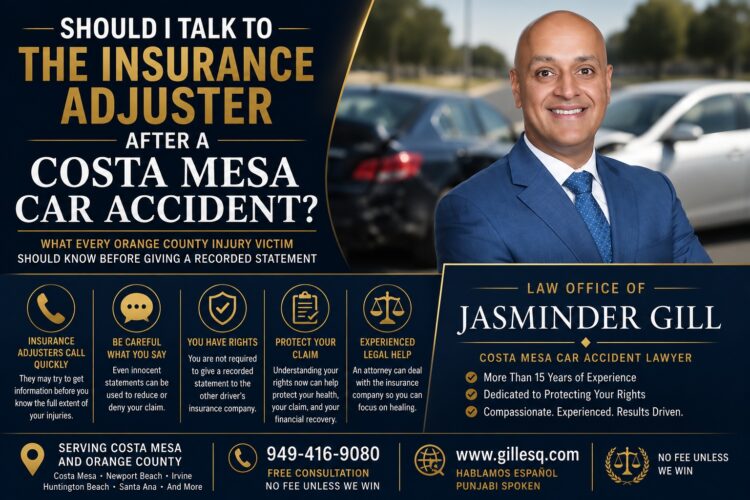
What Every Orange County Injury Victim Should Know Before Giving a Recorded Statement | Law Office of Jasminder Gill
A car accident can turn your life upside down in a matter of seconds. Whether your crash happened on the 405 Freeway, State Route 55, Harbor Boulevard, Newport Boulevard, Bristol Street, Fairview Road, or another busy Orange County roadway, you may begin receiving phone calls from insurance companies almost immediately.
One of the first questions many accident victims ask is:
“Should I talk to the insurance adjuster?”
The answer depends on which insurance company is calling and what they are asking you to do.
While insurance adjusters often sound friendly and helpful, it’s important to remember that they work for insurance companies—not for you. Their responsibility is to investigate claims, evaluate liability, and protect their company’s financial interests.
Many injury victims unknowingly damage their own cases by giving recorded statements, guessing about what happened, minimizing their injuries, or accepting settlement offers before understanding the true value of their claim.
At the Law Office of Jasminder Gill, we have spent more than 15 years representing car accident victims throughout Costa Mesa and Orange County. We have seen firsthand how innocent statements made immediately after a crash can later be used by insurance companies to dispute liability or reduce compensation.
This guide explains what insurance adjusters do, why they contact accident victims so quickly, what you should avoid saying, and how to protect your rights after a serious collision.
Why Choose the Law Office of Jasminder Gill as Your Costa Mesa Personal Injury Lawyer?
Choosing the right Costa Mesa personal injury lawyer can make a significant difference in the outcome of your case. At the Law Office of Jasminder Gill, we combine more than 15 years of experience with personalized legal representation to help injury victims throughout Costa Mesa and Orange County pursue the maximum compensation available under California law.
When you hire our firm, you can expect:
- More than 15 years representing California personal injury victims
- Direct communication with attorney Jasminder Gill throughout your case
- Free consultations with no obligation
- No attorney fees unless we recover compensation for you
- Individual attention and personalized legal representation
- Thorough accident investigations and evidence preservation
- Aggressive negotiations with insurance companies
- Trial-ready representation when a fair settlement cannot be reached
At the Law Office of Jasminder Gill, we understand that every injury case is unique. We take the time to understand how an accident has affected your health, finances, and future so we can pursue the full compensation you deserve. From your initial consultation through settlement or trial, our firm is committed to providing responsive communication, honest advice, and dedicated legal representation while allowing you to focus on your recovery.
Call 949-416-9080 for a free consultation
Why Does the Insurance Adjuster Call So Quickly?
Many people are surprised when they receive a phone call from an insurance adjuster only hours after a collision.
This is not unusual.
Insurance companies begin investigating claims immediately after an accident is reported.
An adjuster may contact you to:
- Learn how the accident happened.
- Determine who may be at fault.
- Gather information for the insurance company’s file.
- Evaluate potential damages.
- Ask for a recorded statement.
- Request medical authorizations.
- Discuss vehicle repairs.
- Explore the possibility of an early settlement.
Although these requests may sound routine, remember that the insurance company is collecting information before it has paid anything on your claim.
The sooner they speak with you, the greater the chance they can obtain information before you have spoken with an attorney, reviewed the police report, or fully understood the extent of your injuries.
Who Does the Insurance Adjuster Work For?
This is one of the biggest misconceptions after a car accident.
Many people believe the adjuster is a neutral party trying to “figure out what happened.”
In reality, the adjuster works for the insurance company.
Their job is to:
- Investigate the claim.
- Evaluate liability.
- Review available insurance coverage.
- Assess damages.
- Determine the company’s financial exposure.
- Attempt to resolve claims within company guidelines.
This does not necessarily mean the adjuster is dishonest or acting in bad faith.
However, it does mean their interests are different from yours.
Your goal is to recover physically, understand your legal rights, and obtain fair compensation for your injuries.
The insurance company’s goal is to resolve claims efficiently while controlling costs.
Understanding this difference helps explain why you should think carefully before answering detailed questions or agreeing to a recorded interview.
Do You Have to Give the Other Driver’s Insurance Company a Recorded Statement?
In many cases, no.
If the adjuster represents the driver who caused the accident, California law generally does not require you to provide a recorded statement.
The adjuster may say things like:
- “This will help us process your claim.”
- “We’re just trying to understand what happened.”
- “It will only take a few minutes.”
- “We’re on your side.”
- “We can’t move forward until we hear from you.”
While these requests may sound reasonable, you are typically under no obligation to provide a recorded statement to the at-fault driver’s insurance company.
Instead, you may politely explain that you are still receiving medical care and would prefer to speak with an attorney before discussing the accident.
What About My Own Insurance Company?
The situation can be different if your own insurance company contacts you.
If you are making a claim under your own policy—for example:
- Uninsured motorist coverage
- Underinsured motorist coverage
- Medical payments coverage
- Collision coverage
—your insurance policy may require you to cooperate with the investigation.
Even then, cooperation does not mean you should answer questions casually or speculate about what happened.
Before providing detailed information, it is often wise to understand your policy obligations and seek legal guidance if you have suffered significant injuries.
Why Recorded Statements Can Become a Problem
Most people tell the truth.
The problem is not honesty.
The problem is timing.
Immediately after a collision, you may not know:
- The full extent of your injuries.
- What witnesses observed.
- Whether surveillance cameras captured the crash.
- What the police report says.
- Whether the other driver gave a different version of events.
- Whether your injuries will require surgery, injections, or long-term treatment.
Despite these unknowns, the insurance company may ask you detailed questions while everything is still fresh and confusing.
Months later, your recorded answers may be compared with:
- Medical records
- Deposition testimony
- Police reports
- Witness statements
- Vehicle damage
- Dash cam footage
- Body camera footage
- Surveillance video
- Social media posts
Even minor inconsistencies may be used to argue that your memory is unreliable or that your injuries are less serious than you claim.
Common Questions Insurance Adjusters Ask
Many questions seem harmless.
For example:
- What happened?
- How fast were you driving?
- Did you see the other vehicle?
- Were you distracted?
- Were you wearing your seatbelt?
- Were you using your phone?
- How are you feeling today?
- Have you seen a doctor?
- Have you missed work?
- Have you ever injured your neck or back before?
These questions are designed to gather information.
Your answers become part of the insurance company’s claim file and may influence how your case is evaluated.
For this reason, it is important to answer carefully, avoid guessing, and understand the purpose behind the questions being asked.
Why Some Injuries Don’t Appear Right Away
One of the biggest mistakes people make is assuming they are not seriously injured because they feel “okay” immediately after the crash.
Adrenaline often masks pain.
Symptoms of injuries such as:
- Whiplash
- Herniated discs
- Concussions
- Traumatic brain injuries
- Shoulder injuries
- Torn ligaments
- Knee injuries
- Soft tissue injuries
may not become noticeable until hours—or even days—later.
This is one reason it is risky to tell an insurance adjuster that you are “fine” or “not hurt.”
Those early statements may later be used to argue that your injuries were unrelated to the collision or not as severe as your medical records eventually show.
Seeking prompt medical evaluation protects both your health and your legal claim.
Insurance Companies Are Not Your Enemy—But They Are Protecting Their Interests
After a serious car accident, it’s important to remember that insurance companies exist to investigate and evaluate claims. Their goal is to determine liability, verify damages, and resolve cases according to the terms of the insurance policy.
At the same time, insurance companies also have a responsibility to control claim costs. That means adjusters often ask detailed questions, review medical records, inspect vehicle damage, and evaluate every piece of evidence before deciding what a claim may be worth.
Understanding how this process works allows injury victims to make informed decisions and avoid mistakes that could unintentionally weaken their claim.
Seven Common Insurance Company Tactics After a Costa Mesa Car Accident
1. Calling Before You’ve Seen a Doctor
Many adjusters contact accident victims within hours of a collision.
At that point you may still be experiencing:
- Shock
- Adrenaline
- Confusion
- Delayed pain
- Stress
Because many injuries—including whiplash, concussions, and soft tissue injuries—may not fully develop for several days, it is often too early to accurately describe your condition.
Rather than guessing, focus on obtaining appropriate medical care and following your physician’s recommendations.
2. Asking Questions Repeatedly
An adjuster may ask the same question several different ways.
Examples include:
- What lane were you in?
- Did you ever see the other vehicle?
- Were you distracted?
- Could you have stopped sooner?
- Was there anything you could have done differently?
This does not necessarily mean the adjuster believes you are being dishonest.
Instead, they are attempting to gather a complete understanding of the accident and compare your answers with other available evidence.
The best approach is simple:
Answer truthfully.
If you don’t know, say you don’t know.
Never guess.
3. Requesting Broad Medical Authorizations
Some insurance companies ask accident victims to sign medical authorization forms.
These documents may allow the insurance company to obtain medical records directly from healthcare providers.
Before signing any authorization, understand exactly what records are being requested and why.
In some situations, providing unlimited access to years of unrelated medical history may create unnecessary disputes over pre-existing conditions that have nothing to do with the collision.
4. Asking You to Estimate Your Injuries
One of the most common questions is:
“How are you feeling today?”
It seems harmless.
However, if you answer:
“I’m doing okay.”
“I think I’m getting better.”
“It’s just a little sore.”
Those statements may later be compared to MRI results, surgical recommendations, or physical therapy records if your injuries become more serious.
If your medical treatment is ongoing, it’s perfectly appropriate to explain that you’re still being evaluated and are following your doctor’s recommendations.
5. Looking for Inconsistencies
Insurance companies review many different sources of information.
These may include:
- Police reports
- Medical records
- Photographs
- Witness statements
- Vehicle inspections
- Dash cam footage
- Cell phone records
- Surveillance video
- Social media posts
Consistency matters.
That is why it is important to be truthful, avoid exaggeration, and avoid making assumptions about facts you do not know.
6. Discussing Settlement Before Treatment Is Complete
Sometimes an insurance company may discuss resolving your claim shortly after the accident.
An early settlement may seem appealing if you are:
- Missing work
- Facing medical bills
- Without transportation
- Feeling overwhelmed
However, settling a claim before understanding your long-term medical condition could leave you responsible for future expenses that were not considered during negotiations.
Every case is different, which is why it is important to understand the full extent of your injuries before making significant decisions.
7. Monitoring Public Information
Many people are surprised to learn that publicly available social media posts may become part of a claim investigation.
Photos, videos, comments, and activity that appear inconsistent with claimed injuries can become issues during settlement negotiations or litigation.
This does not mean accident victims should stop living their lives.
It simply means you should think carefully before posting publicly while your case is ongoing.
Ten Mistakes That Can Hurt Your Personal Injury Claim
Mistake #1 – Delaying Medical Treatment
Prompt medical care benefits both your health and your claim.
Waiting days or weeks to seek treatment may allow the insurance company to argue that your injuries were unrelated to the accident.
Mistake #2 – Missing Follow-Up Appointments
Medical records often tell the story of an injury.
Consistently following treatment recommendations helps document your recovery and demonstrates that you are taking your injuries seriously.
Mistake #3 – Guessing About What Happened
If you are unsure about speeds, distances, traffic signals, or vehicle positions, avoid speculation.
Facts are always stronger than estimates.
Mistake #4 – Admitting Fault Too Soon
California follows a comparative negligence system.
Liability is determined after reviewing all available evidence—not simply by what someone says immediately after a collision.
Never assume you know every factor that contributed to the accident.
Mistake #5 – Accepting the First Settlement Offer
Some cases resolve quickly.
Others require extensive medical treatment before their value can be accurately evaluated.
Understanding your injuries before accepting compensation helps ensure informed decision-making.
Mistake #6 – Repairing or Disposing of Evidence Too Quickly
Vehicle damage often provides important evidence regarding:
- Speed
- Point of impact
- Severity of the collision
- Crash dynamics
Photograph your vehicle thoroughly before repairs whenever possible.
Also preserve damaged helmets, bicycles, child safety seats, or other property that may become important evidence.
Mistake #7 – Forgetting to Document the Accident
Strong evidence often includes:
- Scene photographs
- Vehicle damage
- Skid marks
- Debris
- Weather conditions
- Traffic signs
- Witness contact information
The more documentation available, the easier it may be to reconstruct what happened.
Mistake #8 – Posting Too Much Online
Insurance companies may review publicly available online content.
Even innocent vacation photos, exercise posts, or family activities can be taken out of context if they appear inconsistent with claimed injuries.
Consider limiting public posts while your claim remains active.
Mistake #9 – Ignoring Your Doctor’s Recommendations
Stopping treatment prematurely may create questions about whether your injuries resolved sooner than expected.
If your symptoms improve, discuss treatment decisions with your healthcare provider rather than simply discontinuing care on your own.
Mistake #10 – Waiting Too Long to Learn About Your Legal Rights
Evidence can disappear quickly.
Witness memories fade.
Video footage may be overwritten.
Vehicles are repaired.
Understanding your options early allows you to preserve important evidence and make informed decisions throughout the claims process.
Why Documentation Matters After a Costa Mesa Car Accident
Whether your accident occurred on Interstate 405, State Route 55, Harbor Boulevard, Newport Boulevard, Bristol Street, Baker Street, Fairview Road, or another Orange County roadway, documentation can significantly strengthen your claim.
Helpful evidence often includes:
- Police traffic collision reports
- Photographs of the accident scene
- Vehicle damage
- Medical records
- Emergency room records
- Ambulance reports
- Witness statements
- Surveillance footage
- Dash cam recordings
- Cell phone photographs
- Repair estimates
- Employment records documenting lost wages
The stronger the documentation, the easier it is to present a clear picture of what happened and how the accident affected your life.
FAQ’s About When to Contact a Lawyer After a Costa Mesa Car Accident
What If I’ve Already Given a Recorded Statement?
Many people worry that they have damaged their case after speaking with an insurance adjuster.
The good news is that giving a recorded statement does not automatically prevent you from recovering compensation.
Every case is different.
An experienced personal injury attorney can review:
- The recorded statement
- The police report
- Witness statements
- Medical records
- Vehicle damage
- Dash cam footage
- Surveillance video
- Insurance communications
Even if you believe you made a mistake during your conversation with the insurance company, additional evidence may help clarify what actually happened.
The most important thing is to continue receiving appropriate medical treatment and seek legal advice before making additional statements or accepting a settlement.
Should You Hire a Costa Mesa Car Accident Lawyer Before Talking to the Insurance Company?
There is no law requiring you to hire an attorney after a car accident.
However, many people choose to consult a lawyer before speaking extensively with an insurance company because they want to better understand:
- Their legal rights
- The claims process
- Potential compensation
- Insurance coverage
- Medical expenses
- Lost wages
- Future treatment costs
An attorney can also help explain legal terminology, communicate with insurance companies, gather evidence, and ensure deadlines are not missed.
Every accident is different, and obtaining information early allows you to make informed decisions about your case.
What Compensation May Be Available After a Costa Mesa Car Accident?
Depending on the facts of your case, California law may allow an injured person to seek compensation for damages resulting from another person’s negligence.
Potential damages may include:
Medical Expenses
This may include:
- Emergency room treatment
- Ambulance transportation
- Hospital care
- Surgery
- Diagnostic testing
- MRI scans
- CT scans
- X-rays
- Physical therapy
- Chiropractic treatment
- Pain management
- Prescription medications
- Future medical treatment
Lost Income
If your injuries prevent you from working, you may be able to recover compensation for:
- Lost wages
- Missed overtime
- Bonuses
- Lost business income
- Reduced earning capacity
Property Damage
Compensation may also include:
- Vehicle repairs
- Total loss value
- Rental vehicle expenses
- Personal property damaged during the collision
Pain and Suffering
California law may also allow recovery for non-economic damages such as:
- Physical pain
- Emotional distress
- Anxiety
- Mental suffering
- Loss of enjoyment of life
- Permanent disability
- Permanent disfigurement
The amount available depends on the facts of each individual case.
Should I answer the insurance adjuster’s phone calls?
If the adjuster represents the other driver’s insurance company, you may choose to politely decline providing a recorded statement until you understand your rights.
If the adjuster represents your own insurance company, your policy may require reasonable cooperation depending on the type of claim involved.
Can the insurance company deny my claim if I refuse a recorded statement?
Every claim is different.
Simply declining to provide a recorded statement to the at-fault driver’s insurance company does not automatically prevent you from pursuing a claim.
However, insurance policies may contain different cooperation requirements for claims made under your own policy.
What if the insurance adjuster offers me money right away?
Some claims settle quickly.
However, accepting a settlement generally requires signing a release that may prevent you from seeking additional compensation later.
Before accepting any settlement, it is important to understand:
- The full extent of your injuries.
- Future medical needs.
- Lost income.
- Other damages related to the accident.
What if I was partially at fault?
California follows a pure comparative negligence system.
In many situations, an injured person may still recover compensation even if they were partially responsible for the accident.
The amount recoverable may be reduced based on that person’s percentage of fault.
Because every case is unique, liability should be evaluated based on the available evidence.
How long do I have to file a car accident claim in California?
Time limits, known as statutes of limitation, apply to personal injury claims.
Because deadlines can vary depending on the facts of a case—including whether a government entity is involved—it is important to avoid waiting too long to learn about your legal rights.
Why Early Evidence Can Make a Difference
One reason many people contact an attorney shortly after an accident is to help preserve evidence before it disappears.
Important evidence may include:
- Traffic camera footage
- Business surveillance video
- Dash cam recordings
- Vehicle event data
- Witness statements
- Police body camera footage
- Accident scene photographs
- Cell phone evidence
- Vehicle inspections
- Medical documentation
Some types of evidence are only available for a limited time.
Acting promptly may help preserve information that could later become important to your claim.
Serving Costa Mesa and Orange County Injury Victims
The Law Office of Jasminder Gill represents injured clients throughout:
- Costa Mesa
- Newport Beach
- Irvine
- Huntington Beach
- Fountain Valley
- Santa Ana
- Tustin
- Orange
- Anaheim
- Garden Grove
- Westminster
- Seal Beach
- Laguna Beach
- Mission Viejo
- Orange County
Whether your accident occurred on Interstate 405, State Route 55, Pacific Coast Highway, Harbor Boulevard, Bristol Street, Fairview Road, Baker Street, MacArthur Boulevard, Newport Boulevard, or another Orange County roadway, understanding your rights after a collision is an important first step.
Get Help From a Costa Mesa Motor Vehicle Accident Lawyer
If you or a loved one has been injured in a motor vehicle accident, you don’t have to deal with insurance companies alone.
If you’re searching for a motor vehicle accident lawyer near you, The Law Office of Jasminder Gill represents accident victims in Costa Mesa, Newport Beach, Santa Ana, Irvine, and throughout Orange County. We are committed to helping clients recover maximum compensation for medical expenses, lost income, and pain and suffering.
Insurance companies often try to minimize claims or shift blame after an accident. Our firm works to protect your rights, gather evidence, and build a strong case to ensure you receive the full compensation you deserve.
Learn more from our Car Accident Lawyer in Costa Mesa.