
Totaled Car After a Car Accident in Costa Mesa
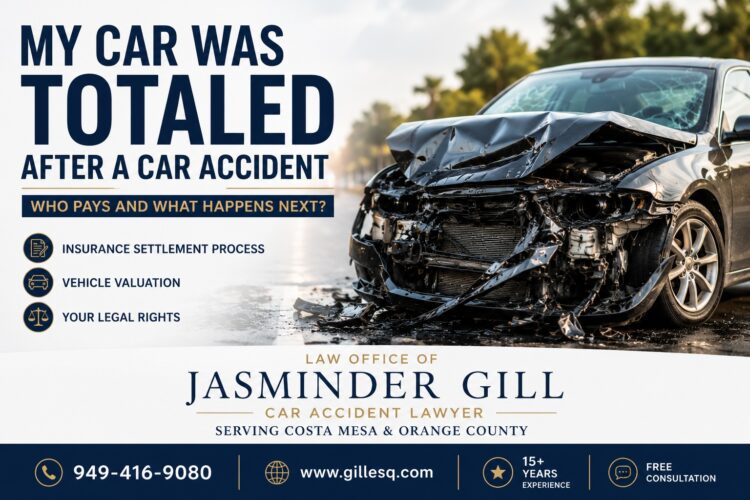
Who Pays Me, How Much Will I Get, and What Happens Next? | Law Office of Jasminder Gill
A serious car accident can change your life in seconds. Between dealing with injuries, speaking with insurance companies, arranging transportation, and missing work, the situation can quickly become overwhelming.
One of the first questions many accident victims ask after a major collision is:
“My car was totaled. Who pays me and what happens next?”
Unfortunately, the answer is not always straightforward.
Many drivers assume that if another driver caused the accident, the insurance company will immediately pay for everything and the process will be simple. In reality, total loss claims often involve disputes over vehicle value, rental cars, outstanding loans, liability, and insurance coverage.
At the Law Office of Jasminder Gill, we help accident victims throughout Costa Mesa, Newport Beach, Irvine, Huntington Beach, Santa Ana, Fountain Valley, Tustin, Orange, Anaheim, Garden Grove, and throughout Orange County understand their rights after serious crashes.
If your vehicle was declared a total loss after an accident, understanding the process can help protect both your finances and your injury claim.
What Does It Mean When a Car Is “Totaled”?
A vehicle is generally considered a total loss when the insurance company determines that repairing the vehicle is not economically practical compared to the vehicle’s value.
In simple terms, the insurance company concludes that repairing the vehicle would cost too much relative to what the vehicle is worth.
Insurance companies evaluate several factors, including:
- Vehicle age
- Mileage
- Vehicle condition
- Market value
- Cost of repairs
- Salvage value
Many people are surprised to learn that a vehicle does not need to be completely destroyed to be considered totaled.
A newer vehicle with extensive frame damage, airbag deployment, suspension damage, or structural damage may be declared a total loss even if it still appears repairable.
Common Accidents That Result in Totaled Vehicles
Serious collisions frequently result in total loss determinations.
Examples include:
High-Speed Freeway Accidents
Crashes on:
- Interstate 405
- State Route 55
- State Route 73
- Interstate 5
often involve significant vehicle damage due to higher speeds.
T-Bone Accidents
Side-impact collisions can cause extensive structural damage that is expensive to repair.
Head-On Collisions
These crashes often result in severe front-end damage, airbag deployment, and frame damage.
Multi-Vehicle Pileups
Chain-reaction collisions can damage multiple areas of a vehicle, increasing repair costs.
Truck Accidents
Commercial truck collisions frequently result in catastrophic vehicle damage due to the size and weight difference between vehicles.
Who Pays for My Totaled Vehicle?
The answer depends on the circumstances of the accident.
If Another Driver Caused the Accident
If another driver is responsible for the crash, their liability insurance may be responsible for compensating you for your vehicle.
The insurance company may investigate:
- Liability
- Vehicle value
- Damage extent
- Ownership information
Before making payment.
If You Have Collision Coverage
Many drivers carry collision coverage through their own policy.
In this situation, your own insurance company may pay for the vehicle and later seek reimbursement from the at-fault driver’s insurance carrier through a process known as subrogation.
Uninsured Driver Accidents
If the at-fault driver does not have insurance, your own coverage may become extremely important.
Depending on your policy, available coverage may include:
- Collision coverage
- Uninsured motorist property damage coverage
Hit-and-Run Accidents
Hit-and-run crashes can complicate vehicle damage claims.
Coverage often depends on:
- Policy language
- Available evidence
- Police reports
- Witness statements
How Much Will the Insurance Company Pay for My Totaled Car?
Many accident victims expect the insurance company to pay whatever it costs to buy a replacement vehicle.
Unfortunately, that is not usually how the process works.
Insurance companies generally pay what is known as the vehicle’s:
Actual Cash Value (ACV)
Actual Cash Value represents the fair market value of the vehicle immediately before the collision.
Insurance companies may consider:
- Vehicle year
- Make
- Model
- Mileage
- Condition
- Local market sales
- Prior damage
The goal is to determine what a comparable vehicle would have sold for immediately before the accident occurred.
How Insurance Companies Determine Actual Cash Value
Many accident victims are surprised when they receive a valuation report from the insurance company. The number often seems lower than expected, especially in today’s vehicle market.
Insurance companies typically use third-party valuation systems that examine numerous factors, including:
- Year, make, and model
- Mileage
- Prior damage
- Vehicle condition
- Local market sales
- Vehicle options and packages
The insurance company may compare your vehicle to similar vehicles recently sold within Southern California. Adjustments are often made for mileage differences, condition, upgrades, and optional equipment.
Unfortunately, valuation reports are not always accurate.
Sometimes comparable vehicles are located hundreds of miles away. In other situations, important features such as premium packages, upgraded wheels, navigation systems, towing packages, or recent mechanical improvements may be overlooked.
For example, a vehicle with a recently installed engine, transmission, suspension system, or premium tire package may be worth substantially more than the insurance company’s initial estimate.
Before accepting a settlement offer, carefully review the valuation report. Even small errors can result in thousands of dollars in lost compensation.
Many drivers never realize they have the right to challenge an insurance company’s valuation. However, providing documentation, receipts, maintenance records, and comparable vehicle listings may help support a higher value.
Why Insurance Company Valuations Are Often Too Low
One of the biggest complaints accident victims have is that the insurance company’s offer seems unfair.
Common reasons include:
Incorrect Vehicle Condition
The valuation may fail to account for:
- Excellent maintenance
- Premium condition
- Recent upgrades
Missing Features
Insurance adjusters sometimes overlook:
- Leather interiors
- Premium audio systems
- Navigation systems
- Safety packages
Local Market Differences
Vehicle prices vary significantly throughout Southern California.
A valuation based on distant markets may not accurately reflect replacement costs in Orange County.
Recent Repairs
Major repairs may increase the value of your vehicle.
Examples include:
- New engine
- New transmission
- New tires
- Suspension work
- Brake replacement
Keep receipts whenever possible.
What If I Still Owe Money on My Vehicle?
This is one of the most stressful situations drivers face.
Suppose:
Vehicle value: $28,000
Loan balance: $35,000
Insurance payment: $28,000
You may still owe:
$7,000
even after the insurance company pays for the vehicle.
This situation is often referred to as being “upside down” on a loan.
What If My Totaled Vehicle Was Leased?
Leased vehicles create additional challenges after a serious car accident. Many drivers assume the process is the same as owning a vehicle outright, but there are several important differences.
When a leased vehicle is declared a total loss, the insurance company will generally pay the vehicle’s actual cash value. In most situations, the payment is made directly to the leasing company because they technically own the vehicle.
If the insurance payment is less than the amount owed under the lease agreement, the remaining balance may still need to be addressed. Fortunately, many lease agreements include GAP protection, which may help cover the difference between the insurance payout and the remaining lease balance.
Drivers should also be aware that lease contracts may contain specific requirements regarding accident reporting, vehicle inspections, and settlement procedures. Failing to follow those requirements can sometimes create additional complications.
If your leased vehicle is totaled, it is important to review both your insurance policy and your lease agreement to understand your rights and obligations. The process can become even more complicated when liability is disputed or serious injuries are involved.
Many Costa Mesa drivers rely on leased vehicles for commuting throughout Orange County, including travel on Interstate 405, State Route 55, and Pacific Coast Highway. Understanding how total loss claims affect leased vehicles can help avoid unexpected financial surprises after an accident.
What Is GAP Insurance?
GAP insurance is designed to cover the difference between:
- The vehicle’s actual cash value
- The remaining loan balance
Using the example above:
Loan balance: $35,000
Insurance payment: $28,000
Remaining balance: $7,000
GAP insurance may cover the remaining balance depending on the policy terms.
Many drivers do not realize they have GAP coverage until after an accident.
Review your financing documents carefully.
What Happens to My Rental Car?
Many people become more concerned about transportation than the vehicle itself.
Rental coverage typically does not continue indefinitely.
Insurance companies often provide rental benefits only until:
- The vehicle is repaired
- The vehicle is declared a total loss
- A settlement offer is made
Many accident victims are surprised to learn that rental coverage may end shortly after the total loss determination.
This is one reason it is important to address vehicle valuation disputes quickly.
Can I Keep My Totaled Vehicle?
In some situations, yes.
Insurance companies may allow owners to retain a totaled vehicle while reducing the settlement amount by its salvage value.
However, there are important considerations:
- Salvage title requirements
- Registration issues
- Reduced resale value
- Future insurance limitations
Keeping a totaled vehicle is not always the best option.
What If I Disagree With the Insurance Company’s Offer?
You are not necessarily required to accept the first offer.
If you believe the vehicle has been undervalued, you may be able to challenge the valuation.
Helpful evidence may include:
Comparable Vehicle Listings
Research similar vehicles in:
- Costa Mesa
- Newport Beach
- Irvine
- Huntington Beach
- Orange County
Service Records
Maintenance records may support a higher valuation.
Upgrade Documentation
Provide receipts for:
- Wheels
- Tires
- Audio systems
- Safety features
- Mechanical improvements
Photographs
Pre-accident photographs can help establish the vehicle’s condition.
What If the At-Fault Driver Has Minimum Insurance Coverage?
California drivers are required to carry liability insurance, but minimum policy limits may not fully compensate accident victims after a serious crash.
This becomes especially important when an accident results in both substantial vehicle damage and significant injuries.
Consider a situation where:
- A newer vehicle is declared a total loss
- Emergency medical treatment is required
- Multiple people are injured
- Lost wages begin to accumulate
The available insurance coverage may be insufficient to fully compensate everyone involved.
When policy limits become an issue, additional sources of recovery may need to be explored. Depending on the circumstances, these may include:
- Underinsured motorist coverage
- Umbrella insurance policies
- Employer liability
- Commercial vehicle coverage
- Additional responsible parties
Truck accidents, delivery vehicle accidents, rideshare accidents, and business-related collisions often involve larger insurance policies than ordinary passenger vehicle accidents.
Because insurance coverage can significantly affect the value of a claim, accident victims should avoid assuming that the insurance company has explained every available source of compensation. A thorough investigation may uncover additional coverage that is not immediately obvious.
Does a Totaled Vehicle Mean I Have an Injury Case?
Not necessarily.
However, many accidents involving totaled vehicles also involve significant injuries.
The force required to total a vehicle often places substantial stress on the human body.
Common injuries include:
Whiplash
Neck injuries remain one of the most common consequences of serious collisions.
Herniated Discs
Back and spinal injuries may cause long-term pain and limitations.
Concussions
Traumatic brain injuries can occur even when there is no direct impact to the head.
Shoulder Injuries
Seat belts frequently protect occupants but can also contribute to shoulder injuries during severe collisions.
Broken Bones
Fractures often occur in high-impact crashes.
Why You Should Not Ignore Delayed Symptoms
Many accident victims feel relatively normal immediately after a crash.
Adrenaline can mask symptoms for hours or even days.
Delayed symptoms may include:
- Headaches
- Neck pain
- Back pain
- Numbness
- Tingling
- Dizziness
- Memory problems
Seeking prompt medical attention is important both for your health and for documenting injuries.
Can I Recover Compensation Beyond the Value of My Vehicle?
Many accident victims focus entirely on their vehicle during the first few days after a crash. While replacing a totaled vehicle is certainly important, the value of an injury claim is often much greater than the value of the car itself.
Depending on the circumstances, compensation may be available for:
Medical Expenses
Serious collisions frequently result in significant medical bills, including:
- Ambulance transportation
- Emergency room treatment
- Hospitalization
- Surgery
- Diagnostic testing
- Physical therapy
- Chiropractic treatment
- Follow-up medical care
Lost Income
Injuries may prevent a person from working for days, weeks, or even months.
Compensation may be available for:
- Lost wages
- Missed overtime
- Lost commissions
- Lost business opportunities
Pain and Suffering
California law may allow injured victims to pursue compensation for physical pain, emotional distress, inconvenience, and the impact injuries have on daily life.
Future Medical Care
Some injuries require ongoing treatment long after the vehicle claim has been resolved.
Future damages may include:
- Additional surgeries
- Rehabilitation
- Specialist treatment
- Long-term therapy
For this reason, accident victims should be cautious about focusing solely on property damage. A totaled vehicle claim may resolve relatively quickly, while an injury claim may continue for months or longer.
What Happens If the Other Driver Is Blaming Me?
Liability disputes often delay total loss payments.
Insurance companies may investigate:
- Police reports
- Witness statements
- Photographs
- Video footage
- Vehicle damage
California follows comparative negligence laws, meaning fault can be shared among multiple parties.
Even if you are partially responsible for an accident, compensation may still be available.
How Long Does It Take to Get Paid for a Totaled Vehicle?
Every claim is different.
Factors affecting payment timelines may include:
- Liability disputes
- Coverage issues
- Vehicle inspections
- Loan payoff verification
- Valuation disagreements
Some claims resolve within weeks while others take significantly longer.
The more complex the claim, the longer the process may take.
Mistakes to Avoid After Your Car Is Totaled
Accepting the First Offer Without Review
The first offer is not always the highest offer.
Throwing Away Vehicle Documents
Keep:
- Registration
- Service records
- Repair receipts
- Loan information
Failing to Document Injuries
Property damage and injury claims are separate issues.
A vehicle settlement does not automatically resolve injury claims.
Waiting Too Long to Seek Medical Care
Delayed treatment can create challenges later.
FAQ’s About Totaled Vehicles After California Car Accidents
How long does it take to get paid for a totaled car?
Every claim is different. Some claims are resolved within a few weeks, while others take longer due to liability disputes, vehicle inspections, or valuation disagreements.
Can I negotiate a total loss settlement offer?
Yes. Insurance companies do not always make their best offer first. Supporting documentation and comparable vehicle listings may help support a higher valuation.
What if I just bought my vehicle?
Many newer vehicles lose value quickly. If you owe more than the vehicle’s actual cash value, GAP insurance may become important.
Can I keep my personalized license plates?
In many situations, personalized plates can be transferred to a replacement vehicle, although specific DMV requirements may apply.
What if the accident was a hit-and-run?
Available coverage depends on the facts of the case and your insurance policy. Collision coverage and other protections may be available.
Can I recover compensation for aftermarket upgrades?
Potentially yes. Upgrades such as wheels, suspension systems, audio equipment, towing packages, and performance modifications may affect vehicle value if properly documented.
What if my vehicle was used for work?
A totaled vehicle can create significant financial hardship for business owners, contractors, rideshare drivers, and delivery drivers. Additional damages may be available depending on the circumstances.
Should I accept the first settlement offer?
Not necessarily. Before accepting any offer, ensure that the valuation accurately reflects your vehicle and that all available compensation has been considered.
Get Help From a Costa Mesa Motor Vehicle Accident Lawyer
If you or a loved one has been injured in a motor vehicle accident, you don’t have to deal with insurance companies alone.
If you’re searching for a motor vehicle accident lawyer near you, The Law Office of Jasminder Gill represents accident victims in Costa Mesa, Newport Beach, Santa Ana, Irvine, and throughout Orange County. We are committed to helping clients recover maximum compensation for medical expenses, lost income, and pain and suffering.
Insurance companies often try to minimize claims or shift blame after an accident. Our firm works to protect your rights, gather evidence, and build a strong case to ensure you receive the full compensation you deserve.
Learn more from our Car Accident Lawyer in Costa Mesa.