
Walnut Park Car Accident Lawyer
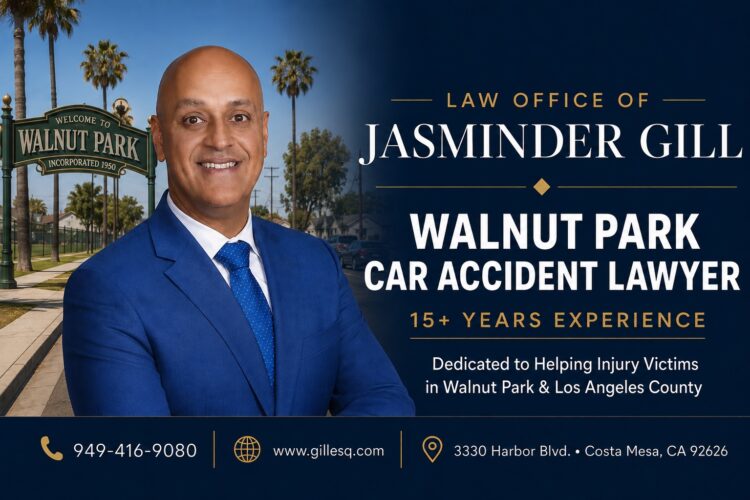
An Accident Close to Home Can Have Lasting Consequences
An injury from a Walnut Park car accident can make ordinary responsibilities difficult—from getting to work to caring for your children. As medical bills arrive and missed income adds up, you may also face questions about who caused the collision, which insurance applies, and whether a settlement will cover your losses.
Call 949-416-9080 for a Free Consultation
The Law Office of Jasminder Gill can investigate the crash, preserve available evidence, identify applicable insurance coverage, and handle communications with adjusters. Each claim is evaluated based on the injuries and their consequences, including medical treatment, lost earnings, pain and suffering, and future needs supported by the evidence.
Evaluación inicial en español
Para un accidente con lesiones en Walnut Park, comuníquese al 949-416-9080 y solicite una evaluación inicial. La firma ofrece consultas en español. Primero debe aceptarse el caso y firmarse el contrato de representación; la consulta con el abogado viene después. Los honorarios de abogado y los gastos se explican por separado.
A Clear Injury Evaluation for Walnut Park Residents
An accident during a local trip can interrupt work, appointments and responsibilities at home even when the vehicle is quickly repaired. The Law Office of Jasminder Gill reviews the collision and those consequences together. For Walnut Park residents, a useful evaluation identifies the actual roadway, the available evidence and the injury’s effects rather than assuming that every crash in the community involves the same drivers or circumstances.
The firm is based in Costa Mesa and provides phone and video communication. Jasminder Gill has been a California attorney since 2009 and has more than 15 years of experience. The first contact is screening and an initial case evaluation. Representation and an attorney consultation follow acceptance and a signed retainer. Spanish consultations are available, and the attorney speaks Punjabi.
Understanding Traffic Risks in Walnut Park
Walnut Park is an unincorporated Los Angeles County community with homes, businesses and transit activity along corridors such as Pacific Boulevard, Florence Avenue, Santa Fe Avenue and Mountain View Avenue. Travel to nearby freeway connections brings additional vehicles through the surrounding area.
Major Streets, Intersections, Landmarks, and Areas in Walnut Park
Pacific Boulevard
Pacific Boulevard is a major commercial and transit corridor through Walnut Park and Huntington Park. Traffic may include buses, pedestrians, shoppers, delivery vehicles, parked cars, and drivers entering or leaving businesses.
Florence Avenue
Florence Avenue carries substantial east-west traffic and connects Walnut Park with Huntington Park, Bell, South Gate, Florence-Graham, and I-710. Intersections may involve turning vehicles, buses, pedestrians, and commercial traffic.
Santa Fe Avenue and Mountain View Avenue
Santa Fe Avenue and Mountain View Avenue serve residential, commercial, and industrial areas. Truck traffic, work vehicles, school trips, curbside parking, and limited visibility can affect collision analysis.
Schools, Residential Streets, and County Jurisdiction
Walnut Park is an unincorporated Los Angeles County community rather than an incorporated city. Crashes near local schools, parks, and neighborhood streets may be investigated by the Los Angeles County Sheriff’s Department, while freeway crashes may be handled by the California Highway Patrol.
Accident Patterns Along Pacific, Florence and Local Streets
A Turning Car Crosses a Pedestrian’s Route
Commercial and transit activity can bring people and turning vehicles together. For an incident near Pacific Boulevard, identify the crossing point, traffic controls and direction of the turn. A claim should address what the driver and pedestrian were doing and what each could see. The presence of shops or a bus stop does not itself resolve right of way or establish responsibility by a nearby business.
A Driver Leaves a Curbside Space
A vehicle moving from parking into traffic can collide with a passing car, bicycle or another vehicle making a maneuver. Preserve the positions, signal use and sequence rather than assume the parked vehicle is always the sole cause. The width of the lane and the available sight line may help assess accounts, but the conclusion must be tied to the actual driving conduct.
A Queue Produces More Than One Impact
A collision on Florence Avenue may involve vehicles stopped at an intersection or slowing behind an earlier event. Record the order of contacts and the observations of occupants. A car pushed into another vehicle presents different questions from a driver who struck the car ahead before receiving an impact. Review damage and witness accounts together rather than assign fault from the lineup after traffic clears.
A Work Vehicle Uses a Neighborhood Corridor
An incident involving a van, truck or delivery car can require identifying the purpose of the trip and the driver’s relationship to a business. Vehicle markings and plate information can assist that inquiry. Ownership, work assignments and policy terms need separate assessment before concluding which parties or insurers are involved. Not every vehicle used during a workday creates the same legal relationship.
An Unidentified Driver Leaves the Scene
A hit-and-run places greater importance on details preserved promptly: vehicle description, original photographs, witness contacts and possible recordings. Keep uncertain observations clearly identified as uncertain. The investigation and coverage review should proceed together, since locating the driver and meeting policy requirements are distinct issues. Do not postpone required reporting while trying to complete an incomplete identification yourself.
Getting Help and Organizing What Is Available
Call for emergency assistance when needed and remain out of immediate traffic danger. Follow responder directions before attempting photographs or exchanging documents. Once safe, collect the information available for the drivers, vehicles and insurers, together with the incident number. Preserve witness contacts and the original versions of images or video rather than only copies compressed into a message thread.
A record of the wider street can help explain the impact location, parked vehicles and visibility. Retain towing and repair paperwork, insurer messages and medical instructions. An incomplete file can be evaluated during screening, but its gaps should be stated honestly. Do not reconstruct unknown details simply to make the first account appear complete.
County Jurisdiction and the Exact Collision Location
Walnut Park is an unincorporated Los Angeles County community. That distinction can matter when identifying records or evaluating a possible claim against a public entity. It does not mean that every collision there creates county liability. Start with the precise location and the conduct or condition being investigated before deciding which public-party questions, if any, are relevant.
A caller may refer to a nearby city when describing where the crash occurred. Compare that description with the incident report, street addresses and available photographs. The agency that responded and the agency holding a particular record may also need confirmation. Preserve the report number and source information rather than assume every nearby local-street or freeway incident is handled through one office.
Roadway maintenance, traffic controls and a public driver’s conduct can involve separate legal theories. A pothole or sign issue requires evidence connecting the alleged condition to the event, along with analysis of the governing public-property rules. A public-vehicle claim can raise different questions. Identifying the correct entity and theory early helps the attorney evaluate any claim-presentation requirement in time.
The county setting also does not select the courthouse automatically. Venue and filing assignments must be reviewed under the applicable rules and facts. The defendant identities and actual collision location matter more than a general neighborhood label. A sound claim begins with accurate geography and then applies the relevant procedure, rather than assume the closest courthouse is necessarily correct.
Preserving Cameras and Witness Accounts on a Busy Corridor
A camera can be helpful only if its recording and viewing angle address the event. Identify nearby businesses or vehicles that may have captured the approach, then raise preservation promptly. Some systems overwrite material, while others may not have recorded at all. A visible device is a reason to inquire, not a guarantee that evidence exists or will be provided without an appropriate process.
When a recording is obtained, keep the relevant sequence intact. The seconds before impact may explain a lane change, obstruction or turning movement that a short clip omits. Check timestamp information where possible and identify any uncertainty. A recording should be assessed for what it actually shows, including portions of the road or crossing outside its frame.
Witness observations can complement an incomplete camera view. Record where each witness stood and whether the person saw the lead-up, heard a sound or arrived afterward. An account from inside a business may have a different field of view from one given by a person waiting at the curb. Preserve those limits so later statements are not represented as more complete than the observations support.
Do not coach witnesses or try to make several accounts identical. Differences can be understandable when people saw different moments. The investigation should compare them with vehicle damage, scene information and the timeline. A reliable claim can acknowledge an unresolved question while identifying the evidence that supports the essential facts of responsibility and injury.
Comparing the Drivers’ Conduct and the Physical Record
The legal analysis requires a supported connection between conduct and harm. A driver may have failed to yield, followed too closely or moved unsafely, but the allegation must fit the evidence. The point of damage can help assess vehicle positions without necessarily resolving signal timing, speed or attention. A collision label is a starting description rather than a substitute for that analysis.
A police report can identify useful statements, witnesses and observations. Review how its conclusions were reached. If a factual error appears, preserve the material supporting a correction or explanation. An unfavorable assessment does not automatically defeat a civil claim, but disagreement alone is insufficient; the lawyer needs evidence explaining why the event should be evaluated differently.
California comparative negligence can reduce an injured person’s recovery by the responsibility assigned to that person. A liability carrier may raise alleged distraction, crossing conduct or a lane movement as a basis for reduction. Ask how the evidence supports the position. The analysis should consider the conduct of all relevant participants rather than accept a percentage solely because it is included in an offer.
Other parties may warrant investigation when the facts support a separate legal connection. Vehicle ownership, a driver’s employment and a property condition are distinct questions. A nearby business or public entity is not automatically liable because its name or address appears in the record. Each theory requires appropriate evidence and review of the applicable requirements and defenses.
Household Vehicles and the Policies That May Matter
The coverage inquiry should begin with the actual policies rather than assumptions about who pays. A household may have more than one vehicle or policy, but that does not mean every coverage applies to the collision. Identify ownership, listed drivers and relevant policy terms. A borrowed car or resident family relationship can raise questions that need documents and individual analysis.
Uninsured- and underinsured-motorist coverage may be relevant when another driver cannot provide adequate liability compensation. Benefits depend on what coverage exists and the conditions governing it. Review reporting, cooperation and settlement requirements promptly. A lack of insurance by the other driver does not establish that your household necessarily purchased protection for the situation.
If the vehicle was being used for deliveries or rideshare activity, the driver’s status may affect coverage. A personal policy and a business-related policy can have different provisions. Preserve available trip or work information rather than infer coverage from a sticker or logo. The inquiry should establish what was happening at the collision time and which policy, if any, responds.
Keep track of the role of each adjuster. Your carrier may seek information under your contract, while another party’s insurer evaluates its insured’s exposure. Obtain advice about recorded statements and broad authorizations without ignoring your own obligations. Respond truthfully, distinguish facts from estimates and review requests that require information you do not yet have.
Medical Care When Time, Transport or Cost Is a Barrier
Appropriate evaluation should follow the symptoms and clinical guidance. Emergency concerns take priority over insurance questions. Tell providers when symptoms began, how they changed and whether relevant problems existed earlier. A complete history helps distinguish a new injury, aggravation or unrelated condition. The lawyer evaluates the medical record but does not diagnose or direct treatment.
Continuity can be difficult when a person depends on a shared vehicle, public transport or someone else’s schedule. If a recommended visit is delayed, document the circumstances and contact the provider about appropriate follow-up. Those facts can explain the treatment sequence. They do not justify recording an appointment that did not occur or assuming the barrier itself proves the severity of the injury.
Keep discharge instructions, restrictions and referral information so care across facilities can be understood. An emergency visit and an outpatient appointment may address different issues at different stages. Review the actual findings before treating the records as inconsistent. Diagnostic decisions should be made by healthcare professionals based on the person’s condition, not selected because a particular test might appear useful in negotiations.
An injury’s effect can change over time. Explain both improvement and continuing limitations at visits. A return to some activities does not necessarily mean complete recovery, but it should be included in the history. The claim is stronger when it accurately describes the course of function than when every account repeats the same extreme limitation despite documented progress.
Showing Work Loss for Hourly, Irregular and Self-Employed Work
An hourly worker may lose pay through missed shifts, shorter hours or an inability to perform certain duties. Preserve the schedule, pay information and any restriction that explains the change. Irregular hours can make a simple comparison between weeks misleading. The record should distinguish ordinary variations from income affected by the collision and injury.
Someone who continues working may still need modified tasks or assistance. Document what changed and why, even when the immediate paycheck stays the same. That information can help assess functional loss and any future earnings issue. It should not be described as a wage loss unless there is a supported financial consequence or another legally appropriate basis for the claim.
Self-employed clients should preserve invoices, business records, appointment calendars and evidence of cancelled or postponed work. A lost project may differ from one completed later. Revenue and profit are not interchangeable, and substitute labor can introduce additional questions. The attorney needs the underlying facts to determine which losses can be supported rather than rely on a broad monthly estimate.
Household responsibilities also deserve attention. Childcare, shopping, cooking or assistance for a relative may become more difficult. Describe the help received and its duration without assuming every family task has a fixed settlement value. The facts can demonstrate the injury’s practical effect even where an individual item does not produce a separate economic award.
Avoiding Confusion Between Repairs and Bodily-Injury Settlement
A repair estimate is useful for property issues and may provide information about vehicle damage, but it is not a complete measure of injury loss. Medical findings, occupant circumstances and the course of recovery require separate review. Neither extensive damage nor a modest repair bill independently establishes the diagnosis or value of the bodily-injury claim.
Save property-related correspondence and read releases carefully. Determine whether a payment addresses only repair or replacement, or whether its terms also purport to resolve injury claims. The effect depends on the agreement. A document should not be signed merely because an adjuster describes it as routine or promises verbally that other rights remain open.
When the vehicle contains disputed evidence, discuss inspection before repairs, sale or disposal. The appropriate preservation step depends on what is being contested and the available alternatives. Storage expenses and transport needs also matter. An evidence plan should consider those practical circumstances rather than assume indefinite storage is always necessary or that photographs always replace every inspection.
Record accident-related transport expenses accurately, including their date and purpose. A ride to an appointment is different from an unrelated household trip, and whether an item is legally recoverable requires review. Keeping those distinctions makes the loss account easier to assess without treating every expense incurred after the collision as automatically attributable to it.
Reviewing Settlement as a Complete Financial Decision
A meaningful offer assessment examines responsibility, injury evidence, coverage and the medical outlook. Identify whether key documents are missing and whether the insurer’s position relies on an assumption about fault or recovery. An early offer is not automatically unacceptable, but it should not be accepted without understanding the unresolved questions that could affect the claim.
Future care and loss of earning capacity require support; possible treatments or permanent limitations should not be assumed simply because they could occur. Noneconomic harm also needs a credible account of pain and changed activities. A settlement evaluation should recognize uncertainty honestly and use the best available evidence, rather than promise a particular result based on the community or accident type.
The release identifies what claims and parties are resolved. With several vehicles or policies involved, review its possible effect on remaining rights before signature. Applicable uninsured- or underinsured-motorist provisions may require attention. A payment cannot safely be treated as a temporary installment if the agreement actually closes the specified claim.
Finally, distinguish the gross recovery from the net distribution. Attorney fees, separately handled case costs and medical or health-plan obligations may affect the amount received. The written retainer governs the firm’s accepted representation and cost provisions. The decision should include those calculations and any unresolved repayment issue instead of focusing only on the headline offer.
Litigation and the Dates That Can Require Action
If the claim cannot be resolved appropriately, a lawsuit may be necessary. Filing allows formal procedures for seeking evidence and advancing the case, but it also involves time, expense and risk. The decision should consider the strength of proof and available recovery. A suit does not guarantee a trial, a larger settlement or a favorable result.
Many California personal injury lawsuits are subject to a two-year period, with exceptions and different dates for certain claims. A potential public-entity case may require government claim presentation within six months. Walnut Park’s county status makes identifying the proper public entity important where a supported public-party theory exists, while ordinary private-driver claims require their own deadline analysis.
Insurance notices and police reports do not replace claim presentation or a lawsuit. Negotiations should not be assumed to suspend the dates, and further requirements may follow a government response. The accepted case should be evaluated promptly so the necessary documents and procedures can be addressed while there is time to investigate.
Litigation can also clarify a disputed medical or liability issue through records, testimony or expert review. That work should be directed at questions that matter to the case. More documents or experts do not inherently make every claim stronger. The attorney should explain the purpose of the proposed work and how its expected value compares with the expense and uncertainty involved.
Walnut Park Questions About an Injury Claim
Can I Request Help Before I Have the Police Report?
Yes. Provide the incident number and the facts you know during initial screening. The report can be identified for follow-up. Be clear about what you observed personally and avoid repeating an unconfirmed explanation as established fact.
Does Living in an Unincorporated Community Change My Rights Against a Driver?
The location does not itself eliminate an injury claim against a responsible driver. It may matter to records, public-party identification and filing questions. Liability and damages still require analysis of the actual collision and applicable law.
What If I Missed Care Because I Had No Ride?
Tell the provider and preserve information explaining the delay. Seek guidance about appropriate follow-up. A truthful account can clarify the treatment sequence without suggesting that the delay proves either the absence or severity of an injury.
Can a Household Policy Help When the Driver Flees?
Potentially, if applicable coverage exists and its requirements are met. Review the actual policy and reporting conditions. A household relationship or another insured vehicle does not automatically establish benefits for every person or event.
How Should I Describe Pain If I Kept Working?
Explain the duties, symptoms and adjustments accurately. Continuing work and continuing pain can coexist. Record any reduced hours, assistance or restrictions rather than claiming complete inability to work when you remained on the job.
Can the Initial Evaluation Be Conducted Remotely?
Phone and video options are available through the office. The first stage is screening, and an attorney consultation follows acceptance and a signed written retainer. Contact alone does not establish representation.
Are Spanish Consultations Offered?
Yes. Identify the client’s preferred language when arranging communication. The firm can also arrange direct Punjabi communication with Jasminder Gill.
How Are Attorney Fees Distinguished From Costs?
An accepted case is governed by a written contingency agreement, with no upfront attorney fee and no attorney fee unless compensation is recovered. Case expenses are separate. Review the retainer and proposed distribution to understand their treatment.
Making Remote Communication Useful Throughout the Case
Phone and video access can reduce travel demands, but important information still needs a reliable route into the case file. Keep insurer letters, appointment instructions and notices that may contain dates. Send copies through the method the office provides and retain the originals. A verbal summary can identify an issue quickly, while the actual document may reveal language that needs closer review.
Tell the office if contact information changes or a vehicle is about to be repaired, sold or released from storage. A missed message can affect the chance to preserve evidence or respond to a request. Communication should identify the practical decision and any stated date rather than assume the firm will learn about a change from an insurer or another family member.
Language preferences should also be addressed at the start. A relative may help with scheduling, but important decisions should be explained to the client in an accessible manner. Spanish consultations are available through the firm, while Jasminder Gill speaks Punjabi. Confirm the needed arrangements instead of assuming every person participating in a call speaks the same language.
Update the office about material changes in treatment or work. A new restriction, referral or return to duties can affect the assessment. These updates should describe what occurred and provide relevant records, not announce that a particular development must increase the claim’s value. The attorney evaluates its significance together with the remaining evidence.
A person assisting with paperwork should distinguish their own knowledge from the client’s recollection. Someone who manages appointments may not have witnessed the collision. Clear roles prevent a useful scheduling helper from becoming the apparent source of facts they cannot confirm. They also help protect the client’s ability to make informed decisions personally.
Remote communication is a means of managing an accepted case, not a promise that every procedural event can be completed from home. Litigation can require participation under applicable rules and court directions. The office can explain those requirements when they arise, while using phone and video options for appropriate communication and keeping the representation defined by the written agreement.
Contact the Law Office of Jasminder Gill
For an initial evaluation after a Walnut Park injury accident, call 949-416-9080. Phone and video options support communication with the Costa Mesa office. The inquiry is screened before the firm accepts the case and a retainer is signed; an attorney consultation follows acceptance and signature.