
Orange County Motorcycle Accidents on Pacific Coast Highway (PCH)
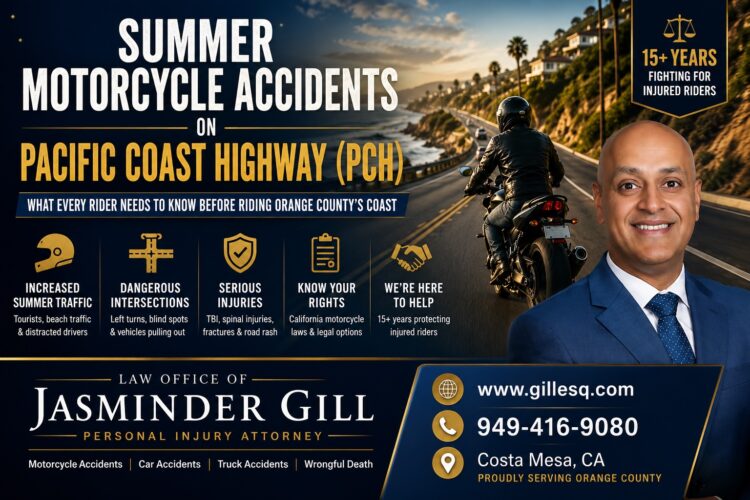
What Every Rider Needs to Know Before Riding Orange County’s Coast | Law Office of Jasminder Gill
Few roads in California are as recognizable—or as breathtaking—as Pacific Coast Highway. Stretching along the Orange County coastline, PCH attracts thousands of motorcyclists every summer who come to enjoy the ocean views, coastal breeze, and scenic ride through Newport Beach, Corona del Mar, Crystal Cove, Laguna Beach, and Huntington Beach.
For many riders, traveling Pacific Coast Highway is one of the highlights of the summer riding season.
Unfortunately, it is also one of the most dangerous.
Each year, the combination of increased tourism, heavy beach traffic, distracted drivers, construction, special events, and holiday travel contributes to a significant increase in motorcycle accidents throughout Orange County. While motorcycles account for only a small percentage of vehicles on the road, riders are far more likely to suffer catastrophic or fatal injuries when a collision occurs because they lack the physical protection available inside a passenger vehicle.
At the Law Office of Jasminder Gill, we understand how devastating a motorcycle accident can be. For more than 15 years, attorney Jasminder Gill has represented injured riders and their families throughout Costa Mesa and Orange County, helping clients pursue compensation for medical expenses, lost income, future treatment, pain and suffering, and other damages caused by another driver’s negligence.
Motorcycle accidents are often far more complex than ordinary automobile collisions. Insurance companies frequently attempt to place blame on riders by alleging excessive speed, unsafe lane splitting, reckless riding, or rider error—even when the evidence tells a very different story. Building a successful motorcycle accident claim often requires a prompt investigation, preservation of evidence, witness interviews, accident reconstruction, and a thorough understanding of California personal injury law.
Whether you ride every day or only on weekends, understanding the unique risks associated with Pacific Coast Highway can help reduce your chances of becoming another summer accident statistic.
Why Summer Is the Most Dangerous Time of Year for Motorcycle Riders
Southern California enjoys riding weather nearly year-round, but the summer months consistently bring a noticeable increase in traffic and roadway hazards.
Beginning around Memorial Day and continuing through Labor Day, Orange County experiences a dramatic increase in visitors traveling to local beaches, restaurants, shopping districts, and entertainment venues. Families are on summer vacation, students are out of school, rental cars become more common, and thousands of visitors unfamiliar with local roads begin navigating Pacific Coast Highway.
This seasonal increase in traffic creates a perfect storm for motorcycle accidents.
Unlike occupants inside passenger vehicles, motorcyclists have very little protection during a collision. Even relatively low-speed crashes can result in severe orthopedic injuries, traumatic brain injuries, spinal cord damage, extensive road rash, internal bleeding, or permanent disability.
Summer also introduces several additional risk factors that riders should recognize.
Increased Tourist Traffic
Orange County welcomes millions of visitors every year, with many arriving during the summer months to enjoy the beaches, resorts, and coastal communities.
Many tourists are unfamiliar with Pacific Coast Highway and may:
- Make sudden lane changes after missing a turn.
- Stop unexpectedly to access beach parking.
- Slow dramatically while searching for restaurants or hotels.
- Rely heavily on GPS navigation instead of watching surrounding traffic.
- Become distracted by ocean views rather than nearby vehicles.
These driving behaviors can be especially dangerous for approaching motorcycles.
Holiday Weekends Create Higher Crash Risks
Major holidays such as Memorial Day, Independence Day, and Labor Day typically bring significantly heavier traffic throughout Orange County.
Popular destinations including Newport Beach, Huntington Beach, Laguna Beach, Crystal Cove State Park, and Corona del Mar attract thousands of additional vehicles.
Holiday weekends also tend to increase incidents involving:
- Impaired driving
- Speeding
- Aggressive driving
- Driver fatigue
- Distracted driving
- Congested intersections
Motorcyclists frequently find themselves surrounded by drivers who are impatient, distracted, or unfamiliar with local traffic patterns.
More Inexperienced Drivers
Summer vacation means more newly licensed teenage drivers are sharing the road.
While many young drivers are careful and responsible, they naturally have less driving experience recognizing motorcycles, judging their speed, and anticipating their movements.
One of the most common statements heard after a motorcycle collision is:
Unfortunately, failing to see a motorcycle does not excuse negligent driving.
Why Pacific Coast Highway Presents Unique Risks for Riders
Pacific Coast Highway differs from many other Orange County roadways because it combines scenic coastal driving with heavy commercial activity, pedestrian traffic, cyclists, beach access points, shopping districts, restaurants, and residential neighborhoods.
Drivers frequently enter and exit traffic while attempting to access:
- Beach parking lots
- Hotels
- Coastal restaurants
- Shopping centers
- Gas stations
- Residential neighborhoods
- Public parking structures
Every driveway and intersection presents another opportunity for a driver to violate a motorcyclist’s right-of-way.
Unlike freeway riding, where traffic generally travels in the same direction with fewer interruption points, PCH contains countless conflict areas where vehicles cross directly into the path of approaching motorcycles.
Even experienced riders must remain alert every second they are on the roadway.
The Most Dangerous Sections of Pacific Coast Highway in Orange County
While every portion of Pacific Coast Highway requires caution, several stretches consistently experience heavier congestion and greater collision risks.
Newport Beach
The Newport Beach section of Pacific Coast Highway becomes extremely congested during the summer months.
Drivers entering and exiting the Balboa Peninsula, Newport Pier, Lido Marina Village, and Mariners’ Mile frequently make abrupt lane changes or stop unexpectedly while searching for parking.
Visitors unfamiliar with local streets often become distracted by navigation systems while attempting to locate beach access points, restaurants, or hotels.
Motorcyclists should expect:
- Heavy weekend congestion
- Frequent left-turning vehicles
- Pedestrian crossings
- Rideshare pickups
- Vehicles entering from side streets
- Sudden braking
Corona del Mar
Corona del Mar offers beautiful coastal scenery but presents unique challenges for riders.
Numerous intersections, retail businesses, restaurants, and residential neighborhoods create constant turning movements throughout the day.
Drivers entering Pacific Coast Highway from local streets often focus on larger passenger vehicles while overlooking approaching motorcycles.
This area also experiences substantial bicycle and pedestrian traffic, particularly during weekends and holidays.
Crystal Cove
Crystal Cove State Park attracts thousands of visitors throughout the summer.
Vehicles frequently slow unexpectedly while entering beach parking lots or searching for available spaces.
Changing speed limits, limited shoulders, blind curves, and increased pedestrian activity make this stretch particularly hazardous for motorcyclists.
Visitors unfamiliar with the roadway may brake suddenly after spotting scenic overlooks or beach entrances.
Laguna Beach
The Laguna Beach section of Pacific Coast Highway combines steep hills, tight curves, pedestrian crossings, and dense commercial activity.
During the summer, traffic often slows dramatically through downtown Laguna Beach as drivers search for parking or stop for pedestrians crossing the roadway.
Motorcyclists should remain particularly alert near intersections, crosswalks, and parking entrances where vehicles frequently change direction without adequate warning.
Huntington Beach
Although many riders associate Huntington Beach with open coastal riding, summer weekends often produce heavy congestion near Main Street, Beach Boulevard, Pacific City, Huntington Beach Pier, and Bolsa Chica State Beach.
Drivers entering traffic from parking lots or attempting last-second lane changes create dangerous conditions for nearby motorcyclists.
Congestion often extends for several miles during holiday weekends.
The Most Common Causes of Motorcycle Accidents on Pacific Coast Highway
No two motorcycle accidents occur exactly the same way. However, after years of representing injured riders, certain collision patterns appear repeatedly.
Understanding how these crashes happen can help riders anticipate dangerous situations before they become life-changing accidents.
Left-Turn Collisions
One of the leading causes of serious motorcycle accidents occurs when a driver turns left directly into the path of an oncoming motorcycle.
These crashes commonly happen when drivers:
- Misjudge a motorcycle’s speed.
- Fail to see an approaching rider.
- Rush through an intersection.
- Attempt to beat oncoming traffic.
- Focus on larger vehicles while overlooking motorcycles.
Because motorcycles occupy less visual space than passenger vehicles, drivers often underestimate how quickly they are approaching.
Unfortunately, these collisions frequently result in catastrophic injuries because riders are thrown from their motorcycles upon impact.
Unsafe Lane Changes
Drivers frequently change lanes without checking blind spots or signaling.
This becomes increasingly common during summer traffic when motorists are searching for beach parking, restaurants, hotels, or alternate routes.
Motorcycles can disappear into a vehicle’s blind spot within seconds, making proper mirror checks and shoulder checks essential.
When drivers fail to look carefully before changing lanes, the results can be devastating.
Distracted Driving Continues to Be One of the Leading Causes of Motorcycle Accidents
While distracted driving has become a nationwide safety concern, it poses an even greater threat to motorcyclists. A driver who glances away from the road for only a few seconds may fail to notice an approaching motorcycle until a collision is unavoidable.
Along Pacific Coast Highway, distractions are everywhere. Drivers often look toward the ocean, search for beach parking, adjust GPS directions, answer text messages, or focus on passengers instead of the traffic around them. Because motorcycles have a smaller visual profile than passenger vehicles, they are easier to overlook when a driver’s attention is divided.
Common distractions include:
- Texting or checking social media
- Programming GPS navigation
- Searching for beach parking
- Looking at ocean views instead of traffic
- Eating or drinking while driving
- Talking with passengers
- Adjusting vehicle controls
- Looking for hotels, restaurants, or shopping centers
Even a momentary lapse in attention can have devastating consequences for a motorcyclist.
Rear-End Motorcycle Accidents
Many people assume rear-end collisions only result in minor property damage. Unfortunately, that is rarely true when a motorcycle is involved.
During the busy summer months, traffic on Pacific Coast Highway often slows unexpectedly near intersections, beach entrances, crosswalks, and popular attractions. A distracted driver following too closely may not have enough time to stop before striking a motorcycle from behind.
Unlike occupants of passenger vehicles, riders have little protection from the force of impact. Even a relatively low-speed rear-end collision can eject a motorcyclist from the bike, resulting in broken bones, spinal injuries, traumatic brain injuries, or permanent disability.
Maintaining a safe following distance is important for all drivers, but motorists must also recognize that motorcycles may stop more quickly than larger vehicles under certain conditions.
Unsafe Lane Changes and Blind Spot Collisions
One of the most common crash scenarios on Pacific Coast Highway involves a driver changing lanes directly into the path of a motorcycle.
Heavy summer traffic encourages frequent lane changes as drivers attempt to reach beach parking lots, restaurants, hotels, or turn lanes. Unfortunately, many motorists fail to check mirrors carefully or perform a proper shoulder check before moving into another lane.
Motorcycles occupy less space than passenger vehicles and can easily disappear within a driver’s blind spot.
These crashes frequently occur when:
- Drivers become impatient in slow-moving traffic.
- Motorists suddenly realize they are about to miss a turn.
- Vehicles merge after leaving beach parking areas.
- Drivers attempt to avoid congestion by changing lanes repeatedly.
When a driver fails to maintain awareness of surrounding traffic, the resulting collision can throw a rider from the motorcycle and cause life-altering injuries.
Drivers Opening Vehicle Doors Into Motorcyclists
Dooring accidents are another hazard found throughout coastal communities.
Areas with parallel street parking, restaurants, cafés, and retail businesses often place parked vehicles immediately adjacent to traffic lanes. When occupants open a vehicle door without checking for approaching motorcycles, riders may have little time or space to react.
Attempting to swerve around an unexpectedly opened door may force a rider into another lane or directly into oncoming traffic.
These crashes commonly occur in commercial areas throughout Newport Beach, Laguna Beach, and Huntington Beach during the busy summer season.
California Motorcycle Laws Every Rider Should Understand
Understanding California’s motorcycle laws not only promotes safer riding but also helps riders protect their legal rights after a collision.
California Helmet Law
California law requires both motorcycle operators and passengers to wear a properly fitted, DOT-compliant safety helmet while riding.
A quality helmet significantly reduces the risk of severe head injuries and may become important evidence during an injury claim.
Lane Splitting Is Legal in California
California is one of the few states where lane splitting is legal when performed safely.
Although lane splitting is permitted, every situation must be evaluated based on surrounding traffic conditions, vehicle speed, roadway conditions, and whether the rider exercised reasonable care.
Insurance companies sometimes attempt to argue that a rider was automatically at fault simply because lane splitting occurred.
That is not how California law works.
The facts surrounding each collision determine liability.
Comparative Negligence
California follows a comparative negligence system.
This means an injured motorcyclist may still recover compensation even if they are found partially responsible for the accident. However, any recovery may be reduced by the rider’s percentage of fault.
Insurance companies frequently attempt to exaggerate a rider’s responsibility in order to reduce the amount they must pay.
An experienced attorney understands how to challenge these arguments using evidence, witness testimony, and accident reconstruction.
Serious Injuries Frequently Seen in Motorcycle Accidents
Motorcycle accidents often involve injuries far more severe than those suffered in passenger vehicle collisions.
Common injuries include:
Traumatic Brain Injuries
Even when wearing a helmet, riders may suffer concussions, traumatic brain injuries, cognitive impairment, memory loss, headaches, dizziness, or long-term neurological complications.
Spinal Cord Injuries
Damage to the spinal cord may result in chronic pain, nerve damage, partial paralysis, or permanent paralysis requiring lifelong medical care.
Multiple Fractures
Broken wrists, arms, shoulders, ribs, hips, legs, ankles, and pelvis fractures are common because riders instinctively attempt to protect themselves during a fall.
Many fractures require surgery, implanted hardware, months of rehabilitation, and extended time away from work.
Road Rash
Road rash is often dismissed as a minor injury, but severe abrasions can remove multiple layers of skin, requiring skin grafts, reconstructive surgery, and extensive wound care.
Permanent scarring is common.
Internal Injuries
Blunt-force trauma may cause internal bleeding or damage to organs such as the liver, spleen, kidneys, or lungs.
Some internal injuries may not produce immediate symptoms, making prompt medical evaluation critical after any motorcycle accident.
Emotional Trauma
Not every injury is visible.
Many riders experience anxiety, depression, sleep disturbances, or post-traumatic stress after a serious collision. Emotional injuries can affect employment, relationships, and overall quality of life long after physical wounds have healed.
Why Insurance Companies Often Challenge Motorcycle Accident Claims
Motorcycle accident claims frequently receive more scrutiny than other motor vehicle cases.
Unfortunately, some insurance adjusters rely on outdated stereotypes suggesting motorcyclists are reckless or inherently dangerous.
These assumptions can unfairly influence the way claims are evaluated.
Common insurance company arguments include:
- The rider was speeding.
- The motorcycle was lane splitting.
- The rider failed to maintain control.
- The rider should have anticipated the driver’s actions.
- The rider’s injuries were pre-existing.
- Medical treatment was delayed.
- The injuries are exaggerated.
- The rider shares responsibility for the collision.
These arguments are often made before a complete investigation has even been conducted.
An experienced motorcycle accident attorney works to obtain surveillance footage, dash camera video, witness statements, vehicle data, accident reconstruction evidence, and medical documentation to establish exactly how the collision occurred.
The Importance of Preserving Evidence Immediately After a Crash
Evidence can disappear quickly after a motorcycle accident.
Traffic camera footage may be erased within days. Witnesses become difficult to locate. Damaged vehicles are repaired or salvaged. Physical evidence at the scene may disappear before investigators arrive.
Preserving evidence as early as possible can make a significant difference in the outcome of a personal injury claim.
Important evidence may include:
- Police reports
- CHP collision reports
- Scene photographs
- Helmet damage
- Riding gear
- Motorcycle damage
- Vehicle damage
- Dash camera recordings
- GoPro footage
- Cell phone records
- Surveillance video
- Witness statements
- Medical records
- Accident reconstruction reports
Prompt legal representation often allows this evidence to be gathered before it is permanently lost.
What to Do Immediately After a Motorcycle Accident on Pacific Coast Highway
The moments following a motorcycle accident are often chaotic and overwhelming. Riders may be in severe pain, unsure of the extent of their injuries, or focused only on getting out of traffic. However, the actions you take immediately after a crash can have a significant impact on both your health and your ability to recover compensation.
If you are physically able, consider taking the following steps:
1. Call 911 Immediately
Report the accident and request emergency medical assistance if anyone is injured.
A responding law enforcement agency—such as the local police department or the California Highway Patrol—can investigate the scene, interview witnesses, document roadway conditions, and prepare an official traffic collision report. That report often becomes an important piece of evidence during an insurance claim or lawsuit.
2. Seek Medical Attention Right Away
Many serious injuries are not immediately apparent after a motorcycle accident. Adrenaline can temporarily mask pain, causing riders to underestimate the severity of their injuries.
Prompt medical evaluation can help identify conditions such as:
- Traumatic brain injuries
- Internal bleeding
- Neck and back injuries
- Spinal cord trauma
- Fractures
- Ligament and tendon injuries
Following your physician’s treatment recommendations also creates medical documentation that may become critical evidence in your case.
3. Photograph Everything
If it is safe to do so, take photographs before the vehicles are moved.
Important photographs include:
- All vehicles involved
- Damage to your motorcycle
- Damage to the other vehicle
- Roadway conditions
- Skid marks
- Debris
- Traffic signals
- Lane markings
- Weather conditions
- Visible injuries
- Your helmet and protective riding gear
Photographs often preserve details that disappear long before an insurance adjuster begins investigating the claim.
4. Obtain Witness Information
Independent witnesses can provide valuable testimony regarding how the collision occurred.
Obtain names and contact information whenever possible before witnesses leave the scene.
5. Avoid Discussing Fault
Remain polite, but avoid making statements such as:
- “I’m sorry.”
- “I didn’t see them.”
- “I may have been going too fast.”
Even innocent comments can later be taken out of context by insurance companies attempting to reduce or deny your claim.
6. Contact an Experienced Motorcycle Accident Attorney
Motorcycle accident cases often involve disputed liability, catastrophic injuries, and substantial financial losses.
Speaking with an attorney early allows important evidence to be preserved while protecting your rights during communications with insurance companies.
What Compensation May Be Available After a Motorcycle Accident?
Every motorcycle accident case is unique, and the value of a claim depends on numerous factors, including the severity of the injuries, available insurance coverage, future medical needs, and the long-term impact the collision has on the injured person’s life.
Depending on the circumstances, compensation may include:
Medical Expenses
Injured riders may recover compensation for:
- Emergency transportation
- Emergency room treatment
- Hospitalization
- Surgery
- Diagnostic imaging
- Physical therapy
- Chiropractic care
- Prescription medications
- Follow-up treatment
- Future medical expenses
Lost Income
If injuries prevent you from working, you may be entitled to recover:
- Lost wages
- Lost overtime
- Lost commissions
- Reduced earning capacity
- Future loss of income
Pain and Suffering
California law allows injured individuals to pursue compensation for non-economic damages resulting from serious injuries.
These damages may include:
- Physical pain
- Emotional distress
- Anxiety
- Depression
- Loss of enjoyment of life
- Permanent disability
- Disfigurement
- Scarring
Property Damage
Motorcycle accidents often result in significant damage to:
- The motorcycle
- Helmets
- Riding jackets
- Gloves
- Boots
- Electronics
- Riding equipment
These losses may also be recoverable.
FAQ’s About Pacific Coast Highway Motorcycle Accidents
Is lane splitting legal in California?
Yes. California permits lane splitting when it is performed safely and reasonably under the circumstances. The fact that a rider was lane splitting does not automatically make them responsible for a collision.
What if the driver says they never saw my motorcycle?
Failure to see an approaching motorcycle is not a legal defense to negligence. Drivers have a duty to keep a proper lookout before turning, merging, or changing lanes.
Can I recover compensation if I was partially at fault?
In many cases, yes. California follows a comparative negligence system, meaning an injured rider may still recover damages even if they share some responsibility for the accident.
Should I speak with the other driver’s insurance company?
It is generally advisable to be cautious. Insurance adjusters may ask questions designed to minimize your claim or obtain statements that can later be used against you.
Before providing a recorded statement, consider consulting with an experienced motorcycle accident attorney.
How long do I have to file a motorcycle accident lawsuit in California?
California law generally establishes deadlines for filing personal injury claims, but the applicable deadline depends on the specific facts of each case. Waiting too long may jeopardize important legal rights, so it is best to consult with an attorney as soon as possible after an accident.
What if the driver who hit me was uninsured?
Depending on your insurance policy, uninsured or underinsured motorist coverage may help provide compensation. An attorney can review your available insurance coverage and explain your options.
What if a defective roadway contributed to my crash?
Hazardous road conditions, poor maintenance, debris, inadequate signage, or dangerous roadway design may contribute to motorcycle accidents. Depending on the circumstances, additional parties may be legally responsible.
Why Choose the Law Office of Jasminder Gill
Choosing the right attorney after a serious motorcycle accident is one of the most important decisions an injured rider can make.
For more than 15 years, attorney Jasminder Gill has represented injury victims throughout Costa Mesa and Orange County, providing personalized legal representation focused on achieving the best possible outcome for every client.
When you work with the Law Office of Jasminder Gill, you receive:
- Direct communication with an experienced attorney—not just staff.
- Thorough investigation of the accident.
- Preservation of critical evidence before it disappears.
- Coordination with medical providers.
- Skilled negotiation with insurance companies.
- Preparation of every case as though it may proceed to trial.
- Representation on a contingency fee basis—you pay no attorney fees unless compensation is recovered.
Motorcycle accident cases often involve complex factual and legal issues. Early legal representation can make a meaningful difference in preserving evidence, protecting your rights, and pursuing the compensation you deserve.
Get Help From a Costa Mesa Motorcycle Accident Lawyer
If you or a loved one has been injured in a motorcycle accident, you don’t have to deal with insurance companies alone.
If you’re searching for a motorcycle accident lawyer near you, The Law Office of Jasminder Gill represents injury victims in Costa Mesa, Newport Beach, Santa Ana, Irvine, and throughout Orange County. We are committed to helping clients recover maximum compensation for medical expenses, lost income, and pain and suffering.
Insurance companies often try to blame motorcyclists or minimize the severity of injuries. Our firm works to protect your rights, gather evidence, and build a strong case to ensure you receive the full compensation you deserve.
Learn more from our Car Accident Lawyer in Costa Mesa.