Modesto Punjabi Truck Accident Lawyer
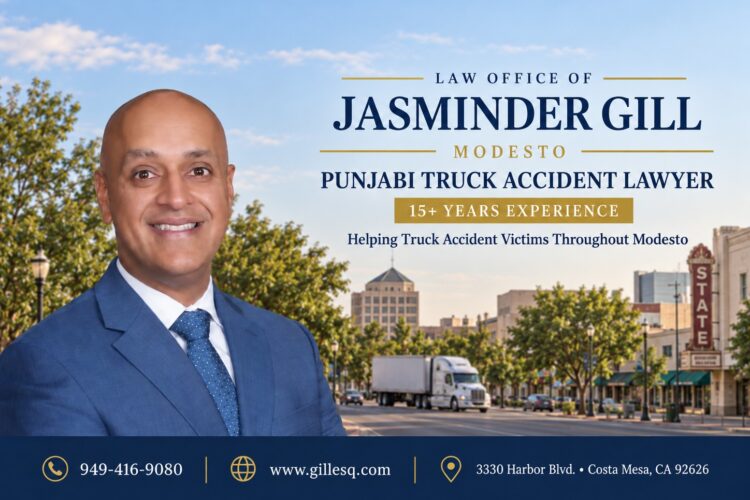
Modesto Punjabi Truck Accident Lawyer for Serious Commercial Vehicle Claims
A truck crash in Modesto can begin with a delivery, a warehouse departure, or a Highway 99 trip and end with months of treatment and uncertainty. Injured people may encounter an adjuster for the driver, another representative for the carrier, and a separate company associated with the trailer. Understanding who did what is often as important as identifying the truck itself.
The Law Office of Jasminder Gill represents people injured in Modesto truck accidents and other California personal injury matters. Attorney Jasminder Gill has more than 15 years of experience, has practiced in California since 2009, has helped thousands of clients, and has recovered millions for injured people and families. He speaks Punjabi and works with a team that includes commercial driver’s license holders.
For a commercial vehicle claim, we evaluate the collision together with the operation behind it: the driver’s assignment, the equipment, the shipment, the maintenance, and the businesses that controlled relevant decisions. We then develop the evidence of responsibility and the medical and financial consequences of the injuries.
15+ YEARS EXPERIENCE | THOUSANDS OF CLIENTS HELPED | MILLIONS RECOVERED | CALIFORNIA ATTORNEY SINCE 2009 | TEAM INCLUDES CDL HOLDERS | PUNJABI ASSISTANCE | 24/7 FREE CONSULTATIONS
Call 949-416-9080 for a Free Modesto Punjabi Truck Accident Consultation
Modesto clients can communicate with the firm’s Costa Mesa office by phone or video. Punjabi-speaking attorney services and Spanish consultations are available.
The initial intake provides information for attorney review. If the firm accepts the matter and a written retainer is signed, we arrange the attorney consultation and begin the representation. You pay no upfront attorney’s fee and owe no attorney’s fee unless the firm recovers compensation. Case costs and other terms are covered by the written agreement. Results depend on each case’s facts and cannot be promised.
Modesto Truck Claims Often Involve Production and Distribution
Modesto’s business economy includes food processing and manufacturing, distribution, and agricultural services. Commercial transportation supports those activities, linking facilities, suppliers, customers, and regional highways. A truck involved in a collision may have been moving finished products, raw materials, packaging, equipment, or another shipment.
The cargo and delivery arrangement can point to important documents. Production records may explain a loading time. A receiving appointment can establish where the driver was expected. A service record may identify work performed on the trailer before the trip. These facts help reconstruct the operation rather than merely adding company names to the claim.
Highway 99 is part of the local transportation setting, but a crash at a facility entrance requires different analysis from one on the highway. We identify the location, maneuver, and disputed issues before determining which records and professionals are needed.
A Delivery Appointment Can Help Reconstruct the Day
A scheduled appointment may be relevant when there is a dispute about where the driver was, how long the driver worked, or whether a delay changed the route. Dispatch messages, check-in information, and receipts can help establish a reliable chronology.
These documents must be interpreted carefully. A delivery timestamp may record arrival, unloading, or completion rather than the exact moment the vehicle entered a gate. We compare records instead of treating every business timestamp as equivalent.
A Facility’s Role Must Be Connected to the Crash
A shipper or receiver is not automatically responsible because the truck was serving its business. The legal inquiry may involve loading, instructions, control of a maneuver, property conditions, or other conduct that contributed to the incident.
A camera owned by a facility can still be an important evidence source even if the business has no liability. Investigating a company’s records and naming it as a defendant are different decisions.
Start With the Driver, Tractor, Trailer, and Carrier
A tractor and trailer can belong to different businesses. The driver may operate leased equipment under a carrier’s authority. A delivery contractor may use a branded vehicle. An insurance representative may refer to a business name that does not identify every legal entity involved.
When available, we review identifying numbers, registrations, operating information, contracts, and employment or dispatch records. Photographs of both the tractor and trailer can be valuable. A single license plate or logo may leave important ownership questions unanswered.
Identifying the correct entities helps direct preservation requests, policy inquiries, and any litigation. It can also reduce the chance that an insurer’s explanation of a corporate relationship is accepted without supporting documentation.
Highway 99 Collisions: Trace the Movement Before Impact
A freeway collision may involve braking traffic, a truck entering a lane, a passenger vehicle near the trailer, or a sequence of impacts. The final resting positions do not always show where the dangerous movement began.
We assess vehicle paths, speed, distance, sightlines, road conditions, and the timing of actions. Available video, witness statements, truck records, and physical evidence can help test competing accounts. A qualified reconstruction professional may be appropriate when the mechanics remain disputed.
The analysis should account for all involved drivers. A commercial truck is not automatically at fault, and a smaller vehicle’s mistake does not necessarily eliminate the truck driver’s responsibility. The facts may support allocation among several parties.
Rear-End and Multiple-Impact Crashes
A truck striking stopped or slowing traffic can push vehicles together. It may be necessary to determine which impacts occurred first, whether a vehicle had already been hit, and whether the truck’s contact created an additional collision.
That sequence can affect fault and injury analysis. The medical history should accurately describe multiple impacts when known. Recordings, damage patterns, and witnesses may help resolve discrepancies between the accounts.
Unsafe Merging and Trailer Contact
The cab may be ahead of another vehicle while the trailer remains beside it. A driver who moves over without sufficient clearance can cause a sideswipe or force the other driver into another lane.
Contact locations, mirror visibility, signaling, and recordings can be useful. If a driver took evasive action without direct truck contact, independent proof may become especially important to establish the connection.
Facility Entrances, Yard Movements, and Backing Injuries
A commercial truck maneuvering near a facility may travel slowly and still cause severe harm. Pedestrians, smaller vehicles, and workers can be difficult to see around large equipment. A driver may be receiving instructions while also monitoring mirrors and traffic.
We may examine the layout, camera views, marked areas, instructions, use of a spotter, and the actual path of the truck. The location of obstacles and parked trailers can affect visibility. Records of the facility’s procedures may provide context when they relate to the collision.
A workplace setting can create separate legal issues. The firm evaluates potential personal injury claims against responsible third parties and does not handle workers’ compensation cases. Whether a civil claim exists depends on the parties and circumstances.
When Another Company Operates the Truck
A worker injured by a separate carrier’s truck may have questions beyond the employer relationship. The carrier’s driving, maintenance, or loading conduct may need evaluation. Applicable benefits and reimbursement rights may also affect a potential recovery.
An attorney should determine the scope of the third-party claim and explain what advice is needed from other counsel. We do not describe every workplace accident as a lawsuit against the employer.
Cargo Problems Can Change a Vehicle’s Handling
A load that is overweight, uneven, inadequately restrained, or otherwise unsafe may affect steering, braking, or stability. Falling material can also create a hazard for vehicles that are never struck by the truck itself.
The investigation may review loading photographs, weight information, restraints, inspection documents, shipment records, and communications. Different parties can be responsible for different parts of loading and transport. Who controlled the work is central to the legal analysis.
A cargo problem should be distinguished from a driver’s unsafe maneuver or an equipment defect. More than one factor may have contributed. Evidence concerning the load needs to be preserved before unloading, cleanup, or repair removes the condition at issue.
Maintenance History and Defective Components
Brake performance, tire condition, steering, lights, coupling equipment, and other systems can matter after a truck collision. A driver or carrier may claim that a sudden failure caused the event. Service records and physical examination can help evaluate that claim.
Prior complaints may show whether a problem was reported. Repair invoices may identify who performed work and which components were replaced. Inspection documents can help establish what was checked, although the existence of a signed form does not prove that an inspection was adequate.
A product defect can raise issues separate from negligent maintenance. Preserving the equipment allows appropriate experts to consider manufacturing, design, wear, repairs, and operational conditions. Liability must be supported rather than inferred from a failure alone.
Why the Condition Before Repair Matters
Replacing a damaged part can alter evidence about the cause of the collision. Photographs, removed components, diagnostic records, and inspection access may need preservation before work begins.
The truck may also be moved between towing, storage, repair, and company facilities. Knowing where it is located and who controls it can be necessary to arrange a lawful examination.
Driver Scheduling, Fatigue, and Company Instructions
A commercial driver’s day may include loading, waiting, inspecting equipment, and driving. Reviewing only the trip immediately before impact can miss the broader work schedule. The applicable hours rules depend on the operation and any valid exceptions.
Dispatch messages, duty logs, location information, fuel records, and delivery appointments may help establish that schedule. We evaluate whether the records support an allegation of fatigue and whether fatigue contributed to the unsafe conduct at issue.
Company pressure may be relevant when instructions encouraged speeding, inadequate rest, or other unsafe practices. A claim must connect the policy or instruction to the collision. A busy business or demanding customer does not automatically create liability.
What Electronic Information Can Actually Show
Truck systems differ. Some record engine events or operational information. Others track duty status, location, delivery progress, or camera footage. The available information and its retention must be determined for the particular vehicle and fleet.
A download may require qualified assistance and preservation of the system’s original context. Timestamps, event triggers, system settings, and later vehicle use can affect interpretation. Not every commercial truck has a recorder that captures a complete account of the crash.
We compare electronic information with other evidence. A speed entry may be useful, but it does not alone explain the signal, lane position, roadway condition, or reason for a maneuver. The goal is a coherent reconstruction rather than a collection of isolated data points.
Driver and Vehicle Cameras
Forward-facing footage may show traffic but omit a vehicle beside the trailer. A driver-facing camera may provide information about attention or activity but have a limited field of view. Cameras can also record different time periods around an event.
Relevant original footage should be sought promptly. A selected clip provided by an insurer may not include all useful angles or the preceding sequence. We review what recordings exist and what gaps remain.
Liability Requires More Than Identifying a Safety Violation
A regulatory violation may support a claim when it relates to the cause of the crash. An unrelated recordkeeping problem does not automatically prove every alleged loss. We examine conduct, causation, and damages together.
Potential claims may involve the driver, employer, motor carrier, equipment owner, maintenance provider, loader, product manufacturer, another motorist, or a public entity. Freight-broker responsibility can involve complicated federal questions. Each party requires individual analysis.
The company’s description of the driver as an independent contractor may need review alongside contracts, operational control, equipment arrangements, and applicable law. The investigation should establish the real working relationship.
Medical Evidence Should Show Both Injury and Change
A serious truck crash can cause brain trauma, back or neck injuries, fractures, internal injuries, burns, or other harm. Medical care is the priority, and emergency symptoms require immediate emergency assistance.
Accurate histories matter. Tell providers about the collision, symptoms, prior conditions, and changes after the event. Continued pain or new symptoms should be discussed with an appropriate clinician rather than assumed to be harmless because initial imaging was normal.
The firm obtains and evaluates medical records to document the injury claim. We consider diagnosis, treatment, restrictions, prognosis, and provider opinions. The evaluation should distinguish accident-related injury or aggravation from unrelated conditions.
When Treatment Extends Beyond the First Few Weeks
Some clients need continuing rehabilitation, specialist treatment, or surgery. Others improve with a shorter course of care. The claim should reflect the actual outlook rather than assuming a standard recovery period.
Future expenses may require medical support and, in major cases, additional professional evaluation. Treatment choices remain medical decisions made with appropriate providers, not steps selected merely to increase settlement demands.
Lost Work and the Consequences for a Household
An injured person may miss wages, lose assignments, reduce hours, or become unable to perform a prior occupation. Employment records and medical restrictions can help establish what changed. Self-employed clients may need business records and historical income information.
The effect can extend to family responsibilities. A client may need help with transportation, childcare, meals, cleaning, or personal care. Documentation should identify the assistance, its necessity, and any associated expense.
Some losses are less easily measured but still significant: pain, anxiety, loss of mobility, sleep disruption, and reduced ability to participate in normal activities. Specific evidence of daily life can explain those consequences without exaggeration.
Reduced Earning Capacity After Returning to Work
A return to work does not necessarily mean that every financial loss has ended. A person may return with restrictions, reduced hours, different duties, or fewer advancement opportunities.
Depending on the claim, vocational and economic evidence can help assess future earning ability. The analysis needs to consider the person’s work history, abilities, medical limitations, and realistic options, rather than simply multiplying a past paycheck by a number of years.
Fatal Modesto Truck Accidents
Families facing a fatal collision need a careful investigation and a clear explanation of legal rights. California law controls which relatives may bring a wrongful death claim and what damages are available. A related survival action can involve the estate’s losses and different procedures.
We consider financial support, household services, family relationships, and other legally recoverable losses. The decedent’s work and role in the household may require records and testimony from several sources.
The firm’s communication is intended to help families understand what must be gathered, what decisions are required, and what remains uncertain. A settlement amount cannot be promised, and the legal process cannot undo the loss.
Evaluating Insurance Coverage and Settlement Terms
A commercial claim can involve several policies. Coverage may depend on ownership, use, contracts, the driver’s assignment, and policy terms. We seek relevant policies and evaluate how they apply instead of assuming that every truck carries the same limits.
An insurer may contest fault, treatment, future care, or a company’s responsibility. Those positions require evidence-based responses. A demand should explain the supported claim and address weaknesses the defense is likely to raise.
Settlement evaluation includes the medical outlook, litigation risk, insurance, attorney’s fees, costs, and repayment obligations. A gross offer does not equal the amount the client will receive. The firm explains the available information so the client can make an informed choice.
Deadlines and Litigation in a California Truck Case
California generally allows two years for a personal injury lawsuit. Public-entity claims generally require presentation within six months. Exceptions and additional procedures can change the deadlines, so obtain advice about the particular circumstances promptly.
Negotiations do not necessarily protect a filing deadline. Evidence preservation, identification of defendants, and review of the applicable period should occur while the claim is being investigated. A lawsuit may be needed to obtain records or pursue a disputed claim.
Litigation can include document requests, depositions, inspections, medical or technical experts, negotiations, and trial preparation. Many cases resolve without trial, but the firm evaluates the steps necessary for the accepted matter rather than promising a particular path.
Follow the Shipment Without Assuming Every Participant Is Liable
A Modesto truck’s assignment may begin with a supplier, continue through a production or packaging facility, and end at a distribution location. Records from that chain can help reconstruct the movement of the goods and vehicle. They can also identify who handled a particular decision that became relevant to the crash.
For example, a loading problem requires understanding who placed and secured the cargo. A maintenance problem may require identifying who serviced the equipment. A scheduling allegation may involve the carrier’s dispatch rather than the business receiving the shipment.
The investigation should keep those roles separate. A company can hold valuable evidence without being responsible, and a company that is not displayed on the truck may still have controlled a relevant activity. We use documents and testimony to establish supported connections.
Contracts and Real-World Practice May Need Comparison
A contract may assign a task to one business while the actual procedure involved another. Messages, invoices, job records, and witness testimony can help establish who did the work and who controlled it.
That comparison is especially important when companies give different explanations after a crash. The legal analysis considers applicable duties and the facts of performance rather than treating a single sentence in a contract as the final answer.
Product Handling, Packaging, and Trailer Condition
Goods can be moved in pallets, containers, bulk loads, or other arrangements. The way the load is prepared and restrained may affect whether it shifts, spills, or changes the truck’s stability. Packaging can also become relevant when a carrier argues that the shipper created a hidden problem.
A trailer’s floor, restraints, doors, tires, and other equipment may need inspection when their condition is disputed. An accident may have damaged them after the relevant failure, making expert analysis necessary to distinguish cause from consequence.
Preserving shipment documents and photographs can help clarify the condition before unloading. We do not assume that every cargo movement caused the crash or that a receiving business’s observation proves the condition at departure.
A Missing Record Is a Question, Not an Automatic Verdict
A company may be unable to produce a recording or document because of retention practices, a technical problem, the record’s location, or another explanation. The circumstances need investigation. Whether there was a duty to preserve, when that duty arose, and what happened can affect the legal consequences.
A preservation notice helps identify relevant materials, but it does not prove that every missing item was intentionally destroyed. If evidence has been lost, the attorney must assess the available remedies and alternative sources.
Independent recordings, duplicate business records, service-provider information, or witness testimony may fill some gaps. The claim should continue to evaluate the complete record rather than relying on a single allegation about missing evidence.
Disputes About a Driver’s Route or Assignment
A carrier may argue that a driver was outside the assigned work at the time of the collision. A driver may describe a different destination or a change requested shortly before departure. The actual trip can become relevant to employment and coverage questions.
Dispatch instructions, route records, messages, delivery documents, and timing information may help establish the purpose of the movement. The evidence should also identify whether the driver was using company equipment and what authority the business had over the trip.
Neither a personal stop nor a contractor label automatically answers every issue. The applicable law, contracts, and facts must be reviewed. We explain uncertainty where a relationship or policy remains disputed.
Why a Detailed Medical Chronology Matters in a Production-Related Truck Claim
A client may be transported for emergency care, return home, and later seek follow-up for continuing symptoms. The insurer may compare those stages and ask why a condition was not identified immediately. A chronology can help establish when symptoms were reported and what the providers evaluated.
Include prior relevant treatment, the collision, emergency care, later examinations, therapy, restrictions, and significant changes. Keep the history accurate; do not revise dates or descriptions to make the sequence appear stronger.
The attorney can review the records with appropriate medical opinions to assess causation and damages. Where the evidence is incomplete or conflicting, that should be identified before settlement discussions rather than concealed until the defense raises it.
Business Owners and Independent Workers Face Different Documentation Problems
A client who is paid through invoices or business revenue may not have a regular wage statement. The claim may require canceled appointments, prior invoices, contracts, tax records, replacement-labor costs, and information about the work the client normally performs.
The analysis must distinguish revenue from net earnings and consider the business’s actual interruption. Money the business would have spent to perform work can matter, as can whether another worker completed an assignment or the client rescheduled it.
Future limitations may require evaluating the client’s role in the business. A physical restriction can affect production, driving, customer service, management, or another responsibility differently. The loss should be supported by facts about that particular operation.
Preparing for a Negotiation That Addresses the Defense’s Arguments
A persuasive claim explains the collision and the losses while addressing reasonable questions about fault, medical causation, and value. Ignoring an unfavorable photograph or a prior condition does not make it disappear.
We review evidence that may be used against the client and determine what can be answered with records, testimony, or expert analysis. If a disputed issue creates litigation risk, the client should understand it when considering settlement.
A settlement decision should be based on the evidence, possible recovery, time, expenses, and available alternatives. Punjabi communication can help make those factors clear without turning the discussion into a promise of success.
Questions About Modesto Truck Accident Representation
What should I provide if the truck was leaving a business?
Tell the intake team the location, business name if known, direction of travel, and anything you observed about the turn or departure. Preserve original photographs and recordings. Do not contact employees to suggest what they should say; witness information should be gathered accurately and without pressure.
Can a delivery van accident be reviewed as a commercial vehicle claim?
Yes. The vehicle does not have to be a tractor-trailer. Employment, ownership, delivery arrangements, and available coverage can matter in claims involving vans, box trucks, moving trucks, and other business vehicles.
What if the carrier says it does not own the trailer?
Separate ownership may identify another evidence source or potentially responsible party. It does not by itself establish or eliminate fault. We review the lease, maintenance responsibility, and conduct connected with the collision.
Is the police report enough to prove the case?
The report is an important starting point, but it may omit company records, camera footage, electronic information, or loading evidence. An independent investigation may be needed to address the questions disputed by an insurer. Preserve the original documents as well as any later supplements.
Should I accept an offer while treatment is continuing?
Consider the current diagnosis, expected future needs, and the release’s effect before deciding. A settlement may end the claim even if the condition later worsens. The decision requires individual review rather than a blanket rule based only on treatment status.
Do you handle a truck driver’s workers’ compensation case?
No. The firm handles personal injury claims and can evaluate potential responsibility of a third party. Workers’ compensation requires separate advice, and any civil representation must be clear about its scope.
Can I discuss the case directly in Punjabi?
Yes. Attorney Jasminder Gill speaks Punjabi. Clients can discuss the collision, treatment, insurance issues, and decisions in a language they understand, with remote communication available for Modesto residents.
Speak With A Modesto Truck Accident Lawyer
A commercial truck injury claim should reflect the operation that produced the collision and the consequences for the person injured. The Law Office of Jasminder Gill works to identify relevant companies, preserve evidence, evaluate coverage, and pursue supported compensation.