
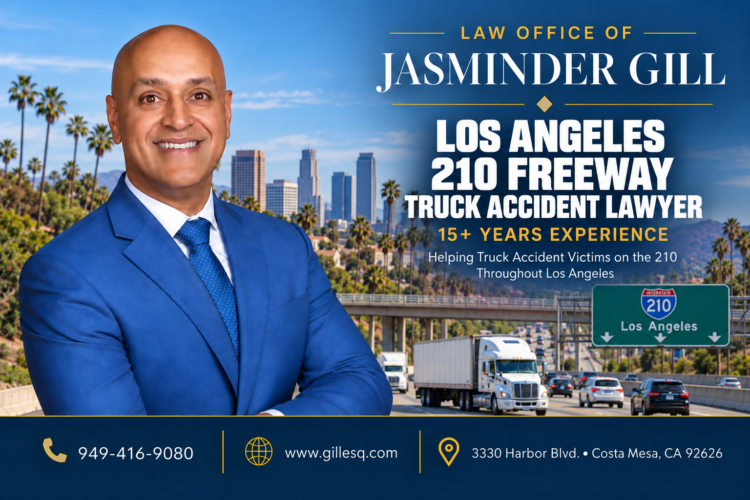
Los Angeles 210 Freeway Truck Accident Lawyer
Foothill Freeway Truck Accidents and Commercial Carrier Liability
If you or a family member was seriously injured in a collision involving a semi-truck, tractor-trailer, 18-wheeler, big rig, box truck, delivery truck, moving truck, construction vehicle, dump truck, flatbed, refrigerated truck, utility truck, equipment hauler, commercial van, or another business-operated vehicle on the 210 Freeway in Los Angeles County, attorney Jasminder Gill can help investigate the collision, preserve potentially important commercial trucking evidence, identify responsible parties, evaluate available insurance coverage, document your injuries and financial losses, and pursue compensation available under California law.
Interstate 210, commonly known as the Foothill Freeway, is a major east-west transportation corridor through the northern San Gabriel Valley.
Within Los Angeles County, the 210 corridor serves or passes through communities including:
- Pasadena
- Arcadia
- Monrovia
- Duarte
- Irwindale
- Azusa
- Glendora
- San Dimas-area destinations
The freeway also connects with major transportation routes including:
- State Route 134
- State Route 2-area connections
- State Route 57
- Interstate 605
- major San Gabriel Valley surface streets
- routes continuing toward San Bernardino County
Metro has specifically studied commercial and heavy-duty truck travel on I-210 between SR-134 in Pasadena and SR-57 in San Dimas.
That study examined:
- Truck travel patterns
- Commodities being transported
- Local warehouses
- Distribution centers
- Freight operators
- Commercial truck routing
That makes the Los Angeles 210 corridor a legitimate commercial-trucking route rather than simply a commuter freeway.
Commercial vehicles using the 210 Freeway may include:
- Tractor-trailers
- Semi-trucks
- Big rigs
- 18-wheelers
- Box trucks
- Delivery trucks
- Moving trucks
- Flatbeds
- Refrigerated vehicles
- Construction trucks
- Dump trucks
- Utility vehicles
- Equipment haulers
- Commercial service fleets
A serious truck collision may involve more than the commercial driver.
Depending on the circumstances, potentially responsible parties may include:
- The commercial driver
- Motor carrier
- Employer
- Truck owner
- Trailer owner
- Maintenance provider
- Cargo-loading company
- Warehouse
- Distribution company
- Delivery company
- Contractor
- Manufacturer
- Another negligent motorist
Call 949-416-9080 for a Free Los Angeles 210 Freeway Truck Accident Consultation
15+ YEARS EXPERIENCE | MILLIONS RECOVERED | THOUSANDS OF CLIENTS HELPED | CALIFORNIA ATTORNEY SINCE 2009 | TEAM INCLUDES CDL HOLDERS | SPANISH CONSULTATIONS AVAILABLE | PUNJABI-SPEAKING ATTORNEY | 24/7 FREE CONSULTATIONS
The Law Office of Jasminder Gill represents people injured in serious commercial truck crashes throughout Los Angeles County and California.
Why the 210 Freeway Matters for Commercial Truck Traffic
The Foothill Freeway runs through one of the northern San Gabriel Valley’s major commercial transportation corridors.
Commercial trucks may use I-210 while traveling between:
- Pasadena
- Irwindale
- Azusa
- Glendora
- San Dimas
- nearby warehouses
- distribution centers
- industrial businesses
- construction projects
- San Bernardino County destinations
A commercial vehicle involved in a collision may therefore be making:
- A local delivery
- A warehouse pickup
- A regional freight trip
- A construction-material delivery
- A utility or equipment trip
- A longer interstate or intrastate commercial route
Understanding the commercial purpose of the trip may help identify evidence that would otherwise be overlooked.
Potential records can include:
- Electronic logging-device data
- Driver logs
- GPS information
- Telematics
- Dispatch communications
- Delivery schedules
- Bills of lading
- Cargo documentation
- Warehouse records
- Fuel receipts
- Work orders
- Electronic vehicle data
Metro Has Specifically Studied Truck Traffic on I-210
Metro conducted an Interstate 210 Truck Origin and Destination study covering approximately 20 miles of I-210 between SR-134 in Pasadena and SR-57 near San Dimas.
The study focused specifically on commercial and heavy-duty truck transportation.
Its goals included identifying:
- Heavy-truck travel patterns
- Commodities transported on I-210
- Freight routing
- Warehouse activity
- Distribution-center activity
- Freight-operator patterns
The studied cities included:
- Pasadena
- Arcadia
- Monrovia
- Duarte
- Irwindale
- Azusa
- Glendora
That history of dedicated truck analysis makes I-210 especially appropriate for a localized commercial truck accident page.
210 Freeway Through Pasadena
Pasadena sits near the western end of the Los Angeles County I-210 freight study corridor.
Commercial vehicles may include:
- Delivery trucks
- Construction vehicles
- Utility trucks
- Box trucks
- Tractor-trailers
- Service fleets
Commercial vehicles may be serving:
- Restaurants
- Retail businesses
- Construction projects
- Commercial properties
- warehouses
- industrial destinations
A commercial truck involved in a Pasadena collision may therefore generate evidence such as:
- Delivery records
- GPS data
- Dispatch communications
- Work orders
- Employer records
- nearby surveillance footage
I-210 and State Route 134
SR-134 connects with I-210 near Pasadena.
Commercial vehicles transitioning between these routes may be moving between:
- Pasadena
- Glendale
- Burbank-area destinations
- San Fernando Valley
- northern San Gabriel Valley
Large trucks need additional room to safely:
- Select lanes
- merge
- account for trailer length
- check blind spots
- respond to slowing traffic
Potential collision issues include:
- Unsafe lane changes
- Improper merging
- Following too closely
- Trailer contact
- Driver distraction
210 Freeway Through Arcadia
I-210 travels through Arcadia and the surrounding northern San Gabriel Valley.
Commercial vehicles may be:
- Making local deliveries
- traveling toward Monrovia or Duarte
- continuing toward industrial destinations farther east
- moving equipment
- serving construction projects
Truck accident evidence may include:
- Commercial GPS history
- delivery documentation
- driver logs
- dispatch records
- business surveillance
- electronic vehicle data
210 Freeway Through Monrovia
Monrovia sits directly along the I-210 corridor.
Commercial traffic may include:
- Box trucks
- delivery vehicles
- tractor-trailers
- construction trucks
- service vehicles
- equipment haulers
A commercial driver may be traveling to or from nearby businesses before entering the freeway.
That can make local commercial records important.
210 Freeway Through Duarte
Duarte is another city included in Metro’s dedicated I-210 truck study.
Commercial vehicles traveling through Duarte may be heading toward:
- Irwindale
- Azusa
- Glendora
- San Dimas
- San Bernardino County
Truck crashes may involve:
- Congestion
- unsafe merging
- following too closely
- speed
- distracted driving
- lane changes
210 Freeway Through Irwindale
A truck accident near Irwindale may require investigators to trace the vehicle’s route, delivery assignment, and connections to nearby industrial businesses. Dispatch records, delivery documents, and business surveillance footage may help establish the truck’s movements before the collision.
Caltrans specifically maintains local truck-route information for Irwindale, reflecting regulated commercial vehicle movement within the city.
Irwindale contains significant:
- Industrial activity
- construction-material businesses
- commercial properties
- freight operations
- equipment movement
Commercial trucks may include:
- Dump trucks
- Flatbeds
- Equipment haulers
- Tractor-trailers
- Construction trucks
- Box trucks
A collision involving a truck serving an Irwindale business may require investigation of:
- Commercial route
- Employer
- Destination
- Cargo
- Weight
- Loading
- Vehicle condition
Why Irwindale Truck Routes Matter
A commercial truck may enter I-210 after operating on a designated local commercial route.
Investigators may need to determine:
- Where the truck originated
- Which business it served
- Whether it followed an appropriate local route
- Whether nearby businesses have surveillance footage
- Whether cargo or loading records exist
Potential evidence may include:
- Gate records
- Security footage
- dispatch instructions
- weight tickets
- loading records
- delivery documentation
- GPS history
Construction and Material Trucks on I-210
The northern San Gabriel Valley contains substantial construction and industrial activity.
Commercial vehicles may include:
- Dump trucks
- Gravel or aggregate haulers
- Flatbeds
- Concrete-related vehicles
- Equipment trailers
- Construction-service trucks
Construction-related truck crashes may involve additional issues such as:
- Cargo weight
- cargo securement
- braking
- maintenance
- tire condition
- driver qualifications
- loading procedures
210 Freeway Through Azusa
I-210 continues east through Azusa.
Commercial vehicles may be traveling between:
- local businesses
- industrial properties
- nearby warehouses
- construction sites
- eastern San Gabriel Valley destinations
A truck may also be continuing toward:
- Glendora
- San Dimas
- San Bernardino County
Potential evidence may include:
- GPS records
- electronic logs
- dispatch information
- delivery appointments
- warehouse documentation
210 Freeway Through Glendora
Glendora sits along the eastern Los Angeles County I-210 corridor.
Commercial vehicles may be completing a local delivery or traveling east toward:
- San Dimas
- La Verne-area destinations
- San Bernardino County
- Inland Empire commercial areas
This may make driver hours and commercial route evidence particularly important.
210 Freeway and State Route 57
The I-210/SR-57 connection is one of the most important commercial transportation junctions on the eastern Los Angeles County corridor.
SR-57 provides access toward:
- San Dimas
- Diamond Bar
- City of Industry-area destinations
- Orange County routes
A commercial truck transitioning between I-210 and SR-57 may be moving between the northern San Gabriel Valley and major warehouse or industrial areas farther south.
Potential evidence may include:
- GPS history
- Dispatch records
- ELD information
- Cargo records
- Delivery schedules
- Bills of lading
I-210 Toward San Bernardino County
After leaving Los Angeles County, I-210 continues east toward the Inland Empire.
Commercial trucks may be heading toward:
- Rancho Cucamonga
- Fontana
- Rialto
- San Bernardino
- Interstate 15
- Interstate 215
- Inland Empire distribution centers
This gives the Los Angeles 210 corridor a clear connection to regional goods movement.
A truck driver involved in a collision in Los Angeles County may therefore be operating on a much longer commercial route.
Why the Inland Empire Connection Matters
A driver traveling between Los Angeles County and the Inland Empire may be operating under:
- delivery deadlines
- dispatch schedules
- warehouse appointments
- long driving shifts
Potential evidence may include:
- electronic logs
- fuel receipts
- GPS data
- warehouse appointment records
- dispatch communications
- bills of lading
Construction Conditions and Truck Collision Evidence on I-210
Bridge repairs, pavement work, maintenance and ramp closures can change traffic conditions on I-210. Narrowed lanes, temporary barriers, reduced shoulders and sudden backups may affect the space available for a commercial truck to merge or stop.
An investigation should establish whether the driver adjusted speed, following distance and lane position for the conditions. Relevant evidence may include traffic-control plans, closure records, roadway photographs, warning signs, dashcam footage and available truck data. The configuration on the crash date matters because work zones can change.
Our Team Includes a CDL-Licensed Staff Member
The Law Office of Jasminder Gill has a staff member who holds a Commercial Driver’s License (CDL).
Commercial truck accident cases involve operational issues that may be unfamiliar to people who have never driven or worked around large commercial vehicles.
A CDL-licensed staff member provides additional practical familiarity with:
- Tractor-trailer operation
- Commercial truck blind spots
- Safe following distance
- Truck braking
- Trailer movement
- Lane positioning
- Freeway merging
- Commercial vehicle inspections
- Driver responsibilities
- Construction-zone driving
- Freeway interchange driving
- grades and roadway conditions
- large-vehicle maneuverability
- driver logs
- commercial trucking terminology
A CDL does not replace qualified accident reconstruction experts, engineers, trucking-safety professionals, mechanics, cargo experts, or other specialists when expert analysis is appropriate.
However, practical commercial-driving familiarity may help identify truck-specific issues that deserve closer investigation.
The Law Office of Jasminder Gill combines 15+ years of California legal experience with practical CDL-related knowledge within its staff.
Why 210 Freeway Truck Accidents Can Cause Serious Injuries
Commercial trucks can weigh substantially more than passenger vehicles.
That difference can increase collision forces significantly.
Large commercial vehicles may also have:
- Longer stopping distances
- Larger blind areas
- Long trailers
- Heavy cargo
- Higher ground clearance
- Different braking characteristics
- More complicated merging requirements
A serious commercial truck crash may involve several passenger vehicles.
Common Causes of Los Angeles 210 Freeway Truck Accidents
Driver Fatigue
Commercial drivers may already have traveled substantial distances before reaching the San Gabriel Valley.
Fatigue may affect:
- Reaction time
- attention
- judgment
- lane control
- braking
- hazard recognition
Potential evidence may include:
- Electronic logging-device data
- driver logs
- GPS information
- dispatch communications
- delivery schedules
- fuel receipts
- work records
Electronic Logging Devices and Driver Hours
Many covered commercial drivers are subject to federal hours-of-service requirements and use electronic logging devices.
FMCSA states that motor carriers must retain electronic records of duty status and supporting documents for six months.
Supporting records can include:
- Bills of lading
- Itineraries
- Schedules
- Dispatch records
- Trip records
- Fleet communications
- Payroll or settlement information
These records may help evaluate whether fatigue or scheduling contributed to a collision.
Following Too Closely
Traffic on I-210 can slow quickly because of:
- congestion
- freeway interchanges
- construction
- lane closures
- collisions ahead
Commercial trucks generally require greater distance to stop safely.
Stopping ability can depend on:
- Speed
- vehicle weight
- cargo weight
- brake condition
- tire condition
- road conditions
- driver reaction time
Unsafe Lane Changes
Commercial trucks have significant blind areas.
Unsafe lane changes can cause:
- Sideswipe collisions
- Passenger vehicles being forced into barriers
- Motorcycle crashes
- Multi-vehicle collisions
Lane-change risks may increase near:
- SR-134
- I-605
- SR-57
- busy local interchanges
Improper Merging
Large commercial trucks need additional roadway space to merge safely.
Drivers should account for:
- Tractor length
- trailer length
- nearby passenger vehicles
- motorcycles
- available lane space
- traffic speed
Distracted Driving
Potential commercial-driver distractions may include:
- Cell phones
- text messages
- GPS systems
- dispatch equipment
- paperwork
- delivery instructions
- in-cab electronics
Unsafe Speed
A truck can be traveling too fast for conditions even when below the posted maximum speed.
Commercial drivers should adjust speed for:
- congestion
- construction
- grades
- curves
- lane reductions
- cargo
- visibility
- traffic backups
Truck Brake Problems
Commercial braking systems require appropriate maintenance and inspection.
Potential evidence may include:
- Brake inspection records
- maintenance files
- repair invoices
- driver defect reports
- physical vehicle evidence
- electronic truck information
Tire Failures
A commercial truck tire failure can cause:
- Loss of control
- roadway debris
- trailer instability
- secondary collisions
Improper Cargo Loading
Cargo loaded or secured improperly may:
- Shift
- affect vehicle balance
- increase braking difficulty
- contribute to rollover
- fall into traffic
A warehouse or cargo-loading company may potentially share responsibility depending on the circumstances.
Types of Los Angeles 210 Freeway Truck Accidents
Rear-End Truck Accidents
A commercial truck may strike stopped or slowing traffic when the driver leaves insufficient stopping distance.
Jackknife Accidents
A tractor-trailer may jackknife and block several freeway lanes.
Underride Accidents
A smaller vehicle may become lodged beneath a truck or trailer.
These collisions can cause catastrophic or fatal injuries.
Rollover Accidents
Truck rollover crashes may involve:
- Speed
- Cargo movement
- Steering
- Ramp geometry
- Mechanical issues
Blind-Spot and Sideswipe Accidents
A truck may strike another vehicle while changing lanes.
The existence of a blind spot does not automatically excuse unsafe driving.
Lost-Cargo Accidents
Commercial cargo or construction materials may fall onto the freeway.
This can cause secondary collisions.
Multi-Vehicle Truck Crashes
Dense traffic may cause one commercial truck accident to involve several vehicles.
Evidence After a Los Angeles 210 Truck Accident
Potential evidence may include:
- Electronic logging-device records
- Driver logs
- GPS information
- Telematics
- Dispatch communications
- Delivery schedules
- Bills of lading
- Cargo documentation
- Warehouse records
- Weight tickets when applicable
- CDL information
- Driver qualification files
- Training records
- Inspection documents
- Maintenance files
- Repair history
- Dash-camera footage
- In-cab video
- Electronic truck data
- CHP reports
- Photographs
- Witness statements
- Business surveillance footage
- Traffic-camera recordings
- Commercial insurance information
Truck Black Box and Electronic Vehicle Data
Some commercial trucks contain electronic systems capable of recording operational information.
Depending on the vehicle, relevant data may concern:
- Speed
- Braking
- Throttle activity
- Engine operation
- Vehicle movement
Electronic information can sometimes be overwritten through continued vehicle operation.
Driver Qualification and CDL Records
A motor carrier may possess information concerning:
- CDL status
- License class
- Endorsements
- Restrictions
- Driving history
- Training records
- Prior violations
- Qualification files
Possession of a valid CDL does not establish that the driver operated safely during the collision.
Truck Maintenance and Inspection Records
Potential evidence may include:
- Pre-trip inspection records
- Maintenance schedules
- Brake service
- Tire replacement
- Repair records
- Safety inspections
- Driver defect reports
Why Evidence Preservation Matters
A trucking company, warehouse, construction company, employer, loading company, or maintenance provider may possess evidence unavailable to the injured person.
Preservation efforts may seek:
- ELD data
- Driver logs
- GPS information
- Dash-camera video
- Dispatch communications
- Driver qualification files
- Warehouse records
- Maintenance documents
- Inspection files
- Cargo records
- Electronic truck data
FMCSA’s six-month retention period for many ELD and supporting records makes timely evidence preservation important in appropriate cases.
Who May Be Responsible for a Los Angeles 210 Truck Accident?
Commercial Driver
A truck driver may be responsible for:
- Unsafe speed
- Following too closely
- Unsafe lane changes
- Distracted driving
- Fatigue
- Improper merging
Motor Carrier or Trucking Company
A carrier may potentially be responsible based on its relationship with the driver or its own conduct involving:
- Hiring
- Training
- Supervision
- Scheduling
- Maintenance
- Safety practices
Employer
Some commercial vehicles are operated by companies that are not traditional trucking companies.
These may include:
- Construction companies
- Delivery businesses
- Equipment companies
- Utility providers
- Service businesses
Truck Owner
The commercial vehicle owner may differ from the driver’s employer.
Trailer Owner
The trailer may belong to another business.
Maintenance Provider
A separate maintenance company may have inspected or repaired the truck.
Cargo Loading Company
Improper cargo loading or securement may create additional responsibility issues.
Warehouse or Distribution Company
A warehouse may possess information concerning:
- truck arrival
- departure time
- cargo
- loading
- delivery schedules
- driver communications
Construction or Materials Company
Construction-related truck cases may involve:
- employers
- contractors
- loading facilities
- material suppliers
- equipment owners
Manufacturer
A defective vehicle component may create additional liability issues.
Another Motorist
A commercial driver is not automatically responsible merely because a truck was involved.
Commercial Truck Insurance After a 210 Freeway Accident
Truck accidents may involve several commercial insurance policies.
Potential coverage may include:
- Motor carrier insurance
- Employer coverage
- Truck-owner insurance
- Trailer-owner coverage
- Contractor insurance
- Other commercial policies
Commercial insurers may begin investigating quickly.
An adjuster may request:
- Recorded statements
- Medical authorizations
- Medical information
- Employment information
- Accident details
- Settlement documents
An injured person should understand who the representative works for and what information is being requested before signing releases or providing extensive statements.
Injuries From Los Angeles 210 Freeway Truck Accidents
Commercial truck collisions may cause:
- Traumatic brain injuries
- Concussions
- Spinal cord injuries
- Neck injuries
- Back injuries
- Herniated discs
- Fractures
- Pelvic injuries
- Shoulder injuries
- Knee injuries
- Internal injuries
- Chest injuries
- Nerve damage
- Crush injuries
- Burns
- Scarring
- Amputations
- Permanent impairment
- Psychological trauma
Wrongful Death After a Fatal 210 Freeway Truck Accident
Some commercial truck accidents result in fatal injuries.
California law may allow certain eligible survivors or legally authorized representatives to pursue wrongful death claims when another party’s wrongful conduct causes a death.
A survival claim may also exist depending on the circumstances.
Compensation After a Los Angeles 210 Truck Accident
Potential damages may include:
- Medical expenses
- Future medical treatment
- Rehabilitation
- Lost wages
- Reduced earning capacity
- Property damage
- Pain and suffering
- Emotional distress
- Physical impairment
- Other legally recoverable damages
No particular settlement or result can be guaranteed.
What to Do After a Truck Accident on the 210 Freeway
Call 911 When Necessary
Commercial truck crashes can create serious freeway hazards.
Obtain Medical Treatment
Medical needs should take priority.
Photograph the Scene When Safe
Potentially useful photographs may include:
- Truck company name
- USDOT number
- Tractor number
- Trailer number
- License plates
- Vehicle damage
- Cargo
- construction materials
- Road debris
- Skid marks
- Lane markings
- Nearby freeway signs
Never enter active freeway lanes to gather evidence.
Obtain Witness Information
Witnesses may have observed:
- Truck speed
- Braking
- Lane changes
- Merging
- Cargo movement
- Sequence of impacts
Preserve Your Documents
Keep:
- Medical records
- Medical bills
- Insurance communications
- Towing paperwork
- Repair estimates
- Photographs
- Wage information
- Receipts
CHP Reports After a Los Angeles 210 Truck Accident
The California Highway Patrol investigates many freeway collisions.
A collision report may include:
- Driver information
- Vehicle information
- Insurance information
- Witness statements
- Collision diagrams
- Roadway conditions
- Investigative observations
A CHP report may be important evidence but does not automatically determine civil liability.
Punjabi-Speaking Los Angeles 210 Freeway Truck Accident Lawyer
Attorney Jasminder Gill speaks Punjabi and can communicate directly with Punjabi-speaking clients regarding serious commercial truck accident claims.
Punjabi-speaking clients can discuss:
- How the collision happened
- Injuries
- Medical treatment
- Insurance coverage
- Vehicle damage
- Missed work
- Trucking-company communications
- Warehouse or freight issues
- Commercial insurance
- The California personal injury process
Clients do not need to rely on a child, friend, or family member to interpret important legal conversations.
Telephone and video consultations are available.
Why Choose the Law Office of Jasminder Gill?
Attorney Jasminder Gill has more than 15 years of California legal experience.
The firm can help:
- Investigate the truck collision
- Identify potentially responsible parties
- Preserve commercial trucking evidence
- Review driver records
- Review motor-carrier records
- Investigate warehouse records
- Evaluate electronic truck data
- Investigate maintenance records
- Investigate commercial insurance
- Obtain available CHP reports
- Document injuries
- Document lost income
- Communicate with insurers
- Negotiate claims
- Prepare litigation when appropriate
The firm also has a CDL-licensed staff member, providing additional practical familiarity with tractor-trailer operation, commercial driving, braking, inspections, blind spots, trailer movement, freeway merging, construction vehicles, grades, and regional commercial routes.
Frequently Asked Questions About Los Angeles 210 Freeway Truck Accidents
What Is the 210 Freeway Called?
Interstate 210 is commonly known as the Foothill Freeway.
What Los Angeles County Cities Does I-210 Serve?
The corridor serves areas including Pasadena, Arcadia, Monrovia, Duarte, Irwindale, Azusa, Glendora, and communities near San Dimas.
Is the 210 Freeway Used by Commercial Trucks?
Yes. Metro has specifically studied commercial and heavy-duty truck movement along I-210 between Pasadena and SR-57, including warehouse, distribution-center, freight-operator, and commodity movements.
Why Is Irwindale Important for Truck Traffic?
Irwindale contains substantial industrial and construction-related activity, and Caltrans maintains specific local truck-route information for the city.
What if My Accident Happened in Pasadena?
Commercial delivery records, GPS data, employer information, dispatch communications, and local surveillance may become important.
What if My Accident Happened Near SR-134?
Commercial trucks transitioning between SR-134 and I-210 may be traveling between Pasadena, Glendale, Burbank-area destinations, and the San Fernando Valley.
What if My Accident Happened in Arcadia or Monrovia?
A commercial truck may be making a local delivery or traveling through the northern San Gabriel Valley. GPS and delivery records can help establish its route.
What if My Accident Happened in Irwindale?
Potential evidence can include weight tickets, loading records, commercial-route information, delivery records, GPS data, and business surveillance footage.
What if a Dump Truck Hit Me?
Dump-truck cases may require investigation of cargo weight, loading, braking, maintenance, employer records, and the driver’s commercial route.
What if My Accident Happened Near Azusa?
The truck may have been traveling between local businesses and eastern San Gabriel Valley or Inland Empire destinations.
What if My Accident Happened Near Glendora?
A commercial vehicle may have been continuing toward San Dimas, San Bernardino County, or other Inland Empire destinations, making route and driver-hours evidence particularly relevant.
Why Is the 210/57 Connection Important?
SR-57 connects the northern San Gabriel Valley with Diamond Bar, Industry-area destinations, Orange County routes, and other major commercial corridors.
Does the 210 Connect With the Inland Empire?
Yes. I-210 continues east into San Bernardino County toward Rancho Cucamonga, Fontana, Rialto, San Bernardino, and major Interstate 15 and I-215 connections.
Why Does Your CDL-Licensed Staff Member Matter?
A CDL-licensed staff member provides practical familiarity with commercial vehicle operation, braking, inspections, blind spots, trailer movement, merging, construction trucks, grades, and driver responsibilities. That practical knowledge does not replace qualified expert analysis.
What if the Truck Driver Had a Valid CDL?
A valid CDL does not establish that the driver acted safely.
What if the Driver Was Fatigued?
Electronic logs, driver records, GPS information, dispatch communications, delivery schedules, fuel receipts, and other commercial records may help evaluate fatigue.
How Long Are ELD Records Retained?
FMCSA states that covered motor carriers must retain RODS and supporting documents for six months.
Can the Trucking Company Be Responsible?
Potentially. Responsibility may involve the driver, motor carrier, employer, vehicle owner, trailer owner, maintenance provider, warehouse, loading business, or another party.
Can a Warehouse Be Responsible?
Potentially, depending on the facts. Cargo loading, weight, securement, scheduling, or other warehouse activities may become relevant.
What if the Truck’s Brakes Failed?
Maintenance records, inspection documents, repair history, driver defect reports, physical vehicle evidence, and electronic truck information may need investigation.
What if Cargo Fell From the Truck?
Potential responsibility may involve the driver, carrier, truck owner, loading company, warehouse, construction company, or another responsible business.
What if Several Vehicles Were Involved?
Multi-vehicle truck crashes may require investigation of the impact sequence, speeds, braking, lane positions, and conduct of multiple drivers.
What if I Was Partially at Fault?
California comparative-fault principles may allow recovery even when an injured person shares responsibility, although compensation may be reduced.
How Long Do I Have to File a Los Angeles Truck Accident Claim?
California imposes legal deadlines on personal injury claims. Different or shorter procedural requirements can apply depending on the parties involved, particularly when a government entity is involved.
Serving Los Angeles County Communities Along the 210 Freeway
The Law Office of Jasminder Gill represents people injured in serious commercial truck crashes in and around:
- Pasadena
- Arcadia
- Monrovia
- Duarte
- Irwindale
- Azusa
- Glendora
- San Dimas-area destinations
- Other northern San Gabriel Valley communities
Speak With a Los Angeles 210 Freeway Truck Accident Lawyer
A serious commercial truck accident on Interstate 210 may involve evidence extending far beyond what is visible at the collision scene.
A thorough investigation may require examination of:
- Commercial driver conduct
- CDL and qualification information
- Motor-carrier records
- Electronic logging-device data
- Driver fatigue
- GPS and telematics
- Dispatch communications
- Warehouse records
- Bills of lading
- Cargo documentation
- Weight tickets when applicable
- Truck maintenance
- Inspection records
- Electronic vehicle data
- Roadway and construction conditions
- CHP evidence
- Commercial insurance coverage
- Medical records
- Lost income
- Other financial and personal losses
If you or a family member was seriously injured in a semi-truck, tractor-trailer, big-rig, 18-wheeler, box-truck, delivery-truck, moving-truck, dump-truck, construction-truck, flatbed, equipment hauler, or another commercial-vehicle collision on the 210 Freeway in Los Angeles County, contact the Law Office of Jasminder Gill.
Call 949-416-9080 for a Free Los Angeles 210 Freeway Truck Accident Consultation
Telephone and video consultations are available.