
Irvine Punjabi Personal Injury Lawyer
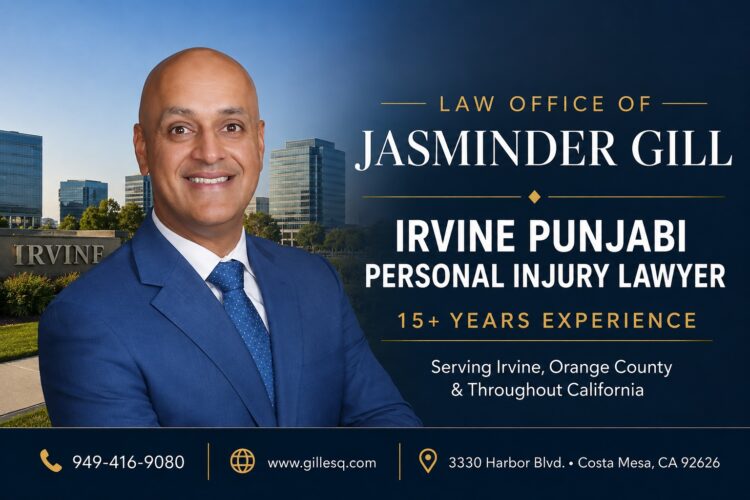
Irvine Punjabi Personal Injury Lawyer for Serious Accidents and Wrongful Death
If you or a family member was injured because of another person’s negligence, an experienced Irvine Indian personal injury lawyer can help you understand your rights, deal with the insurance companies, and pursue compensation supported by the evidence.
Attorney Jasminder Gill has more than 15 years of personal injury experience and has helped thousands of injured clients. The Law Office of Jasminder Gill represents accident victims in Irvine and throughout Orange County.
We understand that a serious injury can affect your health, employment, education, finances, independence, and entire family. Our firm takes the time to listen, explain the legal process clearly, and investigate the complete effect of the accident.
Punjabi-speaking legal assistance is available. ਪੰਜਾਬੀ ਵਿੱਚ ਗੱਲ ਕਰਨ ਲਈ ਸਾਨੂੰ 949-416-9080 ਤੇ ਕਾਲ ਕਰੋ।
Our physical office is located in Costa Mesa, and we assist Irvine clients through telephone consultations, video conferences, electronic document signing, and in-person meetings when appropriate.
15+ YEARS EXPERIENCE | THOUSANDS OF CLIENTS HELPED | MILLIONS RECOVERED | CALIFORNIA ATTORNEY SINCE 2009 | PUNJABI SPEAKING | SPANISH CONSULTATIONS | 24/7 FREE CONSULTATIONS
Call 949-416-9080 for a free consultation
Contact the Law Office of Jasminder Gill if you were injured in Irvine or another Orange County community.
There are no upfront attorney’s fees. You pay no attorney’s fee unless our firm recovers compensation for you.
Personal Injury Cases We Handle in Irvine
Personal injury law covers many accidents and events in which another person, business, property owner, manufacturer, employer, or government entity may be legally responsible.
Our firm handles Irvine personal injury claims involving:
- Car accidents
- Truck accidents
- Motorcycle accidents
- Rideshare accidents
- Pedestrian accidents
- Bicycle accidents
- E-bike accidents
- Bus and public-transit accidents
- Commercial-vehicle collisions
- Delivery-driver accidents
- Hit-and-run accidents
- Uninsured and underinsured motorists
- Dangerous property conditions
- Slip-and-fall accidents
- Dog bites and animal attacks
- Defective products
- Traumatic brain injuries
- Spinal cord injuries
- Burn injuries
- Amputations
- Catastrophic injuries
- Wrongful death
Every case requires an individual investigation. The responsible parties, insurance coverage, evidence, legal deadlines, and available compensation will depend on how the injury occurred.
Why Irvine’s Indian Community May Choose Jasminder Gill
Choosing an attorney after a serious accident is a personal decision. Clear communication and cultural understanding can make an unfamiliar legal process easier for an injured person and the family members helping with treatment, transportation, household responsibilities, and financial decisions.
Attorney Jasminder Gill understands that clients may want an attorney who can communicate naturally with Punjabi-speaking relatives and appreciate the role of the extended family during a medical and financial crisis.
Our firm works to provide:
- Direct communication with the attorney
- Punjabi-speaking assistance
- Clear explanations without unnecessary legal jargon
- Respect for the client’s cultural and family considerations
- Regular updates about the claim
- Assistance communicating with insurance companies
- Careful documentation of medical and financial losses
- Remote consultations for Irvine residents
- Contingency-fee representation
- Litigation preparation when an appropriate settlement cannot be reached
Although cultural familiarity can improve communication, the value of a personal injury claim ultimately depends on the law, evidence, available insurance, and effect of the injuries. Our objective is to prepare every claim carefully and pursue the compensation the evidence supports.
Why Hire an Irvine Personal Injury Attorney?
An insurance adjuster may appear helpful after an accident, but the insurance company’s financial interests are different from yours. The adjuster may investigate the claim immediately, request a recorded statement, examine your medical history, question the seriousness of your injuries, or argue that you contributed to the accident.
A personal injury attorney can protect your interests by:
- Investigating how the accident happened
- Preserving physical and electronic evidence
- Identifying every potentially responsible party
- Locating applicable insurance coverage
- Obtaining police and incident reports
- Interviewing witnesses
- Reviewing photographs and video recordings
- Gathering medical records and bills
- Documenting lost wages and reduced earning ability
- Evaluating future treatment needs
- Responding to allegations of comparative fault
- Communicating with insurance adjusters
- Negotiating for an appropriate settlement
- Filing a lawsuit when necessary
- Preparing the case for trial
The attorney can also help prevent avoidable mistakes, such as signing an overly broad medical authorization, accepting a premature settlement, posting damaging information online, or allowing an important filing deadline to expire.
Irvine Car Accident Claims
Car accidents are a leading source of personal injury claims in Orange County. Irvine has heavily traveled freeways, major arterial roads, residential communities, shopping destinations, business centers, and university traffic.
Collisions may occur on or near:
- Interstate 5
- Interstate 405
- State Route 133
- State Route 241
- Jamboree Road
- Culver Drive
- Jeffrey Road
- Irvine Boulevard
- Barranca Parkway
- Alton Parkway
- Campus Drive
- University Drive
- Sand Canyon Avenue
- MacArthur Boulevard
The location of an accident can affect the available evidence and potentially responsible parties. A collision may involve another passenger driver, commercial business, rideshare company, delivery service, vehicle owner, employer, contractor, or government entity.
Evidence in an Irvine car accident case may include:
- Police reports
- Photographs of the vehicles and roadway
- Traffic-camera recordings
- Business surveillance footage
- Dashboard-camera recordings
- Witness statements
- Vehicle event-data information
- Cellphone records
- Medical documentation
- Repair estimates
- Employment and income records
Evidence can disappear quickly. Video may be overwritten, vehicles may be repaired, witnesses may become difficult to locate, and roadway conditions may change. Prompt investigation can help protect the claim.
Common Causes of Irvine Car Accidents
Motor vehicle collisions frequently involve one or more forms of negligent driving, including:
- Distracted driving
- Texting while driving
- Speeding
- Unsafe lane changes
- Following too closely
- Failing to yield
- Running a red light
- Ignoring a stop sign
- Driving while impaired
- Drowsy driving
- Aggressive driving
- Unsafe turns
- Failure to check blind spots
- Driving too fast for traffic or weather conditions
- Inexperienced driving
- Defective vehicle components
More than one person or entity may share responsibility. For example, a commercial driver may have caused the collision while working, potentially creating a claim involving both the driver and employer.
Irvine Truck and Commercial-Vehicle Accidents
Truck accidents can result in devastating injuries because of a commercial vehicle’s size and weight. These cases may also involve more defendants, insurance policies, records, and federal or state safety requirements than an ordinary passenger-vehicle claim.
Potentially responsible parties may include:
- The truck driver
- The trucking company
- The driver’s employer
- The vehicle owner
- A freight or logistics company
- A maintenance provider
- A cargo-loading company
- A leasing company
- A vehicle or component manufacturer
- Another negligent motorist
Important evidence may include driver logs, electronic logging-device information, inspection records, maintenance documents, dispatch communications, employment files, qualification records, onboard video, electronic vehicle data, and cargo records.
Trucking companies and insurers may begin investigating immediately. A preservation letter may be needed to prevent relevant electronic information and business records from being destroyed under routine retention practices.
Irvine Motorcycle Accident Claims
Motorcyclists have little physical protection when struck by a passenger vehicle, truck, or commercial vehicle. Even a collision at a relatively modest speed can cause severe injuries.
Common motorcycle injuries include:
- Traumatic brain injuries
- Spinal cord damage
- Fractures
- Internal injuries
- Road rash
- Nerve damage
- Shoulder and knee injuries
- Amputations
- Permanent scarring
- Fatal injuries
Insurance companies may attempt to rely on stereotypes about motorcyclists or claim that the rider was speeding, lane splitting unsafely, or difficult to see. Those allegations should be tested against witness testimony, video, vehicle damage, roadway evidence, electronic information, and the conduct of every driver involved.
Irvine Rideshare Accident Claims
Uber and Lyft accidents may involve complicated insurance questions. Available coverage can depend on what the rideshare driver was doing when the collision occurred.
Relevant questions may include whether the driver:
- Was logged out of the application
- Was available and waiting for a request
- Had accepted a ride
- Was traveling to pick up a passenger
- Was transporting a passenger
An injured passenger, pedestrian, cyclist, motorcyclist, or occupant of another vehicle may have claims involving the rideshare driver, another negligent motorist, a vehicle owner, or applicable uninsured or underinsured-motorist coverage.
The rideshare trip information, application status, photographs, electronic communications, and insurance policies should be preserved and reviewed.
Irvine Pedestrian Accident Claims
Pedestrians may be injured in crosswalks, parking lots, intersections, residential neighborhoods, commercial centers, and areas near schools or the University of California, Irvine.
Pedestrian collisions frequently involve:
- Drivers failing to yield
- Distracted driving
- Speeding
- Unsafe turns
- Backing accidents
- Poor visibility
- Driving under the influence
- Failure to stop at a traffic signal
- Delivery and rideshare vehicles
- Dangerous roadway conditions
A driver may argue that the pedestrian crossed outside a marked crosswalk, entered the roadway unexpectedly, or was distracted. California’s comparative-fault rules generally require an examination of everyone’s conduct. An allegation against the pedestrian does not automatically eliminate the claim.
Irvine Bicycle and E-Bike Accidents
Irvine has an extensive network of bicycle routes and shared-use paths, but cyclists and e-bike riders remain vulnerable at intersections, driveways, parking areas, and locations where motor vehicles cross bicycle lanes.
Bicycle and e-bike accidents may involve:
- Drivers turning across a bicycle lane
- Vehicles entering from driveways
- Dooring accidents
- Failure to yield at an intersection
- Distracted driving
- Unsafe passing
- Defective bicycle components
- Dangerous road or trail conditions
- Rideshare and delivery vehicles
- Unleashed or uncontrolled animals
In an e-bike case, the insurance company may question the bicycle’s classification, assisted speed, motor power, rider’s age, helmet use, or possible modifications. The device should be preserved in its post-accident condition whenever possible.
Irvine Slip-and-Fall and Premises-Liability Claims
Property owners and businesses generally have a duty to use reasonable care in inspecting, maintaining, and managing their premises. A person injured by a dangerous property condition may have a premises-liability claim.
Hazardous conditions may include:
- Wet or slippery floors
- Uneven pavement
- Broken stairs
- Missing or loose handrails
- Poor lighting
- Defective elevators or escalators
- Merchandise falling from shelves
- Unmarked elevation changes
- Dangerous parking-lot conditions
- Negligent security
- Construction hazards
- Swimming-pool hazards
- Uncontrolled animals
A fall does not automatically establish that the property owner was negligent. The investigation should determine what created the condition, how long it existed, whether the owner knew or should have known about it, and whether reasonable warnings or repairs were provided.
Incident reports, surveillance recordings, inspection logs, maintenance records, employee statements, photographs, and witness information may help establish liability.
Dog Bites and Animal Attacks in Irvine
A dog bite or animal attack can cause puncture wounds, infections, nerve damage, fractures, scarring, disfigurement, and psychological trauma. Children may experience particularly serious physical and emotional effects.
Evidence may include:
- Photographs of the injuries
- Medical records
- Animal-control reports
- Witness statements
- Veterinary records
- Ownership information
- Prior incident evidence
- Homeowners or renters insurance policies
The dog’s owner, a property owner, landlord, caretaker, or another person may be involved depending on the circumstances. An attorney can investigate ownership and available insurance coverage while the injured person focuses on medical care.
What Should You Do After an Accident in Irvine?
The actions taken after an accident may affect both your health and your ability to establish a claim.
When possible:
- Call 911 when emergency assistance is needed.
- Obtain appropriate medical treatment.
- Report the accident to the police, property owner, employer, or other responsible authority.
- Photograph the scene, injuries, vehicles, and surrounding conditions.
- Obtain the names and contact information of witnesses.
- Preserve damaged clothing, personal property, vehicles, bicycles, or products.
- Keep copies of medical bills, receipts, and employment records.
- Avoid discussing fault at the scene.
- Do not post details about the accident or your injuries on social media.
- Use caution before giving an insurance company a recorded statement.
- Do not sign a release without understanding its effect.
- Speak with a personal injury attorney promptly.
Seeking medical care is important even when an injury initially appears manageable. Some head, neck, back, internal, and soft-tissue injuries may not be fully apparent immediately after an accident.
Medical Treatment After an Irvine Accident
Consistent medical care serves two purposes: protecting the injured person’s health and documenting the relationship between the accident and resulting injuries.
Depending on the injury, treatment may involve:
- Emergency care
- Hospitalization
- Diagnostic imaging
- Surgery
- Physical therapy
- Chiropractic treatment
- Pain management
- Orthopedic treatment
- Neurological care
- Psychological counseling
- Occupational therapy
- Home-health assistance
- Future medical procedures
Insurance companies may argue that delayed treatment or gaps in care show that the injuries were not serious or were unrelated to the accident. Legitimate reasons for delayed or interrupted care—such as transportation problems, insurance issues, work obligations, or difficulty obtaining an appointment—should be documented.
Common Injuries in Irvine Personal Injury Cases
The injuries caused by an accident can range from temporary discomfort to permanent, life-changing harm. Two people involved in similar accidents may experience very different medical outcomes.
Common injuries include:
- Traumatic brain injuries
- Concussions
- Spinal cord injuries
- Herniated or bulging discs
- Neck and back injuries
- Broken bones
- Joint injuries
- Torn ligaments and tendons
- Shoulder injuries
- Knee injuries
- Internal bleeding
- Organ damage
- Nerve damage
- Burn injuries
- Crush injuries
- Amputations
- Facial injuries
- Dental injuries
- Permanent scarring
- Disfigurement
- Psychological trauma
- Anxiety and depression
- Post-traumatic stress
- Fatal injuries
A serious injury can affect much more than the injured person’s immediate medical condition. It may interfere with employment, education, household responsibilities, parenting, family relationships, recreation, religious activities, and the ability to live independently.
The claim should account for the complete effect of the injury rather than focusing only on the first emergency-room bill.
Traumatic Brain Injuries
A traumatic brain injury can occur when the head strikes a vehicle, pavement, window, steering wheel, object, or other surface. A brain injury may also result from the rapid movement of the brain inside the skull, even when the head does not directly strike anything.
Possible symptoms include:
- Headaches
- Dizziness
- Nausea
- Memory problems
- Difficulty concentrating
- Confusion
- Sensitivity to light or sound
- Changes in sleep
- Irritability
- Depression or anxiety
- Balance problems
- Speech difficulties
- Changes in personality
- Loss of consciousness
- Seizures
Some symptoms may not be immediately obvious. Family members, friends, and coworkers may notice behavioral or cognitive changes before the injured person fully recognizes them.
A traumatic brain injury claim may require neurological evaluations, diagnostic testing, rehabilitation records, testimony from family members, employment evidence, and qualified medical opinions about future limitations and care.
Spinal Cord and Back Injuries
Motor vehicle collisions, falls, bicycle accidents, and other traumatic events can damage the vertebrae, discs, nerves, or spinal cord.
Spinal injuries may result in:
- Chronic neck or back pain
- Reduced range of motion
- Numbness or tingling
- Muscle weakness
- Radiating pain
- Difficulty walking
- Loss of coordination
- Bowel or bladder complications
- Partial paralysis
- Complete paralysis
- Permanent dependence on assistive equipment
Treatment may involve medication, physical therapy, pain-management procedures, injections, surgery, rehabilitation, mobility equipment, home modifications, and long-term assistance.
When the injury is permanent, the claim should consider future medical expenses, reduced earning ability, diminished independence, necessary home or vehicle modifications, and the cost of personal care.
Catastrophic Injury Claims
A catastrophic injury permanently changes the injured person’s ability to work, care for themselves, communicate, move independently, or participate in ordinary activities.
Examples may include:
- Severe traumatic brain injuries
- Spinal cord injuries
- Paralysis
- Amputations
- Extensive burn injuries
- Permanent vision loss
- Permanent hearing loss
- Multiple traumatic injuries
- Severe organ damage
- Permanent neurological impairment
These cases require a careful evaluation of future needs. Depending on the circumstances, attorneys may work with medical specialists, rehabilitation professionals, vocational experts, economists, life-care planners, engineers, and accident-reconstruction professionals.
Future losses may include:
- Additional surgeries
- Long-term medical treatment
- Prescription medications
- Physical and occupational therapy
- Psychological care
- Mobility devices
- Prosthetic devices
- In-home assistance
- Accessible transportation
- Home modifications
- Lost future earnings
- Reduced earning capacity
Accepting a settlement before future needs are reasonably understood may leave the injured person responsible for expenses that were not included in the resolution.
Who May Be Responsible for an Irvine Accident?
The person who directly caused an accident is not always the only responsible party. An investigation should examine every individual, business, property owner, employer, manufacturer, contractor, or government entity whose conduct may have contributed to the injury.
Potentially responsible parties may include:
- A negligent driver
- The owner of a vehicle
- A driver’s employer
- A trucking company
- A rideshare or delivery driver
- A commercial business
- A property owner
- A property-management company
- A landlord
- A maintenance contractor
- A construction company
- A manufacturer
- A distributor or retailer
- A repair facility
- A school or university
- A public agency
- A government entity
- Another person whose negligence contributed to the accident
Identifying all responsible parties is important because each party may have different insurance coverage, evidence, defenses, and legal obligations.
The Elements of a California Personal Injury Claim
Most negligence-based personal injury claims require evidence establishing four general elements:
Duty of Care
The responsible person or entity must have owed the injured person a legal duty to use reasonable care.
Drivers, for example, must operate their vehicles with reasonable care. Property owners may have duties concerning the inspection and maintenance of their premises. Businesses may have obligations related to their employees, products, or services.
Breach of Duty
The evidence must show that the responsible party failed to meet the applicable standard of care.
A breach may involve speeding, texting while driving, failing to repair a known hazard, violating a safety rule, improperly loading cargo, or selling a defective product.
Causation
The negligent conduct must have been a substantial factor in causing the accident or injury.
Insurance companies often dispute causation by arguing that the injury existed before the accident, resulted from another event, or was not medically consistent with the collision.
Damages
The injured person must have sustained legally recognizable harm, such as medical expenses, lost income, pain, disability, emotional distress, or property damage.
Evidence supporting damages may include medical records, bills, wage documentation, photographs, testimony, expert opinions, and records showing how the injury affected the person’s life.
California Comparative Fault
California follows a comparative-fault system. Responsibility may be divided among multiple people or entities, including the injured person when the evidence supports such a finding.
For example, an insurance company might argue that:
- A driver was speeding before another vehicle turned in front of them
- A pedestrian was distracted while entering a crosswalk
- A bicyclist was riding outside a designated lane
- A motorcyclist made an unsafe maneuver
- A shopper failed to notice an open and obvious condition
- An injured person failed to follow a posted warning
An allegation of partial fault does not automatically eliminate the claim. The available recovery may be reduced according to the percentage of responsibility assigned to the injured person.
Because insurers frequently attempt to increase the injured person’s share of fault, all available evidence should be examined before accepting an adjuster’s version of the accident.
Evidence That May Support an Irvine Injury Claim
The strength of a personal injury claim often depends on the quality and availability of the evidence.
Relevant evidence may include:
- Police reports
- Incident reports
- Photographs
- Surveillance recordings
- Traffic-camera footage
- Dashboard-camera video
- Body-camera recordings
- Witness statements
- 911 recordings
- Vehicle damage
- Event-data recorder information
- Cellphone records
- Rideshare application data
- Trucking records
- Inspection and maintenance records
- Property inspection logs
- Cleaning records
- Prior complaints
- Medical records
- Medical bills
- Employment records
- Tax and income documents
- Expert analysis
Some evidence is controlled by the person or company that may be responsible. A prompt preservation request can place that party on notice that relevant information should not be destroyed.
Why Photographs and Video Matter
Photographs and recordings can preserve details that may disappear shortly after an accident.
Useful images may show:
- Vehicle positions
- Damage to each vehicle
- Skid marks
- Debris
- Traffic signals
- Lane markings
- Lighting conditions
- Weather conditions
- Obstructed signs
- Uneven pavement
- Spills or foreign substances
- Torn clothing
- Visible injuries
- Changes in bruising or swelling
- Scarring over time
- Damaged personal property
When possible, retain original image files. Original files may contain date, time, and location information that is lost when a photograph is copied, edited, or uploaded to social media.
Witness Statements
Independent witnesses may help resolve disputes about speed, traffic signals, right of way, property conditions, warnings, or the conduct of the people involved.
Obtain the witness’s:
- Full name
- Telephone number
- Email address
- Home or business address, when appropriate
- Short description of what the witness observed
Do not assume that a police officer or business employee obtained everyone’s information. Witnesses can become difficult to locate, and their memories may fade.
Medical Evidence and Causation
Medical records help establish the nature of the injuries, treatment provided, relationship to the accident, expected recovery, and potential future care.
Relevant documentation may include:
- Ambulance records
- Emergency-room records
- Hospital records
- Primary-care records
- Specialist evaluations
- Diagnostic imaging
- Operative reports
- Physical-therapy records
- Prescription records
- Mental-health records
- Disability notes
- Future treatment recommendations
The medical record should accurately describe how the accident occurred, when symptoms began, and how the condition has changed.
An injured person should not exaggerate symptoms, but should also avoid minimizing legitimate pain or limitations. Accurate communication allows medical providers to make informed treatment decisions and creates a clearer record of the injury.
Preexisting Conditions and Personal Injury Claims
A preexisting medical condition does not automatically prevent an injured person from recovering compensation.
An accident may:
- Aggravate a prior injury
- Cause a previously stable condition to become symptomatic
- Accelerate the need for treatment
- Increase pain or physical limitations
- Create a new injury in the same part of the body
- Complicate an existing medical condition
Insurance companies may examine earlier medical records and argue that all symptoms existed before the accident. The analysis should distinguish the person’s condition before the event from the new symptoms, aggravation, treatment, and limitations caused by the accident.
Medical opinions and a clear treatment history may be especially important when causation is disputed.
Compensation Available in an Irvine Personal Injury Case
The compensation available depends on the facts, liability evidence, insurance coverage, injury severity, and effect on the injured person.
Potential damages may include:
- Past medical expenses
- Future medical expenses
- Lost wages
- Lost employment benefits
- Reduced earning capacity
- Property damage
- Out-of-pocket expenses
- Physical pain
- Emotional distress
- Mental suffering
- Permanent disability
- Scarring
- Disfigurement
- Loss of enjoyment of life
- Loss of consortium
- Funeral and burial expenses
- Other wrongful-death damages
Not every category applies to every case. The value should be based on evidence rather than a generic settlement calculator or an amount obtained in an unrelated claim.
Medical Expenses
Medical damages may include the reasonable value of care required because of the accident.
Examples include:
- Ambulance transportation
- Emergency treatment
- Hospitalization
- Surgery
- Diagnostic testing
- Specialist care
- Physical therapy
- Medication
- Medical equipment
- Psychological treatment
- Home-health services
- Future treatment
When additional treatment or surgery is anticipated, the claim should not be resolved without considering the reasonably expected cost and effect of that care.
Lost Income and Reduced Earning Capacity
An injury may prevent a person from working temporarily or permanently. Compensation may be available for income already lost and, in appropriate cases, the reduction in the person’s future ability to earn.
Evidence may include:
- Pay statements
- Employer verification
- Tax returns
- Commission records
- Bonus history
- Business records
- Disability documentation
- Medical work restrictions
- Vocational evaluations
- Economic analysis
Self-employed individuals, business owners, commission-based employees, and gig workers may need additional documentation to demonstrate lost income.
Reduced earning capacity differs from wages already missed. It addresses how permanent restrictions may limit future employment opportunities, hours, advancement, or the ability to remain in the same occupation.
Pain, Suffering, and Emotional Distress
An injured person may be entitled to compensation for the physical and emotional consequences of an accident.
Relevant effects may include:
- Physical pain
- Sleep disruption
- Anxiety
- Depression
- Fear of driving
- Post-traumatic stress
- Loss of mobility
- Inability to exercise
- Interference with family activities
- Loss of independence
- Embarrassment from scarring
- Inability to participate in hobbies
- Reduced quality of life
These losses do not come with invoices. They must be documented through medical records, photographs, testimony, activity records, and evidence explaining how the injury changed the person’s daily life.
How Much Is an Irvine Personal Injury Claim Worth?
There is no standard settlement amount for an Irvine personal injury case.
Important factors include:
- How the accident occurred
- The strength of the liability evidence
- Whether fault is disputed
- The severity of the injuries
- The length of medical treatment
- Whether surgery was required
- Whether the injury is permanent
- Future medical needs
- Time missed from work
- Reduced earning capacity
- Scarring or disfigurement
- The injured person’s age and occupation
- The effect on daily activities
- The number of responsible parties
- Available insurance coverage
- Whether the injured person shares fault
A temporary injury followed by a complete recovery will generally be valued differently from a brain injury, paralysis, amputation, or another permanent condition.
Insurance limits can also affect the practical recovery. An attorney should investigate all potentially available coverage before concluding that the only available policy is insufficient.
How Insurance Companies Evaluate Injury Claims
Insurance companies evaluate claims to protect their financial interests. Adjusters may use software, internal guidelines, medical reviews, recorded statements, surveillance, social-media information, and prior medical records when deciding what to offer.
An adjuster may attempt to reduce or deny a claim by arguing that:
- Its insured did not cause the accident
- The injured person was partially or entirely responsible
- The impact was too minor to cause an injury
- Treatment was delayed
- There were gaps in treatment
- Medical care was excessive
- The injury was preexisting
- The person recovered sooner than claimed
- Future treatment is unnecessary
- Lost wages are insufficiently documented
- The person failed to reduce the damages
- The claim exceeds available insurance coverage
These arguments should be evaluated against the evidence. An insurer’s initial assessment is not a binding determination of fault or value.
Should You Give the Insurance Company a Recorded Statement?
Use caution before providing a detailed recorded statement to another party’s insurance company.
The adjuster may ask questions about:
- The accident
- Your speed or location
- What you saw before the impact
- Whether you were distracted
- Your immediate symptoms
- Prior injuries
- Medical treatment
- Work limitations
- Activities since the accident
Statements made shortly after an accident can later be compared with medical records, testimony, social-media activity, and other evidence.
You may need to cooperate with your own insurer under the terms of your policy, but you should still understand your obligations and consider obtaining legal advice before providing a detailed statement.
Insurance Company Medical Authorizations
An insurer may ask the injured person to sign a medical authorization. Some authorizations are written broadly enough to permit access to years of unrelated medical information.
Before signing, determine:
- Which providers are covered
- What dates are included
- What types of records may be released
- Whether unrelated mental-health or medical records are included
- Whether the authorization can be revoked
- How the insurer intends to use the information
The insurance company may be entitled to relevant documentation, but that does not necessarily mean it should receive unlimited access to the injured person’s complete medical history.
Social Media After an Irvine Accident
Insurance companies and defense attorneys may review public social-media content for information they can use against an injured person.
A photograph, caption, check-in, comment, or video may be presented without context to suggest that the person is less injured than claimed.
After an accident:
- Avoid discussing the claim online
- Do not post photographs of the accident
- Do not post medical information
- Avoid commenting on fault
- Do not exaggerate or minimize your condition
- Review privacy settings
- Ask friends and relatives not to tag you in posts
- Do not delete potentially relevant existing content after a claim arises without legal advice
Privacy settings do not guarantee that content will remain confidential.
What If the At-Fault Driver Is Uninsured?
An uninsured driver does not necessarily mean that no compensation is available.
Potential sources may include:
- Uninsured-motorist coverage
- Underinsured-motorist coverage
- Another qualifying household automobile policy
- Coverage associated with the vehicle
- Employer coverage
- Rideshare or delivery-company coverage
- Commercial insurance
- Other responsible parties
Uninsured-motorist coverage may also apply in some hit-and-run cases. Policy requirements and reporting obligations should be reviewed promptly.
What If the Driver Does Not Have Enough Insurance?
Underinsured-motorist coverage may apply when the responsible driver has insurance but the liability limits are insufficient to compensate the injured person fully.
The injured person should not finalize the underlying liability claim without reviewing:
- The at-fault driver’s policy limits
- Vehicle-owner coverage
- Employer or commercial coverage
- Rideshare coverage
- The injured person’s own policy
- Household automobile policies
- Umbrella coverage
- Consent or notice requirements
Insurance policies contain conditions that can affect coverage. A settlement with one insurer may affect another claim if the required procedures are not followed.
Hit-and-Run Accidents in Irvine
After a hit-and-run accident:
- Call the police immediately.
- Write down every detail you remember.
- Photograph the scene and vehicle damage.
- Look for debris or paint transfer.
- Obtain witness information.
- Identify nearby businesses or homes with cameras.
- Preserve dashboard-camera recordings.
- Notify the appropriate insurance carrier.
- Obtain medical treatment.
- Speak with an attorney about uninsured-motorist coverage.
A partial license plate, vehicle color, body style, distinctive damage, direction of travel, or description of the driver may help identify the vehicle.
Nearby surveillance recordings should be requested quickly because many systems automatically overwrite older video.
Claims Involving Government Entities
An accident involving a public road, government vehicle, public employee, dangerous public property, school, bus, or other government-controlled condition may require compliance with special claim procedures.
Potential government-related cases may involve:
- Dangerous intersections
- Defective traffic signals
- Missing or obscured signs
- Dangerous roadway design
- Potholes
- Public sidewalk defects
- Government vehicles
- Public buses
- Public schools
- Construction zones
- Inadequate warnings
- Public-property hazards
Government claims can involve significantly shorter deadlines than ordinary personal injury lawsuits. Waiting for medical treatment to end before investigating the claim can create serious problems.
The responsible public entity must be identified correctly, and the administrative claim must contain the required information. Prompt legal review is especially important when government responsibility may be involved.
Defective Product Claims
A manufacturer, distributor, retailer, installer, or repair business may be responsible when a defective product causes an injury.
Product claims may involve:
- Defective vehicle components
- Tires
- Brakes
- Airbags
- Seat belts
- E-bike batteries
- Chargers
- Power tools
- Household appliances
- Medical devices
- Children’s products
- Industrial equipment
The product should be preserved in its post-accident condition. Do not discard, repair, alter, charge, dismantle, or return it before obtaining appropriate advice.
Packaging, instructions, warnings, receipts, serial numbers, photographs, maintenance records, and recall information may also be important.
Wrongful Death Claims in Irvine
When negligence causes a fatal accident, qualifying surviving family members may be able to pursue a wrongful death claim.
Potential damages may include:
- Funeral and burial expenses
- Lost financial support
- Loss of household services
- Loss of companionship
- Loss of care, comfort, and guidance
- Other losses permitted under California law
A separate survival claim may also be available for certain losses sustained by the deceased person between the injury and death.
Fatal accident cases require immediate and sensitive investigation. Vehicles, products, video recordings, electronic data, roadway evidence, witness testimony, medical records, and insurance information should be preserved as soon as possible.
The Law Office of Jasminder Gill represents families affected by fatal accidents in Irvine and throughout Orange County. Learn more about the firm’s representation in wrongful death cases.
How Long Does an Irvine Personal Injury Case Take?
The time required to resolve a claim depends on the individual circumstances.
Factors affecting the timeline include:
- The severity of the injuries
- The length of medical treatment
- Whether surgery is required
- Whether future treatment is anticipated
- The availability of evidence
- Whether fault is disputed
- The number of responsible parties
- Insurance coverage disputes
- Whether expert analysis is necessary
- Whether a government entity is involved
- Whether a lawsuit must be filed
- The court’s schedule
Some claims resolve through insurance negotiations. Others require litigation because the insurer denies responsibility, disputes causation, challenges the damages, or refuses to make an appropriate offer.
The fastest settlement is not always the best resolution. Settling before the injuries and future treatment needs are reasonably understood may result in compensation that does not account for the complete loss.
The Irvine Personal Injury Claim Process
Every personal injury case is different, but many claims move through several general stages.
Free Initial Consultation
The process begins with a confidential consultation. The attorney may ask about:
- When and where the accident happened
- How the accident occurred
- Who may have caused it
- Whether the police or another agency responded
- The injuries and medical treatment
- Available photographs and video
- Witnesses
- Insurance information
- Time missed from work
- Communications with insurance companies
- Any settlement offers already received
Bring or provide any documents you have, but do not delay contacting an attorney merely because you are waiting for a police report, medical bill, or another record.
Investigation and Evidence Preservation
If the firm accepts the case, the investigation may include:
- Obtaining police and incident reports
- Photographing the accident location
- Interviewing witnesses
- Requesting surveillance recordings
- Preserving vehicles or defective products
- Sending evidence-preservation notices
- Reviewing insurance policies
- Examining employment relationships
- Identifying additional responsible parties
- Consulting qualified experts when necessary
Prompt investigation is particularly important when surveillance video, electronic data, roadway evidence, or a dangerous property condition may change or disappear.
Medical Treatment and Documentation
The injured person should follow appropriate medical advice and attend recommended appointments. The legal team may gather records documenting the diagnosis, treatment, work restrictions, prognosis, and future medical needs.
The attorney does not make medical decisions. Treatment should be based on the advice of qualified healthcare professionals and the injured person’s condition—not on an attempt to increase the value of a claim.
Insurance and Liability Analysis
The attorney may investigate liability coverage available through:
- The responsible person
- A vehicle owner
- An employer
- A commercial policy
- A rideshare or delivery company
- A property owner
- A homeowners or renters policy
- The injured person’s automobile policy
- A household member’s policy
- Umbrella insurance
- Another responsible party
Coverage can be particularly complicated in truck, rideshare, commercial-vehicle, uninsured-motorist, premises-liability, and defective-product claims.
Calculating the Damages
Before presenting a settlement demand, the attorney should evaluate the available evidence concerning:
- Past medical treatment
- Future medical needs
- Lost income
- Reduced earning capacity
- Property damage
- Out-of-pocket expenses
- Physical pain
- Emotional distress
- Permanent limitations
- Scarring or disfigurement
- Loss of enjoyment of life
A claim involving an unresolved medical condition should be evaluated carefully before a final settlement is accepted.
Settlement Negotiations
After sufficient evidence has been collected, the attorney may submit a demand to the responsible insurer. The insurer may accept the demand, reject it, request additional information, dispute liability, or make a counteroffer.
Negotiations may continue until the parties reach an agreement or determine that litigation is necessary.
Filing a Personal Injury Lawsuit
A lawsuit may be appropriate when:
- The insurer denies liability
- Fault remains disputed
- The insurer undervalues the injuries
- Coverage is disputed
- Several defendants are involved
- The deadline is approaching
- The parties cannot agree on compensation
Filing a lawsuit does not necessarily mean the case will go to trial. The parties may continue negotiating while the case proceeds through litigation.
Discovery, Mediation, and Trial Preparation
During discovery, each side may request documents, submit written questions, take depositions, arrange medical examinations, and retain expert witnesses.
The case may also proceed to mediation or another settlement conference. If an appropriate resolution cannot be reached, the attorney can prepare the evidence for trial.
How Long Do You Have to File an Irvine Personal Injury Lawsuit?
California generally provides two years to file an action for injury or death caused by another person’s wrongful act or negligence under California Code of Civil Procedure section 335.1.
That general rule does not apply to every claim. A deadline may be affected by:
- A government entity’s involvement
- The injured person’s age
- The date the injury was discovered
- The defendant’s identity
- The type of legal claim
- Prior notices or agreements
- The date of death in a wrongful death case
- Other statutory exceptions
Claims involving public entities can have much shorter deadlines. Under California Government Code section 911.2, a claim relating to personal injury or death generally must be presented to the appropriate public entity within six months after the claim accrues.
California law may pause certain limitation periods while an injured person is a minor, but important exceptions apply—including claims against public entities. Do not assume that a child’s claim can always wait until adulthood.
Missing an applicable deadline can prevent an injured person from recovering compensation. Speak with an attorney promptly rather than relying on the general two-year period.
Why Choose the Law Office of Jasminder Gill?
A serious accident can leave an injured person dealing with pain, medical appointments, missed work, vehicle repairs, family responsibilities, and repeated insurance calls. Our firm works to manage the legal claim while the client focuses on recovery.
Attorney Jasminder Gill has more than 15 years of personal injury experience and has helped thousands of clients.
Clients can discuss their injuries and concerns directly with Punjabi-speaking attorney Jasminder Gill. Telephone and video appointments allow Irvine clients to communicate with the firm without traveling to Costa Mesa. The firm explains the claim process, keeps clients informed and discusses important decisions affecting their case.
We do not treat clients as claim numbers. We examine how the injury has affected the individual’s health, employment, family, finances, independence, and future.
FAQ’s About Hiring An Irvine Indian Personal Injury Lawyer
Is the Law Office of Jasminder Gill located in Irvine?
The firm’s physical office is located in Costa Mesa. We represent clients in Irvine and throughout Orange County.
Telephone consultations, video conferences, electronic document signing, and remote case communication allow Irvine clients to work with the firm without making unnecessary trips to the office. In-person meetings may also be arranged when appropriate.
Does Jasminder Gill speak Punjabi?
Yes. Attorney Jasminder Gill speaks Punjabi and assists injured people and families who prefer to discuss a personal injury matter in Punjabi.
Punjabi-speaking assistance can help clients understand insurance questions, medical documentation, settlement decisions, and the litigation process. ਪੰਜਾਬੀ ਵਿੱਚ ਗੱਲ ਕਰਨ ਲਈ 949-416-9080 ਤੇ ਕਾਲ ਕਰੋ।
Do I need an Indian or Punjabi personal injury lawyer?
You are not legally required to hire an attorney who shares your language or cultural background. However, clear communication and cultural understanding may make it easier to discuss injuries, family responsibilities, employment concerns, medical treatment, and settlement decisions.
The attorney should also have relevant personal injury experience, communicate directly, investigate the case carefully, and be prepared to litigate when necessary.
How much does an Irvine personal injury lawyer cost?
The Law Office of Jasminder Gill handles personal injury claims on a contingency-fee basis.
There are no upfront attorney’s fees, and you pay no attorney’s fee unless the firm recovers compensation for you. The contingency fee and responsibility for case expenses will be explained in the written agreement.
How do I know whether I have a personal injury case?
A potential claim may exist when another person or entity failed to use reasonable care and caused an injury.
The attorney will generally examine:
- Whether someone owed you a legal duty
- Whether that duty was violated
- Whether the violation caused the accident
- Whether the accident caused an injury
- What evidence is available
- Whether insurance coverage exists
- Whether the claim is still within the applicable deadline
A consultation is the best way to evaluate the specific facts.
Can I recover compensation if I was partially at fault?
Possibly. California follows a comparative-fault system. An injured person may still recover compensation when partially responsible, although the recovery may be reduced according to the percentage of fault assigned to that person.
Do not accept an insurance adjuster’s percentage without reviewing the physical evidence, witness testimony, applicable rules, and conduct of everyone involved.
What if I did not feel injured immediately after the accident?
Some injuries produce delayed symptoms. Headaches, stiffness, back pain, dizziness, numbness, and other symptoms may become more noticeable after the initial shock or adrenaline subsides.
Seek appropriate medical attention when symptoms arise. Explain accurately when the symptoms began and how they have changed.
Delayed symptoms do not automatically defeat a claim, but insurers may question delays in treatment. Medical evidence can help establish whether the injuries are related to the accident.
What if I already had a neck, back, or other medical condition?
A preexisting condition does not automatically prevent recovery. An accident may aggravate, accelerate, or worsen an existing condition.
The claim should distinguish your condition before the accident from the symptoms, treatment, and limitations afterward. Prior and current medical records and qualified medical opinions may be important.
Should I accept the insurance company’s first settlement offer?
Use caution. An early offer may be made before the full extent of the injuries, future treatment, lost income, or permanent limitations is understood.
A final settlement typically requires the injured person to sign a release ending the claim. The person generally cannot reopen the case merely because the injuries later worsen or additional treatment becomes necessary.
Consider having an attorney review the offer and available insurance coverage before accepting it.
Should I sign the insurance company’s medical authorization?
Do not sign a broad medical authorization without understanding what records it allows the insurer to obtain.
Some authorizations permit access to years of unrelated medical information. The insurer may be entitled to relevant records, but that does not necessarily justify unlimited access to your entire medical history.
Can I handle my Irvine injury claim without an attorney?
You may handle your own claim, but doing so means you will be responsible for investigating liability, preserving evidence, identifying coverage, documenting damages, negotiating with the insurer, complying with deadlines, and evaluating any release.
Claims involving serious injuries, disputed fault, commercial vehicles, government entities, defective products, multiple defendants, permanent disability, or insufficient insurance can be especially complicated.
What if the police report says I caused the accident?
A police report can be important, but it does not always determine civil liability. The investigating officer may not have witnessed the collision and may have prepared the report using limited information.
An attorney can examine photographs, video, witness statements, vehicle damage, electronic data, roadway evidence, and applicable traffic laws.
What if there was no police report?
A missing police report does not automatically prevent a claim. Liability may still be established through:
- Photographs
- Video recordings
- Witness testimony
- Vehicle damage
- Medical records
- Insurance communications
- Electronic data
- Admissions by the responsible person
Report the accident as required and preserve all available evidence.
What if the other driver denies causing the accident?
A denial does not decide the case. The investigation should examine the vehicles, roadway, photographs, witnesses, video, traffic controls, cellphone records, event data, and each driver’s conduct.
When the parties provide conflicting accounts, independent physical and electronic evidence becomes especially important.
Can I recover if the driver who hit me was uninsured?
Possibly. Uninsured-motorist coverage may apply when the responsible driver has no liability insurance. Coverage may be available under your own automobile policy or another qualifying household policy.
Additional coverage may exist through the vehicle owner, an employer, a rideshare company, a delivery business, or another responsible party.
What if my damages exceed the at-fault driver’s insurance limits?
Underinsured-motorist coverage may apply when the responsible driver has insurance but the limits are insufficient.
An attorney should also investigate whether coverage exists through:
- The vehicle owner
- An employer
- A commercial business
- A rideshare company
- An umbrella policy
- Another negligent person or entity
- A qualifying household policy
Do not finalize the underlying claim until all potentially available coverage and policy requirements have been reviewed.
Can I file a claim after a hit-and-run accident?
Yes. Report the accident promptly and look for witnesses, surveillance cameras, dashboard-camera recordings, vehicle debris, paint transfer, or partial license-plate information.
If the driver cannot be identified, uninsured-motorist coverage may apply depending on the policy and circumstances.
Can I recover lost wages if I used sick leave or vacation time?
Possibly. Using paid leave does not necessarily mean there was no employment-related loss.
Preserve pay statements, leave records, employer verification, medical work restrictions, and evidence of lost overtime, commissions, bonuses, or advancement opportunities.
Can a self-employed person recover lost income?
Yes, when the loss can be supported by evidence.
Useful documentation may include:
- Tax returns
- Profit-and-loss statements
- Bank records
- Invoices
- Contracts
- Appointment records
- Canceled work
- Business correspondence
- Evidence of historical earnings
Self-employed income claims often require more detailed documentation than ordinary wage claims.
Can a family member recover compensation?
In some serious injury cases, a spouse or registered domestic partner may have a claim for loss of consortium. The claim may address the effect of the injury on companionship, affection, assistance, and the marital relationship.
Eligibility and damages depend on the relationship and circumstances.
Can a parent file a personal injury claim for a child?
A parent or legal guardian may generally pursue a claim on behalf of an injured minor.
A minor’s settlement may require court approval. The process is designed to protect the child and ensure the settlement proceeds are handled appropriately.
Claims involving children should consider future medical treatment, scarring, developmental effects, emotional trauma, education, and limitations on activities.
What if a government vehicle or dangerous public road caused the accident?
Special claim procedures may apply. A personal injury or death claim against a California public entity generally must be presented within six months after accrual.
Government-related cases may involve public vehicles, buses, schools, roads, sidewalks, traffic signals, signs, construction zones, and public-property hazards.
Because the deadlines can be much shorter than the ordinary lawsuit period, obtain legal advice promptly.
Will my Irvine personal injury case go to trial?
Most personal injury claims do not require a trial. Many resolve through insurance negotiations, mediation, or settlement conferences.
A lawsuit or trial may become necessary when liability, causation, insurance coverage, or damages remain disputed. Preparing the case carefully from the beginning can strengthen the claim in negotiations and litigation.
How long will my personal injury case take?
The timeline depends on:
- The severity of the injuries
- The length of treatment
- Future medical needs
- The strength of the evidence
- Whether liability is disputed
- The number of responsible parties
- Insurance coverage
- Whether experts are needed
- Whether a lawsuit must be filed
- The court’s schedule
A claim involving surgery, permanent disability, disputed liability, several defendants, or a government entity may take longer than a straightforward case involving a complete recovery and undisputed fault.
How much is my Irvine personal injury case worth?
There is no reliable average settlement amount. The value depends on liability, medical evidence, future care, lost income, permanent limitations, pain and suffering, comparative fault, and available insurance.
Online settlement calculators cannot account for the specific evidence and legal issues in an individual claim.
How long will it take to receive money after a settlement?
The timing depends on the settlement documents, insurer, medical liens, outstanding bills, and whether court approval is required.
After settlement funds are received, the attorney may need to resolve liens and case expenses before distributing the client’s net recovery. A minor’s settlement may require additional court procedures.
Will I have to repay my health insurance company?
Possibly. Medicare, Medi-Cal, private health plans, medical providers, workers’ compensation carriers, and other entities may assert reimbursement or lien rights against a recovery.
Liens should be identified and addressed before settlement funds are distributed. The amount and enforceability depend on the type of benefit, governing law, plan language, and facts.
What should I bring to my free consultation?
Provide whatever is available, including:
- Police or incident reports
- Photographs and video
- Witness information
- Insurance cards and policies
- Medical records or discharge papers
- Medical bills
- Vehicle repair information
- Employment records
- Communications from insurers
- Any settlement offer
Do not delay the consultation merely because you do not have every document.
Areas Near Irvine We Serve
The Law Office of Jasminder Gill represents injured people in Irvine and surrounding Orange County communities, including:
- Costa Mesa
- Newport Beach
- Santa Ana
- Tustin
- Lake Forest
- Laguna Woods
- Laguna Hills
- Mission Viejo
- Fountain Valley
- Huntington Beach
- Orange
- Anaheim
- Garden Grove
- Aliso Viejo
- Laguna Niguel
The firm also represents personal injury clients throughout California when appropriate.
Speak With an Irvine Indian Personal Injury Lawyer
You should not have to face an insurance company alone after a serious accident.
Attorney Jasminder Gill has more than 15 years of personal injury experience and has helped thousands of injured clients. The Law Office of Jasminder Gill represents people injured in car accidents, truck collisions, motorcycle crashes, pedestrian and bicycle accidents, dangerous property incidents, dog attacks, defective-product cases, catastrophic accidents, and other acts of negligence.
Punjabi-speaking assistance is available for injured people and families who prefer to discuss the claim in Punjabi.
Our firm works to:
- Investigate the accident
- Preserve available evidence
- Identify every potentially responsible party
- Locate applicable insurance coverage
- Document medical and financial losses
- Address allegations of comparative fault
- Negotiate with insurance companies
- Prepare the case for litigation when necessary
- Keep the client informed