
How Black Box Data Can Prove Fault After a Costa Mesa Commercial Truck Accident
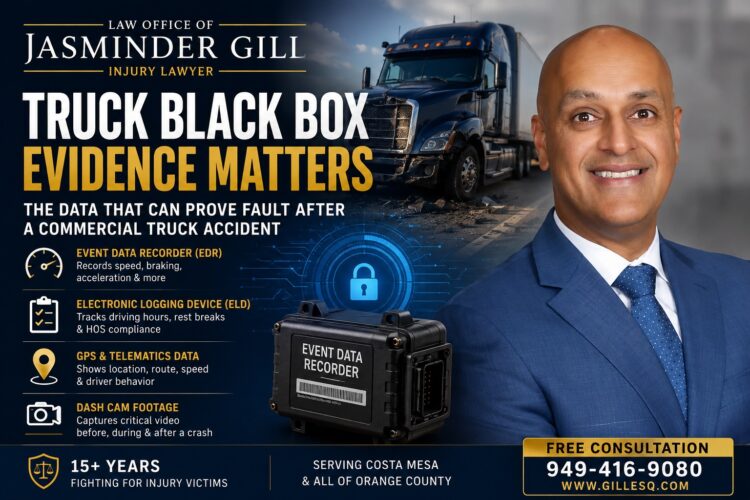
What Every Truck Accident Victim Needs to Know About Black Box Evidence | Law Office of Jasminder Gill
Commercial truck accidents are among the most devastating collisions on California roads. Because tractor-trailers, delivery trucks, tanker trucks, and other commercial vehicles can weigh up to 80,000 pounds, even a low-speed crash can leave victims with catastrophic injuries, permanent disabilities, or the tragic loss of a loved one.
While many accident victims assume that proving fault comes down to witness statements or photographs, one of the most powerful pieces of evidence often cannot be seen with the naked eye.
It is hidden inside the truck itself.
Modern commercial trucks are equipped with sophisticated electronic systems capable of recording valuable information before, during, and after a collision. Often referred to as the truck’s “black box,” these systems can reveal exactly what happened in the seconds leading up to a crash.
For victims, this information can mean the difference between recovering full compensation and having an insurance company deny responsibility.
At the Law Office of Jasminder Gill, we understand how critical electronic evidence can be after a serious commercial truck accident. Preserving this information quickly is often one of the first and most important steps in building a successful injury claim.
Why Black Box Evidence Matters After an Orange County Commercial Truck Accident
Orange County’s busy freeways and commercial corridors see thousands of large trucks transporting goods every day. From tractor-trailers traveling along Interstate 5 (I-5) and Interstate 405 (I-405) to delivery trucks operating on State Route 55 (SR-55), State Route 73 (SR-73), State Route 22 (Garden Grove Freeway), and Pacific Coast Highway (PCH), commercial vehicles are constantly moving through some of the most heavily traveled roads in Southern California.
These trucks frequently travel through Costa Mesa, Newport Beach, Irvine, Santa Ana, Huntington Beach, Fountain Valley, Tustin, Orange, Anaheim, and communities throughout Orange County. Unfortunately, when a fully loaded commercial truck is involved in a collision, the consequences can be devastating.
Unlike a typical passenger vehicle accident, commercial truck crashes often involve multiple parties, extensive insurance coverage, and complex federal trucking regulations. Determining exactly how the collision occurred frequently requires more than witness statements or photographs. Electronic evidence stored inside the truck—including black box data, Electronic Logging Devices (ELDs), GPS records, onboard cameras, and engine control modules—can provide critical information about what happened in the moments before impact.
Whether the collision involved an 18-wheeler, semi-truck, tractor-trailer, delivery truck, Amazon delivery vehicle, FedEx truck, UPS truck, construction truck, cement mixer, or another commercial vehicle, preserving electronic evidence as quickly as possible may significantly strengthen your injury claim.
At the Law Office of Jasminder Gill, we help victims injured in commercial truck accidents throughout Costa Mesa and Orange County understand the importance of preserving evidence before it is lost or overwritten. Acting quickly after a serious truck accident can make a significant difference when proving liability and pursuing maximum compensation.
What Is a Truck Black Box?
Unlike airplanes, commercial trucks do not have a single standardized “black box.”
Instead, most commercial trucks contain several electronic systems that continuously monitor vehicle performance and driver activity.
These systems may include:
- Event Data Recorders (EDR)
- Engine Control Modules (ECM)
- Electronic Control Units (ECU)
- Electronic Logging Devices (ELD)
- GPS tracking systems
- Fleet management software
- Collision mitigation systems
- Dash cameras
- Driver monitoring systems
- Brake control modules
Together, these systems create a digital timeline of what occurred before a collision.
Rather than relying solely on conflicting witness accounts, investigators may be able to reconstruct the accident using actual electronic data recorded by the truck.
What Information Does a Commercial Truck Record?
Many trucking companies collect enormous amounts of operational data every day.
Depending on the manufacturer and equipment installed, electronic systems may record:
Vehicle Speed
One of the most important pieces of evidence is the truck’s speed before impact.
The data may reveal:
- Whether the driver exceeded the speed limit
- Sudden acceleration
- Failure to slow before impact
- Excessive speed entering traffic
- Unsafe downhill speeds
Insurance companies sometimes argue a truck driver was traveling safely.
Black box data may tell a very different story.
Brake Application
Electronic systems frequently record when brakes were applied.
Investigators may determine:
- Whether braking occurred
- How many seconds before impact
- Whether braking was delayed
- Whether emergency braking activated
- Whether no braking occurred at all
Delayed braking may suggest distracted driving, fatigue, impairment, or inattention.
Accelerator Position
The system may also record throttle position.
This can reveal whether:
- The driver attempted to accelerate before impact
- The driver mistakenly accelerated instead of braking
- Cruise control remained engaged
- The driver failed to react
These details often become extremely important in serious injury and wrongful death cases.
Steering Inputs
Some systems document steering movements immediately before the collision.
Investigators can determine whether the driver:
- Attempted to avoid the collision
- Failed to steer
- Overcorrected
- Lost vehicle control
These details help accident reconstruction experts determine exactly how the crash occurred.
Engine RPM
Engine revolutions per minute provide another important clue.
RPM data may indicate:
- Heavy acceleration
- Downshifting
- Sudden engine load
- Attempted evasive maneuvers
Combined with speed and braking information, investigators can reconstruct nearly every second leading up to the collision.
Electronic Logging Devices (ELDs)
One of the biggest changes in the trucking industry occurred when Electronic Logging Devices became mandatory for most interstate commercial carriers.
These devices automatically record:
- Driving hours
- Rest breaks
- Vehicle movement
- Engine start times
- Engine shutoff times
- Mileage
- Duty status
This information is critical because driver fatigue remains one of the leading causes of commercial truck accidents.
Federal Hours-of-Service regulations limit how long truck drivers may operate without rest.
Unfortunately, violations still occur.
If electronic logs show the driver exceeded legal driving limits, that evidence can become extremely valuable in proving negligence.
GPS Data Can Reveal More Than Location
Many commercial trucks continuously transmit GPS information to dispatch centers.
This data often includes:
- Exact travel routes
- Vehicle location
- Stop durations
- Average speed
- Idle times
- Delivery schedules
- Route deviations
GPS records can sometimes contradict statements made by the trucking company or driver.
For example, if a driver claims they stopped for adequate rest but GPS data shows continuous travel, the electronic evidence may expose the inconsistency.
Dash Cameras Continue to Grow in Importance
More commercial fleets now install forward-facing and driver-facing cameras.
These cameras may capture:
- Traffic conditions
- Lane changes
- Following distance
- Driver distraction
- Cell phone use
- Seat belt usage
- Driver fatigue
- Unsafe driving behavior
Video evidence often eliminates disputes over fault because it shows exactly what occurred.
However, this footage is not always preserved indefinitely.
Many systems automatically overwrite recordings after a short period unless the data is specifically retained.
Advanced Driver Assistance Systems
Modern commercial trucks increasingly rely on sophisticated safety technology.
Many trucks now include:
- Collision avoidance systems
- Automatic emergency braking
- Lane departure warnings
- Blind spot monitoring
- Adaptive cruise control
- Stability control
These systems often generate additional electronic records showing:
- Whether warnings activated
- Whether emergency braking engaged
- Driver response times
- Vehicle system alerts
When analyzed together, these records help paint a complete picture of how the collision occurred.
Electronic Evidence Can Disprove Common Insurance Company Defenses
Insurance companies often argue:
- The victim caused the crash.
- The truck driver reacted appropriately.
- The collision was unavoidable.
- Weather caused the accident.
- Mechanical failure was unexpected.
Electronic evidence may contradict these arguments.
For example, black box data may show the truck was traveling 72 mph in heavy traffic, while the driver never applied the brakes until less than one second before impact.
That type of evidence can be far more persuasive than conflicting witness testimony alone.
Why Every Minute Matters After a Truck Accident
Perhaps the biggest misconception people have is believing electronic evidence remains available forever.
It often does not.
Some systems overwrite data after:
- Several days
- A few ignition cycles
- Limited driving hours
- Routine maintenance
- Software updates
The longer critical evidence remains unpreserved, the greater the risk that valuable information may disappear.
That is one reason serious truck accident investigations often begin immediately after a collision.
Why Trucking Companies Fight to Protect Black Box Evidence After a Serious Crash
After a devastating commercial truck accident, most victims assume the trucking company will cooperate with the investigation and provide whatever evidence is necessary to determine what happened.
Unfortunately, that is rarely how high-value truck accident cases unfold.
Commercial trucking companies and their insurance carriers often recognize within hours that a crash could expose them to hundreds of thousands—or even millions—of dollars in liability. Because of the financial stakes, many companies begin preparing their defense almost immediately.
While accident victims are receiving emergency medical treatment or recovering in the hospital, trucking companies may already have investigators reviewing electronic records, inspecting the truck, interviewing the driver, and documenting the crash scene.
This is one reason truck accident cases are often far more complex than ordinary car accident claims.
Understanding how trucking companies respond after a collision can help injury victims appreciate why preserving electronic evidence is so important.
What Is a Rapid Response Team?
Large trucking companies and commercial insurance carriers often maintain what are known as rapid response teams.
These teams may include:
- Insurance adjusters
- Corporate safety managers
- Accident reconstruction experts
- Defense attorneys
- Mechanical engineers
- Private investigators
- Claims specialists
Their purpose is not simply to determine what happened.
Their job is to protect the trucking company’s legal and financial interests.
Depending on the circumstances, these professionals may arrive at the accident scene within hours.
They often begin collecting information long before an injured victim has even spoken with an attorney.
Electronic Evidence Can Change Quickly
Unlike photographs or police reports, electronic evidence is dynamic.
Some data may continue updating every time the truck is driven.
Other information may automatically disappear after:
- Normal operation
- Scheduled maintenance
- Software updates
- Component replacement
- Fleet management downloads
- Limited storage capacity
Certain event data may only record the last significant event before being overwritten by another.
If the truck returns to service without proper preservation measures, valuable evidence could be altered or permanently lost.
This is why timing is so important after a commercial truck accident.
Preservation Letters Can Protect Critical Evidence
One of the first steps many experienced truck accident attorneys take is sending a preservation letter, sometimes called a spoliation letter, to the trucking company.
This formal notice instructs the company to preserve relevant evidence related to the collision.
Depending on the case, that request may include:
- Black box downloads
- Electronic Logging Device records
- GPS information
- Driver qualification files
- Maintenance records
- Inspection reports
- Dash camera footage
- Cell phone records
- Dispatch communications
- Driver training documents
- Cargo loading records
- Drug and alcohol testing results
- Internal safety investigations
- Onboard computer downloads
Once a trucking company has been placed on notice, destroying or failing to preserve relevant evidence may create serious legal consequences.
Why Multiple Companies May Share Responsibility
Many people assume the truck driver is the only party responsible after a crash.
In reality, commercial trucking accidents often involve several businesses.
These may include:
- The trucking company
- Trailer owner
- Freight broker
- Shipping company
- Maintenance contractor
- Tire manufacturer
- Brake manufacturer
- Cargo loading company
- Leasing company
Each may possess different electronic records.
For example:
A fleet management company may retain GPS data.
The trucking company may possess Electronic Logging Device records.
The truck manufacturer may have diagnostic information.
The maintenance contractor may have repair histories.
Identifying every responsible party often becomes an important part of a thorough investigation.
Driver Fatigue Remains One of the Biggest Safety Concerns
Fatigue continues to play a significant role in commercial truck crashes throughout the United States.
Although federal regulations limit driving hours, violations still occur.
Electronic Logging Devices have made falsifying driving logs more difficult than in the past, but investigators may still uncover issues such as:
- Driving beyond legal limits
- Missed mandatory breaks
- False duty status entries
- Unauthorized edits
- Pressure from dispatch
- Unrealistic delivery schedules
When fatigue contributes to a collision, electronic records frequently become one of the strongest forms of evidence available.
Speed Is Only Part of the Story
Many truck accident cases involve more than excessive speed.
Electronic systems may reveal whether the driver:
- Failed to maintain a safe following distance
- Used cruise control during unsafe weather
- Accelerated before impact
- Ignored collision warnings
- Failed to respond to emergency braking alerts
- Repeatedly exceeded company safety policies
Sometimes the truck was technically traveling within the posted speed limit but still moving too fast for traffic conditions.
Electronic evidence helps investigators answer these questions objectively.
Maintenance Problems Can Leave Digital Evidence
Mechanical failures are another common factor in commercial truck accidents.
Investigators may examine whether:
- Brake systems were properly maintained
- Tires were excessively worn
- Steering components were defective
- Lights functioned properly
- Safety inspections were completed
- Repairs were delayed
Maintenance software and repair records often create a timeline showing whether known safety issues existed before the collision.
If a trucking company ignored repeated maintenance warnings, those records may become powerful evidence.
Trucking Companies Must Follow Extensive Federal Regulations
Commercial trucking companies are subject to numerous federal safety regulations.
Depending on the circumstances, investigators may review compliance with rules involving:
- Driver qualifications
- Hours-of-Service
- Vehicle inspections
- Cargo securement
- Drug and alcohol testing
- Maintenance requirements
- Driver training
- Medical certifications
- Recordkeeping obligations
Electronic records frequently help determine whether these regulations were followed.
When violations exist, they may strengthen an injured victim’s claim.
Accident Reconstruction Often Depends on Digital Evidence
Truck accident reconstruction is far more detailed than simply reviewing photographs of damaged vehicles.
Experts may combine information from:
- Police reports
- Witness statements
- Black box downloads
- GPS records
- Dash camera footage
- Cell phone records
- Electronic Logging Devices
- Roadway measurements
- Skid marks
- Vehicle inspections
- Scene photography
- Surveillance cameras
Using specialized software, investigators can often recreate the truck’s movements second by second before the impact occurred.
This reconstruction frequently becomes one of the most persuasive pieces of evidence during settlement negotiations or at trial.
Insurance Companies Often Challenge Serious Injury Claims
Truck accident claims frequently involve catastrophic injuries, including:
- Traumatic brain injuries
- Spinal cord injuries
- Paralysis
- Multiple fractures
- Internal organ damage
- Severe burns
- Amputations
- Permanent disability
- Wrongful death
Because potential damages may be substantial, insurance companies often scrutinize every aspect of the claim.
Objective electronic evidence may reduce disputes over liability by providing data that is difficult to explain away.
Why Early Legal Representation Matters
One of the biggest mistakes accident victims make is waiting weeks—or even months—before seeking legal advice.
By then:
- Electronic records may no longer exist.
- Dash camera footage may have been overwritten.
- GPS information may be unavailable.
- Witness memories may fade.
- Physical evidence may disappear.
- Vehicles may be repaired or returned to service.
Beginning an investigation early can significantly improve the likelihood of preserving important evidence before it is lost.
When catastrophic injuries or wrongful death are involved, acting quickly is especially important because the available evidence may shape the outcome of the entire case.
Every Truck Accident Is Different
No two commercial truck accident investigations are exactly alike.
Some crashes involve distracted driving.
Others involve fatigue, mechanical failures, overloaded trailers, improper maintenance, unsafe lane changes, defective equipment, or violations of federal trucking regulations.
Determining what caused the collision often requires carefully reviewing both physical and electronic evidence before important information disappears.
How Black Box Evidence Can Maximize the Value of Your Truck Accident Claim
When people think about a truck accident lawsuit, they often picture eyewitnesses testifying in court or police officers explaining what happened at the crash scene.
While that evidence certainly matters, one of the most persuasive forms of proof often comes from the truck itself.
Modern commercial vehicles generate enormous amounts of electronic information before, during, and after a collision. When properly preserved and analyzed, this data can help establish liability, expose violations of federal safety regulations, and strengthen an injured victim’s claim for compensation.
At the Law Office of Jasminder Gill, we understand that successful truck accident cases are built on evidence—not assumptions. Every commercial truck collision deserves a thorough investigation because the facts hidden inside a truck’s electronic systems may tell a very different story than the one presented by the trucking company’s insurance carrier.
How Black Box Evidence Can Increase the Value of a Truck Accident Case
Insurance companies evaluate claims based on risk.
If liability is uncertain, they often dispute responsibility or offer settlements that fail to fully compensate injury victims.
However, when electronic evidence clearly demonstrates negligence, the insurance company has far fewer opportunities to shift blame.
For example, black box data may establish that:
- The truck was traveling well above a safe speed.
- The driver never applied the brakes.
- The driver accelerated before impact.
- The truck crossed into another lane.
- Federal Hours-of-Service regulations were violated.
- Safety warnings were ignored.
- Mechanical defects contributed to the collision.
- The trucking company failed to maintain the vehicle.
Objective electronic evidence often becomes one of the strongest tools available during settlement negotiations.
Commercial Truck Cases Often Involve Much Larger Insurance Policies
Unlike many passenger vehicle accidents, commercial trucking companies frequently carry substantial insurance coverage.
Depending on the circumstances, available coverage may reach hundreds of thousands—or even millions—of dollars.
That also means insurance companies have a significant financial incentive to defend these claims aggressively.
Common defense strategies include:
- Blaming the injured driver
- Arguing the crash was unavoidable
- Claiming weather caused the collision
- Disputing the severity of injuries
- Questioning medical treatment
- Suggesting another vehicle caused the accident
Electronic evidence can make many of these arguments far less convincing when it objectively shows what occurred before impact.
Catastrophic Injuries Deserve a Thorough Investigation
Commercial truck accidents often result in life-changing injuries because of the tremendous force involved.
Victims may suffer:
- Traumatic brain injuries
- Spinal cord injuries
- Neck and back injuries
- Multiple fractures
- Crush injuries
- Internal bleeding
- Burns
- Amputations
- Permanent disabilities
Families may also experience the heartbreaking loss of a loved one in a fatal truck accident.
When catastrophic injuries are involved, every piece of available evidence should be preserved and analyzed.
Why Experience Matters in Truck Accident Cases
Not every personal injury case involves commercial trucking regulations.
Truck accident claims frequently require knowledge of:
- Federal Motor Carrier Safety Regulations
- Hours-of-Service requirements
- Driver qualification standards
- Cargo securement rules
- Vehicle inspection requirements
- Commercial maintenance regulations
- Electronic Logging Devices
- Event Data Recorders
- Fleet management systems
Understanding where electronic evidence exists—and how it can be used—can make a significant difference during a truck accident investigation.
FAQ’s About Truck Black Boxes in Orange County
Does every commercial truck have a black box?
Most modern commercial trucks contain electronic systems capable of recording vehicle performance information. While equipment varies between manufacturers and fleets, many trucks include Engine Control Modules (ECMs), Event Data Recorders (EDRs), Electronic Logging Devices (ELDs), GPS systems, and other onboard computers that collect valuable operational data.
How long is truck black box data stored?
The answer depends on the specific system installed in the truck.
Some information may remain available for an extended period, while other data can be overwritten after additional driving, maintenance, software updates, or limited storage capacity is reached.
Because every system is different, preserving electronic evidence as soon as possible after a collision is often extremely important.
Can truck black box evidence be deleted?
Electronic data may be lost, overwritten, or replaced if it is not preserved.
That does not necessarily mean someone intentionally destroyed evidence.
Many commercial vehicle systems automatically replace older information during normal operation.
Prompt investigation may help reduce the risk of losing valuable electronic records.
Can black box data prove who caused the accident?
Black box evidence is often one important piece of a much larger investigation.
It may reveal vehicle speed, braking, steering inputs, throttle position, engine activity, and other operational details.
When combined with witness statements, photographs, police reports, surveillance footage, and accident reconstruction, electronic evidence can provide a much clearer picture of how the collision occurred.
Can trucking companies refuse to provide electronic records?
Every case is different.
Depending on the circumstances, electronic records may become part of the legal discovery process during a truck accident claim or lawsuit.
An experienced attorney can take appropriate legal steps to seek relevant evidence when necessary.
What Should You Do After a Commercial Truck Accident?
If you or someone you love has been injured in a commercial truck accident, taking the right steps early can help protect both your health and your legal rights.
Important steps include:
- Call 911 immediately.
- Seek medical treatment even if injuries appear minor.
- Follow all treatment recommendations.
- Photograph the accident scene if possible.
- Preserve damaged personal property.
- Obtain witness contact information.
- Avoid discussing fault at the scene.
- Keep copies of medical records and expenses.
- Avoid providing recorded statements without understanding your legal rights.
- Consider speaking with an attorney promptly if serious injuries are involved.
Every accident is unique, and the evidence available immediately after a collision may not remain available indefinitely.
Common Orange County Roads Where Serious Truck Accidents Occur
Commercial truck accidents can happen anywhere, but some of Orange County’s busiest roadways experience significantly higher volumes of commercial traffic. Large trucks regularly travel on:
- Interstate 405 (San Diego Freeway)
- Interstate 5 (Santa Ana Freeway)
- State Route 55 (Costa Mesa Freeway)
- State Route 73
- State Route 22 (Garden Grove Freeway)
- Pacific Coast Highway (Highway 1)
- Harbor Boulevard
- Bristol Street
- MacArthur Boulevard
- Newport Boulevard
Heavy commuter traffic, ongoing construction, frequent lane changes, and congestion around ports, warehouses, and distribution centers increase the risk of serious commercial truck collisions on these roadways. When these crashes occur, black box data and other electronic evidence may help investigators determine vehicle speed, braking, steering input, hours of service compliance, and other important facts that can establish liability.
Why Choose The Law Office of Jasminder Gill
For more than 15 years, Attorney Jasminder Gill has represented individuals and families injured by negligence throughout Costa Mesa and Orange County.
Our firm understands that commercial truck accident claims often involve:
- Multiple insurance companies
- Complex investigations
- Federal trucking regulations
- Catastrophic injuries
- Extensive medical treatment
- Significant financial losses
We work to build every case on strong evidence while keeping clients informed throughout the legal process.
Whether the collision involved a tractor-trailer, delivery truck, box truck, construction vehicle, garbage truck, Amazon delivery vehicle, UPS truck, FedEx truck, fuel tanker, or another commercial vehicle, our goal is to pursue the compensation our clients deserve under California law.
Speak With a Costa Mesa Commercial Truck Accident Lawyer Today
If you or a loved one has been injured in a commercial truck accident in Costa Mesa or anywhere in Orange County, you should not have to fight trucking companies and insurance carriers on your own.
At the Law Office of Jasminder Gill, we represent victims injured in:
- Semi-truck accidents
- Tractor-trailer accidents
- 18-wheeler collisions
- Delivery truck accidents
- Amazon delivery vehicle crashes
- UPS and FedEx truck accidents
- Construction truck accidents
- Rear-end truck collisions
- Jackknife accidents
- Blind spot truck accidents
- Underride collisions
- Catastrophic injury claims
- Wrongful death truck accident cases
Commercial truck accident claims often require immediate action to preserve black box data, GPS records, dash camera footage, driver logs, maintenance records, and other critical evidence. Our office works to protect your rights, thoroughly investigate your case, and pursue the maximum compensation available under California law.
If you were injured in a truck accident in Costa Mesa, Newport Beach, Irvine, Santa Ana, Huntington Beach, Fountain Valley, Tustin, Orange, Anaheim, Garden Grove, or anywhere in Orange County, contact the Law Office of Jasminder Gill today for a FREE consultation.