
Fresno Punjabi Personal Injury Lawyer
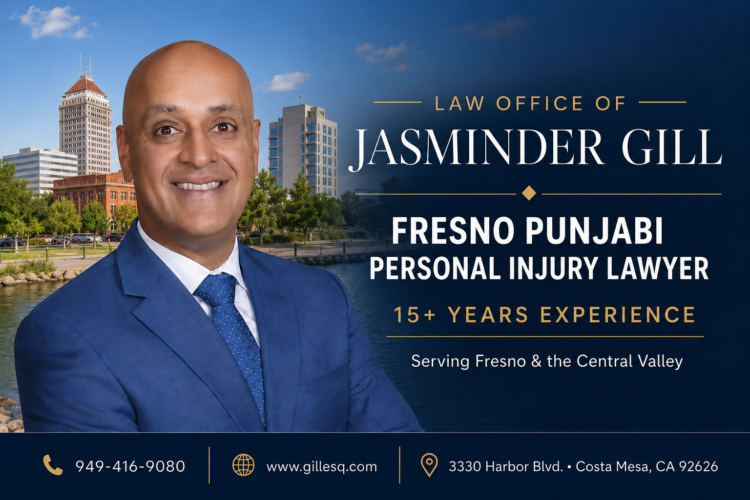
Fresno Punjabi Personal Injury Lawyer | 15+ Years Experience
If you or a family member suffered an injury because of another person’s negligence, a Fresno Punjabi personal injury lawyer can help you understand your rights, communicate with insurance companies, preserve evidence, and pursue compensation supported by your case.
Attorney Jasminder Gill is an Indian and Punjabi-speaking California personal injury lawyer with more than 15 years of experience. He has helped thousands of injured clients and families navigate claims involving motor vehicle accidents, unsafe properties, catastrophic injuries, and wrongful death.
15+ YEARS EXPERIENCE | THOUSANDS OF CLIENTS HELPED | MILLIONS RECOVERED | CALIFORNIA ATTORNEY SINCE 2009 | PUNJABI SPEAKING | SPANISH CONSULTATIONS | 24/7 FREE CONSULTATIONS
Call 949-416-9080 for a free consultation
The Law Office of Jasminder Gill assists injured people in Fresno, Fresno County, the Central Valley, and throughout California. Telephone and video consultations are available, allowing clients to discuss their cases without traveling to the firm’s Costa Mesa office.
ਪੰਜਾਬੀ ਵਿੱਚ ਗੱਲ ਕਰਨ ਲਈ ਅੱਜ ਹੀ ਅਟਾਰਨੀ ਜਸਮਿੰਦਰ ਗਿੱਲ ਨਾਲ ਸੰਪਰਕ ਕਰੋ। ਤੁਹਾਡੀ ਪਹਿਲੀ ਸਲਾਹ-ਮਸ਼ਵਰਾ ਮੁਫ਼ਤ ਹੈ।
Speak directly with Punjabi-speaking personal injury attorney Jasminder Gill. Your initial consultation is free.
There are no upfront attorney’s fees. You pay no attorney’s fee unless the firm recovers compensation for you.
Personal Injury Cases We Handle in Fresno
The Law Office of Jasminder Gill represents injured people and families in claims involving:
- Car accidents
- Commercial truck accidents
- Motorcycle accidents
- Pedestrian collisions
- Bicycle and e-bike accidents
- Uber and Lyft accidents
- Delivery-vehicle crashes
- Rear-end collisions
- T-bone accidents
- Hit-and-run crashes
- Uninsured drivers
- Underinsured drivers
- Slip-and-fall accidents
- Dangerous properties
- Dog bites
- Construction accidents involving negligent third parties
- Defective products
- Traumatic brain injuries
- Spinal cord injuries
- Burn injuries
- Amputations
- Catastrophic injuries
- Wrongful death
Every personal injury claim should be evaluated according to its own evidence. The existence of an injury does not automatically establish liability, and an insurance company’s initial decision does not necessarily determine the final outcome.
Punjabi-Speaking Personal Injury Representation
Punjabi-speaking injury victims should not have to rely entirely on an insurance adjuster, friend, relative, or child to interpret complicated medical and legal information.
Important details can be lost or misunderstood when questions involve:
- How the accident occurred
- Where the accident happened
- Statements made by the responsible party
- Prior medical conditions
- The progression of pain and symptoms
- Medical recommendations
- Time missed from work
- Business or agricultural income
- Insurance-policy language
- Settlement releases
- Future treatment and disability
- The effect of an injury on the family
Communicating directly with a Punjabi-speaking attorney may help clients explain the accident, injuries, treatment, employment losses, and family consequences more completely.
It can also reduce the risk of signing an insurance document or accepting a settlement without fully understanding its effect.
An Indian Personal Injury Lawyer Serving Fresno and the Central Valley
Fresno and the Central Valley are home to a large and diverse South Asian community, including families with roots in Punjab, Gujarat, Rajasthan, Uttar Pradesh, Andhra Pradesh, Telangana, Tamil Nadu, Kerala, Maharashtra, and other regions of India.
When an accident occurs, an injured person may have to manage:
- Medical appointments
- Hospital bills
- Time away from work
- Transportation difficulties
- Family responsibilities
- Insurance paperwork
- Requests for recorded statements
- Pressure to accept a quick settlement
- Uncertainty about future treatment
Language and cultural differences can make the experience even more stressful.
Attorney Jasminder Gill understands concerns that may be important to Indian and Punjabi families after a serious injury. Clients can discuss their cases directly with him in Punjabi or English.
Our firm works to provide clear answers without making clients feel rushed or dismissed. We explain the legal process, help families understand what information matters, and investigate the complete effect of the injury.
Why Fresno Injury Claims Require Careful Investigation
Fresno’s major freeways, commercial corridors, agricultural traffic, distribution centers, and rapidly developing neighborhoods create many different accident risks.
Serious collisions may occur on or near:
- State Route 99
- State Route 41
- State Route 168
- State Route 180
- Blackstone Avenue
- Shaw Avenue
- Herndon Avenue
- Ashlan Avenue
- McKinley Avenue
- Kings Canyon Road
- Clovis Avenue
- Cedar Avenue
- Friant Road
- Jensen Avenue
- Rural roads throughout Fresno County
The City of Fresno has described traffic safety as a serious local problem. Its Vision Zero materials report 217 fatal crashes and 629 severe-injury crashes on city streets during the 2019–2023 study period. Fresno adopted a Vision Zero Action Plan in 2026 to work toward eliminating traffic deaths and severe injuries by 2050.
A personal injury investigation may need to examine more than the conduct of one driver. Depending on the accident, potentially responsible parties may include:
- A negligent driver
- A vehicle owner
- A trucking company
- A driver’s employer
- A delivery company
- A rideshare company
- A property owner
- A commercial tenant
- A contractor
- A product manufacturer
- A maintenance company
- A government entity
- Another person or business whose conduct contributed to the injury
Identifying every responsible party can be especially important when one insurance policy does not provide enough coverage for catastrophic injuries.
Fresno Car Accident Claims
Car crashes are among the most common causes of personal injury claims in Fresno. Heavy traffic, freeway interchanges, high-speed arterial roads, commercial vehicles, and rural routes can contribute to serious collisions.
Common Fresno car accident cases include:
- Rear-end collisions
- T-bone accidents
- Head-on crashes
- Freeway collisions
- Intersection accidents
- Unsafe lane changes
- Sideswipe crashes
- Left-turn accidents
- Multi-vehicle pileups
- Drunk-driving crashes
- Distracted-driving accidents
- Speeding-related collisions
- Red-light accidents
- Hit-and-run crashes
- Rideshare collisions
- Uninsured-motorist claims
A driver may be negligent by speeding, following too closely, failing to yield, running a traffic signal, using a cellphone, driving while impaired, or failing to maintain control of the vehicle.
Evidence should be gathered before vehicles are repaired, recordings are erased, witnesses become difficult to locate, and roadway conditions change.
Commercial Truck and Agricultural Vehicle Accidents
Fresno and the Central Valley are major agricultural, manufacturing, warehousing, and transportation regions. Passenger vehicles regularly share highways and rural roads with tractor-trailers, produce trucks, tankers, delivery vehicles, farm equipment, and other commercial vehicles.
Truck accident claims can be more complicated than ordinary car accident claims because they may involve:
- A commercial driver
- The trucking company
- A vehicle owner
- A freight broker
- A shipping company
- A maintenance contractor
- A loading company
- A parts manufacturer
- Multiple insurance carriers
Evidence may include:
- Electronic logging-device information
- Driver qualification records
- Hours-of-service records
- Inspection reports
- Maintenance records
- Dispatch communications
- Cargo documents
- Drug-and-alcohol testing records
- Dashboard-camera footage
- Event-data-recorder information
- GPS and telematics data
- Cellphone records
- Post-collision company investigations
A trucking company may possess much of this information. A prompt preservation request can help prevent relevant evidence from being deleted or destroyed through routine business practices.
Pedestrian and Bicycle Accidents in Fresno
Pedestrians and cyclists have little protection when struck by a motor vehicle. Even a collision at a relatively low speed may cause a traumatic brain injury, broken bones, internal injuries, spinal damage, permanent disability, or death.
Pedestrian and bicycle crashes may occur when a driver:
- Fails to yield in a crosswalk
- Turns without checking for pedestrians
- Drives through a red light
- Speeds through a residential area
- Backs out without maintaining a proper lookout
- Opens a vehicle door into a cyclist’s path
- Drives while distracted
- Operates a vehicle while impaired
- Fails to use reasonable care near a school
- Leaves the scene after the collision
An insurance company may try to blame the injured pedestrian or cyclist for crossing outside a marked crosswalk, wearing dark clothing, traveling outside a bicycle lane, or failing to notice the vehicle.
Those allegations do not automatically defeat a claim. The investigation should examine the conduct of every person whose actions contributed to the accident.
Slip-and-Fall and Dangerous-Property Claims
Property owners and businesses may be responsible when they fail to use reasonable care to inspect, maintain, or repair dangerous conditions.
Fresno premises-liability claims may arise from hazards at:
- Grocery stores
- Restaurants
- Shopping centers
- Apartment complexes
- Hotels
- Gas stations
- Warehouses
- Parking lots
- Sidewalks
- Office buildings
- Entertainment venues
- Private homes
- Construction properties
- Agricultural businesses
Dangerous conditions may include:
- Spilled liquids
- Wet or recently mopped floors
- Uneven pavement
- Broken stairs
- Missing handrails
- Poor lighting
- Unsafe merchandise displays
- Unsecured rugs or mats
- Debris in walkways
- Potholes
- Defective elevators
- Negligent security
- Uncontrolled animals
Proving a premises-liability claim may require evidence showing that the property owner created the hazard, knew about it, or should have discovered it through reasonable inspections.
Surveillance recordings can be particularly important. Many businesses automatically overwrite their videos after a limited period, so the injured person should not wait to request preservation.
Dog Bites and Animal Attacks
A dog attack can cause puncture wounds, infections, nerve damage, tendon injuries, facial scarring, psychological trauma, and permanent disfigurement.
Children may experience especially serious physical and emotional consequences. A child who is bitten may require:
- Emergency treatment
- Stitches
- Surgery
- Infection monitoring
- Plastic-surgery evaluation
- Scar revision
- Psychological counseling
- Future medical care
Evidence may include photographs, animal-control reports, witness statements, veterinary information, prior complaints, property records, and insurance policies.
The dog should be identified, and the incident should be reported promptly. The injured person should also obtain medical treatment because animal bites can present infection and scarring risks even when the wound initially appears manageable.
Catastrophic Injury Claims
A catastrophic injury can permanently affect a person’s mobility, independence, employment, education, relationships, and ability to perform ordinary daily activities.
Catastrophic injuries may include:
- Traumatic brain injuries
- Spinal cord damage
- Paralysis
- Severe burns
- Amputations
- Organ damage
- Multiple fractures
- Permanent nerve injuries
- Loss of vision
- Loss of hearing
- Disfigurement
- Chronic pain conditions
These cases should account for more than immediate hospital bills. A complete damages analysis may require consideration of:
- Future surgery
- Rehabilitation
- Physical therapy
- Occupational therapy
- Psychological treatment
- Prescription medication
- Medical equipment
- Home modifications
- Accessible transportation
- Personal-care assistance
- Lost earning capacity
- Vocational limitations
- Reduced independence
- Future complications
- Permanent pain and suffering
Accepting a settlement before the long-term medical prognosis is understood may leave the injured person responsible for substantial future expenses.
Wrongful Death Claims in Fresno
Some accidents result in fatal injuries. When negligence causes a death, qualifying family members may be able to pursue a wrongful death claim under California law.
Depending on the circumstances, recoverable damages may include:
- Funeral and burial expenses
- Lost financial support
- Loss of household services
- Loss of companionship
- Loss of care, comfort, and guidance
- Other legally recoverable losses
A survival action may also be available for certain claims the deceased person could have pursued if the person had survived.
Fatal accident cases require immediate attention because vehicles may be repaired or destroyed, electronic data may be overwritten, surveillance recordings may disappear, and witnesses’ memories may fade.
What to Do After an Accident in Fresno
The actions taken after an accident may affect both the injured person’s health and the strength of a future claim.
Get Medical Help
Call 911 when emergency assistance is necessary. Even if the injured person does not need an ambulance, medical evaluation should not be delayed when pain, dizziness, weakness, confusion, numbness, or other symptoms develop.
Some injuries are not immediately obvious. Adrenaline may temporarily mask pain, and symptoms of a concussion, internal injury, or spinal condition may develop later.
Report the Accident
Report a vehicle collision to the appropriate law-enforcement agency. Accidents within Fresno may be investigated by the Fresno Police Department, while freeway and unincorporated-area collisions may involve the California Highway Patrol or another agency.
The CHP advises collision participants to address medical needs first, notify law enforcement, and exchange driver, registration, and insurance information.
For a fall or injury at a business, notify a manager and request that an incident report be created. Obtain the manager’s name and ask for a copy or report number.
Photograph the Scene
When physically able, take photographs or videos of:
- Vehicle positions
- Vehicle damage
- License plates
- Skid marks
- Traffic controls
- Road conditions
- Debris
- Visible injuries
- Damaged clothing
- A dangerous floor or walkway
- Warning signs or the absence of warnings
- The surrounding property
- Business names and addresses
Photographs should be taken from several distances and angles. Do not place yourself in danger to obtain evidence.
Identify Witnesses
Ask witnesses for their names, telephone numbers, email addresses, and a brief explanation of what they observed.
Do not assume the police, store manager, or insurance company collected every witness’s information.
Preserve Physical Evidence
Keep damaged clothing, shoes, helmets, bicycles, electronic devices, child-safety seats, defective products, and other relevant items.
Do not repair, discard, alter, or destroy important evidence before it can be inspected and documented.
Avoid Detailed Insurance Statements
An insurance adjuster may contact the injured person quickly and request a recorded statement. The questions may appear routine, but the answers could later be used to dispute fault, the severity of the injuries, or whether the accident caused the claimed condition.
Consider obtaining legal advice before providing a detailed recorded statement, signing a broad medical authorization, or accepting a settlement.
Do Not Post About the Accident Online
Insurance companies may review public social-media posts. Photographs, comments, location information, and activity updates may be taken out of context and used to argue that the injuries are less serious than claimed.
Avoid discussing the accident, injuries, treatment, activities, or legal claim online.
Evidence That Can Strengthen a Fresno Injury Claim
The evidence required depends on how the injury occurred. Potential evidence may include:
- Police and CHP reports
- 911 recordings
- Body-camera footage
- Traffic-camera recordings
- Business surveillance video
- Residential doorbell video
- Dashboard-camera footage
- Witness statements
- Scene photographs
- Vehicle photographs
- Electronic vehicle data
- Cellphone records
- Employment records
- Medical records
- Diagnostic imaging
- Expert opinions
- Inspection and maintenance records
- Incident reports
- Safety policies
- Training records
- Prior complaints
- Product testing and recall information
- Insurance policies
A driver, business, trucking company, government entity, or property owner may possess evidence that the injured person cannot obtain without a formal request or legal process.
Who May Be Responsible for a Fresno Personal Injury?
Liability depends on the facts and applicable law. Potentially responsible parties may include:
- Negligent motorists
- Vehicle owners
- Employers
- Trucking companies
- Rideshare drivers
- Delivery businesses
- Property owners
- Property-management companies
- Commercial tenants
- Maintenance contractors
- Construction companies
- Product manufacturers
- Distributors and retailers
- Government agencies
- Multiple parties whose conduct combined to cause the injury
An early investigation should identify every potential source of responsibility and insurance coverage.
What If You Were Partially Responsible?
Being partially responsible for an accident does not necessarily prevent recovery in California.
Under California’s comparative-fault system, responsibility may be assigned among the people or businesses that contributed to the injury. An injured person’s compensation may be reduced according to the percentage of fault assigned to that person.
For example, if the total damages were valued at $100,000 and the injured person was assigned 20% of the responsibility, the recovery could be reduced to $80,000.
Insurance companies may use comparative-fault allegations to reduce what they pay. Their determination is not automatically final. Fault should be evaluated using physical evidence, witness testimony, traffic laws, expert analysis, and the conduct of everyone involved.
Where Are Fresno Personal Injury Lawsuits Filed?
A Fresno personal injury lawsuit may be filed in Fresno County Superior Court when the county is a proper venue under California law.
The Fresno County Superior Court explains that civil cases include lawsuits seeking damages for injuries. Unlimited civil matters are handled at the court’s civil location at 1130 O Street in Fresno.
Filing a lawsuit does not necessarily mean the case will go to trial. Many claims resolve through negotiations, mediation, or another settlement process. Litigation may be necessary when an insurer denies responsibility, disputes coverage, minimizes the injuries, or refuses to offer reasonable compensation.
Compensation Available in a Fresno Personal Injury Case
A personal injury claim is intended to seek compensation for the losses caused by another party’s negligent or wrongful conduct. The available compensation depends on the facts, evidence, insurance coverage, severity of the injuries, and effect of those injuries on the person’s life.
Potential damages may include:
- Emergency transportation
- Hospital expenses
- Doctor visits
- Diagnostic testing
- Surgery
- Prescription medication
- Physical therapy
- Chiropractic treatment
- Psychological counseling
- Medical equipment
- Future medical care
- Lost wages
- Lost business income
- Reduced earning capacity
- Vehicle or property damage
- Pain and suffering
- Emotional distress
- Permanent disability
- Scarring or disfigurement
- Loss of enjoyment of life
- Household assistance
- Other accident-related losses
The insurance company may focus only on medical bills that have already been incurred. A complete evaluation should also consider reasonably anticipated future treatment, permanent limitations, employment consequences, and how the injury has changed the person’s daily life.
Economic Damages After a Serious Injury
Economic damages are financial losses that can often be documented through bills, receipts, employment records, tax documents, expert analysis, and other evidence.
Medical Expenses
Medical expenses may include the reasonable cost of:
- Ambulance transportation
- Emergency-room treatment
- Hospitalization
- Surgery
- Physician appointments
- Diagnostic imaging
- Laboratory testing
- Medication
- Physical therapy
- Occupational therapy
- Chiropractic treatment
- Counseling
- Medical equipment
- Home healthcare
- Future treatment
The amount billed by a medical provider does not always determine the recoverable amount. Health-insurance payments, contractual reductions, medical liens, and California evidentiary rules may affect the analysis.
Future Medical Care
A severe injury may require treatment long after the claim begins. Future medical needs should be evaluated before a final settlement is accepted.
Potential future expenses include:
- Additional surgery
- Rehabilitation
- Pain-management procedures
- Scar revision
- Prosthetic devices
- Mobility equipment
- Prescription medication
- Psychological care
- Neurological treatment
- Home modifications
- Accessible transportation
- Personal-care assistance
- Replacement medical equipment
Medical opinions and life-care planning may be necessary when the injuries are permanent or catastrophic.
Lost Income
An injured person may recover compensation for income lost while attending appointments, recovering from surgery, or remaining unable to perform regular job duties.
Evidence may include:
- Pay statements
- Employer verification
- Disability records
- Work schedules
- Attendance records
- Tax returns
- Bank statements
- Commission reports
- Overtime history
- Bonus records
- Medical work restrictions
The claim should distinguish between time missed for accident-related reasons and unrelated absences.
Reduced Earning Capacity
An injury may allow a person to return to work while still limiting the person’s ability to earn income in the future.
Reduced earning capacity may apply when an injury causes the person to:
- Work fewer hours
- Perform lighter duties
- Decline overtime
- Change occupations
- Retire early
- Lose opportunities for promotion
- Stop performing physical labor
- Require frequent medical absences
- Become unable to maintain a business
- Accept lower-paying employment
Vocational and economic experts may be needed to evaluate long-term losses in serious cases.
Documenting Income for Self-Employed and Agricultural Workers
Many people in Fresno and the Central Valley work in agriculture, trucking, construction, hospitality, retail, family businesses, professional practices, or self-employment. Lost-income claims can be more complicated when earnings vary by season, contracts, harvests, commissions, or business performance.
Useful documentation may include:
- Personal and business tax returns
- Profit-and-loss statements
- Bank deposits
- Customer invoices
- Business calendars
- Contracts
- Payroll records
- Appointment schedules
- Agricultural production records
- Sales reports
- Commission statements
- Canceled jobs
- Payments to replacement workers
- Statements from customers or business partners
An injured person should not assume that a lack of traditional pay statements eliminates a lost-income claim. The available records should be reviewed to determine how the loss can be supported.
Cash income presents additional challenges. The claim must be based on credible evidence and should remain consistent with tax and financial records.
Non-Economic Damages After a Fresno Accident
Non-economic damages compensate for the human consequences of an injury that do not come with a precise bill.
Potential non-economic damages include:
- Physical pain
- Emotional suffering
- Anxiety
- Depression
- Sleep disruption
- Humiliation
- Inconvenience
- Permanent scarring
- Disfigurement
- Loss of mobility
- Loss of independence
- Loss of enjoyment of life
- Inability to participate in family activities
- Interference with relationships
- Fear of driving or returning to the accident location
There is no universal formula for calculating pain and suffering. Insurance-company software, a multiplier, or a daily rate does not automatically determine the value.
The analysis should consider the nature, duration, severity, and long-term effect of the injuries.
How an Injury Can Affect an Indian Family
A serious injury rarely affects only the injured person. It may alter the responsibilities and finances of an entire household.
In many Indian families, several generations may depend on one another for childcare, transportation, financial support, elder care, cooking, household work, and assistance with family businesses.
An injury may prevent someone from:
- Caring for children
- Assisting elderly parents
- Driving relatives to appointments
- Preparing meals
- Performing household repairs
- Working in a family business
- Participating in religious or community events
- Attending weddings and family gatherings
- Traveling to visit relatives
- Supporting family members financially
- Performing agricultural or physical work
These effects should be documented. Statements from family members, photographs, activity records, medical evidence, and testimony about the person’s life before and after the accident may help demonstrate the complete impact.
Injuries That May Support a Personal Injury Claim
A Fresno personal injury claim may involve one injury or several related conditions.
Common injuries include:
- Whiplash
- Neck injuries
- Back injuries
- Herniated or bulging discs
- Shoulder injuries
- Knee injuries
- Broken bones
- Torn ligaments
- Nerve damage
- Concussions
- Traumatic brain injuries
- Internal bleeding
- Organ damage
- Facial injuries
- Dental injuries
- Burns
- Scarring
- Psychological trauma
- Chronic pain
- Spinal cord injuries
- Paralysis
- Amputations
The seriousness of an injury should be evaluated through medical evidence rather than assumptions based only on visible vehicle damage or the appearance of the accident scene.
Delayed Symptoms After an Accident
Some injuries produce immediate symptoms, while others develop over hours or days.
Delayed symptoms may include:
- Headaches
- Dizziness
- Nausea
- Confusion
- Memory problems
- Neck stiffness
- Back pain
- Numbness
- Tingling
- Weakness
- Abdominal pain
- Sleep disruption
- Anxiety
- Vision changes
- Sensitivity to light or sound
Seek appropriate medical care if symptoms develop or become worse. This protects the person’s health and creates a medical record documenting when the symptoms were reported.
An insurance company may argue that a delay in treatment proves the accident did not cause the injury. The surrounding circumstances should be examined, including whether the symptoms were delayed, whether the person lacked transportation or insurance, and whether the injured person initially expected the condition to improve.
Following the Recommended Treatment Plan
Insurance companies frequently examine whether an injured person followed medical recommendations.
They may dispute a claim when the records show:
- Missed appointments
- Long gaps in treatment
- Failure to complete physical therapy
- Failure to obtain recommended testing
- Refusal of a specialist referral
- Inconsistent symptom reports
- Continued strenuous activity against medical advice
There may be legitimate reasons for interrupted treatment, including lack of transportation, childcare responsibilities, work demands, cost concerns, scheduling problems, religious travel, family emergencies, or difficulty locating an appropriate provider.
Those issues should be discussed with the medical provider and attorney. Simply disappearing from care may create both health risks and evidentiary problems.
Preexisting Conditions and Prior Injuries
A prior medical condition does not automatically prevent an injured person from recovering compensation.
An accident may:
- Aggravate an existing injury
- Accelerate a degenerative condition
- Cause new symptoms
- Increase the need for treatment
- Turn a manageable condition into a disabling one
- Affect a different part of the body
- Cause an entirely new injury
Medical records from before and after the accident may help distinguish the prior condition from the new injury or aggravation.
The injured person should be honest about prior accidents, symptoms, treatment, and claims. Insurance companies may search databases and medical records for inconsistencies. Attempting to conceal a prior condition can damage credibility even when the new claim is otherwise valid.
Medical Liens and Health-Insurance Reimbursement
A settlement does not always mean the injured person keeps the entire amount after attorney’s fees and expenses.
Health insurers, government benefit programs, hospitals, or medical providers may assert reimbursement or lien rights against a recovery.
Potential claims may involve:
- Private health insurance
- Medicare
- Medi-Cal
- Employer health plans
- Hospital liens
- Treatment provided on a lien
- Workers’ compensation carriers
- Other benefit programs
These issues should be identified before settlement funds are distributed. The existence and amount of a reimbursement claim depend on the applicable law, policy, payments, and facts.
The final amount received by a client may be affected by attorney’s fees, case costs, medical bills, and enforceable reimbursement obligations.
Why Insurance Companies Minimize Fresno Injury Claims
An insurance company investigates a claim to protect its own financial interests. The adjuster may be professional and courteous while still looking for reasons to deny liability or reduce payment.
Common insurance arguments include:
- The insured did not cause the accident
- The injured person was partially responsible
- The impact was too minor to cause injury
- The claimant waited too long to seek treatment
- Treatment was excessive
- Medical charges were unreasonable
- A preexisting condition caused the symptoms
- The claimant failed to follow medical advice
- The injuries have fully resolved
- Future treatment is unnecessary
- Lost income is unsupported
- The claimant exaggerated the limitations
- Another accident caused the condition
- The policy does not provide coverage
- The claimed damages exceed the insurance limits
Each argument should be tested against medical records, physical evidence, witness statements, insurance policies, employment documentation, and qualified expert analysis.
Common Insurance-Company Tactics
An insurer may attempt to control the claim before the injured person understands the full extent of the injuries.
Potential tactics include:
- Requesting an immediate recorded statement
- Asking leading or confusing questions
- Seeking a broad medical authorization
- Contacting the injured person repeatedly
- Suggesting an attorney is unnecessary
- Offering a quick settlement
- Delaying the investigation
- Requesting the same documents multiple times
- Disputing treatment recommended by physicians
- Blaming the injured person
- Minimizing future care
- Monitoring social-media activity
- Scheduling an insurance medical examination
- Misinterpreting prior medical records
- Pressuring the claimant before a deadline
An injured person should not assume that a settlement offer is fair merely because the adjuster describes it as the insurer’s “final” or “best” offer.
Recorded Statements and Medical Authorizations
A recorded statement can become important evidence in a claim.
The adjuster may ask about:
- The direction of travel
- Speed
- Distractions
- Seatbelt use
- Statements made at the scene
- Prior injuries
- Current symptoms
- Medical treatment
- Missed work
- Daily activities
A person who is injured, medicated, tired, or uncertain about the details may accidentally provide incomplete or inaccurate information.
Broad medical authorizations may allow an insurer to seek records extending far beyond the body parts injured in the accident. Consider obtaining legal advice before signing an authorization or providing a detailed statement.
Low-Impact Collision Arguments
Insurance companies sometimes argue that limited vehicle damage means no one could have been seriously injured.
Vehicle damage and physical injury are separate questions. Injury severity may depend on:
- Direction of impact
- Occupant position
- Seat and head-restraint position
- Vehicle design
- Age
- Physical condition
- Prior vulnerability
- Whether the person anticipated the collision
- Whether the body rotated or struck the interior
- Whether the injured person was a pedestrian, cyclist, or motorcyclist
Medical evidence, biomechanics, photographs, repair records, and expert opinions may be relevant. The insurer’s characterization of a crash as “minor” does not decide the claim.
Uninsured and Underinsured Motorist Claims
A negligent driver may have no insurance or insufficient coverage to compensate an injured person fully.
Uninsured-motorist coverage may apply when:
- The responsible driver had no insurance
- A hit-and-run driver cannot be identified
- Coverage was canceled before the accident
- The insurer denies coverage for the responsible driver
Underinsured-motorist coverage may apply when the negligent driver has insurance but the policy limits are insufficient.
Potential coverage may exist through:
- The injured person’s automobile policy
- A policy covering the vehicle occupied
- A resident-relative’s qualifying household policy
- An employer’s policy
- Another applicable policy
Policy language and reporting requirements should be reviewed carefully. An uninsured-motorist claim is made under the injured person’s coverage, but the insurance company may still investigate and dispute liability and damages.
Hit-and-Run Accidents in Fresno
A hit-and-run claim requires prompt investigation.
After a hit-and-run collision:
- Call law enforcement
- Obtain medical care
- Record every remembered vehicle detail
- Photograph damage and debris
- Look for witnesses
- Check nearby businesses for cameras
- Ask residents about doorbell recordings
- Preserve dashboard-camera footage
- Report the accident to the insurer
- Avoid repairing the vehicle before documentation
Helpful details may include:
- Partial license-plate numbers
- Vehicle color
- Make and model
- Direction of travel
- Driver description
- Damage to the fleeing vehicle
- Company markings
- Debris or paint transfer
A driver’s identity may sometimes be discovered through video, witness information, plate data, debris, business records, or law-enforcement investigation.
Rideshare and Delivery-Driver Claims
Accidents involving Uber, Lyft, food-delivery services, parcel carriers, and other app-based businesses may involve complex coverage questions.
Available insurance may depend on whether the driver was:
- Offline
- Logged into the application
- Waiting for a request
- Traveling to pick up a passenger
- Transporting a passenger
- Making a delivery
- Returning after completing a trip
Evidence may include:
- Application activity
- Trip records
- Electronic communications
- GPS information
- Delivery logs
- Photographs
- Witness statements
- Insurance policies
The driver’s personal insurer and the platform’s insurer may dispute which policy applies. The coverage determination should be based on the actual timeline and policy terms.
Injuries Caused by Government Vehicles or Dangerous Roads
A personal injury claim may involve a government entity when an accident is caused by:
- A government employee
- A city or county vehicle
- A public bus
- A dangerous roadway condition
- Defective traffic signals
- Missing or obstructed signs
- Unsafe road design
- Poorly maintained public property
- Inadequate lighting
- Road construction
- A public-school vehicle or property
Claims against California government entities are subject to special procedures and shorter deadlines. An administrative claim may generally need to be presented within six months in many personal injury and wrongful death matters, although exceptions and different rules may apply.
The general two-year personal injury deadline should not be assumed to control a government claim.
An attorney should identify the correct public entity and evaluate the deadline promptly.
Claims Involving Employers and Commercial Vehicles
An employer may be legally responsible when an employee causes an accident while acting within the scope of employment.
Potential examples include:
- Truck drivers
- Delivery drivers
- Sales representatives
- Construction workers
- Agricultural employees
- Utility workers
- Home-service technicians
- Commercial drivers
- Employees traveling between job sites
The employer’s potential liability may provide access to additional insurance coverage. The investigation may also reveal separate claims for negligent hiring, supervision, training, retention, maintenance, or safety practices.
A company may argue that the employee was commuting, taking a personal detour, working as an independent contractor, or acting outside the scope of employment. The actual relationship, work duties, communications, trip purpose, and degree of company control should be examined.
When a Workplace Injury May Also Create a Personal Injury Claim
An employee injured while working may have a workers’ compensation claim. A separate personal injury claim may also exist when someone other than the employer or a coworker caused the accident.
Potential third-party claims may involve:
- A negligent motorist
- A property owner
- A general contractor
- A subcontractor
- A defective-product manufacturer
- A delivery company
- An equipment-maintenance business
- Another outside party
Workers’ compensation and personal injury claims involve different rules and damages. Benefits paid through workers’ compensation may also create reimbursement or lien issues if the employee recovers from a third party.
The claims should be coordinated carefully.
How Much Is a Fresno Personal Injury Claim Worth?
There is no standard settlement value for a Fresno personal injury case.
Important factors include:
- How the accident occurred
- Strength of the liability evidence
- Whether fault is disputed
- Injury severity
- Medical diagnosis
- Length and consistency of treatment
- Whether surgery was required
- Future medical needs
- Permanent disability
- Scarring or disfigurement
- Time missed from work
- Reduced earning capacity
- Effect on daily life
- Credibility of the parties and witnesses
- Available insurance coverage
- Number of responsible parties
- Prior injuries or conditions
- Whether the injured person shares responsibility
A temporary injury followed by a complete recovery will generally be evaluated differently from paralysis, brain damage, amputation, or another permanent condition.
No attorney can responsibly guarantee a particular outcome without examining the evidence, damages, insurance coverage, and disputed issues.
Insurance Policy Limits and Available Recovery
A serious injury may be worth more than the responsible party’s insurance limits.
An investigation should identify all potentially applicable coverage, including:
- Driver liability insurance
- Vehicle-owner coverage
- Commercial automobile insurance
- Employer coverage
- Umbrella or excess coverage
- Uninsured-motorist coverage
- Underinsured-motorist coverage
- Property insurance
- Business liability coverage
- Product-liability coverage
- Government coverage
- Additional qualifying policies
Multiple policies may apply when several parties contributed to the injury.
The existence of a substantial injury does not automatically mean sufficient insurance or collectible assets are available. Coverage analysis is therefore an important part of case evaluation.
Should You Accept a Quick Settlement?
A fast settlement may appear attractive when medical bills are accumulating and the injured person cannot work.
However, accepting an early offer may be risky when:
- Treatment is ongoing
- Surgery is being considered
- Symptoms are becoming worse
- The diagnosis remains uncertain
- Future care has not been evaluated
- The person has not returned to work
- Permanent limitations are unknown
- Additional insurance may exist
- Liability remains under investigation
- Medical liens have not been identified
A settlement usually requires the injured person to sign a release. Once the claim is finally resolved, it generally cannot be reopened merely because the injuries become worse or additional expenses arise.
The medical condition and reasonably anticipated future losses should be understood before a final decision is made.
How Long Does a Fresno Personal Injury Case Take?
The timeline depends on the circumstances.
Factors affecting the duration include:
- Injury severity
- Length of medical treatment
- Whether surgery is required
- Time needed to reach a stable medical condition
- Availability of evidence
- Number of responsible parties
- Insurance coverage disputes
- Government-claim procedures
- Need for expert analysis
- Whether liability is contested
- Whether a lawsuit must be filed
- Court scheduling
- Willingness of the insurer to negotiate reasonably
Some claims resolve through insurance negotiations. Others require litigation, depositions, expert discovery, mediation, and trial preparation.
A fast resolution is not always an appropriate resolution. The claim should be supported before a final settlement is accepted.
What Happens During an Insurance Claim?
Although every case is different, a personal injury claim may involve:
- Initial consultation and case evaluation
- Investigation of the accident
- Preservation and collection of evidence
- Identification of responsible parties
- Review of insurance coverage
- Monitoring of medical treatment
- Collection of medical and employment records
- Evaluation of current and future damages
- Preparation of a settlement demand
- Negotiations with the insurer
- Filing a lawsuit when necessary
- Litigation, mediation, settlement, or trial
These steps do not always occur in the same order. Evidence preservation and deadline analysis should begin immediately.
When a Fresno Personal Injury Lawsuit May Be Necessary
Many injury claims settle without trial, but filing a lawsuit may become necessary when:
- The insurer denies liability
- The parties dispute how the accident happened
- The insurer blames the injured person
- Coverage is denied
- The insurer undervalues the injuries
- Future medical care is disputed
- Lost income is challenged
- Multiple parties blame one another
- A deadline is approaching
- The insurer refuses to negotiate reasonably
Litigation may involve:
- Written discovery
- Document production
- Depositions
- Medical examinations
- Expert witnesses
- Motions
- Mediation
- Settlement conferences
- Trial preparation
- Trial
Preparing the evidence carefully from the beginning can place the injured person in a stronger position whether the claim settles or proceeds to court.
Do All Fresno Injury Cases Go to Trial?
No. Many personal injury cases resolve through negotiated settlements or mediation.
A settlement allows the parties to control the result and avoid the uncertainty of trial. However, a settlement should reflect the available evidence, damages, disputed issues, litigation risks, and insurance coverage.
The decision to accept or reject a settlement belongs to the client. An attorney can explain the strengths, weaknesses, costs, delays, and risks so the client can make an informed decision.
Continuing Your Fresno Personal Injury Claim
A strong claim requires more than an accident report and a stack of medical bills. It requires a clear explanation of what happened, why the responsible party is legally accountable, what injuries were caused, how those injuries changed the person’s life, and what compensation is supported by the evidence.
The Law Office of Jasminder Gill works to investigate personal injury claims, preserve evidence, identify insurance coverage, document damages, respond to blame tactics, negotiate with insurers, and prepare cases for litigation when necessary.
Attorney Jasminder Gill is an Indian and Punjabi-speaking California personal injury lawyer with more than 15 years of experience. Telephone and video consultations are available for injured clients in Fresno and throughout California.
Call 949-416-9080 for a free consultation
There are no upfront attorney’s fees. You pay no attorney’s fee unless the firm recovers compensation for you.
Deadlines for Filing a Fresno Personal Injury Claim
Every personal injury claim is controlled by one or more deadlines. Missing the applicable deadline may prevent an injured person from recovering compensation, regardless of how serious the injuries are.
California generally allows two years from the date of injury to file many personal injury lawsuits. However, the two-year period is only a general rule. Different deadlines may apply depending on:
- Whether a government entity is involved
- Whether the injured person is a minor
- When the injury was discovered
- Whether the defendant left California
- Whether the claim involves medical malpractice
- Whether a defective product caused the injury
- Whether the accident resulted in death
- Whether insurance-policy deadlines apply
- Whether another legal exception changes the filing period
The California Courts warn that personal injury lawsuits are generally subject to a two-year deadline and that government claims have shorter procedures.
Do not wait until the deadline approaches. Evidence may disappear long before the legal filing period expires.
Claims Against Fresno Government Entities
A claim involving the City of Fresno, Fresno County, a public agency, public school, transit system, or government employee may be subject to the California Government Claims Act.
An administrative claim generally must be presented within six months for many personal injury matters. This administrative requirement usually occurs before a lawsuit can be filed.
Government claims may arise from:
- Collisions involving public vehicles
- Public-transit accidents
- Dangerous roadway conditions
- Defective traffic signals
- Missing or obstructed signs
- Unsafe public sidewalks
- Poorly maintained government property
- Public-school accidents
- Negligent government employees
- Road construction
- Inadequate warnings
- Dangerous public intersections
The correct government entity must be identified. Sending a claim to the wrong department or agency may not satisfy the legal requirement.
The California Courts explains that government injury claims typically must be submitted within six months.
Personal Injury Claims Involving Children
Children can suffer severe physical and emotional injuries in car crashes, pedestrian accidents, bicycle collisions, dog attacks, swimming-pool accidents, falls, and defective-product incidents.
A parent or legal guardian may generally pursue a claim on behalf of an injured child.
A child’s claim should consider:
- Emergency treatment
- Surgery
- Future medical care
- Scarring
- Disfigurement
- Developmental consequences
- Emotional trauma
- Psychological treatment
- Missed school
- Educational limitations
- Loss of activities
- Permanent disability
- Effect on future employment
Children may be unable to explain pain, fear, memory problems, or emotional changes as clearly as adults. Medical observations, school records, photographs, activity changes, and statements from parents and teachers may help document the injury’s effect.
Court Approval of a Child’s Settlement
A personal injury settlement involving a minor may require court approval through a minor’s compromise.
This process is intended to protect the child and ensure that the proposed settlement and handling of the proceeds are appropriate. California provides a specific petition for approval of a minor’s claim or lawsuit.
Depending on the circumstances, settlement proceeds may be:
- Deposited into a blocked account
- Used to purchase an annuity
- Placed into a qualifying trust
- Managed through another court-approved arrangement
Parents should not assume that an insurance company can simply issue an unrestricted settlement check for a child’s claim.
Fatal Accidents and Fresno Wrongful Death Claims
A wrongful death can leave a family facing grief, funeral expenses, lost income, household disruption, and uncertainty about the future.
Qualifying family members may be able to pursue compensation when a death results from another party’s negligent or wrongful conduct.
Recoverable damages may include:
- Funeral and burial expenses
- Lost financial support
- Lost household services
- Loss of companionship
- Loss of care
- Loss of comfort
- Loss of protection
- Loss of guidance
- Other damages authorized by California law
The damages depend on the relationship between the surviving family member and the person who died, along with the financial and personal support the deceased person would reasonably have provided.
Survival Actions After a Fatal Injury
A survival action is different from a wrongful death claim.
A wrongful death claim generally addresses losses suffered by qualifying surviving family members. A survival action generally continues certain claims the deceased person possessed before death.
Depending on the circumstances, a survival action may involve:
- Medical expenses incurred before death
- Lost income before death
- Property damage
- Other losses sustained between the injury and death
- Additional damages permitted by California law
Wrongful death and survival claims may proceed together, but they involve different rights and damages.
Preserving Evidence After a Fatal Accident
Families should not assume that law enforcement or an insurance company will preserve every piece of relevant evidence.
Potential evidence may include:
- Vehicles
- Electronic vehicle data
- Commercial driving records
- Surveillance recordings
- Dashboard-camera footage
- Cellphone records
- 911 calls
- Body-camera footage
- Witness statements
- Autopsy records
- Medical records
- Roadway evidence
- Property-inspection records
- Employment and income documentation
- Insurance policies
Vehicles, defective products, and other physical evidence should not be repaired, altered, destroyed, or released before the preservation needs are evaluated.
Why Choose the Law Office of Jasminder Gill?
A serious accident can affect your health, employment, family, finances, and independence. You deserve an attorney who will examine the complete impact of the injury rather than treating your case as another insurance file.
Attorney Jasminder Gill has more than 15 years of personal injury experience and has helped thousands of clients.
When handling a Fresno personal injury claim, our firm works to:
- Listen to the client’s concerns
- Explain the process clearly
- Communicate directly with the client
- Investigate the accident
- Preserve available evidence
- Identify potentially responsible parties
- Review relevant insurance coverage
- Obtain medical documentation
- Document employment and business losses
- Evaluate future treatment
- Address insurance-company blame tactics
- Negotiate for a fair resolution
- Prepare the case for litigation when necessary
- Keep the client informed
Attorney Jasminder Gill speaks Punjabi and English. Telephone and video consultations are available for clients in Fresno and throughout California.
Representation That Respects Indian Families
The legal issues in a personal injury case are governed by California law, but a client’s language, culture, family structure, occupation, and responsibilities may affect how the injury changes the client’s life.
Our firm understands that Indian families may rely heavily on one another for:
- Childcare
- Elder care
- Transportation
- Household responsibilities
- Financial support
- Family businesses
- Agricultural work
- Community involvement
- Religious activities
An injury that prevents someone from caring for a parent, working in a family business, attending community events, or contributing to the household can have consequences beyond the injured person’s medical bills.
Those consequences should be discussed and documented.
Do You Need to Visit the Office?
No. The Law Office of Jasminder Gill’s physical office is located in Costa Mesa, California, but Fresno clients may begin the process by telephone or video.
Many parts of a personal injury case can be handled electronically, including:
- Initial consultations
- Document review
- Electronic signatures
- Insurance communications
- Medical-record requests
- Client updates
- Settlement discussions
- Video meetings
If a case requires an in-person appearance, inspection, deposition, mediation, or court proceeding, the necessary arrangements can be discussed with the client.
The firm does not claim to maintain a physical office in Fresno.
Contingency-Fee Representation
The Law Office of Jasminder Gill handles personal injury claims on a contingency-fee basis.
This generally means:
- No upfront attorney’s fee
- The attorney’s fee is based on a percentage of the recovery
- No attorney’s fee is owed unless the firm recovers compensation
- The fee agreement is provided in writing
Case expenses and the contingency percentage should be reviewed before the agreement is signed.
A contingency fee allows an injured person to pursue a claim without paying an hourly attorney’s fee while the case is pending.
FAQ’s About Hiring A Fresno Indian Personal Injury Lawyer
What does a Fresno personal injury lawyer do?
A personal injury lawyer investigates how an injury occurred, identifies potentially responsible parties, evaluates insurance coverage, collects evidence, documents damages, communicates with insurers, negotiates a settlement, and files a lawsuit when necessary.
The specific work depends on the type and complexity of the case.
Is Jasminder Gill an Indian personal injury lawyer?
Yes. Jasminder Gill is an Indian and Punjabi-speaking California personal injury attorney. He communicates with clients in Punjabi and English and understands concerns that may be important to Indian families.
Does your law firm have an office in Fresno?
No. The Law Office of Jasminder Gill’s physical office is located at 3330 Harbor Boulevard in Costa Mesa, California.
Telephone and video consultations are available for injured clients in Fresno and throughout California.
Can a California lawyer represent someone injured in Fresno?
A California-licensed attorney may represent clients in California matters, subject to the facts of the case, applicable court requirements, conflicts, and the attorney’s acceptance of the representation.
The location of the lawyer’s office does not automatically prevent the lawyer from representing a client elsewhere in California.
Can I discuss my case in Punjabi?
Yes. Attorney Jasminder Gill speaks Punjabi and English. Punjabi-speaking clients can communicate directly with the attorney about the accident, injuries, medical care, employment losses, and insurance claim.
How much does a consultation cost?
The initial personal injury consultation is free.
During the consultation, the firm can ask about the accident, injuries, medical treatment, responsible parties, insurance coverage, and important deadlines.
How much does it cost to hire the firm?
The Law Office of Jasminder Gill handles personal injury cases on a contingency-fee basis. There are no upfront attorney’s fees, and you pay no attorney’s fee unless the firm recovers compensation for you.
The percentage, case expenses, and other terms are explained in the written agreement.
Do I have a personal injury case?
A valid claim generally requires evidence that another person or entity owed a duty, acted negligently or wrongfully, and caused legally recognizable injuries or damages.
Whether a claim exists depends on:
- How the accident occurred
- Who was responsible
- Available evidence
- Medical diagnosis
- Causation
- Insurance coverage
- Applicable deadlines
- Recoverable damages
A case cannot be evaluated responsibly based only on the fact that an accident occurred.
What if I was partially responsible?
California follows a comparative-fault system. An injured person may still recover compensation when partially responsible, but the recovery may be reduced according to the percentage of fault assigned.
The insurance company’s initial fault assessment is not automatically final.
What if I was not wearing a seatbelt?
Failure to wear a seatbelt does not automatically eliminate a claim against the person who caused the collision.
An insurance company may argue that seatbelt use affected the extent of particular injuries. The issue depends on the evidence and requires a separate analysis from determining who caused the crash.
What if I did not seek treatment immediately?
A delay in treatment does not automatically defeat a claim, but it may make causation and injury severity more difficult to prove.
The insurer may argue that:
- The injury was not serious
- Another event caused the symptoms
- The person failed to limit the harm
- The treatment was unrelated
Medical care should be based on the person’s health needs. Explain the accident and symptoms accurately to the provider.
What if my pain started several days later?
Some injuries produce delayed symptoms. Headaches, stiffness, numbness, dizziness, back pain, and concussion symptoms may not become obvious immediately.
Seek appropriate medical evaluation if symptoms develop or worsen. Do not exaggerate or minimize the condition.
What if I have no health insurance?
A lack of health insurance does not necessarily prevent a personal injury claim.
Depending on the situation, medical care may be available through:
- Emergency treatment
- Medi-Cal
- Existing medical benefits
- Medical-payment coverage
- Treatment under a medical lien
- Other healthcare arrangements
The terms of any medical lien should be understood because the provider may seek payment from the settlement.
Should I use my health insurance after an accident?
Using available health insurance may help an injured person obtain necessary treatment and reduce unpaid medical balances.
The health insurer may later assert reimbursement rights. Coverage, liens, and reimbursement claims should be reviewed before settlement funds are distributed.
Should I talk to the other driver’s insurance company?
Use caution before providing a detailed or recorded statement.
The adjuster may ask questions designed to obtain admissions about fault, prior injuries, symptoms, treatment, and daily activities. Consider obtaining legal advice before providing a recorded statement or signing a broad medical authorization.
Should I sign the insurance company’s medical authorization?
A broad authorization may allow the insurer to request medical information beyond the injuries at issue.
Review the scope, dates, providers, and purpose before signing. Consider obtaining legal advice if the request appears overly broad.
What if the insurance company already denied my claim?
An insurance denial does not always end the claim.
The denial should be reviewed to determine:
- Why coverage or liability was denied
- What evidence the insurer considered
- Whether important evidence was ignored
- Whether another policy applies
- Whether the decision can be challenged
- Whether a lawsuit is appropriate
Do not ignore the legal deadline while asking an insurer to reconsider.
What if the responsible driver had no insurance?
Uninsured-motorist coverage may apply through the injured person’s policy, the occupied vehicle, or another qualifying household policy.
Coverage depends on the policy terms and facts. Reporting requirements and deadlines may apply.
What if the responsible driver did not have enough insurance?
Underinsured-motorist coverage may provide additional compensation when the responsible driver’s liability limits are insufficient.
The liability claim and underinsured-motorist claim must be coordinated carefully. Do not sign a release or complete a policy-limits settlement without reviewing the applicable coverage requirements.
What if the driver fled the scene?
Report a hit-and-run accident to law enforcement and the insurance company promptly.
Potential evidence includes:
- Partial license-plate information
- Witness statements
- Business cameras
- Doorbell cameras
- Dashboard-camera footage
- Vehicle debris
- Paint transfer
- Traffic recordings
Uninsured-motorist coverage may apply when the responsible driver cannot be identified, depending on the policy and facts.
Can I recover lost wages if I used vacation or sick time?
Possibly. The fact that an employee used accrued leave does not necessarily mean there was no employment-related loss.
Documentation may include leave records, pay statements, employer verification, and the value of benefits used because of the injury.
Can a self-employed person recover lost income?
Yes, if the loss can be supported by credible evidence.
Evidence may include:
- Tax returns
- Bank statements
- Invoices
- Contracts
- Business records
- Appointment calendars
- Canceled jobs
- Profit-and-loss statements
- Customer testimony
- Payments to replacement workers
Variable income should be evaluated over an appropriate period rather than based on one isolated week.
Can undocumented immigrants bring personal injury claims?
Immigration status does not automatically prevent a person injured by negligence from seeking compensation under California law.
The recoverable damages and use of immigration-related information may involve specific legal rules. An injured person should not avoid medical care or legal advice solely because of immigration concerns.
Can a passenger file a claim?
Yes. An injured passenger may have a claim against one or more drivers whose conduct contributed to the collision.
Potential coverage may exist through:
- The driver of the occupied vehicle
- Another negligent driver
- A vehicle owner
- An employer
- A rideshare policy
- Uninsured or underinsured coverage
- Another applicable policy
Can I file a claim if the driver who caused the accident was a relative?
Possibly. A claim is generally made against applicable insurance coverage rather than requiring the injured person to collect directly from the relative.
Family members may feel uncomfortable pursuing such claims, but serious medical expenses and lost income can create substantial financial hardship.
Policy terms and exclusions should be reviewed.
What if I was injured while working?
You may have a workers’ compensation claim. A separate personal injury claim may also exist if someone other than your employer or coworker caused the injury.
The two claims should be coordinated because reimbursement and lien issues may apply.
What if the accident involved a farm vehicle or agricultural business?
The investigation may need to examine:
- Vehicle ownership
- Driver employment
- Insurance coverage
- Maintenance records
- Equipment condition
- Lighting and reflective markings
- Roadway use
- Loading practices
- Employer safety policies
- Whether the vehicle complied with applicable laws
Agricultural accidents may involve several businesses, contractors, and insurance policies.
Can I sue after falling at a grocery store?
A grocery store may be responsible if negligence in inspecting, cleaning, warning about, or correcting a dangerous condition caused the fall.
Evidence may include:
- Surveillance recordings
- Incident reports
- Inspection logs
- Cleaning records
- Employee statements
- Witness testimony
- Photographs
- Prior complaints
A fall does not automatically establish liability. Evidence concerning the hazard and the store’s notice is important.
What if the business repaired the dangerous condition?
A repair may make it difficult to photograph or inspect the original hazard. Photographs, video, witness statements, maintenance records, and incident reports may still help establish the prior condition.
Prompt notice and preservation requests are important.
Can parents bring a claim for an injured child?
A parent or legal guardian may generally pursue a claim on behalf of a minor.
A settlement may require court approval, and the proceeds may need to be protected through a blocked account, annuity, trust, or another approved arrangement.
How long do I have to file a Fresno injury lawsuit?
California generally allows two years from the date of injury for many personal injury lawsuits.
Shorter or different deadlines may apply to government claims, minors, medical malpractice, delayed injuries, wrongful death, insurance claims, and other circumstances.
Obtain case-specific advice rather than assuming the general rule controls.
How long does a Fresno injury settlement take?
The timeline depends on:
- Severity of the injuries
- Length of treatment
- Liability disputes
- Insurance coverage
- Number of responsible parties
- Future medical needs
- Lost-income documentation
- Whether a lawsuit is required
- Court scheduling
A claim involving surgery, permanent disability, or disputed coverage may take longer than a straightforward claim involving a complete recovery and undisputed fault.
Will my case go to trial?
Most personal injury claims do not end in a trial. Many resolve through negotiations or mediation.
A lawsuit may still be necessary to obtain evidence, protect the filing deadline, challenge a denial, or pursue appropriate compensation.
How much is my case worth?
There is no standard settlement amount.
Value depends on liability, evidence, injury severity, medical treatment, future care, lost income, disability, pain and suffering, insurance limits, and other case-specific factors.
No attorney should guarantee a settlement amount before reviewing the evidence.
Will hiring an Indian personal injury lawyer increase my settlement?
An attorney’s ethnicity alone does not determine the outcome of a case.
Clients may choose an Indian or Punjabi-speaking attorney because direct communication, cultural understanding, trust, and clear explanations make the legal process easier. The result still depends on the facts, evidence, law, damages, insurance coverage, negotiation, and litigation.
Can my family participate in meetings?
Yes, with the client’s permission and subject to confidentiality considerations.
The client remains the decision-maker. Family members may help explain household responsibilities, provide support, and assist with communication, but the attorney’s duties are owed to the client.
Call a Fresno Indian Personal Injury Lawyer
If you or a loved one was injured in Fresno, you do not have to handle the insurance claim alone.
Attorney Jasminder Gill is an Indian and Punjabi-speaking California personal injury lawyer with more than 15 years of experience. He has helped thousands of injured clients and families.
The Law Office of Jasminder Gill can help:
- Investigate the accident
- Preserve available evidence
- Identify responsible parties
- Review applicable insurance coverage
- Document medical treatment
- Calculate employment and business losses
- Evaluate future damages
- Address insurance-company blame tactics
- Negotiate for a fair resolution
- Prepare the case for litigation when necessary