
Boyle Heights Car Accident Lawyer

Boyle Heights Car Accident Lawyer With 15+ Years Experience
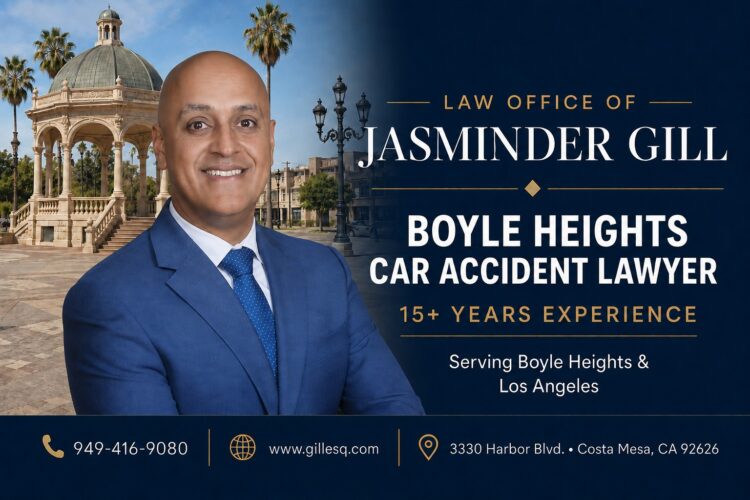
If you or a family member was injured in a car accident in Boyle Heights, attorney Jasminder Gill can help investigate the collision, preserve evidence, identify available insurance coverage, document your injuries and losses, communicate with insurance companies, and pursue compensation available under California law.
Car accidents in Boyle Heights can occur along busy local and regional corridors including Interstate 5, Interstate 10, U.S. Route 101, Cesar E. Chavez Avenue, Whittier Boulevard, Soto Street, Lorena Street, and First Street. Collisions may involve local commuters, school traffic, pedestrians, buses, commercial vehicles, delivery drivers, rideshare drivers, uninsured motorists, and drivers traveling between Boyle Heights, East LA, Downtown Los Angeles, and surrounding Los Angeles communities.
Attorney Jasminder Gill has more than 15 years of California personal injury experience representing injured people and families in serious motor vehicle accident claims.
¿Lesionado en un Accidente de Auto en Boyle Heights?
Se ofrecen consultas en español. Si usted o un familiar resultó lesionado en un accidente de auto, llame al 949-416-9080 para una consulta gratuita. Podemos explicarle el proceso, ayudarle a comunicarse con las compañías de seguros y trabajar para proteger la evidencia importante de su reclamación.
El abogado Jasminder Gill tiene más de 15 años de experiencia representando a personas lesionadas en California. La consulta puede realizarse por teléfono o video, y no es necesario viajar a la oficina de Costa Mesa para comenzar.
Llame al 949-416-9080 para hablar sobre un accidente en Boyle Heights. No hay honorarios de abogado por adelantado y no paga honorarios de abogado a menos que recuperemos compensación para usted.
Call 949-416-9080 for a Free Consultation
Attorney Jasminder Gill has more than 15 years of California personal injury experience and has helped thousands of injured clients and families. The firm serves Boyle Heights, the City of Los Angeles immediately east of Downtown, Downtown Los Angeles, East Los Angeles, Vernon, Commerce, and communities throughout California through telephone and video consultations.
15+ YEARS EXPERIENCE | THOUSANDS OF CLIENTS HELPED | MILLIONS RECOVERED | CALIFORNIA ATTORNEY SINCE 2009 | PUNJABI SPEAKING | SPANISH CONSULTATIONS | 24/7 FREE CONSULTATIONS
No upfront attorney’s fee. You pay no attorney’s fee unless compensation is recovered. Case results depend on the facts, law, available insurance, and evidence; past results do not guarantee a future outcome.
Why Choose the Law Office of Jasminder Gill After a Boyle Heights Crash?
A serious collision is not simply an exchange of insurance information. It can affect a person’s health, work, transportation, household responsibilities, credit, and ability to care for children or relatives. In Boyle Heights, those pressures can be intensified by major freeway interchanges, Metro rail crossings, buses, pedestrians, cyclists, neighborhood streets, and Downtown-bound traffic. The firm approaches each case by first learning what happened and how the injuries changed the client’s actual life, then matching that story to admissible evidence and legally recoverable damages.
Experience matters because insurance disputes often develop gradually. An adjuster may initially appear cooperative, then question treatment, causation, fault, or the need for future care. Attorney Jasminder Gill evaluates the entire claim rather than focusing only on a repair estimate or emergency-room bill. That includes liability, every potentially applicable policy, the medical timeline, wage loss, liens, future needs, and the practical risks of settlement or litigation.
The firm has worked with Hispanic and Latino communities for more than 15 years. Spanish consultations are available so clients can ask questions, involve trusted family members when appropriate, and understand major decisions. Attorney Jasminder Gill is Punjabi-speaking and represents clients from many cultural and linguistic backgrounds. The legal analysis remains evidence-driven; accessible communication helps the client participate fully in that process.
- Direct attorney-led evaluation of liability, insurance, injuries, and damages
- Prompt efforts to identify and preserve video, vehicle, witness, roadway, and digital evidence
- Clear communication about treatment documentation, insurer requests, deadlines, and settlement decisions
- Investigation of employer, rideshare, commercial, umbrella, uninsured, and underinsured coverage when applicable
- Contingency-fee representation with no upfront attorney fee and no attorney fee unless compensation is recovered
Understanding Traffic Risks in Boyle Heights
Boyle Heights is one of Los Angeles’ most historically significant Mexican American and Latino neighborhoods. Its roadway environment includes Cesar Chavez Avenue, First Street, Fourth Street, Whittier Boulevard, Olympic Boulevard, Soto Street, Lorena Street, I-5, I-10, US-101, and SR-60. These are not interchangeable streets. Some carry local shopping and school traffic; others connect industrial districts, freeways, transit, and neighboring communities. A useful local page should explain that context without claiming that every crash happens at the same intersection or for the same reason.
Drivers may encounter major freeway interchanges, Metro rail crossings, buses, pedestrians, cyclists, neighborhood streets, and Downtown-bound traffic. Congestion can increase rear-end risk, but low average speed does not make a corridor harmless. A turning vehicle can strike a pedestrian, a hurried driver can enter an intersection against a signal, and a truck can create severe consequences even during a short local trip. Night visibility, parked vehicles, curb activity, construction, weather, and unfamiliar navigation can also affect what a reasonably careful driver should do.
Local road names alone do not prove expertise. The important question is how the road, traffic control, sight line, vehicle path, and human decisions relate to liability. Investigation may require measuring the scene, locating cameras, preserving signal or maintenance records, examining vehicle damage, speaking with witnesses, and comparing physical evidence with driver accounts. The sooner that work begins, the less opportunity there is for video to be overwritten or conditions to change.
Major Streets, Intersections, Landmarks, and Areas in Boyle Heights
Car accidents can occur anywhere in Boyle Heights, but major corridors, commercial districts, parks, schools, industrial areas, and freeway connections can affect traffic volume, vehicle type, pedestrian activity, available video, and the agency that investigates the collision. Important local areas include the following.
Cesar Chavez Avenue, First Street, and Fourth Street
Cesar Chavez Avenue, First Street, and Fourth Street carry neighborhood, business, bus, bicycle, pedestrian, and Metro-related traffic through Boyle Heights. Intersections and rail crossings may require video, signal, and transit evidence.
Whittier Boulevard, Olympic Boulevard, and Washington Boulevard
Whittier Boulevard, Olympic Boulevard, and Washington Boulevard connect Boyle Heights with East Los Angeles, Commerce, Vernon, and Downtown. Traffic may include trucks, buses, shoppers, employees, and vehicles entering commercial driveways.
Soto Street, Lorena Street, and Major Freeway Interchanges
Soto Street and Lorena Street connect neighborhood streets with I-5, I-10, US-101, and SR-60. Freeway ramps, merging traffic, trucks, and multilane intersections can create complex multi-vehicle collisions.
Mariachi Plaza, Hollenbeck Park, and Local Medical Districts
Mariachi Plaza, Hollenbeck Park, local schools, Metro stations, and medical facilities generate pedestrian, bicycle, rideshare, bus, and visitor traffic. Boyle Heights also includes dense residential streets where parked vehicles can affect sight distance.
Common Types of Car Accident Claims
Rear-end collisions
A rear-end collision in Boyle Heights may require analysis of following distance, distraction, sudden slowing, brake evidence, and whether multiple impacts occurred. The label used in a police report does not decide the civil claim. Photographs, measurements, medical evidence, testimony, electronic data, and insurance records may change the initial picture. The firm evaluates the complete evidence, including unfavorable facts, because a credible demand or lawsuit must anticipate the defenses an insurer is likely to raise.
Intersection and T-bone crashes
An intersection and T-bone crash in Boyle Heights may require analysis of signal phase, right of way, turning movements, sight obstructions, and impact geometry. The label used in a police report does not decide the civil claim. Photographs, measurements, medical evidence, testimony, electronic data, and insurance records may change the initial picture. The firm evaluates the complete evidence, including unfavorable facts, because a credible demand or lawsuit must anticipate the defenses an insurer is likely to raise.
Left-turn collisions
A left-turn collision in Boyle Heights may require analysis of whether the turning driver yielded, how fast vehicles approached, and whether a yellow or red signal affected the maneuver. The label used in a police report does not decide the civil claim. Photographs, measurements, medical evidence, testimony, electronic data, and insurance records may change the initial picture. The firm evaluates the complete evidence, including unfavorable facts, because a credible demand or lawsuit must anticipate the defenses an insurer is likely to raise.
Hit-and-run crashes
A hit-and-run crash in Boyle Heights may require analysis of camera canvassing, witness identification, debris, plate fragments, police reporting, and uninsured-motorist notice. The label used in a police report does not decide the civil claim. Photographs, measurements, medical evidence, testimony, electronic data, and insurance records may change the initial picture. The firm evaluates the complete evidence, including unfavorable facts, because a credible demand or lawsuit must anticipate the defenses an insurer is likely to raise.
Uninsured and underinsured motorist claims
An uninsured or underinsured motorist claim in Boyle Heights may require analysis of policy language, household coverage, vehicle occupancy, notice, medical proof, and the value exceeding the other driver’s limits. The label used in a police report does not decide the civil claim. Photographs, measurements, medical evidence, testimony, electronic data, and insurance records may change the initial picture. The firm evaluates the complete evidence, including unfavorable facts, because a credible demand or lawsuit must anticipate the defenses an insurer is likely to raise.
Rideshare and delivery crashes
A rideshare or delivery crash in Boyle Heights may require analysis of driver app status, trip phase, platform coverage, personal policy exclusions, employer issues, and electronic records. The label used in a police report does not decide the civil claim. Photographs, measurements, medical evidence, testimony, electronic data, and insurance records may change the initial picture. The firm evaluates the complete evidence, including unfavorable facts, because a credible demand or lawsuit must anticipate the defenses an insurer is likely to raise.
Commercial vehicle collisions
A commercial vehicle collision in Boyle Heights may require analysis of company ownership, driver scope of work, maintenance, training, logs, telematics, cargo, and layered insurance. The label used in a police report does not decide the civil claim. Photographs, measurements, medical evidence, testimony, electronic data, and insurance records may change the initial picture. The firm evaluates the complete evidence, including unfavorable facts, because a credible demand or lawsuit must anticipate the defenses an insurer is likely to raise.
Pedestrian collisions
A pedestrian collision in Boyle Heights may require analysis of crosswalk status, visibility, turning movements, yielding duties, speed, lighting, and the pedestrian’s path. The label used in a police report does not decide the civil claim. Photographs, measurements, medical evidence, testimony, electronic data, and insurance records may change the initial picture. The firm evaluates the complete evidence, including unfavorable facts, because a credible demand or lawsuit must anticipate the defenses an insurer is likely to raise.
Bicycle and e-bike collisions
A bicycle or e-bike collision in Boyle Heights may require analysis of lane position, passing distance, dooring, intersection movement, helmet arguments, road condition, and visibility. The label used in a police report does not decide the civil claim. Photographs, measurements, medical evidence, testimony, electronic data, and insurance records may change the initial picture. The firm evaluates the complete evidence, including unfavorable facts, because a credible demand or lawsuit must anticipate the defenses an insurer is likely to raise.
Multi-vehicle pileups
A multi-vehicle pileup in Boyle Heights may require analysis of impact sequence, independent negligent acts, vehicle data, witness angles, and allocation of comparative fault. The label used in a police report does not decide the civil claim. Photographs, measurements, medical evidence, testimony, electronic data, and insurance records may change the initial picture. The firm evaluates the complete evidence, including unfavorable facts, because a credible demand or lawsuit must anticipate the defenses an insurer is likely to raise.
Drunk or drug-impaired driving
A drunk- or drug-impaired driving crash in Boyle Heights may require analysis of criminal investigation, toxicology, punitive-damage questions, insurance, and evidence beyond a citation. The label used in a police report does not decide the civil claim. Photographs, measurements, medical evidence, testimony, electronic data, and insurance records may change the initial picture. The firm evaluates the complete evidence, including unfavorable facts, because a credible demand or lawsuit must anticipate the defenses an insurer is likely to raise.
Fatal collisions
A fatal collision in Boyle Heights may require analysis of wrongful-death standing, survival issues, financial support, household services, grief-related damages allowed by law, and careful family communication. The label used in a police report does not decide the civil claim. Photographs, measurements, medical evidence, testimony, electronic data, and insurance records may change the initial picture. The firm evaluates the complete evidence, including unfavorable facts, because a credible demand or lawsuit must anticipate the defenses an insurer is likely to raise.
What to Do Immediately After a Collision
1. Protect life and call for help
Move only when remaining in place creates danger. Call 911 for injuries, hazards, suspected impairment, or serious damage. Give dispatch a precise location and describe immediate medical needs. These steps are especially important around Cesar Chavez Avenue and other busy Boyle Heights corridors, where traffic and surveillance conditions may change quickly.
2. Document the scene
When safe, photograph vehicle positions, all damage, plates, lanes, traffic controls, skid marks, debris, lighting, construction, weather, and visible injuries. Record a slow video showing how the approaches connect. These steps are especially important around Cesar Chavez Avenue and other busy Boyle Heights corridors, where traffic and surveillance conditions may change quickly.
3. Identify people and evidence
Exchange driver, owner, and insurance information. Obtain witness names and numbers. Note nearby homes, stores, buses, cameras, and dash cameras before people leave. These steps are especially important around Cesar Chavez Avenue and other busy Boyle Heights corridors, where traffic and surveillance conditions may change quickly.
4. Obtain medical evaluation
Do not diagnose yourself at the roadside. Some concussion, spinal, soft-tissue, and internal symptoms appear or worsen later. Describe symptoms accurately and follow reasonable medical advice. These steps are especially important around Cesar Chavez Avenue and other busy Boyle Heights corridors, where traffic and surveillance conditions may change quickly.
5. Report without speculating
Give truthful facts to law enforcement and your insurer, but do not guess about speed, distance, fault, or medical prognosis. Ask for report or incident information. These steps are especially important around Cesar Chavez Avenue and other busy Boyle Heights corridors, where traffic and surveillance conditions may change quickly.
6. Preserve records
Keep photographs in original form, tow and repair papers, damaged property, medication receipts, work notes, pay records, insurance letters, and a contemporaneous symptom and activity journal. These steps are especially important around Cesar Chavez Avenue and other busy Boyle Heights corridors, where traffic and surveillance conditions may change quickly.
7. Get legal advice before a final release
A settlement release is usually permanent. Understand the injuries, coverage, liens, costs, and future care before accepting a final payment. These steps are especially important around Cesar Chavez Avenue and other busy Boyle Heights corridors, where traffic and surveillance conditions may change quickly.
Evidence That Can Strengthen or Weaken a Claim
Evidence is strongest when it is preserved in its original form and connected to a reliable witness or business record. A cropped screenshot may be useful, but the original photo or video with metadata is usually better. A witness name without contact information may be difficult to use months later. A medical bill proves a charge, but the medical record and provider opinion may be necessary to connect treatment to the collision.
- Police traffic-collision report, incident number, body-worn camera, photographs, and 911 audio
- Business, residential, transit, traffic-camera, and dash-camera footage
- Vehicle event-data recorder, infotainment, telematics, inspection, repair, and total-loss records
- Cell-phone or app data obtained through lawful process when distraction or work status is disputed
- Driver qualification, employment, training, dispatch, route, maintenance, and insurance records for commercial cases
- Medical records, diagnostic images, provider opinions, prescriptions, rehabilitation notes, and future-care recommendations
- Employment records, tax documents, schedules, disability notes, and testimony supporting wage loss
- Scene measurements, signal timing, roadway plans, maintenance history, construction records, and prior complaints where relevant
Evidence can also create problems when accounts change, treatment is unrelated or poorly documented, social-media posts conflict with claimed limitations, prior injuries are concealed, or damaged property is destroyed before inspection. A careful attorney does not hide difficult facts. The better approach is to learn them early, determine their legal significance, and present the claim accurately.
How Liability Is Determined Under California Law
Most car-accident claims require proof that another person or entity owed a duty of reasonable care, breached that duty, and caused legally compensable harm. Traffic-law violations can be important, but a citation is not the only path to proving negligence and does not automatically decide every civil issue. The physical evidence and witness testimony still matter.
California uses comparative fault. More than one person may contribute to a collision, and an injured person may still recover even when partly responsible, subject to reduction for the assigned share of fault. Insurers sometimes use comparative-fault arguments aggressively because every percentage point can reduce payment. The response should be evidence: vehicle paths, timing, visibility, speed, driver conduct, and credible testimony.
Responsibility may extend beyond the person behind the wheel. An employer may be liable when an employee causes a crash within the scope of employment. A vehicle owner, rideshare platform, contractor, maintenance provider, manufacturer, property owner, or government entity may be relevant in the right facts. Each theory has different evidence and deadlines, so potential parties should be investigated rather than assumed.
Insurance Coverage and Adjuster Tactics
The visible at-fault driver is only the beginning of an insurance investigation. Available coverage may include personal bodily-injury liability, commercial auto, employer coverage, rideshare or delivery policies, umbrella insurance, household policies, medical payments coverage, collision coverage, uninsured motorist, and underinsured motorist protection. Policy dates, exclusions, definitions, endorsements, and driver status can matter as much as the declarations-page limit.
Adjusters may request a recorded statement, broad medical authorization, vehicle inspection, prior medical records, wage proof, or an early release. Some requests are routine; others are overbroad or premature. Silence is not always the answer because an insured has contractual cooperation duties. The correct response depends on who is asking, which policy applies, and what the request actually requires.
Common disputes include low-impact arguments, delayed symptoms, treatment gaps, preexisting conditions, excessive care, unrelated imaging findings, partial fault, disputed occupancy, lack of visible property damage, and whether future treatment is reasonably necessary. A persuasive response uses specific records and medical reasoning instead of adjectives. The goal is not to exaggerate; it is to prevent an incomplete file from understating a legitimate injury.
Medical Care, Causation, and Documentation
Medical decisions belong to the patient and qualified healthcare providers, not the lawyer or claims adjuster. From a legal perspective, timely and accurate documentation helps establish what symptoms began after the crash, how they progressed, what objective findings exist, which treatments were recommended, and whether the person improved. Unexplained gaps can invite questions, but a gap may have a legitimate cause such as cost, transportation, childcare, work, referral delay, or lack of available appointments.
Preexisting conditions do not automatically defeat a claim. California law can permit recovery when a collision aggravates or activates an earlier condition, but the analysis is fact-specific. Prior records may show baseline function, earlier symptoms, or a materially different condition. Concealing prior treatment damages credibility; careful comparison can clarify what actually changed.
Serious cases may involve emergency care, surgery, orthopedic or neurological evaluation, pain management, physical therapy, occupational therapy, mental-health care, dental treatment, scar evaluation, or future procedures. The claim should distinguish past charges from reasonable future needs and should address medical liens or reimbursement rights before net settlement expectations are discussed.
Damages Available in a California Car Accident Case
Compensation depends on proof, causation, applicable law, and collectible insurance or assets. Potential economic damages include past and future medical expenses, lost wages, reduced earning capacity, replacement services, property damage, towing, rental costs, and other reasonable out-of-pocket losses. Each item needs documentation and a causal connection to the collision.
Potential noneconomic damages include physical pain, inconvenience, emotional distress, anxiety, sleep disruption, disfigurement, physical impairment, and loss of enjoyment of life. These losses are personal, but they still require credible explanation. Specific examples—difficulty lifting a child, inability to drive, missed cultural or family events, fear at an intersection, or limits on ordinary household tasks—usually communicate more than generic statements.
There is no legitimate calculator that can promise a case value from the amount of medical bills. Liability strength, injury severity, prognosis, treatment consistency, prior health, credibility, wage proof, liens, policy limits, venue, expert needs, and litigation risk can all affect value. Any attorney who evaluates a case needs the records and facts, not merely a city name and a diagnosis.
Special Issues in Hit-and-Run and Uninsured Cases
Hit-and-run crashes in Boyle Heights require fast work because cameras along Cesar Chavez Avenue or nearby businesses may overwrite footage. Victims should report the collision promptly, preserve fragments and photographs, obtain witness information, and notify applicable insurers. Uninsured-motorist policies can contain notice, cooperation, proof, and arbitration requirements that should be reviewed carefully.
A fleeing vehicle is not always unidentified forever. Video may show a partial plate, make, model, distinctive damage, company marking, route, or driver. Repair shops, nearby cameras, witnesses, and police investigation may provide leads. The legal team should coordinate preservation without interfering with law enforcement.
Underinsured-motorist coverage may apply when the responsible driver has insurance but not enough to cover proven losses. Consent-to-settle and exhaustion requirements can matter before resolving the third-party claim. Accepting a small liability limit without reviewing the client’s own policy can create avoidable complications.
Commercial, Truck, Rideshare, and Delivery-Vehicle Collisions
The mix of traffic in Boyle Heights can include work vehicles, delivery drivers, rideshare cars, buses, and commercial trucks. A company-related crash may involve multiple policies and defendants. Evidence such as dispatch records, app status, bills of lading, driver logs, inspection records, route data, telematics, and employment agreements may disappear unless preserved.
The name on a truck or app icon on a phone does not by itself answer coverage. The driver may be logged off, waiting for a request, traveling to a pickup, carrying a passenger, delivering goods, or performing another work task. Each phase can trigger different policies or legal theories. The firm investigates status rather than assuming the largest advertised policy applies.
Commercial defendants often have rapid-response investigators. An injured person should avoid giving informal statements to a company investigator without understanding who the investigator represents. Photographs, witness contacts, vehicle preservation, and early legal review are especially important when a business controls much of the evidence.
Deadlines and Government Claims
California deadlines are unforgiving. Many personal injury lawsuits are subject to a two-year statute of limitations, but that is not a universal rule. Claims involving a public entity can require a government claim within six months, and claims involving minors, delayed discovery, death, out-of-state defendants, or contractual insurance rights may involve different rules. The correct deadline requires case-specific legal analysis.
A public bus, dangerous roadway condition, government driver, signal problem, or public property issue can raise government-claim procedures. Waiting for treatment to finish before investigating the deadline can be a serious mistake. Filing a police report or insurance claim does not necessarily satisfy a government-claim requirement or file a civil lawsuit.
Other deadlines may arise from evidence-preservation needs, insurer notice, uninsured-motorist procedures, vehicle storage, medical liens, or court service requirements. Prompt consultation protects options even when the client ultimately chooses not to hire the firm.
Boyle Heights Car Accident Reports, Roadway Information, and Official Resources
After a serious collision, official records can help identify the investigating agency, document the parties and witnesses, confirm the reported location, and show whether officers recorded citations or contributing factors. These records are important, but they are only one part of the evidence. A police report does not automatically determine civil liability, and it may not include surveillance video, complete witness interviews, vehicle data, medical evidence, or every responsible party.
How to Request a Boyle Heights Traffic Collision Report
For a collision investigated on a local street in Boyle Heights, begin with the Los Angeles Police Department. Ask which records unit maintains the report, what identification or authorization is required, whether the report is available online or in person, and whether a fee applies. Keep the report number, incident number, date, time, exact location, and names of the involved drivers available when making the request.
Reports may not be immediately available. Collisions involving a fatality, arrest, juvenile, continuing investigation, or other protected information can require additional processing or may be subject to release restrictions. An attorney can request the report while separately preserving evidence that may not be included in the police file.
Which Agency Investigates a Freeway or Border-Area Crash?
The correct agency depends on the exact location—not simply the city written on a mailing address. The California Highway Patrol commonly investigates crashes on state freeways, while a city police department or the Los Angeles County Sheriff’s Department may handle a collision on a local road. This distinction can matter around Cesar Chavez Avenue, First Street, Fourth Street, Whittier Boulevard, Olympic Boulevard, Soto Street, Lorena Street, I-5, I-10, US-101, and SR-60.
A crash near Downtown Los Angeles, East Los Angeles, Vernon, or Commerce may occur close to a jurisdictional boundary. Confirm the investigating agency from the report or incident number, the officer’s business card, tow paperwork, or dispatch information. Contacting the wrong agency can delay access to the report and other records while video or witness evidence becomes harder to locate.
California DMV SR-1 Accident Reporting Requirements
California drivers may be required to submit an SR-1 collision report to the Department of Motor Vehicles when a crash causes injury, death, or qualifying property damage. The DMV report is separate from a police report and separate from an insurance claim. Filing one does not substitute for the others.
Because reporting requirements and deadlines can change, review the current DMV instructions promptly. Keep proof of submission with the accident file. Do not assume that the responding officer or insurance company will complete the driver’s DMV obligation.
Checking Current Freeway and Road Conditions
Caltrans QuickMap provides current information concerning freeway traffic, lane closures, incidents, construction, and certain roadway conditions. Current traffic information can help travelers avoid an active incident, but it does not preserve the historical conditions that existed when a crash occurred.
When roadway design, construction, signal timing, lane configuration, debris, lighting, or maintenance may have contributed to a collision, the investigation may require photographs, public records, maintenance documents, construction records, traffic-control plans, or expert inspection. Government-related evidence and claims can involve short deadlines.
Finding the Appropriate Los Angeles County Courthouse
The Los Angeles County Superior Court maintains civil courthouses throughout the county. A car accident lawsuit is not automatically filed at the courthouse closest to the injured person. Venue can depend on where the collision occurred, where a defendant resides, the parties involved, and current court assignments.
The California Courts also provides general self-help information concerning personal injury lawsuits. Court resources provide general procedural information; they do not evaluate insurance coverage, preserve evidence, calculate damages, or give case-specific legal strategy.
Why These Official Records Are Only the Beginning
A professional accident investigation should not stop after downloading a police report. Depending on the case, the evidence may include 911 recordings, body-worn camera footage, photographs, surveillance video, dash-camera files, traffic-signal information, vehicle event data, repair and inspection records, witness statements, cell-phone or app records obtained through lawful process, medical documentation, and wage-loss evidence.
Some evidence can be overwritten or destroyed quickly. Businesses may routinely erase surveillance video, vehicles may be repaired or sold, witnesses may move, and roadway conditions may change. Prompt preservation letters and targeted record requests can be just as important as obtaining the official collision report.
Hospitals and Urgent Care Near Boyle Heights
Boyle Heights is served by major hospitals, emergency departments, urgent-care facilities, and outpatient medical centers. People injured in Boyle Heights car accidents should select a facility based on the nature and severity of their symptoms.
Call 911 immediately for a medical emergency. Urgent-care centers and outpatient clinics are not substitutes for hospital emergency departments when someone experiences loss of consciousness, breathing difficulty, chest pain, uncontrolled bleeding, confusion, severe head or neck pain, weakness or paralysis, a suspected spinal injury, major fractures, or another potentially life-threatening condition.
The following facilities are provided as local resources—not endorsements or medical referrals. Services, operating hours, appointment requirements, and insurance participation can change. Unless the situation is an emergency, call the facility or review its official website before traveling.
Adventist Health White Memorial – Emergency Department
Facility type: Hospital and emergency department in Boyle Heights
Address: 1720 East Cesar E. Chavez Avenue, Los Angeles, CA 90033
Phone: (323) 268-5000
Website: Adventist Health White Memorial
Adventist Health White Memorial is located in Boyle Heights near East Cesar E. Chavez Avenue, State Street, Boyle Avenue, Pennsylvania Avenue, and Bailey Street. The hospital’s official campus map identifies a dedicated emergency room and emergency entrance.
LA General Medical Center – Emergency and Urgent Care
Facility type: Hospital, 24-hour emergency department, and urgent-care center in Boyle Heights
Address: 2051 Marengo Street, Los Angeles, CA 90033
Phone: (323) 409-1000
Website: LA General Medical Center
LA General Medical Center provides 24-hour emergency services in addition to urgent care, primary care, diagnostic services, surgery, orthopedics, neurology, radiology, and other medical specialties.
Edward R. Roybal Comprehensive Health Center – Urgent Care
Facility type: Los Angeles County urgent-care and outpatient health center near Boyle Heights
Address: 245 South Fetterly Avenue, Los Angeles, CA 90022
Phone: (323) 362-1010
Website: Los Angeles County Urgent Care Services
Los Angeles County identifies the Edward R. Roybal Comprehensive Health Center as an urgent-care location. Patients should call before traveling to confirm current hours, available services, and appointment requirements.
AltaMed Medical and Dental Group – Boyle Heights
Facility type: Outpatient medical and dental center; not an emergency department
Address: 3945 Whittier Boulevard, Los Angeles, CA 90023
Phone: (888) 499-9303
Website: AltaMed Locations and Services
AltaMed’s Boyle Heights location provides outpatient medical, dental, and pharmacy services. It should not be described as a hospital emergency department. Patients should contact AltaMed to confirm whether the facility can evaluate their particular symptoms or injuries.
Choosing Between a Medical Clinic, Urgent Care, and an Emergency Department
An outpatient medical clinic may be appropriate for nonemergency evaluation or follow-up care. Urgent care may be appropriate for certain non-life-threatening symptoms and minor injuries requiring prompt attention. A hospital emergency department may be necessary following a serious Boyle Heights collision involving substantial bleeding, loss of consciousness, breathing problems, neurological symptoms, a suspected traumatic brain injury, possible spinal trauma, or major fractures.
When there is uncertainty about the seriousness of an injury, call 911 or obtain guidance from a qualified healthcare professional. Do not delay emergency medical treatment to contact an attorney.
Why Medical Documentation Matters After a Boyle Heights Car Accident
Medical records may document when accident-related symptoms began, what the injured person reported, examination findings, diagnostic testing, diagnoses, prescribed medications, treatment recommendations, work restrictions, specialist referrals, and follow-up instructions. These records may become important when establishing the nature, severity, and progression of injuries caused by a Boyle Heights car accident.
Patients should describe their symptoms accurately and follow the recommendations of qualified healthcare professionals. The attorney does not diagnose injuries or direct medical treatment. Inclusion of a medical clinic, urgent-care center, hospital, or emergency department on this page does not imply an endorsement, affiliation, referral arrangement, or professional relationship between the facility and the Law Office of Jasminder Gill.
Frequently Asked Questions About Boyle Heights Car Accident Claims
How Much Does It Cost to Hire a Boyle Heights Car Accident Lawyer?
The firm handles accepted injury cases on a contingency fee. There is no upfront attorney fee, and no attorney fee is owed unless compensation is recovered. The written agreement explains the percentage and treatment of case costs.
Can I Still Have a Boyle Heights Car Accident Claim If the Police Report Blames Me?
Possibly. A report is important evidence but is not always the final word in a civil claim. Witnesses, video, vehicle damage, scene evidence, and comparative-fault rules may support a different or more complete analysis.
Can I Recover Compensation If I Was Partly at Fault for a Boyle Heights Crash?
California comparative negligence may allow recovery reduced by the percentage of fault assigned to you. Do not accept an insurer’s percentage without reviewing the supporting evidence.
Should I Give the Insurance Company a Recorded Statement After a Boyle Heights Accident?
An adverse adjuster may seek a recorded statement or broad authorization. Obtain advice before agreeing. Your own insurer may have cooperation requirements, so do not ignore communications; respond appropriately after reviewing the policy and request.
What If My Injuries Appeared Hours or Days After a Boyle Heights Car Accident?
Some symptoms develop after adrenaline fades or inflammation increases. Seek appropriate medical care, report the timeline honestly, and avoid claiming that every delayed symptom must have been caused by the crash without medical evaluation.
Can I Recover Compensation After a Hit-and-Run Accident in Boyle Heights?
A hit-and-run claim may be supported by police investigation, video, witnesses, physical evidence, and uninsured-motorist coverage. Prompt reporting and policy review are important.
What Happens If the Driver Who Hit Me in Boyle Heights Has No Insurance?
Your own uninsured-motorist coverage, household policies, employer coverage, vehicle-owner liability, or another responsible party may be relevant. Coverage analysis is fact-specific.
How Long Does a Boyle Heights Car Accident Claim Usually Take?
Timing depends on medical recovery, evidence, insurance, liability disputes, liens, negotiation, and whether litigation is necessary. Settling before the medical picture is reasonably understood can undervalue future needs.
Will I Have to Go to Court for a Boyle Heights Car Accident Case?
Most claims resolve without trial, but filing a lawsuit may be necessary when liability, causation, damages, or coverage is disputed. Preparation for litigation can improve the quality of negotiations.
Can an Undocumented Person Pursue a Car Accident Claim in California?
Immigration and damages issues are legally sensitive and fact-dependent. Do not let an adjuster or nonlawyer intimidate you. Discuss status privately with counsel so the legal rules and protections can be evaluated.
Are Spanish Consultations Available for Boyle Heights Car Accident Victims?
Spanish consultations are available. Attorney Jasminder Gill is Punjabi-speaking and the firm works with clients from diverse California communities.
What Should I Bring to a Free Boyle Heights Car Accident Consultation?
Bring the report or incident number, insurance information, photographs, videos, witness contacts, medical paperwork, employer information, repair or tow documents, and every insurer communication available. Missing items should not prevent an initial call.
What Compensation May Be Available After a Boyle Heights Car Accident?
Depending on the evidence and California law, compensation may include emergency treatment, continuing medical care, future medical needs, lost income, reduced earning capacity, vehicle damage, out-of-pocket expenses, physical pain, emotional distress, inconvenience, impairment, disfigurement, and loss of enjoyment of life. The available recovery depends on liability, causation, documentation, insurance coverage, and the individual effect of the injuries.
What Is the Deadline for Filing a Boyle Heights Car Accident Lawsuit?
Many California personal injury lawsuits are subject to a two-year limitations period, but shorter or different deadlines can apply. A claim involving a city, county, public bus, government driver, or dangerous public roadway condition may require a government claim within six months. Minors, deaths, delayed discovery, absent defendants, and insurance-contract issues can affect the analysis. Obtain case-specific advice promptly.
Which Courthouse Handles a Boyle Heights Car Accident Case?
The courthouse is not selected solely by choosing the building closest to the injured person. Venue can depend on where the collision occurred, where a defendant resides, which parties are involved, and current Los Angeles County Superior Court assignments. The appropriate filing location should be confirmed before litigation begins.
How Is the Value of a Boyle Heights Car Accident Claim Determined?
There is no honest fixed calculator. Claim value may be affected by the strength of the liability evidence, comparative fault, injury severity, medical causation, prognosis, consistency of treatment, prior conditions, wage documentation, available insurance, liens, credibility, future needs, venue, and litigation risk. A settlement should be evaluated using the complete record rather than medical bills alone.
Punjabi-Speaking Car Accident Lawyer Serving Boyle Heights
Punjabi-speaking car accident lawyer Jasminder Gill represents people and families injured in car accidents, truck accidents, motorcycle crashes, pedestrian accidents, rideshare collisions, hit-and-run accidents, and other serious traffic incidents in Boyle Heights and throughout California.
Attorney Jasminder Gill speaks Punjabi and can communicate directly with Punjabi-speaking clients about the accident, their injuries, available insurance coverage, medical documentation, property damage, lost income, and the personal injury claims process. Clients do not need to rely on a relative, friend, or child to interpret important legal conversations.
Call a Boyle Heights Car Accident Lawyer
If you or a family member was injured on Cesar Chavez Avenue, First Street, SR-60, or another road in or near Boyle Heights, call the Law Office of Jasminder Gill. The consultation can address fault, insurance, evidence, medical documentation, deadlines, liens, and practical next steps.
