
Costa Mesa E-Bike Accident Lawyer | Law Office of Jasminder Gill
Representing Injured Electric Bicycle Riders Throughout Costa Mesa and Orange County
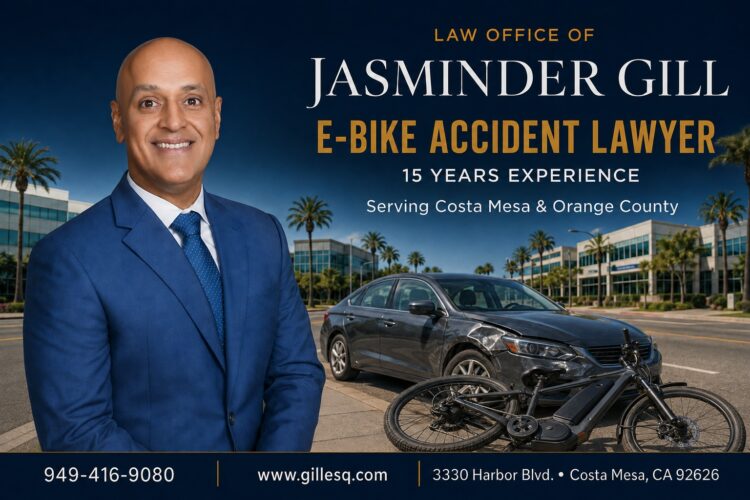 Electric bicycles have transformed how people travel through Costa Mesa and surrounding Orange County communities. Adults use e-bikes to commute to work, teenagers ride them to school, and families use them for recreation. However, their increased speed, weight, acceleration, and presence around motor vehicles can result in devastating accidents.
An e-bike collision can leave a rider with a traumatic brain injury, broken bones, spinal damage, internal injuries, permanent scarring, or other life-changing harm. Riders have little protection when struck by a car, SUV, pickup truck, delivery vehicle, or commercial truck. Even an accident at a relatively low speed can require emergency treatment, surgery, rehabilitation, and months away from work or school.
At the Law Office of Jasminder Gill, we represent people injured in electric bicycle accidents in Costa Mesa and throughout Orange County. Attorney Jasminder Gill has more than 15 years of personal injury experience and has helped thousands of clients facing the physical, emotional, and financial consequences of serious accidents.
Our firm investigates how an e-bike collision occurred, identifies every potentially responsible party, preserves available evidence, documents the full extent of the injuries, and deals directly with insurance companies. We pursue compensation for medical expenses, lost income, pain and suffering, permanent impairment, future treatment, and every other loss supported by the evidence.
Call 949-416-9080 for a Free Consultation
If you or your child was injured while riding an electric bicycle, contact the Law Office of Jasminder Gill to discuss your legal rights and available options.
There are no upfront attorney’s fees. You pay no attorney’s fee unless we recover compensation for you.
Why Hire a Costa Mesa E-Bike Accident Lawyer?
E-bike accident claims can involve legal and insurance issues that do not ordinarily arise in traditional bicycle cases. The classification of the e-bike, its motor power, its maximum assisted speed, the rider’s age, the location of the collision, and whether the bicycle was modified may all become important.
Insurance companies may attempt to characterize an injured rider as reckless or inexperienced. They may argue that the e-bike was traveling too fast, the rider entered traffic unexpectedly, a helmet was not worn, or the device did not qualify as a lawful electric bicycle. These arguments do not automatically defeat a claim, but they must be addressed with evidence.
When you hire the Law Office of Jasminder Gill, our firm can:
- Investigate how the e-bike accident happened
- Obtain available police and traffic-collision reports
- Interview witnesses before their memories fade
- Seek surveillance, doorbell, intersection, and dashboard-camera footage
- Photograph the e-bike, motor vehicle, roadway, and surrounding conditions
- Preserve the damaged e-bike and its electronic components
- Determine the e-bike’s classification and specifications
- Investigate whether the bicycle was modified before the accident
- Examine the conduct of the driver and the e-bike rider
- Identify applicable automobile, homeowners, renters, business, and product-liability insurance
- Evaluate uninsured and underinsured motorist coverage
- Gather medical records and evidence of future care
- Document lost wages and diminished earning capacity
- Address allegations of comparative fault
- Negotiate directly with insurance companies
- Prepare the claim for litigation when a fair resolution cannot be reached
Our goal is to protect your rights while you focus on your medical treatment and recovery.
Why E-Bike Accidents Can Cause Serious Injuries
A traditional bicycle depends entirely on the rider’s physical effort. An electric bicycle uses a motor to assist propulsion and can accelerate more quickly or maintain a higher speed with less effort.
A compliant Class 3 e-bike may provide assistance at speeds approaching 28 miles per hour. At that speed, a rider can cover a significant distance before a driver realizes the bicycle is approaching. The additional speed also increases the force involved when the rider strikes a vehicle, pavement, curb, sign, or other object.
Several features can make e-bike accidents especially dangerous:
- E-bikes are generally heavier than traditional bicycles
- Riders may accelerate more quickly than motorists expect
- Drivers may underestimate an approaching e-bike’s speed
- Motorists may fail to see riders in bicycle lanes
- Younger riders may have limited traffic experience
- Some riders may not be familiar with the bicycle’s acceleration or braking distance
- Modified devices may travel faster than their original classification permits
- Riders lack the protective structure of an automobile
- Road defects can become more dangerous at increased speeds
- Drivers may turn across a bicycle lane without checking for riders
A person injured in an e-bike accident should not assume that the driver’s insurance company will fairly evaluate these factors. An insurer may begin searching for evidence that shifts responsibility to the rider immediately after the collision.
California’s Three Electric Bicycle Classes
California recognizes three classifications of electric bicycles. A qualifying e-bike must have fully operable pedals and an electric motor that does not exceed 750 watts. Understanding the classification can be important when determining where the bicycle could lawfully be operated and whether age or helmet requirements applied.
Class 1 Electric Bicycles
A Class 1 e-bike provides motor assistance only while the rider is pedaling. The motor must stop providing assistance when the bicycle reaches 20 miles per hour.
Class 1 e-bikes are commonly used for commuting, recreation, and family riding. They generally operate more like traditional bicycles because the rider must pedal for the motor to provide assistance.
Class 2 Electric Bicycles
A Class 2 e-bike may use a throttle to propel the bicycle without continuous pedaling. Motor assistance must stop when the bicycle reaches 20 miles per hour.
The throttle capability can make Class 2 e-bikes easier to accelerate from a stopped position. However, drivers may not expect a rider to enter an intersection or cross a driveway as quickly as a throttle-assisted bicycle permits.
Class 3 Electric Bicycles
A Class 3 e-bike provides assistance while the rider pedals and stops providing assistance at 28 miles per hour. Under California law, a person must be at least 16 years old to operate a Class 3 e-bike.
A properly fitted and fastened helmet is required for anyone operating or riding as a passenger on a Class 3 e-bike on a street, bikeway, public bicycle path, or trail. California also generally requires riders under 18 to wear a properly fitted and fastened helmet when riding a bicycle or qualifying e-bike on public roads and bikeways.
California’s current classifications and Class 3 requirements are explained by the California Highway Patrol.
When an Electric Device May Not Legally Qualify as an E-Bike
Not every two-wheeled electric device marketed or described as an “e-bike” necessarily satisfies California’s legal definition.
A device may fall outside the e-bike classifications when it:
- Does not have fully operable pedals
- Has a motor exceeding the permitted power
- Provides motor assistance above the speed allowed for its class
- Has been modified to travel beyond the lawful assisted speed
- Operates more like an electric motorcycle or e-moto
- Does not comply with applicable equipment requirements
California prohibits modifications that cause an electric bicycle to fall outside the state’s e-bike definition. It also prohibits selling a product, device, or application designed to modify an e-bike’s speed capability so that the bicycle no longer qualifies as an e-bike.
A device that falls outside the legal e-bike definition may be treated differently for licensing, registration, equipment, roadway use, and insurance purposes. That classification can become important after an accident, but it does not automatically excuse a negligent motorist who caused the collision.
Our firm can investigate the bicycle’s manufacturer, model, motor, controller, speed settings, labels, purchase records, modifications, and electronic data when classification becomes disputed.
New California E-Bike Equipment and Battery-Safety Requirements
California’s e-bike laws continue to change as electric bicycles become more common.
Beginning in 2026, California requires an electric bicycle to have a red reflector or a solid or flashing red light with an integrated reflector on the rear during all hours of operation. The requirement is no longer limited to nighttime use.
California also adopted safety requirements addressing e-bikes, powered mobility devices, lithium-ion batteries, and charging systems. These requirements are intended to reduce the danger of battery fires, electrical malfunctions, and unsafe charging equipment. California’s 2026 changes are summarized by the California Highway Patrol.
When an e-bike battery, charger, or electrical component catches fire, the resulting claim may involve more than an ordinary traffic accident. Potentially responsible parties could include:
- The e-bike manufacturer
- A battery manufacturer
- A charging-system manufacturer
- A component supplier
- A distributor
- A retailer
- A repair business
- A rental company
- Another company in the product’s supply chain
Evidence should be preserved before the damaged bicycle, battery, charger, or electrical components are discarded, altered, or repaired.
Newport-Mesa Unified School District E-Bike Restrictions
Electric bicycle use among children and teenagers has become a significant safety issue in Costa Mesa and Newport Beach.
Beginning with the 2026–27 school year, the Newport-Mesa Unified School District prohibits elementary and middle or intermediate school students in grades TK–8 from possessing or operating e-bikes, e-motos, and certain other covered devices on school property, including the periphery of the campus.
High-school students in grades 9–12 may possess qualifying e-bikes on campus, subject to the district’s safety-training, permit, and related requirements. E-motos remain prohibited on district property for all grade levels.
The district’s policy includes safety education, helmet rules, campus walking requirements, and permit procedures. The current requirements are available through the Newport-Mesa Unified School District’s Bike and E-Bike Safety Program.
These school rules may become relevant when an accident occurs on or around a campus. However, violating a school policy does not automatically determine who is legally responsible for an accident. Liability still requires an examination of all relevant facts, including:
- Where the collision occurred
- Whether the rider was entering, leaving, or traveling near campus
- Whether the driver kept a proper lookout
- Whether the driver yielded the right of way
- The rider’s age and e-bike classification
- Whether the bicycle was permitted on the property
- The timing and visibility of the collision
- Applicable traffic laws
- Roadway and bicycle-lane design
- The conduct of every person involved
An insurance company should not be permitted to use a school policy as a substitute for a complete investigation.
E-Bike Accidents Involving Children and Teenagers
Children and teenagers are among the most frequent e-bike users in Costa Mesa, Newport Beach, and nearby Orange County communities. Younger riders may use e-bikes to travel to school, visit friends, attend sports practices, or move through residential neighborhoods.
A child may understand how to operate the bicycle without fully appreciating the dangers created by intersections, driveways, parked vehicles, blind corners, and high-speed traffic. Drivers must still operate carefully around young riders and should not assume that a child will react like an experienced adult cyclist.
Accidents involving minors may raise additional questions about:
- The child’s age and riding experience
- The e-bike’s classification
- Whether the child was legally permitted to operate that class
- Whether the device had been modified
- Helmet use
- Driver visibility
- School rules
- Road and bicycle-lane conditions
- The conduct of the driver
- Insurance coverage
- The procedure for resolving a minor’s injury claim
A parent is not automatically legally responsible simply because a child was involved in an e-bike accident. The facts must be evaluated under the laws applicable to the particular claim.
When a child is seriously injured, the claim should also account for the possibility of future medical care, additional surgery, permanent scarring, emotional trauma, interrupted education, and the long-term effect of the injury.
Common Causes of E-Bike Accidents in Costa Mesa
Most electric bicycle collisions are preventable. They often occur because a motorist, property owner, product manufacturer, or another party failed to act with reasonable care.
Common causes include:
- Drivers failing to yield at intersections
- Motorists turning right across bicycle lanes
- Drivers turning left in front of approaching riders
- Distracted driving
- Texting or using a cellphone
- Speeding
- Unsafe lane changes
- Opening a vehicle door into a rider’s path
- Backing out of driveways or parking spaces
- Running red lights or stop signs
- Driving under the influence
- Following an e-bike too closely
- Entering a bicycle lane without checking for riders
- Poorly designed or maintained roads
- Construction debris in bicycle lanes
- Defective brakes, tires, batteries, or electrical components
- Rental-company maintenance failures
- E-bike modifications
- Inadequate lighting or visibility
- Inexperienced operation
Determining the cause may require more than reviewing the police report. Video, electronic information, physical evidence, witness testimony, road measurements, vehicle damage, and e-bike components may reveal details that are not immediately apparent.
Right-Hook E-Bike Accidents
A right-hook accident occurs when a vehicle turns right across the path of an e-bike traveling beside it or in a bicycle lane.
The driver may overtake the rider and immediately turn, fail to check a mirror or blind spot, or misjudge how quickly the e-bike is approaching. The rider may have only seconds to brake or attempt an evasive maneuver.
Right-hook collisions frequently happen near:
- Intersections
- Shopping-center entrances
- Parking garages
- Gas stations
- Apartment driveways
- Restaurant entrances
- School drop-off areas
- Freeway on-ramps
- Commercial parking lots
Evidence showing the positions of the vehicle and bicycle, turning signals, traffic controls, bicycle-lane markings, visibility, and impact damage can help determine how the collision happened.
Left-Turn E-Bike Accidents
A left-turn collision may occur when a driver turns across the path of an approaching e-bike. The motorist may see the rider but underestimate the bicycle’s speed or assume there is enough time to complete the turn.
These accidents can result in a direct impact with the front or side of the vehicle. The rider may be thrown onto the hood, windshield, roadway, or into surrounding traffic.
Witness statements, intersection cameras, dash-camera footage, vehicle data, skid marks, and the locations of the damage can be especially important in a disputed left-turn case.
Dooring Accidents Involving E-Bikes
A dooring accident happens when a driver or passenger opens a parked vehicle’s door into the path of an approaching e-bike.
The rider may strike the door directly, lose control while attempting to avoid it, or be pushed into moving traffic. Because e-bikes may approach faster than traditional bicycles, a person opening the door may misjudge the available distance.
Potential evidence includes:
- Nearby business surveillance
- Residential doorbell cameras
- Dashboard-camera recordings
- Photographs of the open door and bicycle
- Vehicle occupant statements
- Witness information
- The location of the vehicle relative to the bicycle lane
- Damage to the door and e-bike
Drivers and passengers should check for approaching bicyclists before opening a door into traffic or a bicycle lane.
Driveway and Parking-Lot E-Bike Accidents
Drivers pulling out of driveways, parking structures, shopping centers, apartment complexes, and commercial properties may focus on approaching motor vehicles without checking for e-bike riders.
A building, hedge, parked vehicle, sign, or poorly placed barrier may obstruct visibility. Drivers may also roll through sidewalks and bicycle lanes without stopping.
Liability may involve the driver, but unsafe property design or obstructed visibility could raise questions about a property owner, business operator, maintenance company, or another responsible party.
A prompt site inspection can help document:
- Sight lines
- Landscaping
- Sign placement
- Lighting
- Pavement markings
- Traffic controls
- Driveway configuration
- Surveillance-camera locations
- Temporary obstructions
These conditions may change quickly after an accident, making early documentation especially important.
Where E-Bike Accidents Happen in Costa Mesa
Costa Mesa contains major arterial roads, residential neighborhoods, shopping districts, school zones, bicycle lanes, and freeway access points. Electric bicycle riders may encounter vehicles entering from driveways, turning across bicycle lanes, leaving parking structures, or changing lanes in heavy traffic.
An accident can happen anywhere, but e-bike riders may face increased risks along and around:
- Harbor Boulevard
- Newport Boulevard
- Bristol Street
- Fairview Road
- Placentia Avenue
- Victoria Street
- Baker Street
- Adams Avenue
- Wilson Street
- Mesa Verde Drive
- East 17th Street
- West 19th Street
- Sunflower Avenue
- South Coast Drive
- Bear Street
- Red Hill Avenue
- The 55 Freeway entrance and exit areas
- The 405 Freeway entrance and exit areas
Mentioning these locations does not mean that every road or intersection is inherently dangerous. The circumstances of each collision must be evaluated individually.
E-Bike Accidents at Costa Mesa Intersections
Intersections are particularly dangerous for e-bike riders because motorists must monitor traffic signals, pedestrians, bicycles, oncoming vehicles, and multiple lanes simultaneously.
Common intersection accident scenarios include:
- A driver turns left in front of an approaching rider
- A motorist turns right across an occupied bicycle lane
- A driver runs a red light or stop sign
- A vehicle enters the roadway from a shopping center
- A driver fails to yield while leaving a parking structure
- A motorist misjudges an e-bike’s approaching speed
- A rider is struck while crossing with the right of way
- A vehicle blocks or enters a bicycle lane
- A driver makes an unsafe U-turn
- Confusing construction signs redirect riders into traffic
Traffic-light sequencing, bicycle-lane markings, visibility, sun glare, signal timing, and the positions of the vehicles may become important evidence. When fault is disputed, an attorney may seek intersection-camera recordings, nearby surveillance video, witness statements, vehicle data, and accident-reconstruction evidence.
E-Bike Accidents Near Schools
Costa Mesa students may travel by bicycle or e-bike near schools throughout the Newport-Mesa Unified School District. School arrival and dismissal periods can create congestion involving cars, buses, pedestrians, traditional bicycles, and other mobility devices.
Accidents near schools may involve:
- Drivers rushing through drop-off or pickup areas
- Vehicles stopping in bicycle lanes
- Drivers backing out without checking for riders
- Illegal or unsafe U-turns
- Double-parked vehicles
- Obstructed visibility
- Students entering the road between parked cars
- Drivers failing to obey crossing guards
- Delivery vehicles blocking sidewalks or bicycle lanes
- Inadequate signs or traffic controls
- Poorly designed campus entrances
- Drivers distracted by passengers or mobile devices
A school policy violation does not automatically determine civil liability. An investigation should examine the conduct of the driver and rider, the location of the accident, applicable traffic laws, the e-bike’s classification, the rider’s age, and the surrounding roadway conditions.
E-Bike Accidents Near Shopping Centers and Commercial Properties
Costa Mesa contains major shopping and entertainment destinations that generate substantial vehicle, bicycle, and pedestrian traffic. E-bike collisions may occur near shopping centers, restaurants, office buildings, apartment communities, and parking structures when drivers fail to watch for riders.
Potentially dangerous situations include:
- Vehicles crossing bicycle lanes to enter a driveway
- Drivers leaving parking structures with limited visibility
- Rideshare drivers stopping in travel or bicycle lanes
- Delivery vehicles blocking the rider’s path
- Drivers backing out of parking spaces
- Poorly maintained pavement
- Obstructed signs
- Inadequate lighting
- Unsafe construction detours
- Landscaping that blocks sight lines
Depending on the facts, liability could extend beyond the driver. A property owner, property management company, maintenance provider, contractor, or business operator may bear responsibility when an unsafe property condition contributes to the collision.
E-Bike Accidents Involving Distracted Drivers
A driver looking at a cellphone may travel a considerable distance without watching the road. Even a brief distraction can prevent the driver from seeing an e-bike in a bicycle lane, intersection, crosswalk, or driveway.
Driver distractions can include:
- Texting
- Reading notifications
- Entering directions
- Looking at a navigation application
- Making calls
- Adjusting music
- Eating or drinking
- Reaching for an object
- Interacting with passengers
- Looking at an accident or activity outside the vehicle
Cellphone records may become relevant in some cases, but obtaining them may require formal legal procedures. Surveillance footage, witness statements, dashboard-camera recordings, vehicle data, and the driver’s statements can also help establish distraction.
E-Bike Accidents Involving Delivery and Commercial Vehicles
Delivery vans, box trucks, service vehicles, rideshare vehicles, and commercial trucks frequently stop near curbs, driveways, businesses, and residential properties. These vehicles may obstruct bicycle lanes or create significant blind spots.
A commercial e-bike collision may happen when a driver:
- Turns across a bicycle lane
- Backs into a rider
- Opens a door into the rider’s path
- Stops illegally in a bicycle lane
- Fails to check a blind spot
- Enters traffic from a delivery location
- Drives while distracted by a routing device
- Operates while fatigued
- Speeds to meet a delivery deadline
- Fails to yield at an intersection
When a driver was performing job duties, the employer may share responsibility under applicable California law. Other potentially responsible businesses may include the vehicle owner, delivery contractor, maintenance provider, or company controlling the driver’s work.
Commercial cases may involve valuable evidence such as dispatch information, delivery records, electronic communications, onboard camera footage, GPS information, vehicle inspection records, and company safety policies.
Hit-and-Run E-Bike Accidents
A driver who strikes an e-bike rider may panic and leave the scene. Unfortunately, a hit-and-run can leave the injured person without immediate assistance and make it more difficult to identify the responsible vehicle.
After a hit-and-run e-bike accident, helpful evidence may include:
- A partial license-plate number
- The vehicle’s color, make, model, or body type
- Driver and passenger descriptions
- Debris left at the scene
- Paint transferred to the bicycle
- Business surveillance footage
- Residential doorbell-camera video
- Traffic-camera recordings
- Dashboard-camera footage
- Witness statements
- Nearby vehicle-repair records
The rider should report the collision to law enforcement promptly and provide every available detail. If the driver cannot be identified, uninsured-motorist coverage may provide a possible source of recovery depending on the applicable policy and facts.
Who May Be Liable for a Costa Mesa E-Bike Accident?
More than one person or company can contribute to an electric bicycle accident. Identifying every responsible party is important because serious injuries may exceed the insurance coverage available from a single source.
Potentially responsible parties may include:
- A negligent driver
- The driver’s employer
- A vehicle owner
- A delivery company
- A rideshare company
- A property owner
- A property management company
- A maintenance contractor
- A construction contractor
- A government entity
- An e-bike manufacturer
- A battery or component manufacturer
- A distributor or retailer
- A repair shop
- An e-bike rental company
- Another negligent road user
Liability depends on the facts. The existence of several possible parties does not mean that all of them are legally responsible.
Negligent Motorists
Drivers have a responsibility to operate their vehicles with reasonable care. A motorist may be liable when careless conduct causes an e-bike collision.
Examples include:
- Failing to yield
- Speeding
- Driving while distracted
- Running a traffic signal
- Turning without checking for riders
- Entering a bicycle lane unsafely
- Following too closely
- Driving under the influence
- Opening a door into a rider’s path
- Backing without checking the area
- Making an unsafe lane change
- Driving too fast for traffic or visibility conditions
The driver’s insurance company may dispute fault even when the rider believes the driver’s negligence was obvious. Physical and electronic evidence can help establish what happened.
Employers and Commercial Businesses
An employer may be responsible when an employee causes an accident while acting within the scope of employment. This issue may arise when the vehicle was operated by:
- A delivery driver
- A sales representative
- A service technician
- A construction employee
- A restaurant employee
- A courier
- A utility worker
- A company manager
- Another employee performing work duties
Commercial insurance policies may provide more coverage than an individual automobile policy. However, the company may deny that the driver was working or argue that the employee was acting outside assigned duties.
Employment records, delivery schedules, dispatch communications, GPS information, time records, and company testimony may help resolve the issue.
Property Owners and Businesses
A property owner or business may be responsible when a dangerous property condition contributes to an e-bike accident.
Examples may include:
- A concealed driveway
- Vegetation obstructing visibility
- Poor lighting
- Broken pavement
- Debris in a riding area
- An unsafe parking-lot design
- Missing or confusing signs
- A dangerous construction detour
- Improperly placed barriers
- Vehicles regularly blocking a designated path
A premises-related claim generally requires evidence connecting the unsafe condition to the accident and showing why a legally responsible party should have discovered or corrected it.
Government-Entity Liability
A city, county, state agency, school district, or other public entity may potentially bear responsibility when a dangerous public-property condition contributes to an accident. These cases can involve:
- Defective road design
- Dangerous intersections
- Malfunctioning traffic signals
- Missing or damaged signs
- Unrepaired pavement defects
- Unsafe public bicycle paths
- Inadequate warnings
- Construction-zone hazards
- Obstructed public rights of way
Claims involving a California government entity are subject to special rules and substantially shorter deadlines. An administrative claim may need to be presented within six months, depending on the circumstances.
Because missing the applicable deadline can prevent recovery, anyone who suspects that public property contributed to an accident should obtain legal advice promptly.
E-Bike and Battery Manufacturers
An e-bike accident may result from a defective bicycle or component rather than—or in addition to—someone’s negligent driving.
Potential defects include:
- Brake failure
- Tire or wheel failure
- Frame failure
- Steering defects
- Unexpected acceleration
- Throttle malfunctions
- Motor-controller defects
- Battery fires
- Charging-system failures
- Defective wiring
- Inadequate warnings
- Faulty software or firmware
- Improper assembly
The damaged e-bike should be preserved in its post-accident condition whenever possible. Repairing, discarding, charging, disassembling, or modifying it could destroy important evidence.
Product-liability cases may require engineers, battery specialists, fire investigators, accident-reconstruction professionals, or other qualified experts.
Rental E-Bike Companies
Rental e-bike accidents may involve questions concerning inspection, maintenance, rider instructions, software, brakes, batteries, speed controls, or the company’s response to previously reported defects.
Evidence may include:
- Rental records
- User agreements
- Maintenance histories
- Prior customer complaints
- Electronic trip data
- Application records
- Inspection procedures
- Battery-charging records
- Repair documentation
- Internal safety communications
A rental agreement does not necessarily eliminate a company’s responsibility for its own legally actionable conduct. The agreement and all available evidence should be reviewed before accepting an insurer’s denial.
Can an E-Bike Rider Be Partially at Fault?
Yes. California follows a comparative-fault system. A person may still recover compensation when more than one party shares responsibility, although the recoverable damages may be reduced by the percentage of fault assigned to that person.
An insurance company may accuse the rider of:
- Traveling too fast
- Failing to yield
- Entering traffic unexpectedly
- Riding against traffic
- Ignoring a stop sign
- Using an unlawful device
- Operating a Class 3 e-bike while underage
- Riding outside a permitted area
- Failing to use required lighting
- Not wearing a helmet
- Being distracted
- Carrying a passenger improperly
These allegations should be evaluated rather than automatically accepted. Insurance adjusters may overstate the rider’s conduct while minimizing the driver’s failure to maintain a proper lookout, yield, or operate safely.
A helmet allegation also requires careful analysis. The absence of a helmet does not cause a motorist to strike a rider. Depending on the injuries and circumstances, the insurer may argue that helmet use affected the extent of a particular injury, but that is different from proving who caused the collision.
Evidence That Can Strengthen an E-Bike Accident Claim
Evidence may disappear quickly after an electric bicycle collision. Vehicles are repaired, surveillance video is overwritten, roadway conditions change, witnesses become difficult to locate, and electronic devices may lose data.
Important evidence may include:
- Police reports
- Photographs of the accident scene
- Video of the surrounding roadway
- Damage to the e-bike and vehicle
- The rider’s helmet and clothing
- Witness statements
- Intersection-camera recordings
- Business surveillance footage
- Residential doorbell-camera video
- Dashboard-camera recordings
- Vehicle event data
- Cellphone records
- GPS information
- E-bike application or trip data
- Motor-controller information
- Manufacturer specifications
- Classification labels
- Purchase and repair records
- Medical records
- Ambulance and emergency-room reports
- Photographs of injuries
- Employment and wage records
- Expert analysis
Preservation notices may be necessary to instruct a business, driver, rental company, government entity, or other party not to destroy relevant evidence.
What to Do After an E-Bike Accident in Costa Mesa
The actions taken after a collision can affect both the rider’s health and the ability to establish a claim.
When possible:
- Call 911 and report the accident.
- Request medical assistance.
- Remain at the scene unless emergency treatment requires transportation.
- Obtain the driver’s name, contact information, license information, and insurance details.
- Photograph the vehicles, e-bike, roadway, signs, bicycle lanes, traffic controls, and injuries.
- Ask witnesses for their names and contact information.
- Identify nearby businesses, homes, buses, or vehicles that may have cameras.
- Do not repair or dispose of the e-bike, battery, helmet, or damaged components.
- Follow medical recommendations and attend scheduled appointments.
- Keep copies of medical bills, work restrictions, receipts, and accident-related correspondence.
- Avoid posting accident details or physical activities on social media.
- Speak with an attorney before accepting a settlement or providing a detailed recorded statement.
A person with severe pain, confusion, weakness, numbness, breathing difficulty, uncontrolled bleeding, loss of consciousness, or other potentially serious symptoms should seek emergency assistance immediately.
Common E-Bike Accident Injuries
Electric bicycle riders have little physical protection from vehicles, pavement, curbs, barriers, and other objects. Injuries may include:
- Traumatic brain injuries
- Concussions
- Skull fractures
- Spinal cord injuries
- Herniated or bulging discs
- Neck and back injuries
- Broken arms and wrists
- Leg and ankle fractures
- Pelvic fractures
- Facial injuries
- Dental injuries
- Eye injuries
- Shoulder injuries
- Knee injuries
- Internal bleeding
- Organ damage
- Nerve injuries
- Road rash
- Deep lacerations
- Scarring and disfigurement
- Crush injuries
- Amputations
- Psychological trauma
- Catastrophic injuries
Some symptoms do not become obvious immediately. Adrenaline and shock can temporarily mask pain, while concussion, soft-tissue, and spinal symptoms may develop or worsen after the scene has cleared.
Traumatic Brain Injuries and Concussions
An e-bike rider may strike a vehicle, windshield, pavement, curb, or another object. The brain can be injured even without a skull fracture or an extended loss of consciousness.
Possible symptoms include:
- Headaches
- Dizziness
- Nausea
- Confusion
- Memory problems
- Sensitivity to light or sound
- Fatigue
- Mood changes
- Sleep disruption
- Difficulty concentrating
- Balance problems
- Blurred vision
Brain injuries should be medically evaluated and documented. A seemingly “mild” concussion may still interfere with school, employment, driving, family responsibilities, and daily activities.
Orthopedic and Spinal Injuries
A rider may instinctively extend an arm during a fall, causing wrist, elbow, shoulder, or collarbone injuries. The direct force of a vehicle impact can also fracture the legs, pelvis, ribs, or spine.
Treatment may involve:
- Emergency care
- Diagnostic imaging
- Casting
- Surgery
- Hardware implantation
- Physical therapy
- Occupational therapy
- Pain management
- Mobility equipment
- Home assistance
- Future corrective procedures
A claim should account for reasonably anticipated future treatment rather than only the bills accumulated before settlement.
Road Rash, Scarring, and Disfigurement
When an e-bike rider slides across pavement, friction can remove multiple layers of skin. Serious road rash may cause infection, nerve damage, embedded debris, permanent discoloration, or disfiguring scars.
Facial injuries and visible scars may have a profound emotional effect, particularly on children and teenagers. Compensation may address the physical injury, medical treatment, permanent appearance changes, psychological consequences, and possible future procedures.
Compensation Available After an E-Bike Accident
Depending on the evidence and available coverage, an injured rider may pursue compensation for economic and noneconomic damages.
Recoverable losses may include:
- Ambulance transportation
- Emergency-room care
- Hospitalization
- Doctor visits
- Diagnostic testing
- Surgery
- Medication
- Physical and occupational therapy
- Mental-health treatment
- Medical equipment
- Future medical care
- Lost wages
- Reduced earning capacity
- Property damage
- Pain and suffering
- Emotional distress
- Permanent disability
- Scarring and disfigurement
- Loss of enjoyment of life
- Necessary household assistance
No attorney can guarantee a specific result. The value of a claim depends on the available evidence, insurance coverage, severity of the injuries, medical prognosis, degree of fault, and long-term effect of the accident.
Automobile Insurance and E-Bike Accident Claims
When a motorist causes an e-bike collision, the driver’s automobile liability insurance may provide compensation. Additional coverage may exist through the vehicle owner, a commercial policy, an employer, or another responsible party.
Insurance companies may attempt to reduce the claim by arguing that:
- The rider caused the accident
- The e-bike was speeding
- The bicycle was illegally modified
- The injuries were preexisting
- Treatment was excessive
- Medical care was delayed
- The rider recovered quickly
- Future treatment is unnecessary
- The claimed income loss is unsupported
A claim should be supported with medical documentation, accident evidence, employment records, expert opinions when appropriate, and a clear explanation of how the injuries affected the rider’s life.
Uninsured and Underinsured Motorist Coverage
When the responsible driver has no insurance, leaves the scene, or lacks enough coverage to pay for the injuries, uninsured or underinsured motorist coverage may become important.
Potential sources may include:
- The injured rider’s automobile policy
- A resident family member’s policy
- A policy covering the involved household
- Another applicable automobile policy
Coverage depends on the policy language, residency, relationships between insured persons, accident circumstances, and compliance with reporting requirements. Because these claims are made through the injured person’s own insurer, many people expect cooperation. However, the insurance company may still dispute fault, injuries, coverage, or claim value.
The applicable policies should be reviewed before concluding that no recovery is available.
How Much Is a Costa Mesa E-Bike Accident Claim Worth?
There is no standard settlement amount for an electric bicycle accident. The value depends on the circumstances of the collision, available insurance coverage, strength of the liability evidence, and complete effect of the injuries.
Important factors may include:
- The severity of the injuries
- Whether surgery was required
- The length of hospitalization
- Future medical needs
- Permanent physical limitations
- Scarring or disfigurement
- Time missed from work
- Reduced earning capacity
- The effect on school or education
- Emotional and psychological trauma
- Damage to the e-bike and personal property
- The strength of the evidence
- Whether fault is disputed
- The number of responsible parties
- Applicable insurance limits
- Whether the rider shares responsibility
A claim involving a temporary injury and complete recovery will generally be evaluated differently from one involving permanent brain damage, paralysis, amputation, or another life-changing condition.
An injured rider should be cautious about accepting a settlement before the medical condition and reasonably anticipated future care are understood. Once a final settlement and release are signed, the claim generally cannot be reopened merely because the injuries later become worse.
How Long Does an E-Bike Accident Case Take?
The time required to resolve an e-bike accident claim varies. Some cases resolve through insurance negotiations, while others require litigation because fault, insurance coverage, or damages remain disputed.
Factors affecting the timeline include:
- The length of medical treatment
- Whether the rider has reached a stable medical condition
- The severity of the injuries
- Whether future surgery is anticipated
- The availability of accident evidence
- Whether the e-bike was modified
- Whether the responsible driver can be identified
- The number of potentially responsible parties
- Insurance coverage disputes
- Whether a government entity is involved
- Whether expert analysis is required
- Whether a lawsuit must be filed
Settling too early may leave the injured person responsible for medical expenses or losses that were not yet known. The objective should be to resolve the case appropriately based on the evidence—not simply to accept the first available offer.
Why Insurance Companies Dispute E-Bike Claims
Insurance companies may view an e-bike case as an opportunity to shift responsibility to the rider. E-bikes are still relatively unfamiliar to many drivers, adjusters, witnesses, and jurors, and insurers may attempt to use that uncertainty to reduce a claim.
Common insurance arguments include:
- The rider was traveling too fast
- The rider appeared unexpectedly
- The e-bike was modified
- The device did not qualify as an electric bicycle
- The rider violated a traffic law
- The rider was too young to operate that class of e-bike
- The rider was not wearing a helmet
- The rider was outside a designated bicycle lane
- The driver could not have avoided the accident
- The injuries were caused by a preexisting condition
- Medical treatment was unnecessary or excessive
- The accident did not cause the claimed injuries
These arguments should be tested against the physical evidence, traffic laws, witness testimony, medical records, electronic information, and conduct of the driver.
Fatal E-Bike Accidents and Wrongful Death Claims
An electric bicycle rider has little protection when struck by a motor vehicle. Some collisions result in fatal brain injuries, internal bleeding, spinal trauma, or other catastrophic harm.
When negligence causes a fatal e-bike accident, qualifying surviving family members may be able to pursue a wrongful death claim. Depending on the circumstances, recoverable damages may include:
- Funeral and burial expenses
- Lost financial support
- Loss of household services
- Loss of companionship
- Loss of care, comfort, and guidance
- Other damages authorized under California law
A separate survival claim may also be available for certain losses the person sustained between the injury and death.
Fatal accident cases require careful investigation. Evidence involving the vehicle, e-bike, roadway, witnesses, electronic devices, surveillance recordings, and insurance policies should be preserved as soon as possible.
The Law Office of Jasminder Gill represents families affected by fatal bicycle and e-bike collisions in Costa Mesa and throughout Orange County. Learn more about our representation in wrongful death bicycle accident cases.
Why Choose the Law Office of Jasminder Gill?
A serious e-bike accident can affect your health, employment, education, family, finances, and independence. You deserve an attorney who will examine the complete impact of the collision rather than treating your case as another insurance file.
Attorney Jasminder Gill has more than 15 years of personal injury experience and has helped thousands of clients. Our firm represents injured people in Costa Mesa and throughout Orange County.
When handling an e-bike accident claim, we work to:
- Listen to the client’s concerns
- Explain the legal process clearly
- Investigate the cause of the accident
- Preserve available evidence
- Identify every potentially responsible party
- Analyze relevant insurance coverage
- Gather medical and employment documentation
- Evaluate future treatment and financial losses
- Address insurance-company blame tactics
- Negotiate for a fair resolution
- Prepare the case for litigation when necessary
- Keep the client informed throughout the case
We understand that an e-bike injury can be especially overwhelming when the injured rider is a child. Our firm works with parents and families to explain the legal process, document the child’s injuries, and pursue compensation supported by the evidence.
FAQ’s About Costa Mesa E-Bike Accidents
What qualifies as an electric bicycle in California?
A qualifying California electric bicycle has fully operable pedals and an electric motor that does not exceed 750 watts. California divides compliant e-bikes into Class 1, Class 2, and Class 3 based on how the motor provides assistance and the speed at which that assistance stops.
A device that exceeds the applicable power or assisted-speed requirements, lacks operable pedals, or has been unlawfully modified may not legally qualify as an e-bike.
What is the difference between a Class 1, Class 2, and Class 3 e-bike?
A Class 1 e-bike provides motor assistance only while the rider pedals, with assistance ending at 20 miles per hour. A Class 2 e-bike may use a throttle without continuous pedaling, but motor assistance must end at 20 miles per hour. A Class 3 e-bike provides pedal assistance up to 28 miles per hour.
Class 3 e-bikes are subject to additional age and helmet requirements.
How old must someone be to ride an e-bike in California?
California generally prohibits anyone under 16 from operating a Class 3 e-bike. State law does not impose that same general statewide age restriction on Class 1 and Class 2 e-bikes, although specific local programs, schools, trails, properties, and jurisdictions may have additional restrictions.
The Newport-Mesa Unified School District also has rules concerning students’ possession and operation of e-bikes on school property.
Does an e-bike rider have to wear a helmet?
California generally requires bicycle and e-bike riders under 18 to wear a properly fitted and fastened helmet on public roadways and bikeways.
Anyone operating or riding as a passenger on a Class 3 e-bike must wear a qualifying helmet on streets, bikeways, and public bicycle paths or trails, regardless of age. Additional school, property, or local rules may also apply.
Are e-bikes permitted at Newport-Mesa schools?
Starting with the 2026–27 school year, Newport-Mesa Unified prohibits TK–8 students from possessing or operating e-bikes, e-motos, and certain other covered devices on school property, including the campus periphery.
High-school students may possess qualifying e-bikes on campus subject to applicable training, permit, helmet, and safety requirements. E-motos are prohibited on district property for all grade levels.
Because policies may change, families should review the district’s current requirements.
Does violating an e-bike rule prevent an injured rider from recovering compensation?
Not necessarily. Violating a traffic law, age restriction, school policy, or equipment requirement does not automatically eliminate an injury claim.
California’s comparative-fault system allows responsibility to be divided among the people or entities whose conduct contributed to the accident. The rider may still recover compensation, although the recovery could be reduced when the rider is assigned a percentage of fault.
Can I recover compensation if I was not wearing a helmet?
Possibly. Not wearing a helmet does not cause a driver to collide with an e-bike rider. The insurance company may argue that helmet use affected the extent of a particular head injury, but that is different from proving who caused the accident.
The effect of helmet use depends on the circumstances, injuries, applicable helmet requirement, and available medical evidence.
What if the driver says that I was riding too fast?
The driver’s accusation does not establish fault. Speed may be evaluated using witness testimony, video, physical evidence, electronic information, road conditions, and the e-bike’s specifications.
The investigation should also examine whether the driver kept a proper lookout, yielded, checked the bicycle lane, obeyed traffic controls, and operated at a safe speed.
What if my e-bike was modified?
A modification can complicate a claim, especially if it increased the assisted speed beyond California’s e-bike classifications. However, a modification does not automatically excuse a driver who acted negligently.
An attorney may need to examine what was modified, who performed the work, whether the change contributed to the accident, and how the device should legally be classified.
Can a parent file an e-bike accident claim for an injured child?
Yes. A parent or legal guardian may generally pursue a personal injury claim on behalf of a minor.
A settlement involving a child may require court approval. The procedures are intended to protect the child and ensure that settlement proceeds are handled appropriately.
The claim should account for current treatment, reasonably anticipated future care, permanent injuries, scarring, emotional trauma, and the effect on the child’s education and activities.
Are parents automatically liable when a child causes an e-bike accident?
No. A parent is not automatically responsible merely because the rider is a minor.
Potential parental responsibility depends on the facts and applicable California law. The analysis may include ownership of the device, the child’s conduct, the parent’s knowledge, how the e-bike was used, and whether a specific legal basis for liability exists.
Can I file a claim after a dooring accident?
Yes. A driver or passenger who opens a vehicle door into the path of an approaching e-bike may be responsible for the resulting injuries.
Surveillance footage, witness statements, photographs, bicycle-lane markings, and damage to the vehicle door and bicycle can help establish how the accident occurred.
What if a road defect caused the e-bike accident?
A dangerous roadway condition may support a claim against a government entity, contractor, property owner, or another responsible party.
Government claims involve special procedures and short deadlines. An administrative claim may need to be presented within six months, depending on the circumstances. Prompt investigation is important because potholes, debris, signs, construction conditions, and other hazards may be repaired or removed.
Can I file a claim for a defective e-bike or battery fire?
A manufacturer, distributor, retailer, rental company, repair shop, or another business may be responsible when a defective e-bike, battery, charger, brake, throttle, or electrical component causes injuries.
Preserve the bicycle and every related component. Do not discard, repair, charge, alter, or disassemble the device before obtaining appropriate advice because doing so could destroy important evidence.
Does automobile insurance cover an e-bike accident?
The responsible motorist’s automobile liability coverage may apply when a driver causes the accident. Additional insurance may be available through a vehicle owner, employer, commercial business, household policy, or another legally responsible party.
Coverage depends on the policies and facts of the collision.
What if the driver who hit me was uninsured?
Uninsured-motorist coverage may provide compensation if the responsible driver had no insurance or fled the scene. Underinsured-motorist coverage may apply if the responsible driver had insurance but insufficient limits.
Potential coverage could exist under the rider’s automobile policy or another qualifying household policy. The policies should be reviewed before concluding that no coverage is available.
What if the e-bike accident was a hit-and-run?
Report the collision to law enforcement immediately and provide every available detail about the vehicle and driver.
Look for witnesses, business cameras, residential doorbell cameras, dashboard-camera recordings, debris, paint transfer, and a partial license plate. If the driver cannot be identified, uninsured-motorist coverage may apply depending on the policy and facts.
How long do I have to file an e-bike accident lawsuit in California?
California generally allows two years from the date of injury to file many personal injury lawsuits. However, exceptions can shorten or change the deadline.
A claim involving a government entity may require an administrative claim within six months. Different rules may apply to minors, wrongful death cases, delayed discovery, and other circumstances. Do not assume that the general two-year period controls your particular claim.
How long does an e-bike accident settlement take?
The timeline depends on the severity of the injuries, length of treatment, strength of the liability evidence, available insurance, number of responsible parties, and whether litigation becomes necessary.
A claim involving surgery, permanent disability, a disputed e-bike classification, defective equipment, or a government entity may require more time than a straightforward claim involving undisputed fault and a complete medical recovery.
Should I give the driver’s insurance company a recorded statement?
Use caution. The adjuster may ask questions designed to obtain statements about speed, helmet use, traffic laws, the e-bike’s classification, prior injuries, or medical treatment.
You may need to provide certain basic information, but consider obtaining legal advice before giving a detailed recorded statement or signing a broad medical authorization.
What if I had a previous injury before the e-bike accident?
A preexisting condition does not automatically prevent recovery. A collision can aggravate or worsen an existing medical problem.
Medical records and qualified medical opinions may help distinguish the prior condition from the new injury or aggravation caused by the accident.
What compensation can I recover after an e-bike collision?
Depending on the case, compensation may be available for medical expenses, future care, lost wages, diminished earning capacity, property damage, pain and suffering, emotional distress, permanent disability, scarring, and loss of enjoyment of life.
The available recovery depends on liability, evidence, insurance coverage, injury severity, and other case-specific factors.
Do all e-bike accident cases go to court?
No. Many personal injury claims resolve through negotiated settlements. However, a lawsuit may be necessary when an insurer denies liability, undervalues the injuries, disputes coverage, or refuses to make a reasonable offer.
Preparing a claim carefully from the beginning can place the injured rider in a stronger position whether the case settles or proceeds to litigation.
How much does it cost to hire the Law Office of Jasminder Gill?
The Law Office of Jasminder Gill handles personal injury claims on a contingency-fee basis. There are no upfront attorney’s fees, and you pay no attorney’s fee unless the firm recovers compensation for you.
The fee arrangement and case expenses will be explained in the written agreement.
Speak With a Costa Mesa E-Bike Accident Lawyer
If you or your child was injured in an electric bicycle accident, you do not have to face the driver, business, manufacturer, or insurance company alone.
Attorney Jasminder Gill has more than 15 years of personal injury experience and has helped thousands of clients. The Law Office of Jasminder Gill represents injured e-bike riders and families in Costa Mesa and throughout Orange County.
Our firm works to:
- Investigate the accident
- Preserve available physical and electronic evidence
- Determine the e-bike’s proper classification
- Identify every potentially responsible party
- Locate applicable insurance coverage
- Document current and future damages
- Address allegations of rider fault
- Negotiate with insurance companies
- Prepare the claim for litigation when necessary
We pursue compensation for medical expenses, lost income, reduced earning ability, pain and suffering, emotional trauma, permanent disability, scarring, property damage, and future care supported by the evidence.
Learn more about Attorney Jasminder Gill and the firm’s approach to representing injured clients.
You can also review our Costa Mesa car accident lawyer page for additional information about California motor vehicle claims.
Call 949-416-9080 for a Free Consultation
Contact the Law Office of Jasminder Gill to discuss your Costa Mesa or Orange County e-bike accident case.
There are no upfront attorney’s fees. You pay no attorney’s fee unless we recover compensation for you.