
Costa Mesa Motorcycle Accident Lawyer | Law Office of Jasminder Gill
Experienced Motorcycle Accident Attorney Serving Costa Mesa and Orange County
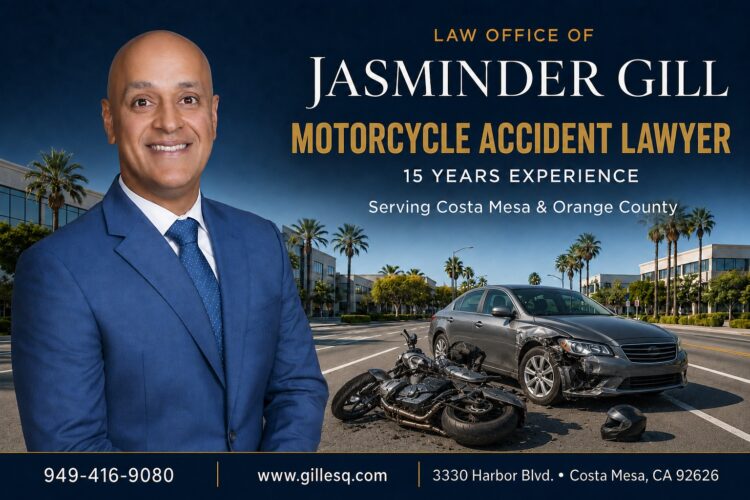 A motorcycle accident can change a rider’s life in seconds. Without the protection of a passenger compartment, seat belt, or surrounding metal frame, motorcyclists are vulnerable to direct impact with vehicles, pavement, barriers, and other objects.
A rider may be left facing emergency medical treatment, surgery, rehabilitation, lost income, permanent injuries, and uncertainty about the future. At the same time, an insurance company may begin looking for ways to blame the rider or reduce the value of the claim.
Attorney Jasminder Gill is a Costa Mesa motorcycle accident lawyer with more than 15 years of personal injury experience. At the Law Office of Jasminder Gill, we represent motorcyclists injured by negligent drivers, commercial vehicles, unsafe road conditions, defective motorcycle components, and other preventable hazards.
15+ YEARS EXPERIENCE | THOUSANDS OF CLIENTS HELPED | MILLIONS RECOVERED | CALIFORNIA ATTORNEY SINCE 2009 | PUNJABI SPEAKING | SPANISH CONSULTATIONS | 24/7 FREE CONSULTATIONS
Call 949-416-9080 for a free consultation!
Our firm investigates how the crash occurred, identifies potentially responsible parties, preserves critical evidence, and pursues compensation for the complete effect of the rider’s injuries.
If you or a family member was injured in a motorcycle accident, contact the Law Office of Jasminder Gill to discuss your rights and possible next steps. There are no upfront attorney’s fees, and you pay no attorney’s fee unless we recover compensation for you.
Why Hire the Law Office of Jasminder Gill After a Motorcycle Accident?
Motorcycle accident claims can become complicated quickly. Drivers may claim they never saw the motorcycle, police reports may contain incomplete information, and insurance companies may rely on unfair assumptions about how motorcyclists ride.
An experienced motorcycle accident attorney can investigate the collision before evidence disappears and help prevent the insurer from controlling the narrative.
When you retain the Law Office of Jasminder Gill, our firm can:
- Investigate how the motorcycle accident occurred
- Obtain police and traffic collision reports
- Locate witnesses and available video footage
- Photograph and inspect the motorcycle
- Preserve the rider’s helmet and protective equipment
- Examine vehicle damage and physical evidence
- Review electronic vehicle data when available
- Identify every potentially responsible party
- Investigate whether a driver was working at the time
- Review applicable insurance policies
- Obtain medical records and bills
- Document lost income and reduced earning capacity
- Evaluate future medical and rehabilitation needs
- Challenge attempts to unfairly blame the rider
- Negotiate directly with insurance companies
- File a lawsuit when necessary to protect the client’s rights
Every motorcycle accident is different. Our firm develops a strategy based on the evidence, injuries, insurance coverage, and the individual effect the accident has had on the rider’s life.
Motorcycle Accident Claims Are Different From Ordinary Car Accident Claims
Although motorcycles and passenger vehicles are governed by many of the same traffic laws, motorcycle injury claims present unique issues.
Motorcycle accidents frequently involve:
- More severe injuries
- Greater medical expenses
- Longer recovery periods
- Total loss of the motorcycle
- Disputes involving lane splitting
- Questions about helmet use
- Limited eyewitness information
- Unfair assumptions about rider behavior
- Complex accident reconstruction
- Commercial or rideshare insurance
- Permanent disability
- Substantial future damages
A rider may be unconscious, hospitalized, or unable to provide a statement immediately after the crash. The driver may then give the first account of what happened, even when that account is incomplete or inaccurate.
That is why physical evidence, witness statements, video footage, vehicle data, and accident-scene documentation can be critical.
Insurance Companies May Unfairly Blame Motorcyclists
Some insurance adjusters approach motorcycle claims with preconceived assumptions. They may suggest that the rider was speeding, riding aggressively, or lane splitting unsafely before obtaining all the evidence.
Common allegations include:
- The motorcycle was traveling too fast
- The rider appeared suddenly
- The rider was difficult to see
- The rider was improperly lane splitting
- The rider followed too closely
- The rider was outside the normal flow of traffic
- The rider could have avoided the collision
- The rider’s injuries resulted from not wearing proper equipment
These allegations do not prove fault. Responsibility should be determined through evidence, including:
- Witness testimony
- Surveillance recordings
- Dashboard-camera video
- Vehicle damage
- Motorcycle damage
- Skid marks and debris
- Electronic data
- Traffic-signal timing
- Roadway design
- Statements made at the scene
- Qualified accident-reconstruction analysis
A driver who claims not to have seen a motorcycle is not automatically free from responsibility. Drivers must maintain a reasonable lookout, check blind spots, signal, and ensure that turns or lane changes can be completed safely.
Common Types of Motorcycle Accidents in Costa Mesa
Motorcycle collisions happen in many different ways. Identifying the type of collision can help determine which traffic rule was violated and what evidence should be preserved.
Left-Turn Motorcycle Accidents
A left-turn collision occurs when an oncoming driver turns across the motorcycle’s path.
The driver may:
- Fail to notice the motorcycle
- Misjudge the rider’s speed
- Turn without sufficient space
- Become distracted
- Attempt to beat approaching traffic
- Focus on larger vehicles and overlook the rider
These crashes can cause a direct impact between the motorcycle and the side of the turning vehicle. The rider may have little time to brake or take evasive action.
Evidence may include intersection video, witness statements, vehicle positions, signal timing, damage patterns, and roadway measurements.
Unsafe Lane-Change Accidents
Drivers must ensure that a lane change can be completed with reasonable safety. Under California Vehicle Code Section 21658, a vehicle generally should remain within a single lane and should not move from that lane until the movement can be made safely.
A motorcycle accident may occur when a driver:
- Fails to check mirrors
- Does not look over their shoulder
- Changes lanes without signaling
- Drifts into another lane
- Moves across several lanes at once
- Enters the rider’s path
- Misjudges the location of the motorcycle
- Becomes distracted by a cellphone or navigation system
Large trucks, buses, vans, and delivery vehicles present additional dangers because their blind spots can conceal a motorcycle.
Rear-End Motorcycle Collisions
A motorcycle may be struck from behind while stopped at a red light, slowing for congestion, or yielding to traffic.
Rear-end motorcycle crashes are frequently associated with:
- Distracted driving
- Following too closely
- Speeding
- Driver fatigue
- Impaired driving
- Failure to recognize stopped traffic
- Unsafe freeway speeds
Even a low-speed rear impact can eject the rider, push the motorcycle into another vehicle, or trap the motorcyclist between vehicles.
Intersection Motorcycle Accidents
Intersections create risks because vehicles may cross the rider’s path from several directions.
Intersection crashes may involve:
- A driver running a red light
- Failure to stop at a stop sign
- Failure to yield
- Unsafe right turns
- Unsafe left turns
- Drivers exiting parking lots
- Obstructed visibility
- Confusing lane movements
- Drivers misjudging the motorcycle’s speed
When responsibility is disputed, the investigation may require video footage, witness statements, traffic-signal records, and physical evidence.
Dooring Accidents
A dooring accident occurs when a driver or passenger opens a vehicle door into the path of an approaching motorcyclist.
The rider may strike the door or swerve into another traffic lane to avoid it. Either situation can result in severe injuries.
The claim may involve:
- The driver
- A passenger
- A rideshare operator
- A delivery driver
- The driver’s employer
- Another business or insurer
Nearby surveillance footage and photographs of the vehicle, door, roadway, and motorcycle can become important evidence.
Sideswipe Motorcycle Accidents
A sideswipe may occur when a driver moves into the rider’s lane, passes without sufficient clearance, or drifts because of distraction or impairment.
A direct impact is not always required to establish responsibility. A negligent driver may cause a rider to lose control or collide with another object even if the vehicle never touches the motorcycle.
Head-On Motorcycle Collisions
Head-on crashes are among the most dangerous motorcycle accidents. They may occur when a driver:
- Crosses the centerline
- Travels the wrong way
- Makes an unsafe pass
- Loses control
- Drives while impaired
- Falls asleep
- Becomes distracted
- Enters an exit ramp in the wrong direction
These collisions often result in catastrophic or fatal injuries because the combined force of both vehicles is transferred directly to the rider.
Freeway Motorcycle Accidents
Motorcyclists traveling on State Route 55, Interstate 405, and connecting Costa Mesa roadways may encounter high speeds, congestion, sudden stops, and frequent lane changes.
Freeway motorcycle accidents may involve:
- Stop-and-go traffic
- Unsafe merging
- Sudden lane changes
- Drivers crossing solid lines
- Distracted commuters
- Road debris
- Commercial trucks
- Hit-and-run drivers
- Multi-vehicle collisions
A rider may be struck by more than one vehicle or thrown into active lanes. These claims require a careful investigation to determine the sequence of impacts and the responsibility of each driver.
Learn more about accidents involving the 55 Freeway and 405 Freeway.
Hit-and-Run Motorcycle Accidents
Some drivers flee after striking a motorcyclist. A rider may still have options even when the responsible driver is not immediately identified.
Evidence that may help locate the vehicle includes:
- Witness descriptions
- License-plate information
- Surveillance footage
- Traffic-camera recordings
- Dashboard-camera video
- Vehicle debris
- Paint transfer
- Doorbell-camera footage
- Photographs taken by bystanders
If the driver cannot be located, uninsured-motorist coverage may apply depending on the policy and circumstances.
Commercial Vehicle and Truck Accidents
Motorcyclists face substantial risks around tractor-trailers, buses, delivery vans, work trucks, and other commercial vehicles.
Commercial vehicles have:
- Large blind spots
- Longer stopping distances
- Wider turns
- Greater weight
- Limited maneuverability
- More severe impact forces
Potentially responsible parties may include:
- The commercial driver
- The driver’s employer
- The trucking company
- A delivery company
- The vehicle owner
- A maintenance provider
- A contractor or subcontractor
- A manufacturer of defective equipment
Commercial vehicle claims may involve electronic logs, driver qualification files, inspection records, maintenance records, dispatch communications, and onboard-camera footage.
Learn more from our Costa Mesa truck accident lawyer.
Rideshare Motorcycle Accidents
Uber and Lyft drivers may become distracted by their applications, stop unexpectedly, make unsafe turns, or change lanes while looking for passengers.
Insurance coverage may depend on whether:
- The application was off
- The driver was waiting for a ride request
- The driver had accepted a trip
- A passenger was inside the vehicle
Trip records and application data should be preserved promptly.
Learn more from our Costa Mesa rideshare accident lawyer.
Lane-Splitting Motorcycle Accidents in California
California law recognizes lane splitting. California Vehicle Code Section 21658.1 defines lane splitting as operating a two-wheeled motorcycle between rows of stopped or moving vehicles in the same lane on divided or undivided roads.
The California Highway Patrol states that lane splitting is legal when performed safely and prudently.
However, the fact that lane splitting is legal does not mean every lane-splitting maneuver is automatically safe. Responsibility depends on the complete circumstances, including:
- Traffic speed
- The rider’s speed
- Visibility
- Lane width
- Road conditions
- Surrounding vehicles
- Whether a driver signaled
- Whether a driver made an unsafe lane change
- Whether either party was distracted
- Whether the rider had time to react
Insurance companies may attempt to treat lane splitting as automatic proof that the rider caused the collision. That is incorrect. A rider may be entitled to compensation when a driver makes an unsafe lane change, drifts between lanes, opens a vehicle door, or otherwise acts negligently.
California’s comparative-fault rules may also permit recovery when responsibility is shared.
California Motorcycle Helmet Requirements
Under California Vehicle Code Section 27803, motorcycle drivers and passengers must wear a qualifying safety helmet while riding on California highways. The helmet must be properly fitted and fastened.
A helmet can reduce the risk of certain head injuries, but it cannot prevent every concussion, traumatic brain injury, facial injury, spinal injury, or fatality.
If an insurance company raises helmet use, it must still address:
- Who caused the collision
- Whether the helmet issue is relevant to the claimed injury
- Whether the driver’s negligence caused the accident
- What medical evidence establishes causation
- Whether the rider suffered injuries unrelated to helmet use
Helmet use does not excuse a driver who made an unsafe turn, changed lanes without looking, followed too closely, or otherwise caused the crash.
Costa Mesa Roads and Areas Where Motorcycle Accidents May Occur
Motorcycle accidents can happen anywhere vehicles and riders share the road. In Costa Mesa, collisions may occur along major traffic corridors, around freeway entrances, at busy intersections, and near commercial parking areas.
Locations may include:
- Harbor Boulevard
- Newport Boulevard
- Bristol Street
- Fairview Road
- Baker Street
- Adams Avenue
- 17th Street
- 19th Street
- Sunflower Avenue
- Paularino Avenue
- State Route 55
- Interstate 405
- The SR-55 and I-405 interchange
- South Coast Plaza
- The Orange County Fairgrounds
- Orange Coast College
- Commercial and residential parking areas
Mentioning these locations does not mean every road or intersection is inherently dangerous. Liability must be determined using the facts and evidence from the specific accident.
Common Causes of Motorcycle Accidents in Costa Mesa
Most motorcycle accidents are preventable. They frequently occur because a driver fails to pay attention, violates a traffic law, or does not recognize that a motorcycle is nearby.
Determining the precise cause is important because it helps establish who may be held responsible and what evidence should be preserved.
Drivers Failing to See Motorcycles
Drivers frequently claim that they did not see the motorcycle before the collision. Motorcycles are smaller than passenger vehicles, but drivers are still responsible for maintaining a reasonable lookout and checking their surroundings.
A driver may overlook a motorcycle while:
- Turning at an intersection
- Changing lanes
- Exiting a driveway
- Entering a roadway
- Merging onto a freeway
- Backing out of a parking space
- Opening a vehicle door
- Crossing a motorcycle’s path
Drivers should check mirrors, look over their shoulders, signal before moving, and wait until a turn or lane change can be completed safely.
Distracted Driving
A driver who looks away from the roadway for even a few seconds may fail to notice a motorcycle.
Common distractions include:
- Reading or sending text messages
- Using social media
- Entering navigation instructions
- Looking for an address
- Using a rideshare or delivery application
- Adjusting vehicle controls
- Eating or drinking
- Speaking with passengers
- Reaching for an object
- Looking at an accident or roadside activity
Proving distraction may require cellphone records, application data, surveillance footage, witness testimony, vehicle information, and evidence of the driver’s activity immediately before the collision.
Speeding and Unsafe Speed
Excessive speed reduces the time available to recognize and avoid a motorcyclist. It also increases the force of impact and the severity of resulting injuries.
A driver can be traveling at an unsafe speed even when below the posted limit. Traffic, weather, visibility, congestion, and roadway conditions may require a slower speed.
Speed may be evaluated through:
- Vehicle event data
- Skid marks
- Surveillance video
- Dashboard-camera footage
- Witness statements
- Collision damage
- Resting positions of the vehicles
- Accident-reconstruction analysis
Unsafe Left Turns
A driver making a left turn must yield when required and ensure that the turn can be completed safely.
Left-turn collisions may occur because a driver:
- Fails to notice the approaching motorcycle
- Misjudges the rider’s speed
- Turns without sufficient space
- Attempts to cross several lanes
- Becomes distracted
- Focuses on larger vehicles
- Rushes to beat approaching traffic
These crashes may result in the motorcycle striking the side of the turning vehicle, ejecting the rider, or forcing the rider to take evasive action.
Unsafe Lane Changes and Merging
A driver may cause a motorcycle accident by changing lanes without checking mirrors or blind spots.
Unsafe lane-change accidents frequently involve:
- Failing to signal
- Drifting between lanes
- Crossing several lanes at once
- Entering the rider’s path
- Merging without yielding
- Moving suddenly in congested traffic
- Crossing solid lane markings
- Failing to account for a motorcycle traveling between lanes
Blind-spot warnings and mirrors do not eliminate a driver’s responsibility to ensure that a movement can be completed safely.
Following Too Closely
A driver who follows a motorcycle too closely may be unable to stop if the rider slows for traffic, a signal, or a roadway hazard.
Tailgating is particularly dangerous because a motorcycle may stop more quickly than a heavier passenger vehicle.
A rear-end impact can:
- Throw the rider from the motorcycle
- Push the motorcycle into another vehicle
- Trap the rider between vehicles
- Cause a multi-vehicle collision
- Result in serious spinal or head injuries
Drivers should leave sufficient space to respond to changing traffic conditions.
Driving Under the Influence
Alcohol, cannabis, prescription medication, and illegal drugs can impair a driver’s judgment, vision, coordination, and reaction time.
Evidence of impairment may include:
- Breath or blood test results
- Field sobriety testing
- Officer observations
- Arrest records
- Witness statements
- Restaurant or bar receipts
- Surveillance footage
- Admissions made by the driver
A criminal case against the impaired driver is separate from the injured rider’s civil claim. The criminal case addresses punishment, while the civil claim seeks compensation for injuries and losses.
Driver Fatigue
A fatigued driver may have slowed reactions, impaired judgment, and difficulty maintaining a lane.
Driver fatigue may affect:
- Commercial truck drivers
- Delivery drivers
- Rideshare drivers
- Overnight workers
- Long-distance commuters
- Drivers taking sedating medication
Evidence may include work schedules, delivery records, electronic logs, trip information, text messages, and the driver’s activities before the crash.
Road Rage and Aggressive Driving
Some drivers become impatient when sharing the roadway with motorcyclists.
Aggressive behavior may include:
- Tailgating
- Unsafe passing
- Cutting off a rider
- Intentionally blocking a motorcycle
- Excessive horn use
- Sudden braking
- Shouting or threatening the rider
- Forcing the rider toward a curb or barrier
- Making unsafe lane changes
Intentional conduct may create different legal and insurance issues than ordinary negligence. Preserve any video, witness information, or identifying information connected to the aggressive driver.
Dangerous Road Conditions
Motorcycles are more sensitive than passenger vehicles to pavement defects, debris, and sudden roadway changes.
Hazards may include:
- Potholes
- Loose gravel
- Oil or diesel fuel
- Uneven pavement
- Broken drainage grates
- Construction debris
- Unmarked lane changes
- Poorly designed repairs
- Missing warning signs
- Standing water
- Obstructed visibility
- Malfunctioning traffic signals
Potentially responsible parties may include a public entity, contractor, utility company, construction company, property owner, or another party responsible for creating or maintaining the condition.
Claims involving a city, county, state agency, or other public entity have special requirements and may be subject to a six-month administrative claim deadline. Immediate legal review is important when a public roadway condition may have contributed to the accident.
Defective Motorcycle Parts
A defective or improperly maintained motorcycle component may cause or contribute to a crash.
Potential problems can involve:
- Brakes
- Tires
- Wheels
- Steering systems
- Throttles
- Fuel systems
- Frames
- Suspension components
- Lighting
- Electrical systems
- Safety equipment
Potentially responsible parties may include:
- Motorcycle manufacturers
- Parts manufacturers
- Distributors
- Dealerships
- Repair shops
- Maintenance providers
- Rental companies
The motorcycle and damaged components should be preserved in their post-accident condition. Repairing or disposing of the motorcycle before an inspection could destroy important evidence.
Construction-Zone Motorcycle Accidents
Construction zones can create dangerous conditions for riders through:
- Loose gravel
- Uneven pavement
- Sudden lane shifts
- Poor lighting
- Missing warning signs
- Construction debris
- Confusing traffic control
- Inadequate barriers
- Exposed metal plates
- Vehicles entering active lanes
Liability may involve a construction company, contractor, subcontractor, public entity, utility company, or property owner.
The contracts governing the project may help identify which party controlled the work and was responsible for roadway safety.
Common Motorcycle Accident Injuries
Motorcycle collisions frequently cause multiple injuries affecting different parts of the body. A rider may require emergency treatment, surgery, rehabilitation, and ongoing medical care.
Traumatic Brain Injuries
A rider’s head may strike a vehicle, pavement, barrier, or another object. Even when the rider wears a helmet, the force of the impact can cause a concussion or more severe brain injury.
Symptoms may include:
- Headaches
- Dizziness
- Memory problems
- Confusion
- Nausea
- Light or sound sensitivity
- Blurred vision
- Difficulty concentrating
- Mood changes
- Sleep disturbances
- Loss of balance
- Loss of consciousness
A person does not need to lose consciousness to suffer a traumatic brain injury. Initial imaging may also appear normal even when concussion symptoms are present.
Victims may require neurological evaluations, cognitive rehabilitation, occupational therapy, speech therapy, or long-term assistance.
Learn more from our Costa Mesa traumatic brain injury lawyer.
Road Rash
Road rash occurs when a rider’s skin slides across pavement or another rough surface.
Serious road rash can cause:
- Deep abrasions
- Embedded dirt or debris
- Nerve damage
- Infection
- Tissue loss
- Permanent scarring
- Disfigurement
- Limited movement
Treatment may involve wound cleaning, antibiotics, surgery, skin grafts, reconstructive procedures, and rehabilitation.
Photographs taken throughout recovery can help document the severity and progression of the injuries.
Spinal Cord and Back Injuries
The force of a motorcycle crash can damage the spinal cord, vertebrae, discs, nerves, muscles, and ligaments.
Injuries may include:
- Herniated discs
- Bulging discs
- Vertebral fractures
- Nerve compression
- Spinal cord damage
- Partial paralysis
- Complete paralysis
- Chronic pain
Severe spinal injuries may require surgery, mobility equipment, home modifications, attendant care, and lifelong rehabilitation.
Broken Bones and Orthopedic Injuries
Motorcyclists frequently suffer fractures when struck by a vehicle, thrown from the motorcycle, or pinned beneath the bike.
Commonly injured areas include:
- Arms
- Wrists
- Hands
- Shoulders
- Ribs
- Pelvis
- Hips
- Legs
- Knees
- Ankles
- Feet
- Facial bones
Treatment may require surgery, internal hardware, casting, physical therapy, and extended time away from work.
Some fractures cause permanent stiffness, weakness, arthritis, or reduced range of motion.
Lower-Extremity Injuries
A rider’s legs are particularly vulnerable because they may be struck directly by a vehicle or trapped between the motorcycle and another object.
Lower-extremity injuries can include:
- Femur fractures
- Tibia or fibula fractures
- Knee ligament tears
- Ankle injuries
- Foot injuries
- Crush injuries
- Nerve damage
- Amputation
These injuries can interfere with walking, standing, driving, working, and ordinary daily activities.
Internal Organ Damage
Internal injuries may not be immediately visible but can become life-threatening.
Motorcycle crashes may cause:
- Internal bleeding
- Lung injuries
- Liver damage
- Spleen injuries
- Kidney damage
- Abdominal trauma
- Rib fractures
- Cardiac injuries
Seek emergency medical attention for chest pain, abdominal pain, dizziness, fainting, difficulty breathing, or unexplained bruising after a collision.
Facial and Dental Injuries
A rider may suffer facial fractures, dental damage, eye injuries, or lacerations even when wearing a helmet.
These injuries may require:
- Oral surgery
- Dental reconstruction
- Plastic surgery
- Vision treatment
- Scar revision
- Psychological care
Visible injuries can also cause significant emotional distress and social anxiety.
Burn Injuries
Motorcycle accidents may expose riders to hot engine parts, fuel, fire, electrical components, or heated pavement.
Burn injuries may require:
- Hospitalization
- Wound care
- Skin grafts
- Reconstructive surgery
- Infection treatment
- Physical therapy
- Long-term scar management
Learn more from our Costa Mesa burn injury lawyer.
Amputation Injuries
Crush injuries, severe fractures, infection, or direct trauma may result in surgical or traumatic amputation.
An amputee may require:
- Multiple surgeries
- Prosthetic devices
- Replacement prosthetics
- Physical rehabilitation
- Occupational therapy
- Home modifications
- Vocational assistance
- Psychological counseling
A claim should consider these lifetime costs rather than only the expenses incurred immediately after the accident.
Emotional Trauma After a Motorcycle Accident
Motorcycle accident victims may experience:
- Anxiety
- Depression
- Post-traumatic stress
- Nightmares
- Panic attacks
- Fear of riding
- Fear of driving
- Irritability
- Sleep disruption
- Social withdrawal
Psychological injuries can be significant even when they are less visible than fractures or surgical wounds. Victims should report emotional symptoms to an appropriate healthcare provider.
Delayed Symptoms After a Motorcycle Crash
Adrenaline and shock may temporarily mask pain. Symptoms can appear or become more noticeable hours or days later.
Delayed symptoms may include:
- Headaches
- Neck or back pain
- Dizziness
- Memory difficulties
- Numbness
- Tingling
- Shoulder pain
- Abdominal pain
- Sleep problems
- Emotional changes
Prompt medical evaluation protects the rider’s health and helps connect the symptoms to the collision.
Important Evidence in a Motorcycle Accident Claim
The quality of the evidence can determine whether an insurance company accepts responsibility or attempts to blame the rider.
Important evidence may include:
- Police reports
- Photographs of the scene
- Video footage
- Witness statements
- Vehicle and motorcycle damage
- Skid marks and debris
- Helmet and protective equipment
- Traffic-signal information
- Electronic vehicle data
- Cellphone records
- Rideshare or delivery records
- Medical documentation
- Employment and income records
- Repair or replacement estimates
Evidence should be collected and preserved as soon as possible.
Preserve the Motorcycle, Helmet, and Riding Gear
Do not immediately repair, sell, or discard the motorcycle. Keep the helmet, jacket, gloves, boots, clothing, and damaged personal property.
These items may help establish:
- The direction and force of impact
- The point of contact
- Whether the motorcycle had a defect
- The severity of the crash
- Whether the driver’s account is consistent with the damage
Take detailed photographs before moving or storing the motorcycle whenever possible.
Surveillance and Traffic-Camera Footage
Video may be available from:
- Nearby businesses
- Homes
- Apartment communities
- Parking structures
- Gas stations
- Traffic systems
- Dashboard cameras
- Doorbell cameras
- Commercial vehicles
Many systems automatically overwrite footage. Prompt preservation requests may be necessary.
Electronic Evidence
Electronic records may help establish speed, location, timing, distraction, or employment status.
Depending on the case, evidence may include:
- Cellphone records
- Text messages
- Navigation history
- Vehicle event data
- Dashboard-camera recordings
- GPS data
- Rideshare records
- Delivery records
- Commercial driver logs
- Motorcycle-mounted camera footage
- Smartwatch or fitness-tracker information
Original files and devices should be preserved.
What to Do After a Motorcycle Accident in Costa Mesa
The steps taken after a collision can protect your health and strengthen your legal claim.
Call 911
Request law enforcement and emergency medical assistance. A formal report can document the parties, location, witnesses, insurance information, and initial observations.
Move to Safety When Possible
If you can move without worsening an injury, get out of active traffic. Do not attempt to move when you suspect a spinal, head, neck, or other serious injury unless remaining in place creates an immediate danger.
Seek Immediate Medical Care
Accept emergency transportation when needed. Tell medical providers:
- How the accident happened
- Which parts of your body struck the vehicle or ground
- Whether your head was hit
- Whether you lost consciousness
- Every symptom you are experiencing
- Whether symptoms change or worsen
Obtain Driver and Insurance Information
Collect:
- Driver’s name
- Address
- Telephone number
- Driver’s license information
- License-plate number
- Vehicle make and model
- Insurance company
- Policy information
- Employer information if the driver was working
Photograph the Accident Scene
If your condition permits, photograph:
- Vehicle positions
- Motorcycle damage
- Vehicle damage
- Skid marks
- Debris
- Road conditions
- Traffic signals
- Signs and lane markings
- Nearby cameras
- Visible injuries
Ask a witness, friend, or family member for help if you cannot take photographs yourself.
Obtain Witness Information
Collect each witness’s name, telephone number, email address, and a brief description of what the person observed.
Do not assume the police report will identify every witness.
Avoid Arguing About Fault
Exchange necessary information, but avoid apologizing, guessing, or making statements that could be misinterpreted.
Do not say that you are uninjured merely because pain has not yet developed.
Report New or Worsening Symptoms
Seek additional medical attention if you develop:
- Increasing headaches
- Confusion
- Vomiting
- Weakness or numbness
- Vision changes
- Severe neck or back pain
- Chest or abdominal pain
- Difficulty breathing
- Loss of balance
- Increasing swelling
- Signs of infection
Follow Medical Recommendations
Attend appointments and complete prescribed treatment. Insurance companies may use unexplained gaps in care to argue that the injuries were minor or unrelated.
Avoid Social-Media Posts
Do not post about the accident, injuries, physical activities, travel, or settlement negotiations. Insurance companies may review public content and remove photographs or comments from context.
Do not delete existing relevant content without first obtaining legal advice.
Speak With an Attorney Before Giving a Recorded Statement
The other driver’s insurer may request a statement shortly after the collision. The adjuster may ask about lane splitting, speed, helmet use, prior accidents, or medical history.
Consider obtaining legal advice before providing a detailed statement or signing a broad medical authorization.
What if the Police Report Blames the Motorcyclist?
A police report can be important evidence, but it is not necessarily the final determination of civil responsibility.
An officer may arrive after the crash and rely on incomplete statements. The rider may be hospitalized or unable to explain what happened, while the driver provides the first account.
Other evidence may challenge an inaccurate report, including:
- Video footage
- Witness testimony
- Electronic data
- Vehicle damage
- Motorcycle damage
- Accident reconstruction
- Driver admissions
- Traffic-signal records
An attorney can investigate the collision independently instead of treating the report as the only available evidence.
What if the Rider Was Partially at Fault?
California follows a pure comparative-fault system. An injured motorcyclist may still recover compensation even when partially responsible.
The recovery may be reduced according to the percentage of responsibility assigned.
For example, if total damages were $300,000 and the rider was found 20 percent responsible, the potential recovery would be reduced by 20 percent to $240,000.
Insurance companies may exaggerate allegations of speeding, lane splitting, or improper positioning to reduce what they must pay. Fault should be evaluated using evidence rather than stereotypes.
Compensation Available After a Costa Mesa Motorcycle Accident
A motorcycle accident claim should account for the complete effect the collision has had on the rider—not only the bills already received.
Depending on the circumstances, compensation may be available for economic damages, noneconomic damages, property damage, and, in limited cases, punitive damages.
Medical Expenses
Motorcycle accident victims may require extensive medical care. Recoverable expenses may include:
- Ambulance transportation
- Emergency-room treatment
- Hospitalization
- Diagnostic imaging
- Surgery
- Physician appointments
- Specialist evaluations
- Prescription medication
- Physical therapy
- Occupational therapy
- Neurological treatment
- Pain management
- Psychological counseling
- Medical equipment
- Prosthetic devices
- Home healthcare
- Transportation to appointments
Keep copies of medical bills, insurance statements, prescription receipts, and other accident-related expenses.
Future Medical Treatment
Serious motorcycle injuries may require treatment long after the claim begins.
Future medical damages may include:
- Additional surgery
- Rehabilitation
- Physical or occupational therapy
- Neurological care
- Pain-management treatment
- Reconstructive procedures
- Scar revision
- Prosthetic replacement
- Mobility equipment
- Psychological treatment
- In-home assistance
- Long-term medication
- Home or vehicle modifications
An injured rider should understand the diagnosis, expected recovery, and reasonably anticipated future treatment before accepting a settlement.
Catastrophic injury cases may require opinions from medical specialists, rehabilitation professionals, life-care planners, vocational experts, or economists.
Lost Wages
A motorcycle accident may prevent the rider from working because of hospitalization, surgery, pain, medical appointments, or physical restrictions.
Compensation may be available for:
- Lost hourly wages
- Lost salary
- Missed overtime
- Lost commissions
- Missed bonuses
- Used sick or vacation time
- Lost employment benefits
- Missed contracts
- Reduced business income
- Missed advancement opportunities
Evidence may include pay statements, tax records, employer verification, work schedules, medical restrictions, contracts, and business records.
Loss of Future Earning Capacity
A permanent injury may prevent a rider from returning to the same job, working the same hours, or pursuing the same career.
Loss of earning capacity may apply when injuries cause:
- Permanent physical restrictions
- Reduced mobility
- Chronic pain
- Cognitive difficulties
- Loss of strength or coordination
- Inability to stand, lift, or drive
- Inability to perform previous job duties
- Reduced prospects for advancement
- The need to change careers
- Early retirement
The calculation may consider the rider’s age, education, occupation, work history, expected career path, and permanent medical limitations.
Pain and Suffering
Pain-and-suffering damages compensate an injured rider for physical pain and discomfort caused by the accident.
Factors may include:
- Severity of the injuries
- Length of recovery
- Number and type of surgeries
- Physical therapy
- Chronic pain
- Sleep disruption
- Physical limitations
- Reduced independence
- Interference with daily activities
- Permanent symptoms
There is no universal calculator that determines pain and suffering. Each claim must be evaluated according to its evidence and individual circumstances.
Emotional Distress
A serious motorcycle collision can cause psychological trauma in addition to physical injuries.
A rider may experience:
- Anxiety
- Depression
- Post-traumatic stress
- Nightmares
- Panic attacks
- Fear of riding
- Fear of driving
- Irritability
- Embarrassment
- Social withdrawal
- Difficulty concentrating
- Loss of confidence
- Sleep disturbances
Medical documentation, counseling records, and testimony from the rider and family members may help demonstrate these effects.
Loss of Enjoyment of Life
Motorcycle injuries may prevent someone from participating in activities that were previously important.
The accident may interfere with:
- Riding
- Exercise
- Sports
- Travel
- Family activities
- Household responsibilities
- Caring for children
- Hobbies
- Social events
- Community involvement
These losses may be considered when evaluating how the injury has affected the rider’s quality of life.
Scarring and Disfigurement
Road rash, burns, lacerations, fractures, and surgical procedures can leave permanent scars or visible changes in appearance.
A claim may consider:
- Location and size of the scars
- Whether they are visible
- Physical discomfort
- Skin discoloration
- Restricted movement
- Emotional distress
- Future plastic or reconstructive surgery
- Effects on employment or social activities
Photographs taken throughout recovery can document how the injuries developed and whether the scarring became permanent.
Permanent Disability
A permanent motorcycle injury can affect mobility, employment, independence, relationships, and family responsibilities.
Compensation may address:
- Future medical treatment
- Rehabilitation
- Lost earning capacity
- Mobility equipment
- Prosthetic devices
- Personal assistance
- Home modifications
- Vehicle modifications
- Physical pain
- Emotional distress
- Reduced independence
A permanent injury claim should be evaluated carefully before the rider signs a final settlement release.
Motorcycle and Property Damage
Motorcycle accidents frequently result in significant property damage.
A claim may include:
- Motorcycle repair
- Motorcycle replacement
- Towing
- Storage charges
- Rental transportation
- Helmet replacement
- Damaged riding gear
- Damaged electronics
- Custom motorcycle components
- Other personal property
Keep photographs, purchase receipts, repair estimates, maintenance records, and documentation of aftermarket upgrades.
Do not repair or dispose of the motorcycle before it has been photographed and, when necessary, inspected. The damage may help establish the direction and force of impact.
Can Punitive Damages Be Recovered?
Punitive damages are not available in every motorcycle accident case. They may be considered when the defendant’s conduct meets California’s demanding legal standard for oppression, fraud, or malice.
Ordinary negligence is generally insufficient. The availability of punitive damages depends on the specific conduct, parties, evidence, and applicable law.
How Much Is a Motorcycle Accident Case Worth?
There is no fixed settlement amount for a motorcycle accident. The value depends on the rider’s injuries, damages, liability evidence, and available insurance.
Important factors include:
- Severity of the injuries
- Length of medical treatment
- Whether surgery was required
- Past medical expenses
- Future treatment needs
- Lost income
- Reduced earning capacity
- Permanent disability
- Scarring or disfigurement
- Emotional trauma
- Effects on daily life
- Strength of the evidence
- Comparative responsibility
- Available insurance coverage
- Number of responsible parties
- Whether litigation becomes necessary
A rider with temporary injuries will generally have different damages than someone who suffered a brain injury, spinal cord damage, amputation, multiple fractures, or permanent disability.
Be cautious of anyone who assigns a precise value before reviewing the medical evidence, accident facts, and insurance coverage.
What Insurance May Cover a Motorcycle Accident?
Several policies may apply, depending on who caused the collision and how it happened.
Potential coverage may include:
- The negligent driver’s automobile liability insurance
- The vehicle owner’s policy
- The rider’s motorcycle insurance
- An employer’s commercial policy
- Trucking-company insurance
- Delivery-company coverage
- Rideshare insurance
- Uninsured-motorist coverage
- Underinsured-motorist coverage
- Medical-payments coverage
- Umbrella or excess insurance
- Product-liability insurance
- Government-entity coverage
Identifying every policy is important when one driver’s coverage is insufficient to compensate a rider with catastrophic injuries.
Uninsured and Underinsured Motorist Claims
A negligent driver may have no insurance or only the minimum amount of coverage.
Uninsured-motorist coverage may apply when:
- The responsible driver has no insurance
- The driver flees and cannot be identified
- A stolen vehicle is involved
- The responsible policy excludes coverage
Underinsured-motorist coverage may apply when the responsible driver’s insurance is insufficient to compensate the rider fully.
Coverage depends on policy language, reporting requirements, proof of the collision, and other circumstances. Even though the claim involves the rider’s own insurer, the insurance company may still dispute responsibility, damages, or coverage.
Learn more about uninsured-motorist accident claims.
What if a Driver Fled the Scene?
Call law enforcement immediately after a hit-and-run motorcycle accident and provide every detail you remember.
Helpful information may include:
- Vehicle make and model
- Vehicle color
- License-plate numbers or letters
- Direction of travel
- Visible vehicle damage
- Business markings
- Stickers or distinctive features
- Description of the driver
Nearby businesses, homes, apartment buildings, traffic systems, commercial vehicles, and dashboard cameras may have recorded the vehicle.
When the driver cannot be identified, uninsured-motorist insurance may provide compensation if the policy requirements are satisfied.
Who Pays Medical Bills While the Claim Is Pending?
The responsible driver’s insurance company generally does not pay medical bills as treatment is received.
Bills may initially be handled through:
- Health insurance
- Medical-payments coverage
- Medicare
- Medi-Cal
- Medical-provider payment arrangements
- Medical liens
- Other available benefits
Health insurers and government benefit programs may assert reimbursement rights against a settlement. Medical providers may also have unpaid balances or liens.
These claims should be identified and addressed before settlement proceeds are distributed.
Should You Accept the Insurance Company’s First Offer?
Insurance companies may make an early settlement offer before the rider completes treatment or understands the long-term consequences of the injuries.
An early offer may fail to account for:
- Future surgery
- Additional physical therapy
- Neurological care
- Permanent disability
- Reduced earning capacity
- Reconstructive treatment
- Chronic pain
- Future medical equipment
- Emotional trauma
Accepting a settlement generally requires signing a release that permanently ends the claim. After signing, the rider typically cannot request additional compensation if the medical condition worsens.
How Long Does a Motorcycle Accident Case Take?
Some motorcycle accident claims resolve within several months, while complex cases may take substantially longer.
The timeline may depend on:
- Severity of the injuries
- Duration of medical treatment
- Need for future care
- Disputed liability
- Allegations of lane splitting
- Number of responsible parties
- Available insurance coverage
- Need for accident reconstruction
- Whether a lawsuit is filed
- Court schedules
- The insurer’s willingness to negotiate fairly
Settling too early may be harmful when the rider’s future medical and financial needs remain uncertain.
Will a Motorcycle Accident Case Go to Trial?
Many motorcycle accident claims settle through negotiations, but settlement is never guaranteed.
A lawsuit may become necessary when an insurance company:
- Denies that its driver caused the accident
- Blames the motorcyclist
- Misrepresents lane-splitting laws
- Disputes the medical diagnosis
- Claims treatment was excessive
- Blames a preexisting condition
- Refuses to consider future damages
- Offers substantially less than the claim’s supported value
Filing a lawsuit does not mean the case will definitely reach trial. Settlement negotiations may continue while the case proceeds through discovery, depositions, expert evaluation, and mediation.
How Long Do You Have to File a Motorcycle Accident Claim?
Under California Code of Civil Procedure Section 335.1, a lawsuit for personal injury or death caused by another person’s wrongful act or neglect generally must be filed within two years.
However, the correct deadline can depend on:
- The type of claim
- Identity of the defendant
- The rider’s age
- When an injury was discovered
- Whether a public entity is involved
- Other facts that may shorten or extend the deadline
Do not assume every motorcycle accident claim has exactly two years. Missing the applicable deadline may prevent recovery.
Government Claims May Have Shorter Deadlines
A motorcycle accident involving a dangerous public roadway, malfunctioning signal, government vehicle, missing sign, or public construction project may be subject to special claim procedures.
Under California Government Code Section 911.2, a claim relating to personal injury, death, or personal-property damage generally must be presented to the appropriate public entity within six months after the claim accrues.
Presenting an administrative claim is different from filing a lawsuit. Additional deadlines apply after the public entity responds.
Obtain legal advice promptly if a city, county, state agency, transit agency, or other government entity may be responsible.
Fatal Motorcycle Accidents
Some motorcycle collisions tragically result in fatal brain injuries, internal trauma, spinal injuries, or multiple catastrophic injuries.
Eligible surviving family members may be entitled to pursue a wrongful death claim when another party’s negligence caused the rider’s death.
Depending on the circumstances, compensation may be available for:
- Funeral and burial expenses
- Loss of expected financial support
- Loss of household services
- Loss of companionship
- Loss of protection
- Loss of guidance
- Loss of affection and moral support
A related survival action may address certain losses the deceased person sustained between the collision and death.
No financial recovery can replace a family member. A legal claim can provide financial support and hold negligent parties accountable.
Why Choose the Law Office of Jasminder Gill?
Attorney Jasminder Gill has more than 15 years of personal injury experience. Our firm understands the medical, financial, and emotional challenges that follow a serious motorcycle collision.
When you hire the Law Office of Jasminder Gill, we can:
- Listen to your account of the accident
- Explain your rights under California law
- Investigate all possible causes
- Preserve physical and electronic evidence
- Locate witnesses and available video
- Identify responsible parties
- Review applicable insurance policies
- Document medical expenses and income losses
- Evaluate future damages
- Communicate directly with insurance companies
- Challenge unfair assumptions about riders
- Negotiate for a fair resolution
- File a lawsuit when necessary
- Keep you informed throughout the case
Our firm handles motorcycle accident cases on a contingency-fee basis. There are no upfront attorney’s fees, and attorney’s fees are owed only if we recover compensation for you.
FAQ’s About Costa Mesa Motorcycle Accidents
What should I do immediately after a motorcycle accident?
Call 911, obtain medical care, report the crash, photograph the scene if possible, collect witness information, and preserve your motorcycle and equipment. Speak with an attorney before providing the opposing insurer with a detailed recorded statement.
Can I recover compensation if I was lane splitting?
Possibly. Lane splitting is legally recognized in California, but it must be performed safely and prudently. Liability depends on the rider’s conduct, the driver’s actions, traffic speed, road conditions, and other evidence.
Does lane splitting automatically make the motorcyclist responsible?
No. Lane splitting does not automatically establish fault. A driver may be responsible for making an unsafe lane change, drifting between lanes, opening a door, or failing to maintain a reasonable lookout.
What if the driver says they did not see my motorcycle?
Failing to see a motorcycle is not automatically a defense. Drivers are expected to check mirrors and blind spots, maintain a reasonable lookout, and ensure that turns or lane changes can be completed safely.
What if the police report blames me?
A police report is important evidence, but it is not necessarily the final determination of civil responsibility. Video, witnesses, physical damage, electronic data, and expert analysis may challenge an incomplete or inaccurate report.
Can I recover compensation if I was partially at fault?
California’s comparative-fault system may allow you to recover compensation even if you share responsibility. Your recovery may be reduced by your assigned percentage of fault.
What if I was not wearing a helmet?
California generally requires motorcycle riders and passengers to wear qualifying helmets. Helmet use may become relevant to certain head-injury claims, but it does not automatically determine who caused the collision or eliminate claims for unrelated injuries.
Can a helmeted rider still suffer a brain injury?
Yes. A helmet can reduce certain risks but cannot prevent every concussion or traumatic brain injury. Seek medical care for headaches, dizziness, confusion, memory problems, nausea, or other neurological symptoms.
What if my injuries appeared several days later?
Delayed symptoms can occur because adrenaline and shock temporarily mask pain. Seek medical attention promptly when symptoms appear and explain how and when they developed.
Who pays for my damaged motorcycle?
The responsible driver’s property-damage coverage may pay for repair or replacement. Your own collision coverage may also apply. Preserve evidence of custom parts and upgrades.
What if my motorcycle was totaled?
The insurer may offer the motorcycle’s actual cash value rather than its replacement cost. Maintenance records, comparable listings, photographs, receipts, and documentation of aftermarket parts may help establish value.
What if the driver had no insurance?
Your uninsured-motorist coverage may apply. If the driver had inadequate limits, underinsured-motorist coverage may provide additional compensation, subject to the policy and California law.
What if the driver fled?
Report the crash immediately and document all identifying details. Video footage, witnesses, vehicle debris, and uninsured-motorist coverage may help provide a path to compensation.
What if a truck caused my motorcycle accident?
The claim may involve the truck driver, trucking company, vehicle owner, maintenance provider, cargo company, or another commercial party. Additional insurance and federal safety records may be available.
Can I recover lost wages?
Compensation may be available for income lost because of hospitalization, treatment, pain, or medical restrictions. Employment and financial records can help document the loss.
Can I recover compensation for permanent scarring?
Yes. A claim may include compensation for permanent scarring, disfigurement, emotional distress, future reconstructive treatment, and the effect on daily life.
How much is my motorcycle accident case worth?
The value depends on the injuries, medical treatment, future care, lost income, permanent limitations, liability evidence, comparative fault, and available insurance. There is no standard settlement amount.
Should I accept the insurance company’s first offer?
Do not accept an offer until you understand your injuries, future treatment, income loss, and legal rights. Signing a release generally ends the claim permanently.
How long will my motorcycle accident case take?
The timeline depends on medical treatment, disputed responsibility, insurance coverage, damages, and whether litigation becomes necessary. No attorney can guarantee an exact completion date.
How much does it cost to hire a motorcycle accident lawyer?
The Law Office of Jasminder Gill handles motorcycle accident cases on a contingency-fee basis. There are no upfront attorney’s fees, and attorney’s fees are owed only if compensation is recovered.
Get Help From a Costa Mesa Motorcycle Accident Lawyer
If you or a family member was injured in a motorcycle crash, you do not have to deal with insurance companies alone.
Attorney Jasminder Gill has more than 15 years of experience representing personal injury victims. The Law Office of Jasminder Gill investigates motorcycle collisions, preserves evidence, identifies available insurance, and works to hold negligent parties accountable.
Our firm represents riders injured in Costa Mesa and throughout Orange County in accidents involving negligent drivers, unsafe lane changes, left turns, lane splitting, commercial vehicles, hit-and-run drivers, and dangerous roadway conditions.
Learn more from our Costa Mesa car accident lawyer.